



Soundcheck06 Feb 202612 MIN

Anoushka Shankar is keeping the noise away from the music

Playing in Mumbai on Grammys night, the sitarist discusses candour, motherhood, neurodivergence and that Gorillaz collab we’re all waiting on

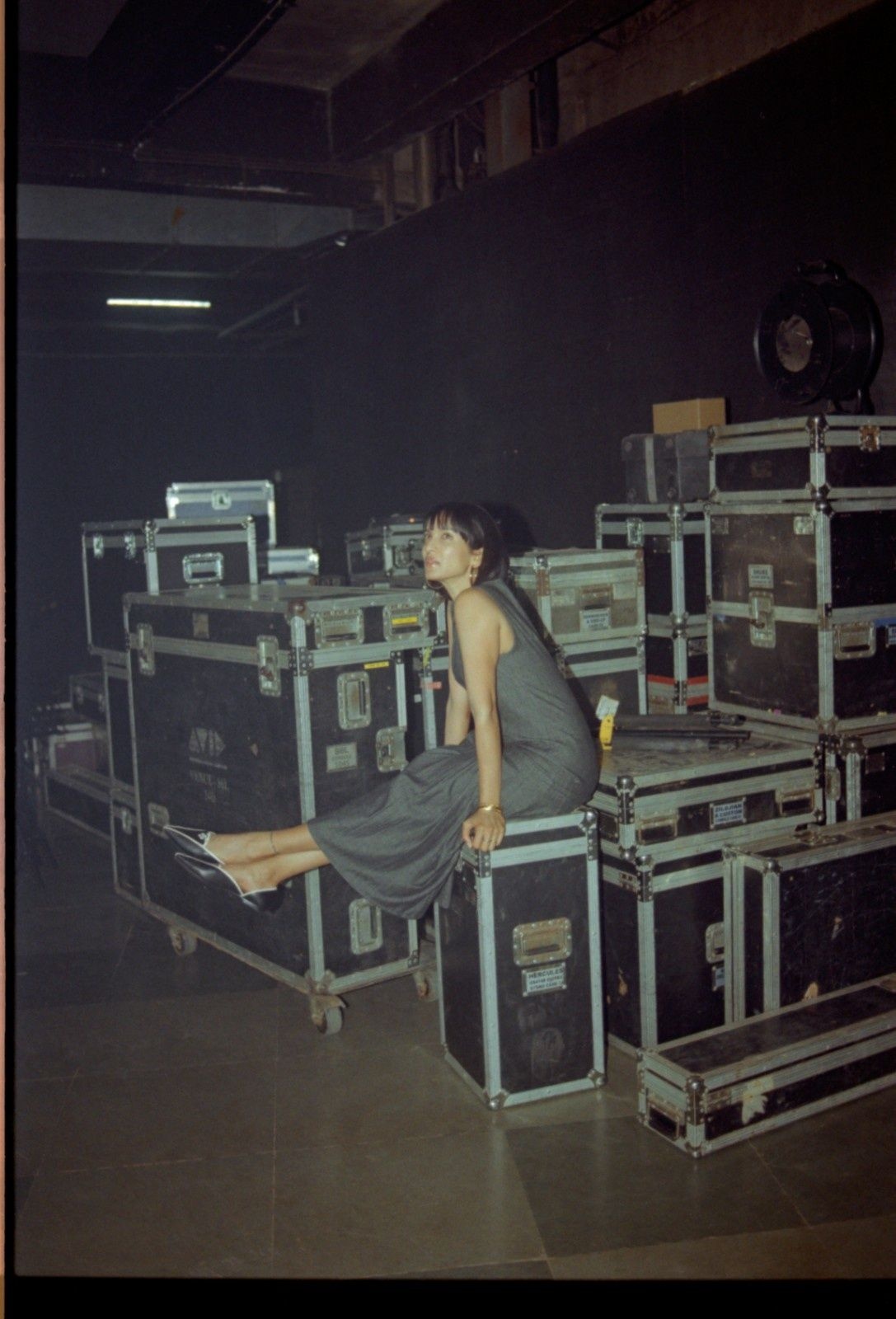
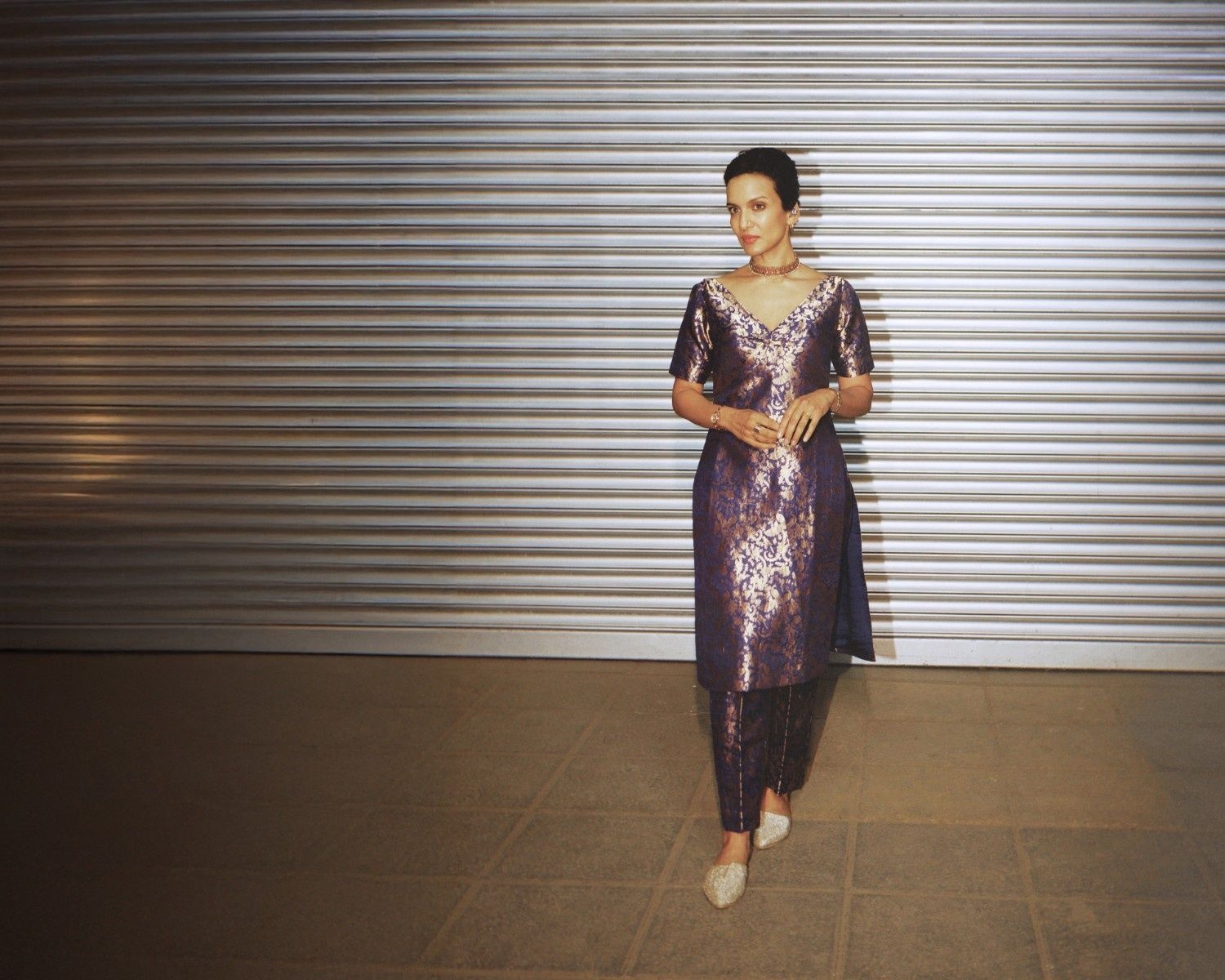
Backstage with Anoushka

Photographs by Sarang Gupta

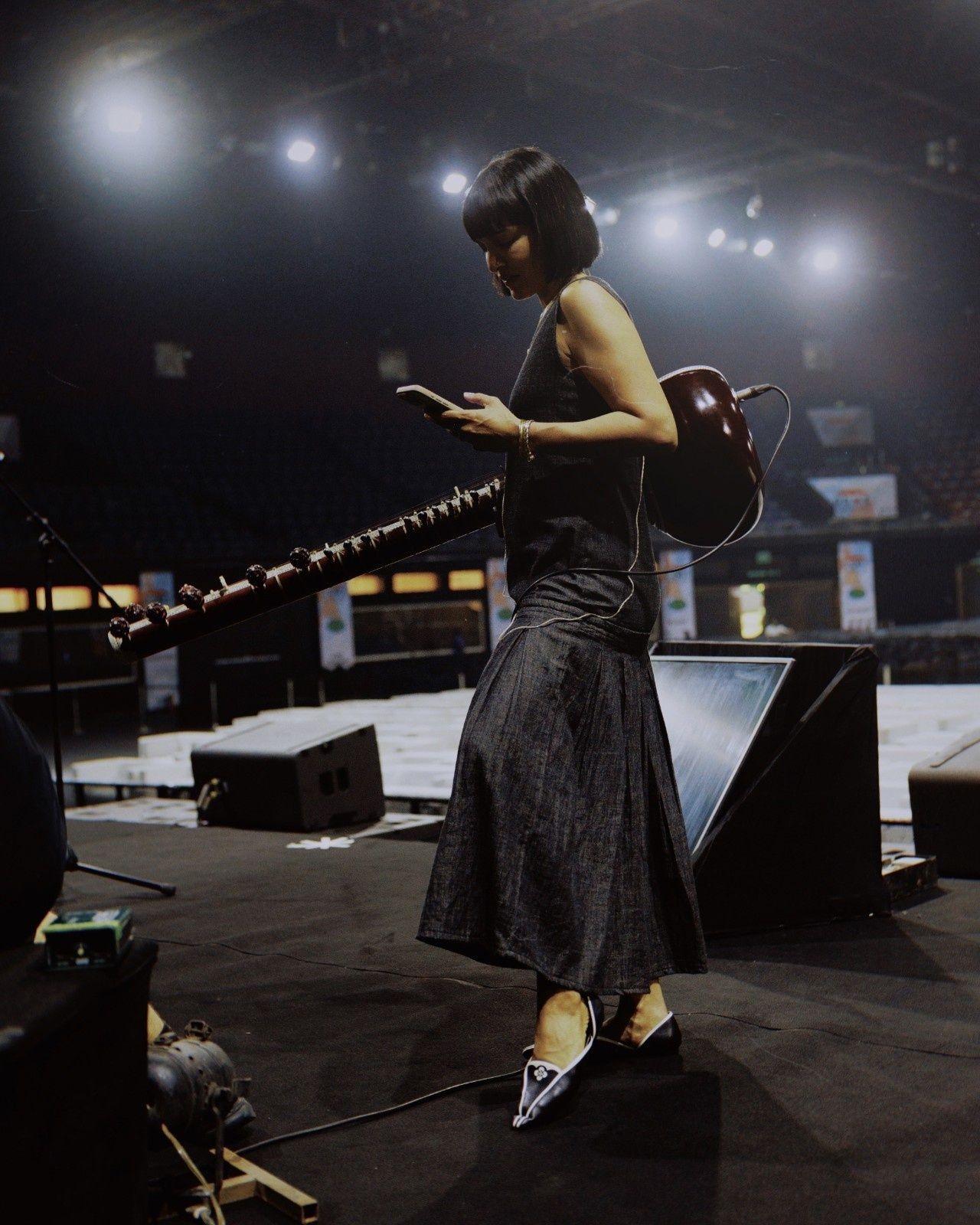
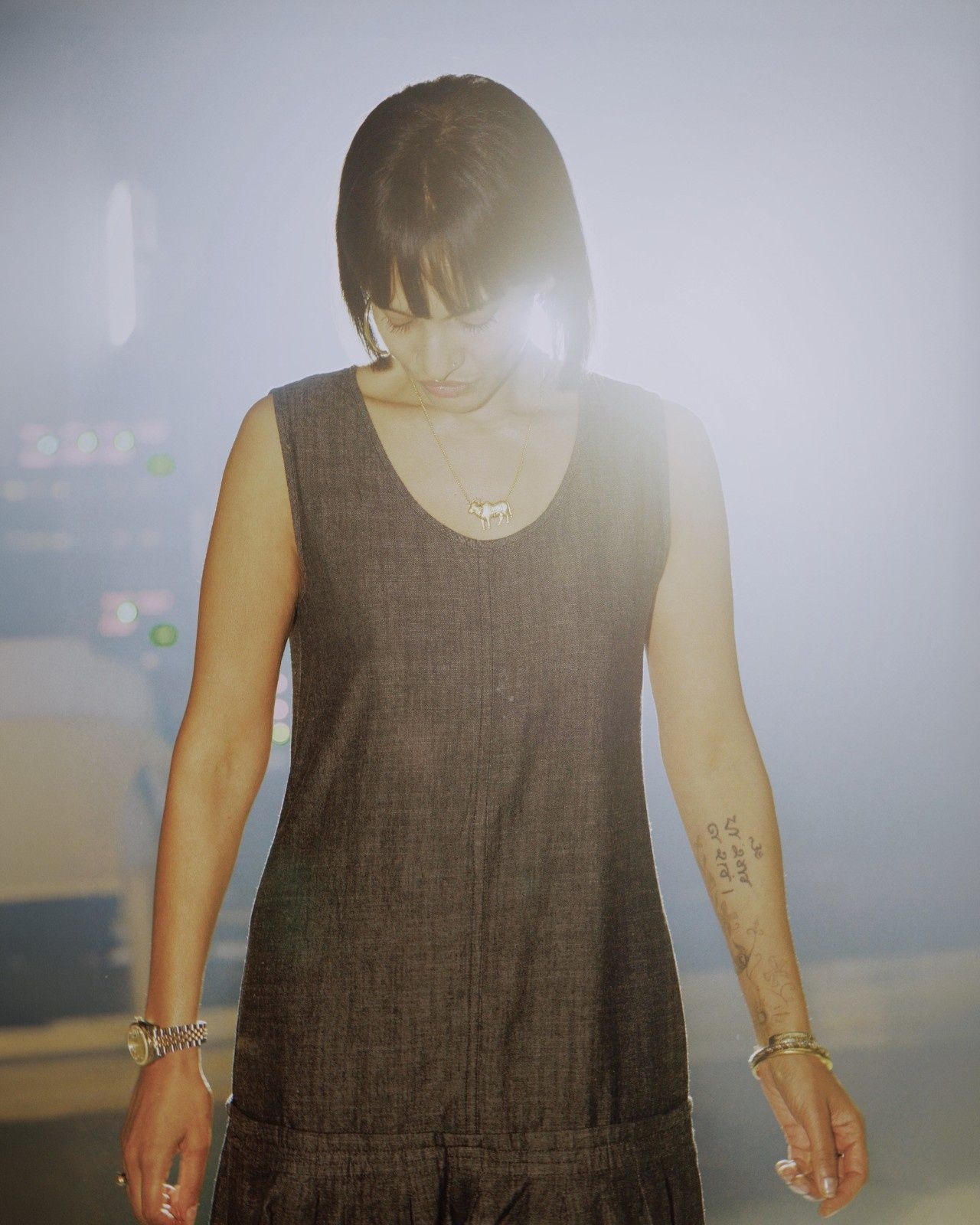
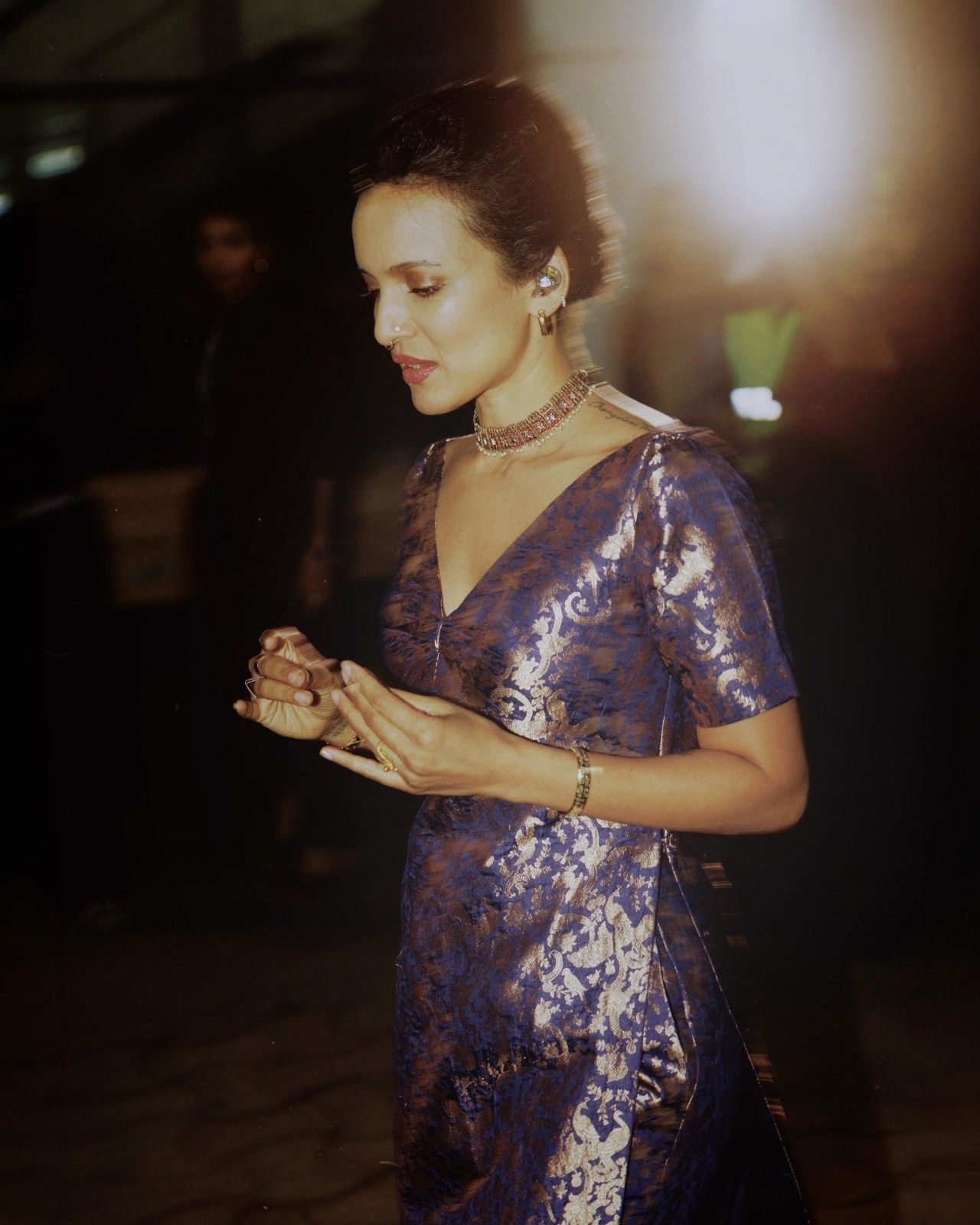
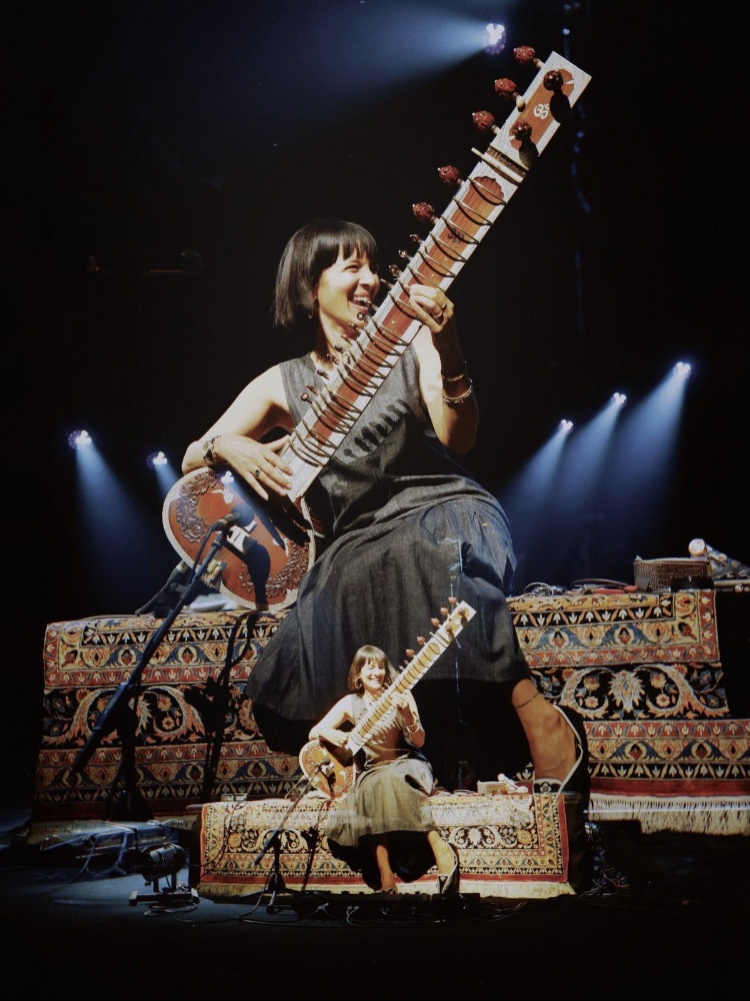
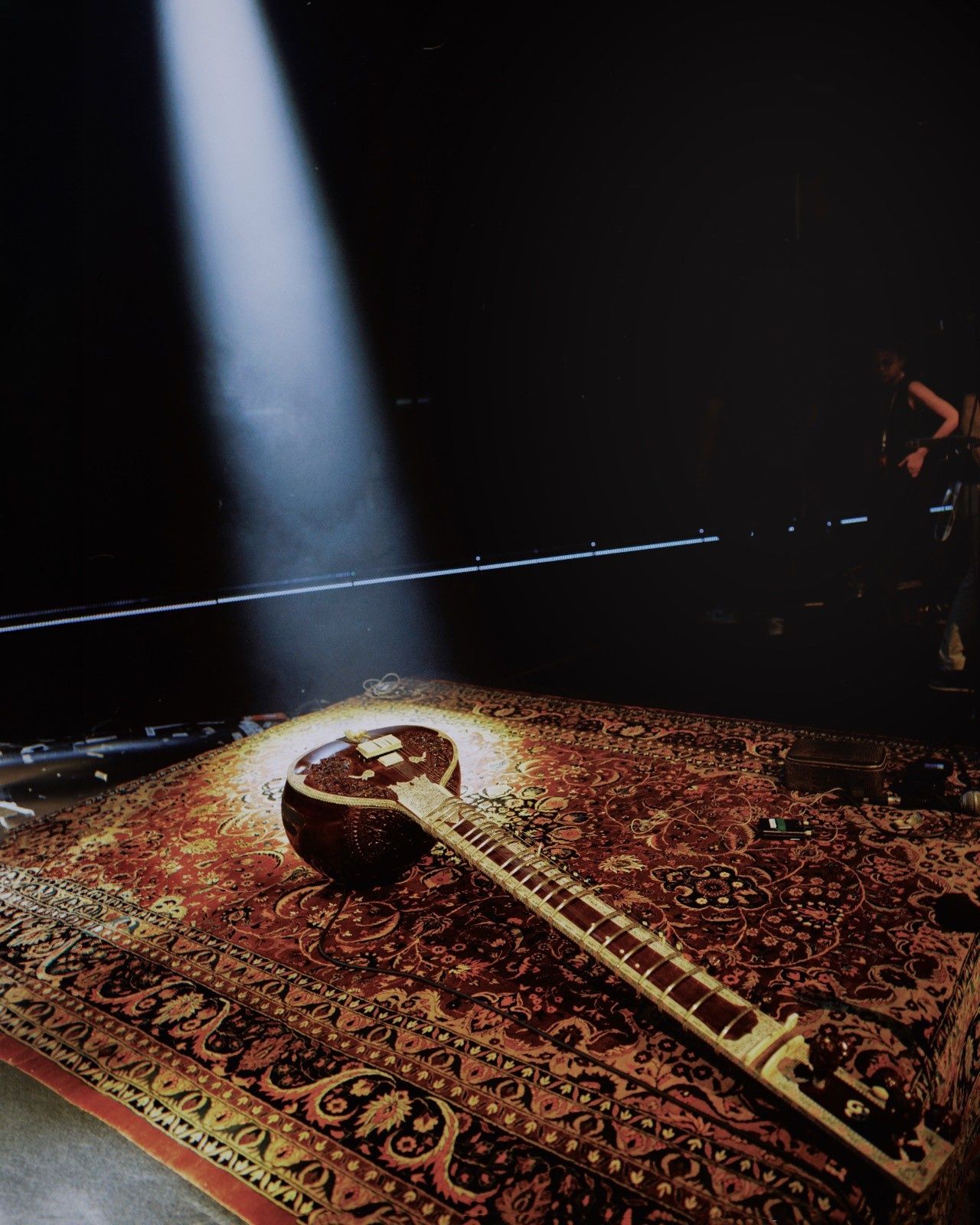
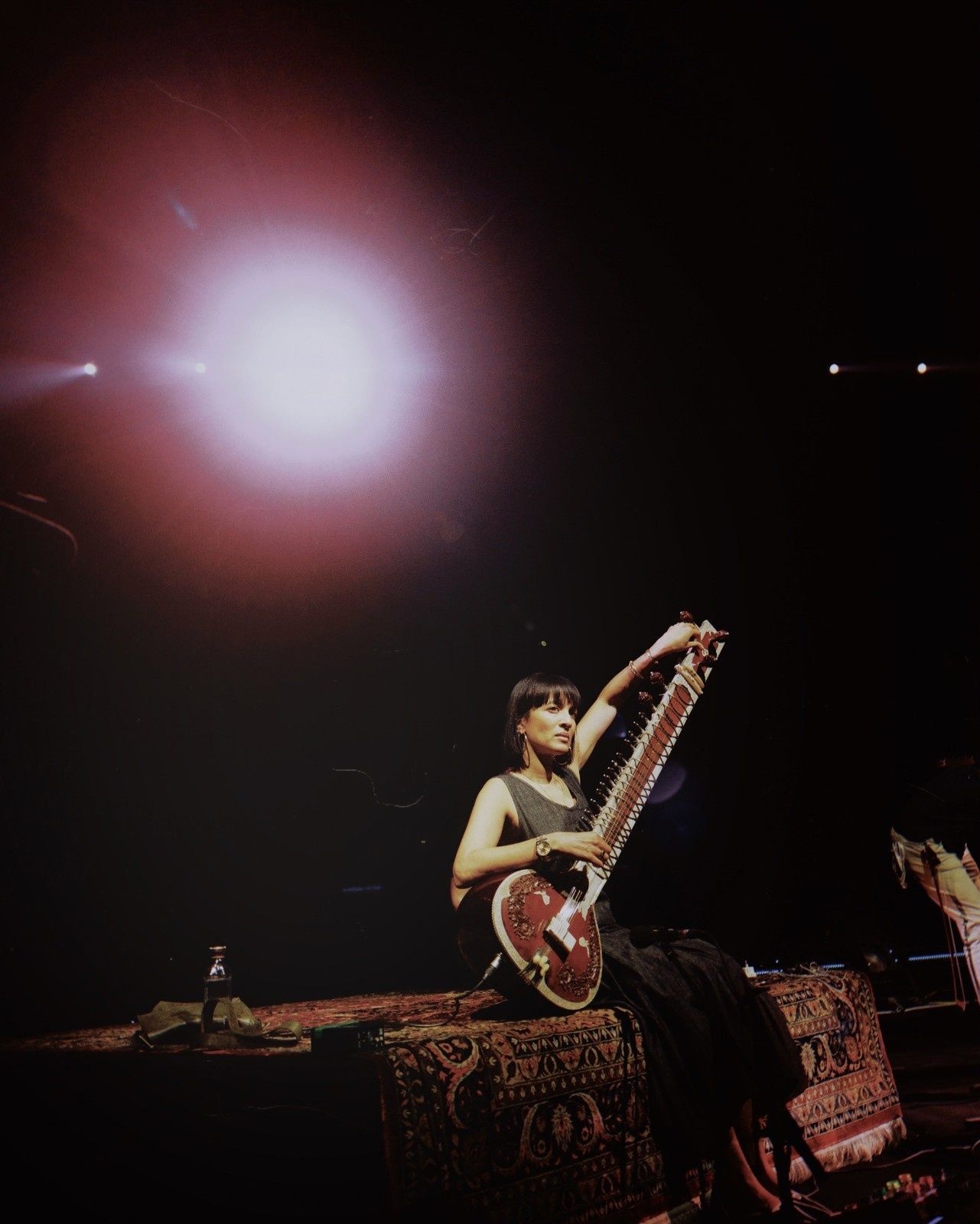
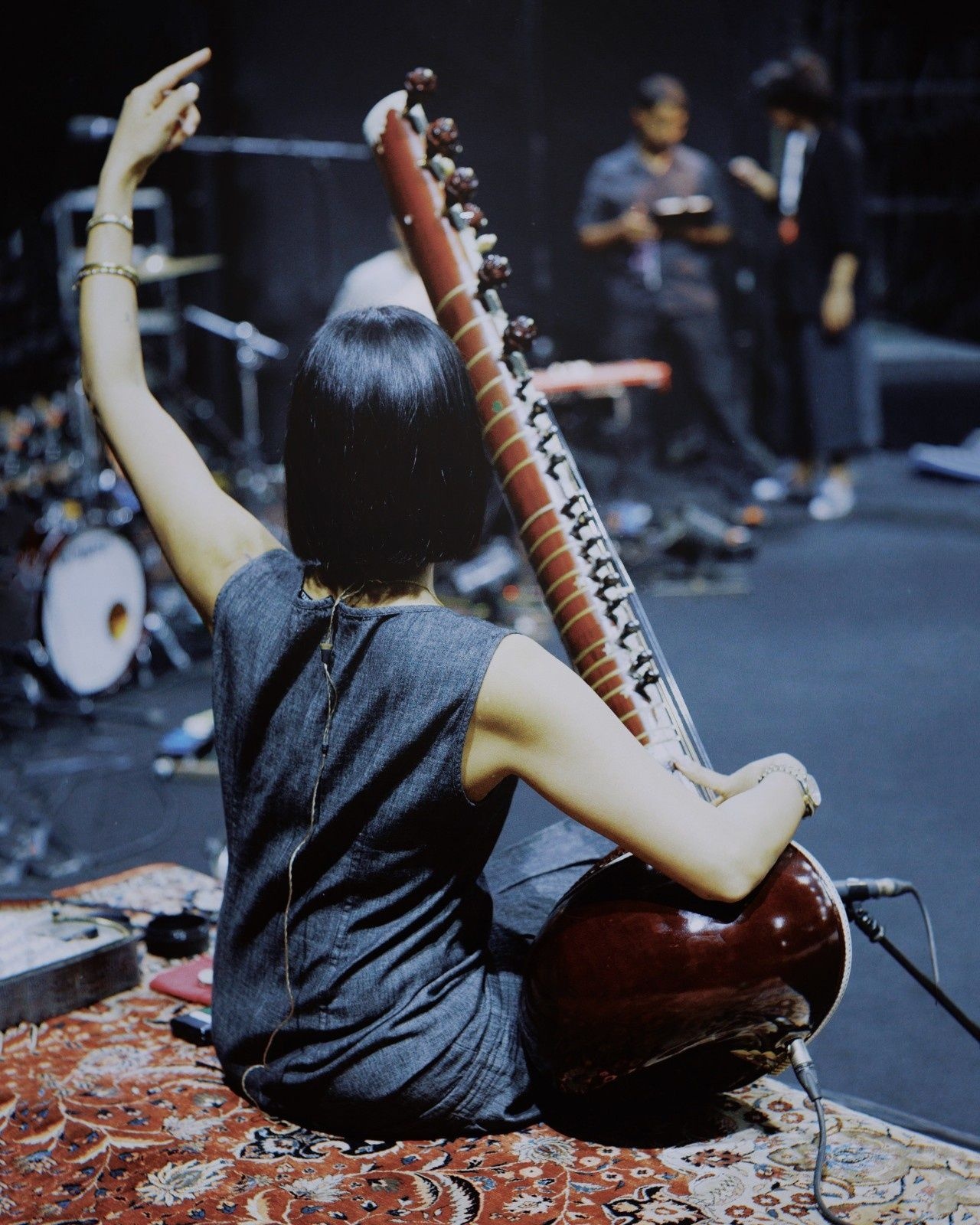
As if waking up from a trance, Anoushka Shankar opens her eyes and wonders aloud, into a mic: “Does sitar #2 sound like it is holding its nose?” At soundcheck, hours before her show in Mumbai, as fresnel lights dance across the stage, she sits stage right on a baithak, gently cradling a sitar’s neck in one hand, a nandi pendant at her neck, a Cleopatra-like melon coiffure on her crown. The band—Sarathy Korwar on drums, Arun Ghosh on clarinet, Tom Farmer on bass—joyfully rehearses ‘We Burn So Brightly’, something of a club banger from her latest album, Chapters III. There is the atmosphere of a drum circle, full of playful eye contact and laughter. Unmistakably, Shankar’s entire attention is on the music. 

And she has feedback aplenty for the sound guys: Is there space to split the difference on her instrument’s volume? Could the house music be turned down a smidge so the bass doesn’t sound too boomy? Does anyone need the pedal notes for ‘Hiraeth’? She’s checking in on every band member, pointing out every potential technical glitch… Naturally, a sitar that sounds like it has a cold is not ideal. But she listens to the voice on her headset, flashes her trademark smile and punctuates the air with a thumbs-up, confident in everyone’s ability to do their job.  

Mumbai is the third stop on a significant six-city India tour for Shankar, after Hyderabad and Bengaluru, and it’s a city with which she has deep connections. Plus, it’s Grammys night. If she’s on edge, she’s not showing it. “We made the choice (about touring on the dates of the Grammy awards) before the nominations arrived,” she says flatly. We’re inside her trailer a few minutes later, where she has taken a moment to catch her breath and post a picture of Douglas the sloth (her son’s favourite toy, which is accompanying her on tour) with her sitar on Instagram. 

Outside, press gathers while Korwar and Farmer stretch their muscles by playing catch under a hazy Mumbai sunset. “I decided that I’m not going to hold space for something like this—like, maybe it will happen, maybe it won’t, but I’ve got to live my life,” she says with a little laugh. Thirty years in, 14 nominations later—she’s not blind to the magnitude of it, nor to the glamour. She’s attended a few times and it’s been…fine. “I’d rather keep it real than get sucked into that stressy thing, and do what I really do, and that’s playing music.”

And the music continues to flow through Shankar, undulating over decades like a restless, untameable, ceaseless sea. Chapters III, a project that began with a whimsical idea in Goa, is coming to a close: three cross-cultural albums, three geographies, three years, each little love letters to the last 30 years of her life and career. For each of these albums, she has cherry-picked collaborators from across the world. “I don’t know what it is; I have a good intuition about people,” she muses. Names like Arooj Aftab and Nils Frahm have come to her as mystically as the melodies she wants them to play. “There’s no logical process; I don’t know where that voice comes from each time, but I’ve learned to trust it.”  
Backstage with Anoushka

On Chapters III, she invited Alam Khan—sarod player and son of the legendary Ali Akbar Khan, who trained alongside Anoushka’s father Ravi Shankar. It’s family history, legacy, the whole weight of Indian classical music royalty between them. But for Shankar, here at last was the right moment because they could “finally play on their own terms”. “We were ready to make the music we wanted to make together.”  

You hear the potency of this statement on the goosebump-inducing ‘Hiraeth’. Wrapped around the central notes from the raag Palas Kafi—a 1960s-era jugalbandi by their fathers—are glittering, looping melodies and backward sarod lines, gathering a rave-like pace as the track culminates. A touch of her roots, a sprinkling of her legacy, a dash of herself... It’s what her fans flock to see. “What I love seeing [in audiences in India] is there’s this nice mix of people who are responding to this music that they may not have heard of as well as calling out or having the excitement when we play a couple of the older things,” she smiles. The fact that people recognise her old songs still blows her mind. “When people appreciate the spectrum, that’s when I feel grateful—that they’ve been along for the journey.” 

In Shankar’s hands, through her long journey as a professional musician, the sitar has sounded like many things. Like discipline and obedience, when she played with her father on stage for the first time at his 75th birthday concert in 1996. Like precision and reverence on her debut album, Anoushka, in 1998. Like curiosity and rebellion on her Billboard-charting, genre-melding 2005 album, Rise. Like the call of the wild in her flamenco-inflected 2011 album Traveller. Like the gentle pour of a magic elixir on jazz legend Herbie Hancock and pop star Jacob Collier’s keyboards. Like the tinkling laughter of an inside joke between sisters when Norah Jones joined her at the North Sea Jazz Festival in 2025.
If Shankar’s life-long goal has been to liberate the sitar from the golden cage in which Indophiles and purists like to lock it up, the sitar has, in return, witnessed her quest for a rhythm, touched with a determined vulnerability, to her (let’s just say) eventful and extraordinary life. It has strung out the lows—the darkness of her divorce pouring out on the EP Love Letters, the boundless grief of losing her father on Traces of You—but it has also witnessed the highs of her life, such as raising a Gen Z and a Gen Alpha kid, if more quietly. 

“[My kids are] the most passionate love of my life,” she says, her face lighting up. “It’s equally so much more difficult than I ever imagined—and I don’t even mean that in the jokey ‘we don’t get any sleep’ kind of way but in a deeply profound way. The fears that come up, the patterning one has to break, what it really means to put other people first, no matter for how long, the growth that one has to do as a person to become a parent... I’m glad I didn’t understand all this because I probably wouldn’t have had kids if I’d known, because it’s also utterly beautiful when it feels like they’re blooming.”  

That they’re both deeply creative but not necessarily musical—leaning instead to visual arts and film—does not bother her. “In a way, part of why they don’t do music is because I didn’t insist on it,” she muses. “Because in my family, even though my father and I were close, the priority in our dynamic was passing on the music and connecting through music. That balanced out for me because I also had my mother. But with my kids, I want that closeness, that full connection where they feel they can be messy with me, say anything to me, and not be intimidated by me because I’m, like, their teacher,” she laughs. 

As a single parent, she takes cues from her own mother, and growing up in a pretty unconventional family structure has brought its own lessons. “Needless to say, the baseline [of a healthy family unit] is love and creating safety,” she says. “Seeing grownups who were modelling bravery and integrity, as far as who they were and what they wanted for their life, was really important. But also adults who could model owning mistakes and making amends and trying to move through that—that really showed me so much in terms of how I parent.  Because the truth is, we’re gonna mess stuff up. We’re going to have to approach everything with that knowledge and be open to learning. The only red flag, I think, is making the same mistakes again and again.”  

A recent double diagnosis of neurodivergence, on the other hand, has brought a sigh of relief. “The diagnoses shone a light on what felt like a missing piece in my understanding of, in particular, why I would find certain things deeply difficult or felt more shattered physically by the same experiences than other people did,” says Shankar. After years of seeking recourse in the realm of physical health, the discovery of neurodivergence made her accept that “I do process things differently, and that it’s a part of my gift as well”.  

Life on the road as a touring musician is unstoppable. “Even though it is understandable to be tired from the kind of life I’ve lived, there is an underlying propensity to burn out and a struggle that has been more because of trying to move through this stuff in a non-neurotypical way,” she observes. “And the biggest gift has been getting to learn all the ways to do things differently to honour that in my work habits: the way I request communication to be filtered to me on tour, if I have to take in a lot of information in my business, changing how I read on my computer, boundaries, not multitasking... A lot of things like that that make life more peaceful.”  

It is also a life that Shankar talks about with raw candour on social media. I ask if she hasn’t received the instruction to limit herself in the online world, and she grimaces. “I developed the habits for how and what I say in public a long time before social media.” Starting young in an unconventional multicultural family, even as a teenager, she was considered “shockingly open” just for being herself. By the time Instagram arrived in her twenties, she’d found a balance between career management and offering something else—truth that resonated beyond music. “There was a subset of people that were connecting with me because of the truth rather than music. And I know what that does for me when others do it.”

That gives her an unusual relationship with public vulnerability: It is strategic without feeling calculated, intimate without being exhibitionist. “I’ll never be really explicit about something when I’m going through it, when I’m raw about that experience,” she explains. Those moments she takes to private spaces: friends, family, therapy. “By the time I’m sharing it with people, I’m either in a different layer of processing and feel able to share publicly because I think it’ll help or it’s already healed.”

On politics, she’s now equally measured. Where she has been open about her political views—speaking out during India’s Nirbhaya moment, letting the refugee crisis inform her work (Lands of Gold), and frequently alluding to the troubles in her birthplace, the US, she does not believe she’s “some brave, super open person”. “I would never do less than I feel like I can do,” she muses. “Maybe to you it looks like I do a lot, but actually I feel like I don’t always do as much as I can because I also measure things in terms of being a mother, or in terms of safety, or in terms of my output. Like, I want to continue to be helpful while having a career with it as it gives me a platform and a voice, so how often should I do it so people listen? How do I protect that longevity? I try to be tolerant of different limitations. But I also feel like we’re at a rather scary time in the world, when that opportunity to gauge for ourselves how much we can say is getting smaller and smaller, because the global climate makes it harder to speak freely. And that scares me.”

The day after her Mumbai show, she posts one of those characteristically transparent Instagram updates acknowledging technical failures during the performance—monitor issues, sound problems that left the band struggling to hear each other. The kind of thing most artists would pretend didn’t happen. She’s built in a break in the tour, and her Stories reflect the more mundane texture of her cross-continental existence: reconnecting with old friends, including musicians like Monica Dogra and DJ Nerm, hanging out at cafes and house parties, the ordinary stuff that strings together extraordinary stage nights. 

The tour continues through India and beyond, with Pune next and Europe in the summer. Of course, Shankar has developed survival hacks through years of learning her body’s limits. She always carries supplements and healthy snacks, firm boundaries and grounding exercises. “What happens is that in the first or second show, you’ll feel like you’re being so healthy, but by the third show, you are actively riding into your adrenalin reserves,” she explains. Musicians don’t sleep for hours after shows, she says: “You’re chemically buzzing.” Wake at 6 am for travel and it’s not just sleepiness; it’s your fight-or-flight system working overtime. She’s learned to soften the crash when possible.

As for new music? There is the Gorillaz situation. Damon Albarn and Jamie Hewlett’s upcoming ninth album, The Mountain, due March 2026, features Shankar on multiple tracks alongside Asha Bhosle, Amaan and Ayaan Ali Bangash, and Asha Puthli, among a wild cast of collaborators across latitudes. “By the time they reached out to me, they’d already had their big India trip that made them want to make an album about their experiences,” she says. “They’d done their field recordings (across Mumbai, Delhi, Rajasthan and Varanasi, reportedly) but they wanted me to do the sitar.” 

Thus followed two quiet days of recording in London, including one free-flowing exploratory session that opened up their collaboration across multiple tracks. The live set for the unveiling of the album, she remembers, was magical—almost all the collaborators turned up. After a point, they asked her if she’d like to simply stay on stage given how many tracks she was on. “I was like, yeah, I’ll just groove. That’ll be cool,” she laughs.  

“Damon and Jamie occupy a very particular space in mainstream music that doesn’t quite toe the line on what pop music is and mainstream music is, and yet they really set the tone, culturally, with what they do,” she observes. “There’s so much collaboration and, the truth is, the more mainstream you go, the less healthily it might be done. But they really centre and credit artists who collaborate with them in a way that feels really respectful.”  

She’d never worked with Gorillaz before, but “the cultural cross-collaboration isn’t new to me, even if it happens mostly in niche spaces. Just by virtue of the number of artists and the kind of artists on this album, I do think that there will be some people out there who will hear something they’ve never heard before.”  

She doesn’t think she’d be joining their tour, given her own busy touring season—even though they’re keeping channels open to see where they can hop on to stage together.

Meanwhile, her vision for the sitar’s future now lies elsewhere—collaborations that push beyond musical genres into visual arts, film, performance. Last year, she invited How Are You Feeling Studio to the Brighton Festival, where the designer duo solicited drawings from 10,000 participants to interpret the theme ‘New Dawn’, which they then assembled into an interactive, immersive art installation. Shankar remembers the moment fondly, but she’s interested in “translating that across mediums”. “I really love collaboration,” she says, without quite revealing the ideas cooking in her head. “I love the energy of exchange and growth and pleasure that comes with working with and learning from other people.”

But playing to the crowds? That is not why Shankar is here. “I keep changing, I keep trying new things. So, I know it’s always going to be a risk,” she shrugs. “You’re never going to please everyone.”

Editorial Direction: Megha Mahindru and Ridhima Sapre. Booking Editor: Nikita Moses. Multimedia Designer: Mehak Jindal. Visuals Editor: Ria Rawat

The Nod Newsletter

We're making your inbox interesting. Enter your email to get our best reads and exclusive insights from our editors delivered directly to you.