




Sometimes, travel can feel like a bit of a prank. Imagine flying to Pisa only to find out that the Leaning Tower has disappeared. Well, that may not happen, but you may have booked a stay in Hakone just to be told that the rain has obliterated all predictions of a clear sky and, thus, your hopes of seeing Mt Fuji. Mine was worse.
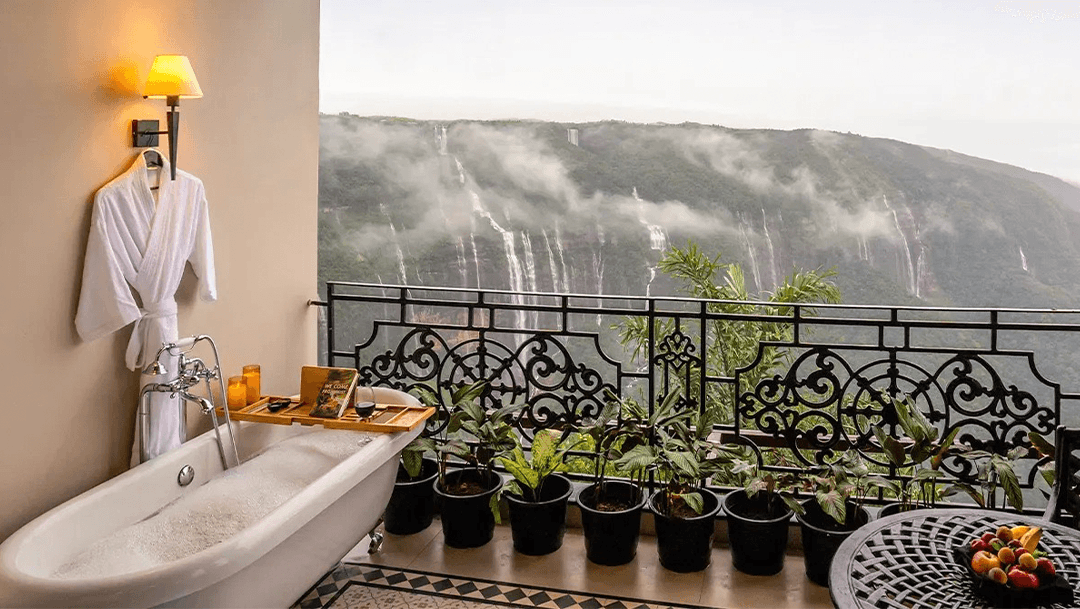
I was at Polo Resort Cherrapunji when a thick blanket of mist enveloped all four sides of the building. In front of me, a chlorine-doused pool was meant to face the majestic Seven Sisters waterfall, a sight that pulls tourists from far and beyond to Cherrapunji but especially to Polo for its fated location. Opened in 2012 with 58 keys, the hotel sits magically close to the water; you can hear the seven streams gushing with determined force. The sounds could fit right into any ASMR video. But even on my second day in the hotel, I wasn’t lucky enough to catch a single sighting of the falls. They continued to hide behind the mist. It was worse because here I could hear it, feel the cold wind bouncing off the water, but not see it fall.
In all fairness, it was July, the heart of monsoon in Cherrapunji, among the wettest places in the world, second only to its neighbouring town, Mawsynram. You probably read all about the endless rain that Meghalaya navigates in middle-school geography.
I was here to embark on a four-hour-long trek to see the world’s only double-decker living root bridge. You’re probably thinking peak rainy season may not be a wise time to take on a trek that involves 3,500 narrow steps (one way) down a hill. And you may be right. But the kind folk at Polo assured my brother and I that the weather was nothing to worry about. This is also what we heard the previous day from our driver, Faster, who, despite what his name suggests, was in no hurry as he drove us five hours from Guwahati to Cherrapunji.
With every passing village and winding turn on the way, we witnessed the view from the window shift. We went from just a little rain and pooling on the roads to more and more, until we were surrounded by so much mist that Faster was driving more off vibes and muscle memory than guided by vision. “The trek will be so smooth,” he reassured me, as I stared in disbelief.
Hopped up on adrenaline, I took his word for it. After all, we made the long journey from Bengaluru to Cherrapunji just for this trek; it was too late to chicken out. To be clear, this isn’t just any walk up and down a hill. The journey leads to the double-decker living root bridge, one of the most ingenious human-and-nature collaborations to ever exist. For hundreds of years, this bridge has helped the native Khasi and Jaintia communities cross the swelling river in the monsoons.
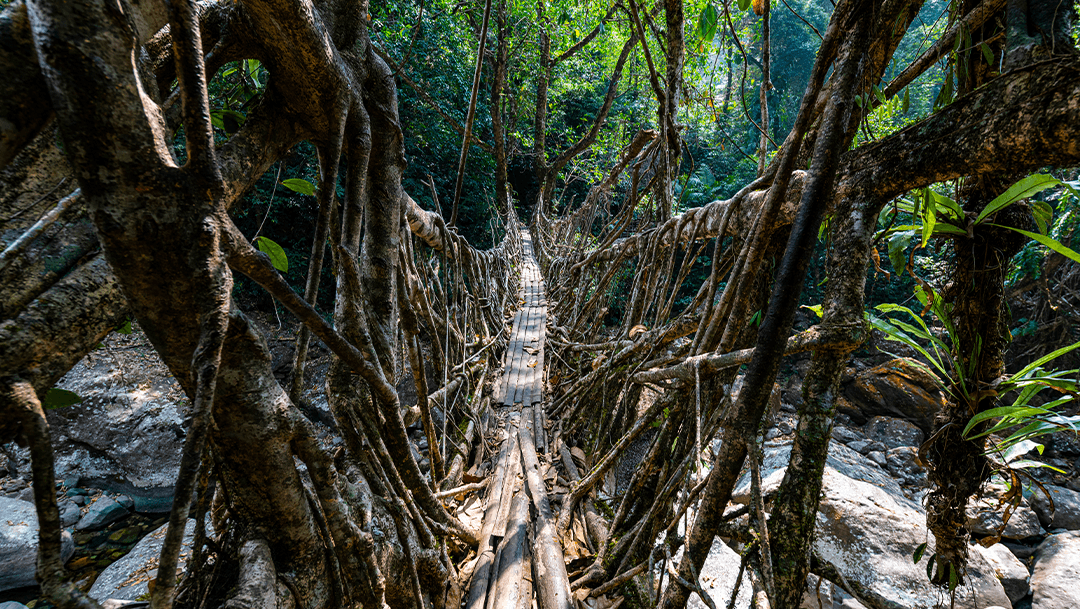
The effort began with planting a sapling of the Ficus elastica, or rubber tree. A decade later, it sprouted aerial roots that the villagers expertly wove onto a bamboo support. Then they pulled this across the river to implant the roots on the opposite bank, creating the base of the bridge. Every year, the Khasi and Jaintia people make amends to the existing roots and intertwine the new tendrils, creating a dense structure strong enough to hold a dozen people at a time.
It really is a wonder unlike any other, but to see it you have to suffer the walk. There is no helicopter, no car route, no sea voyage. Just your two feet. After a short drive, I arrive at Tyrna village, the starting point, decked in waterproof hiking boots and a raincoat. Here, I met Early, our local guide for the day and a stickler for time (see his name), who came wearing tracks and Crocs. Phew! Surely this journey wouldn’t be that hard if he was in Crocs?!
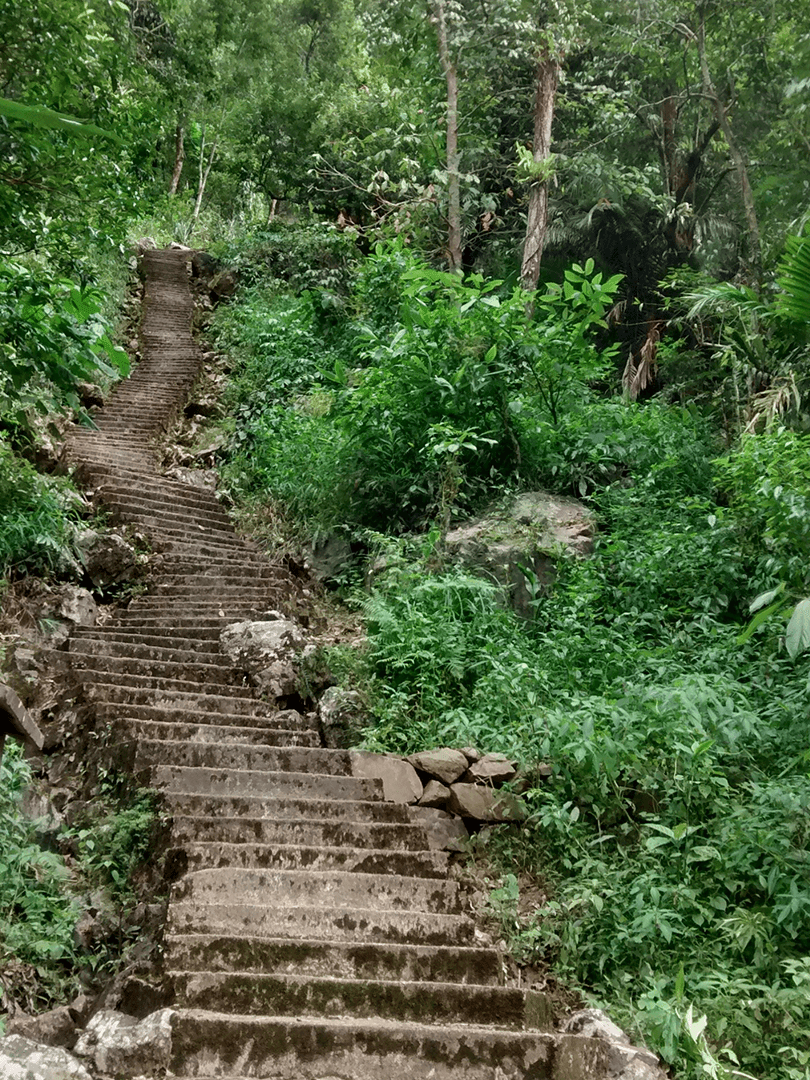
The trickery continued for the first half of the trek. Unlike many hikes that go upward, ours began with us going down 3,500 mud steps. It was slightly challenging to hold steady on the narrow framework as it pitter-pattered on us, but the strain was not that bad at all. On the way, we spotted pineapples, oranges, and lemons growing wild on trees. There were fluorescent yellow and orange snails clinging onto slimy, wet side railings. Butterflies so blue cropped up every now and then, looking like emojis come to life.
The mood was touch grass, high on nature, life is beautiful. The only thorns in my fantasy were the barely breathing people making their backward journey up, asking every guide to “just be honest” on how much further the starting point is. I decided that was a later problem.
An hour and a half, many thousand steps, and two suspension bridges later, we were finally a stone’s throw away from the living root bridge, whose sound welcomes you before the sight itself.
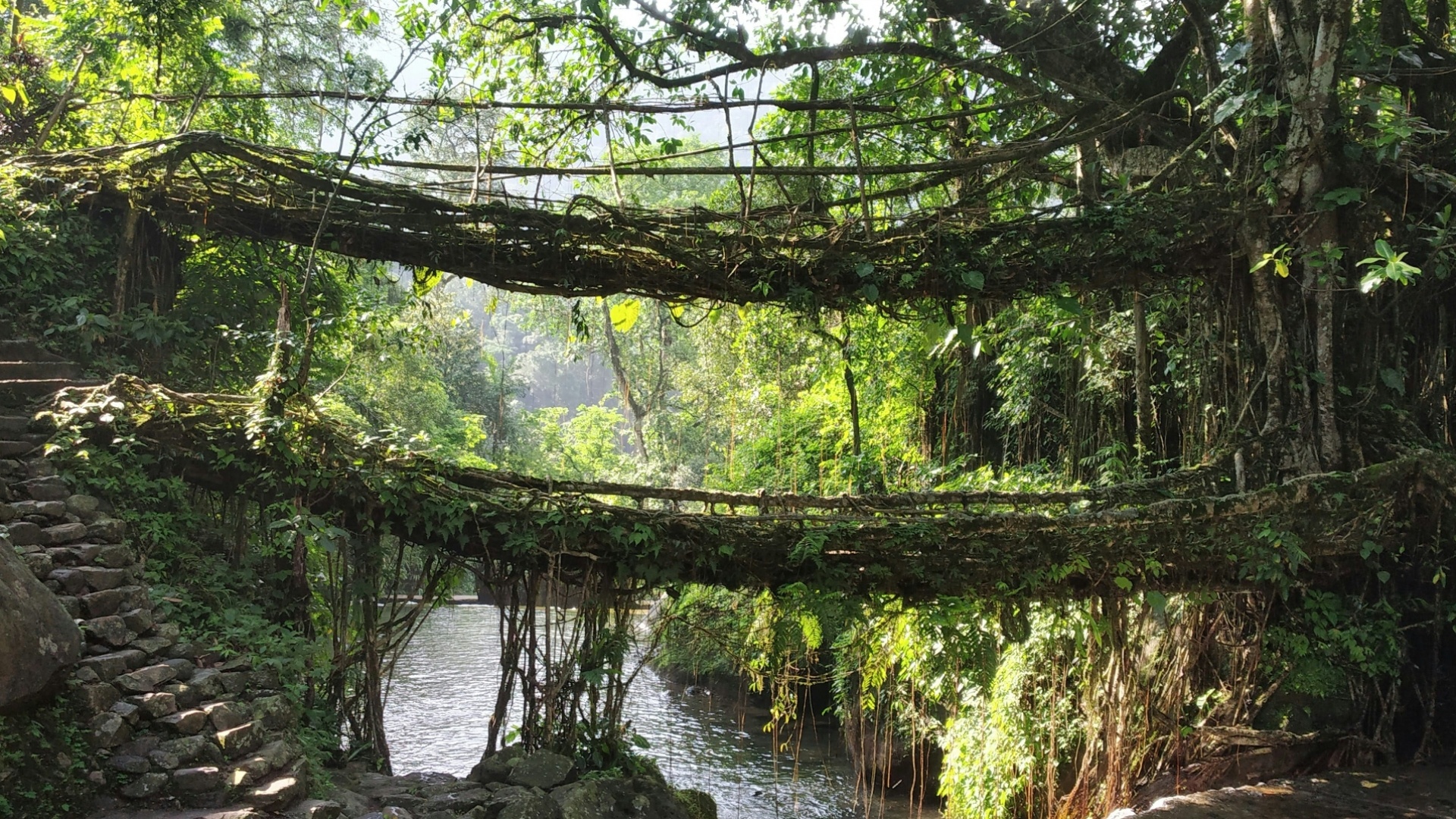
When you first see the sculptural rope-like roots painted green by the wild saplings wrapped around them, it’s hard to look away. This bridge is especially unique because it is built as two storeys; the upper one works as an alternative when the bottom gets submerged in heavy rains. Stepping on the roots, I bent down to caress the dense structure, almost confirming that it is alive.