The BAFTA-nominated actor always wanted to pursue music. Now, with a new prog rock EP and part two of a Hollywood franchise on the horizon, it looks like he has the rare vantage of enjoying the best of both worlds
Photographs by Sarang Gupta, Styled by Naheed Driver
“Would you like to listen to a song?”
Adarsh Gourav pulls out his phone without ceremony and sets it on the table between us. “It’s called ‘Shor’,” he offers demurely and presses play.
The room in a noisy corner of Mumbai goes very still. A voice rises, unhurried, over a bed of drum and bass, notes of the sarod curling around its edges. ‘Dekha hai maine bhi aankhon mein khushi se / qaid hai udaasi kahin.’ It’s his voice floating over a melody that lands somewhere between Bombay folk and indie dream-pop. “That’s my girlfriend,” he says with a smile, of the gentle female voice that joins his seconds later.
As the song nears its natural crescendo, Gourav informs his tiny, stunned audience that ‘Shor’ is not yet mixed and mastered, but when it is it will be “even better”. It will also be part of his upcoming EP: a collection of four songs that he’s been working on for the last few months that he hopes to put out this month, before he decamps to London for six months to shoot for the second season of the major and critically acclaimed Hollywood franchise Alien: Earth.
As we all sit quietly in the afterglow of this ethereal song, feeling its beauty elevate our 15th-floor view of this city, equal parts shimmering and suffocating on this unusually bright April day, I ask: Do he and Radhika Kolgaonkar, his aforementioned girlfriend of eight years, jam together a lot? “Not as much as we’d like to,” he laughs, talking about his life and career with the clarity of a low-AQI day. “She’s into karaoke and cover songs. I’m always like, what’s your song, bro? We have that ongoing disagreement, but that’s a childish thing I have—it’s very hard for me to sing other people’s songs.”
ADVERTISEMENT
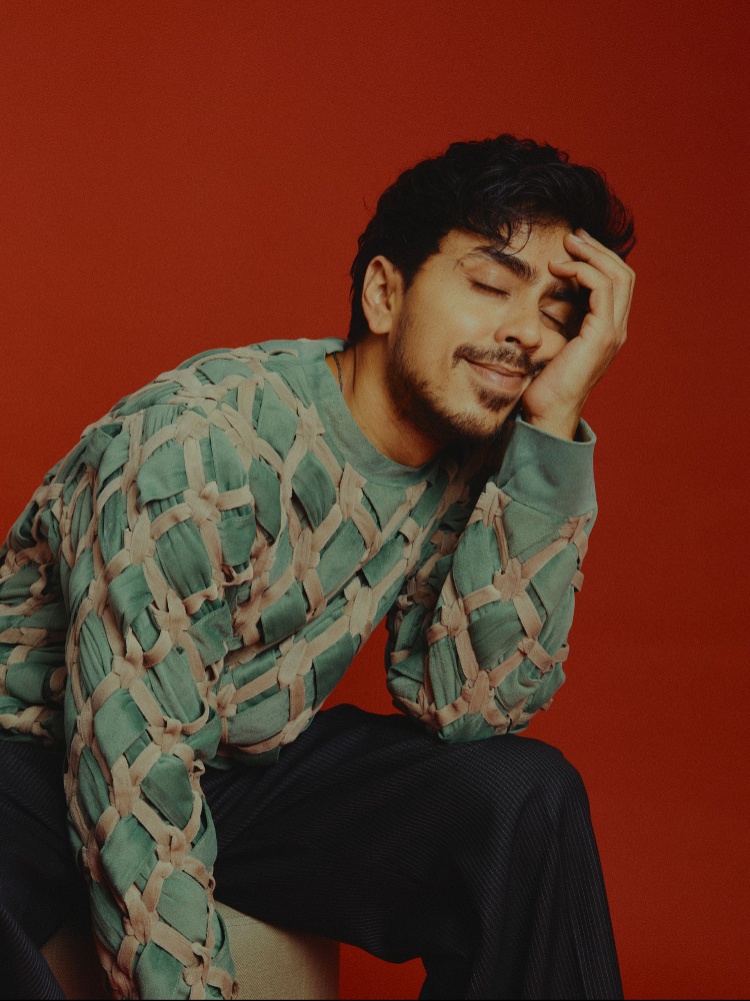
Sweater, trousers, Taarini Anand. Shoes, Zara
You see, for Adarsh Gourav—the BAFTA-nominated actor who had the dream debut of playing a younger Shah Rukh Khan in My Name is Khan (2010) and has, in the last 15 years, worked with bucket-list filmmakers like Zoya Akhtar, Bejoy Nambiar, Ramin Bahrani, and Arjun Varain Singh—music has always been his first love. It’s a love seeded in his childhood, one that has stuck despite often being unrequited, through rejection, failure, and harsh realisations. It has been his Everest, and it has given him everything he has today; he would likely not be on screen if it weren’t for being “noticed” while singing ‘Vande Mataram’ at the Kala Ghoda Arts Festival as a teenager, which really put him on the path to auditioning for films.
“I’ve always wanted to make music. I wanted to be a playback singer,” he says now, relaying a parallel life story that’s stayed under wraps until very recently. “And now I’m just using my street cred as an actor to push this side of myself. And why not? I hope they’ll think: ‘Acting achhi kar leta hai toh ye bhi theek thaak kar hi leta hoga.’”
So, is this where Gourav, 31, no longer a newcomer in the movie business, begins to monetise his polymathic creative abilities and build out a vision, a brand for himself—like so many of his generation seem eager to do? “I don’t think of it in those terms,” he says, screwing up his face. “But I do think people limit themselves by the way they think about themselves. I have been told—and I think I told myself for a long time—that I am an actor. Full-stop. What does that even mean? Acting itself is such a childish thing to do. I mean, look at us role-play on screen. But the best actors I admire are also editors, also directors in their imaginations, also musicians in their sense of rhythm. These categories are artificial.”
Of course, someone who grew up in the soundscape that Gourav did would resist silos. In his early years in Jamshedpur in a Telugu-speaking middle-class household, his father—a Central Bank of India employee and a classically trained Carnatic singer who never got the chance to become one professionally—played Jagjit Singh cassettes in the car and let his younger son absorb melancholy by osmosis.
He studied Hindustani classical music from the age of five, and when the time came, like a rite of passage, his brother introduced him to 2000s-era AR Rahman compositions as well as the gamut of Hindi rock (Strings, early Kailash Kher, Indian Ocean, Rabbi Shergill). By the time his family moved to Mumbai, he was barely a teenager, and Gourav’s aural environment changed yet again—onto his adolescent brain were seared the symphonic signatures of Tool, Porcupine Tree, Jethro Tull, and their ilk.
Fresh-faced and hungry to belong at Mithibai College in Mumbai, he walked up to an existing band and asked if he could sing for them. They said no. Or rather, they said it in a way that stung. “They were condescending,” he remembers. The hurt was swift and galvanising, and birthed Steep Sky, his first band. It lasted a year and a half. Then came Oak Island, a prog rock outfit, which gave him his real musical education via some tough-love coaching by Indian rock legend Uday Benegal on the reality show Never Hide Sounds on MTV Indies. (“Why is that video still on YouTube?” he groans, and I don’t bring up the comments under it.)
They performed at Hard Rock Café Mumbai and the Park Hotel in Kolkata. They made an EP called Aliens Can’t Jump. They made a totally independent music video for a track called ‘Magic Man’. And then, like true indie bands, they disbanded, because, as Gourav puts it with the resigned pragmatism of someone who has since made very different choices (knowing, even within his orbit, several others who didn’t and respecting them for it): “We realised we can’t make money through rock.”
Anyone who’s paid attention to the Indian independent music scene (a catchphrase for anything that wasn’t built in service of a movie) as it has grown over the past decade, knows that the musicians who really broke the bank were hip hop artists. It is the sort of rags-to-riches story perfectly exemplified by the character Gourav last essayed for Bejoy Nambiar’s Tu Yaa Main. Maruti Kadam is a passionate aspiring rapper from Nalasopara who goes by the alias Aala Flowpara, a man whose bravado is enormous and whose vulnerability is carefully buried beneath it.
“What I liked,” Gourav says, “is how well he hides his feelings. Human beings are not straight. We are all very twisted and strange and unique. And when a writer and director preserves that—when there’s a real paradox between where a character comes from and how confident he appears—that’s when I get genuinely excited.”
To prepare for this role, he spent time with rising hip hop artists from Mumbai’s suburbs, like Shaikhspeare, Gravity, Bombay Local, and even Naezy, the OG of gully rap. From them he learned the importance of, yes, being earnest but also diligent, persistent, unvanquished. “When you hear their stories,” he says, “it suddenly puts things into perspective. You start getting desensitised to things around you, stop having gratitude. And then you meet somebody who started from scratch, had nothing, and you reflect on your own journey.”
He says something that could serve as the thesis of his entire career—a career burnished, he’ll have you know, by a priceless education at The Drama School Mumbai, under the tutelage of stalwarts like Feisal Alkazi, Yuki Ellias, Pooja Sarup, and Sheena Khalid. “I like to play characters that are misfits in some way,” he says. “Maybe because I have been a misfit all my life. When I read scripts, I naturally gravitate towards characters that don’t fit somewhere. You can call them underdogs, misfits, whatever—I love that in human beings and in stories.”
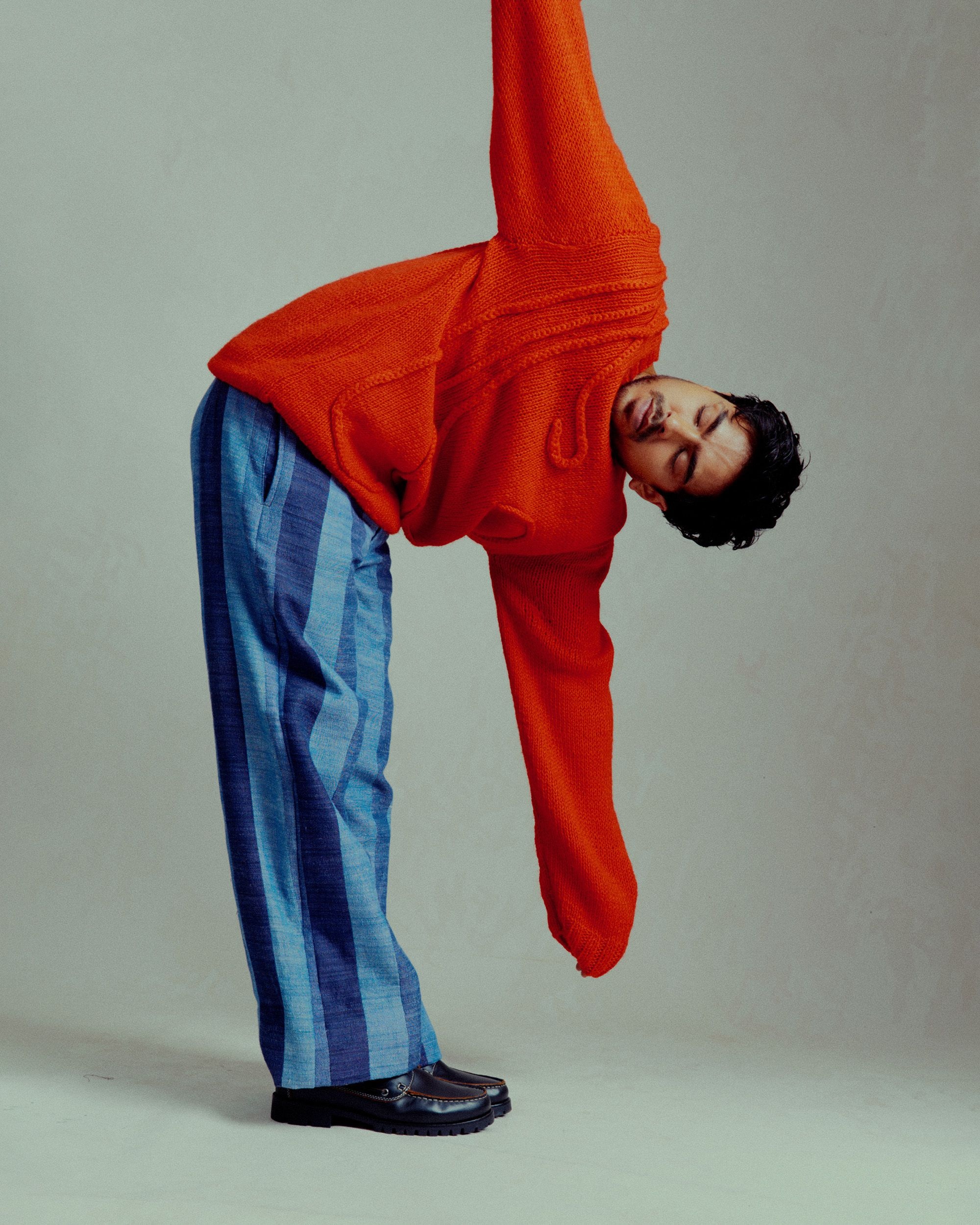
Sweater, trousers, Taarini Anand. Shoes, Zara
In real life, misfits are having a rough time in Bollywood. Tu Yaa Main landed on Netflix in April after a brief and bruised theatrical run in February. The discourse that followed was uncomfortable and necessary. Back then, Gourav had quickly made headlines with a question he posed that cut to the quick of what ails the business right now: “Where will actors like me go?” He had spoken candidly about the audience’s post-pandemic tilt toward spectacle, the growing dominance of big-ticket films, and a humble plea for attention for the kind of work he exists to make so that such films can also exist.
He groans again when I ask about it now. “I think what I said was honest, not despairing,” he says, carefully, adding that his words had been taken out of context. “It makes perfect sense for a film like Dhurandhar to be as successful as it is right now.” With its scale, skill and expertise, it is obvious that that kind of tentpole film will be a monster hit at a time when going to the theatre is an event for any one of us. “I mean, I myself rarely go to the theatre unless there’s a really good horror flick running,” he shrugs.
So, while it makes sense to him that a film like Tu Yaa Main could flop at the box office, “these films, or what Vir Das has attempted with Happy Patel, are also important,” he adds. “They are also cinema. They just require a different kind of faith from audiences. And right now that faith is scarce.”
The divide isn’t just about money, he insists—it’s about cultural imagination. In an industry that still sells “hero energy” through a fixed template, even casting him as a commercial leading man is, by the trade’s logic, a risk. He pauses. “It is a risk. I know that. And I am grateful for every director who looks past the template and bets on something real.”
So, the question remains: How does someone like Adarsh Gourav, inducted into the industry at a time when a new wave of independent (also variously referred to as parallel, alt, cerebral) cinema was beginning to rise, adapt to this changing environment? Mostly, he seems to take it all in his stride, looking for outlets for his creativity wherever he can. And he’s got moves. He’s just returned from weeks travelling through the northeast, exploring the lives of local tribes, kitchens, customs, and more for an upcoming travel documentary he is hosting for NatGeo Discovery. He is marshalling his celebrity to “present” worthy independent cinema: shorts like Ayushi Gupta’s Namak, a sweet story about three generations of women and a cake. He is leading a Telugu psychological thriller, currently in post-production. For the rest, he’s reading, and he’s certain something will be in the works by the time he returns from London, even as he secretly manifests work with Hollywood horror masters Jordan Peele and Ari Aster.
Meanwhile, the musical and the cinematic have been talking to each other in his work for a while now. His debut single ‘Bechaini’, released in collaboration with OAFF two years ago, was deeply personal—a return to his musical roots. The pair performed at Lollapalooza this year—his first stage appearance in years—and something clicked. “I just realised how amazing it feels to be on stage again,” he says. “That really pushed me to work on my original music.”
And he has. If ‘Shor’ is anything to go by, the EP will likely channel the spirit of prog rock and meld whole galaxies of music, the ones he has grown up loving. He’s collaborating, among others, with composer Aditya N —the music producer with whom he co-composed ‘Jee Liya’ for Tu Yaa Main— and his girlfriend, who, other than contributing her voice, fulfils the unenviable task of keeping him honest and grounded. In a first, he’s writing three songs himself. “I wasn’t very confident about writing,” he admits. “But I’m trying to practise that muscle.”
The vision is to tour with the EP next year. But on a more granular level, the two disciplines speak a shared language for him. “Music informs my sense of the pacing of a scene, the rhythm of an edit. As an actor, you need to be a musician, an editor, a writer, all at once. It’s only when you can imagine the film in its final form when you can hear its beats, that you can take the right call on the choices you make in a scene.”