



Design07 Aug 20265 MIN

In this Telangana home, the elephant headdress is just the beginning

How Akila Raju’s lakeside residence turned into an evolving home for two dozen Tanjore paintings, an antique Baccarat stand, a 120-year-old Pichwai work, and countless other museum-worthy collectibles

Image

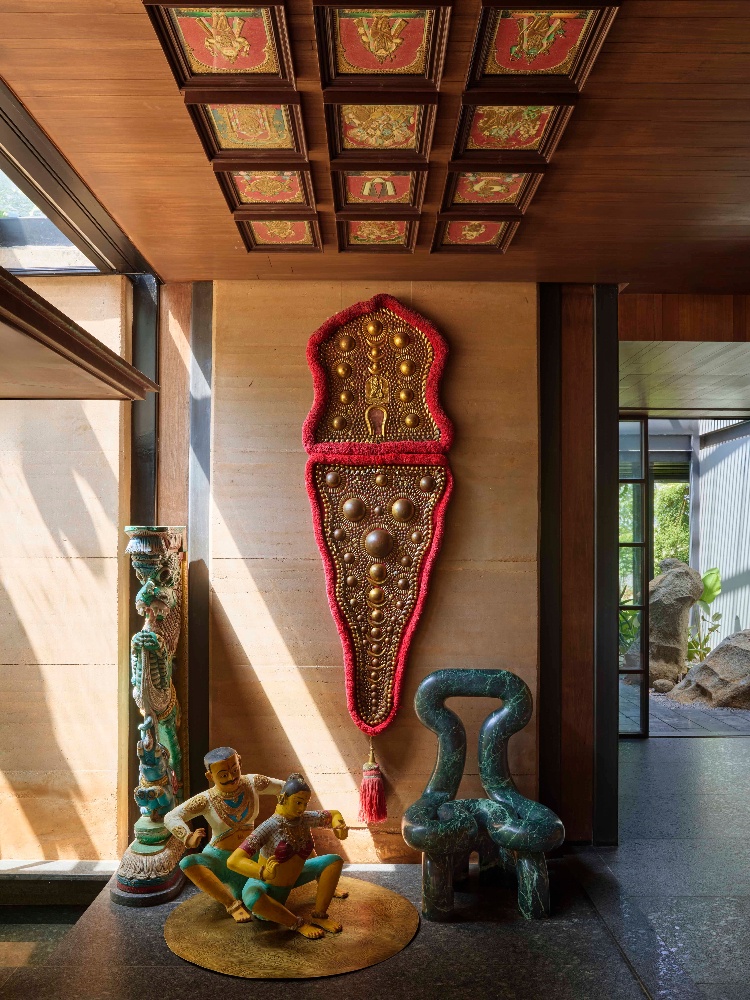
A series of 24 Tanjore paintings from the Eastern Art Museum in Visakhapatnam spans the ceiling of the entrance foyer, above the elephant headdress from Heritage Arts in Kochi. Beside it sits the sculptural Petronova marble chair from Ziba Homes

At the entrance to Akila Raju’s home in Gandipet, on the outskirts of Hyderabad, a tall, two-part elephant headdress rises vertically along the foyer wall. Edged in deep red and studded with gleaming gold-toned discs, it once adorned an elephant during ceremonial processions in south India. Interior stylist and designer Samir Wadekar found it at Heritage Arts in Kochi. In the foyer, it shares space with 24 Tanjore paintings across the ceiling, an antique seater, Cambodian sculptures, and a marble chair. Removed from its original context, the headdress reads as sculpture.

It is an apt introduction to a home that now holds over 200 artworks and collected objects, including paintings, ceramics, textile art, and sculptures. Raju and her husband had long collected art, antiques, and culturally rooted objects, while many more were acquired during the 15-month refurbishment led by Ameet Mirpuri, principal designer at Design Studio, and Wadekar. Mirpuri invited him to collaborate from the outset, knowing his eye for antiques and sourcing network would suit Raju’s appetite for collecting. Wadekar calls the headdress his favourite piece because its purpose has changed completely. “A collector’s home is never complete,” he says. “You keep collecting, and the pieces keep travelling. A vase might sit in one room, disappear into storage for five years, then return somewhere else for the next 30.”

Raju, her husband, and their two young children first used the original home as a weekend retreat, but the prospect of a quieter life close to nature eventually drew them there permanently. Designed by Spasm Design in 2021, the five-bedroom, 15,000 sq ft farmhouse unfolds over two levels on a 30-acre, lake-facing property surrounded by landscaped greens, open lawns, verandahs, and horse stables. Public rooms spill into verandahs and decks on the ground floor, while bedrooms and family spaces are gathered upstairs. The interiors remained sparse, with a Baxter sofa, dining set, console, coffee table, and brass repoussé bar by Vikram Goyal among the few pieces against its grey-and-wood shell.

After speaking to nearly 15 designers, Raju met Mirpuri and distilled her taste into one sentence: “I’m a maximalist at heart.” The house needed colour, art, storage, and the character of objects gathered over time.
The first interventions were practical. The entrance verandah was enclosed and air-conditioned, while the outdoor puja area was encased in glass, almost tripling the arrival space. Storage was added for a homeowner who describes herself as a hoarder. The lighting throughout the house was completely redone, with the long, naturally dim corridor posing a challenge. Mirpuri and Wadekar worked through on-site mock-ups with lighting designers in Hyderabad, sourcing fittings that would illuminate the family’s paintings, sculptures, antiques, and ritual objects without giving the home the air of a showroom. Since the rammed-earth walls could not be drilled into, some artworks were suspended from slim ceiling channels.

With the groundwork in place, the three turned to sourcing the art, antiques, and objects that would give the house its character. Their first shopping day began at Art Mumbai, where they found several works now displayed in the powder room, along with a contemporary paper installation. From there, they went to Mahendra Doshi, Moorthy’s, and Taherally’s for chandeliers, lamps, furniture, and antiques. Further trips took them through galleries, warehouses, antique stores, and craft ateliers in Kochi, Ahmedabad, Delhi, and Visakhapatnam. Some days yielded a single object. On another, they bought 75 pieces. Between journeys, the search continued over WhatsApp. A photograph of an antique Baccarat candle stand produced three immediate replies, each some version of “Let’s get it”. Raju was involved in every acquisition. “If any of us gave something a second thought, it was usually a no,” Mirpuri says. “It had to feel like first love.”

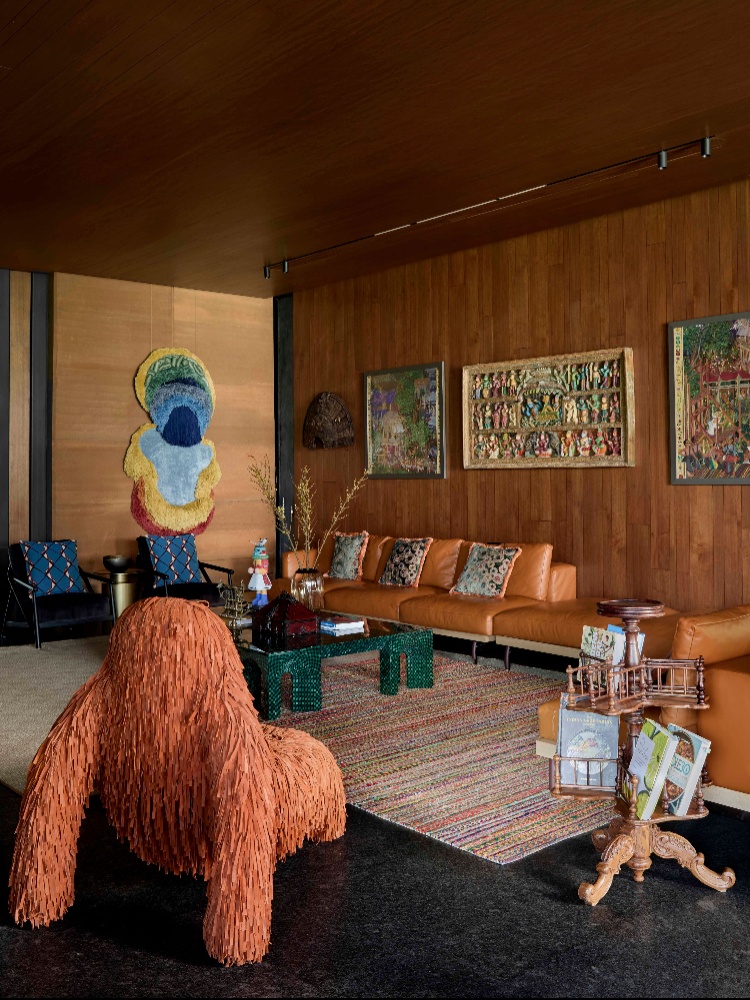
Most pieces arrived before anyone knew where they might live. “To me, a true collector buys something for the love of it, without deciding which wall or table it belongs to,” Wadekar says. Before the refurbishment, the homeowners already owned miniature paintings from Curator Studio in Bengaluru, a gifted painting by Sri Lankan artist Senaka Senanayake, several sculptures, and a registered 120-year-old Pichwai. Around them grew a collection spanning regions, periods, and mediums, with paintings by Lado Bai, Siddharth Shingade, and Gouri Vimula; textile works by Arinjoy Sen; Ashiesh Shah’s Ganesha; Indonesian Buddhist bronzes; Cambodian artefacts; Panjurli Bhuta masks; antique diya stands; reclaimed architectural fragments; and an antique graphoscope.

Raju is drawn to objects that reveal the labour behind them. “We wanted pieces where you could see the workmanship and effort that had gone into them, and feel that they would hold their value,” she says. For some, value came from the artist’s name or investment potential. Others were chosen for craftsmanship, rarity, or curiosity. The graphoscope in the entertainment room, whose lenses lend photographs an almost three-dimensional quality, appealed to her because it was both curious and beautiful.

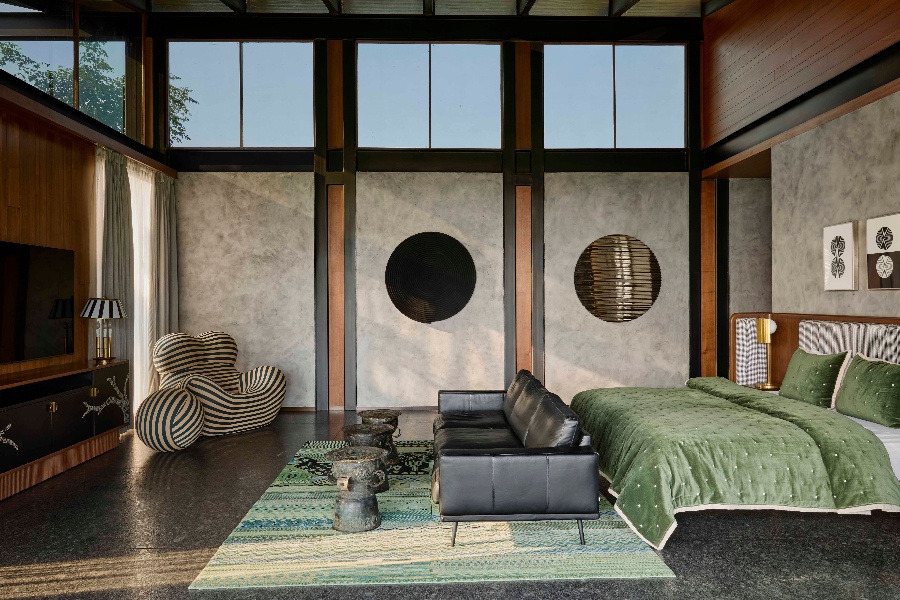
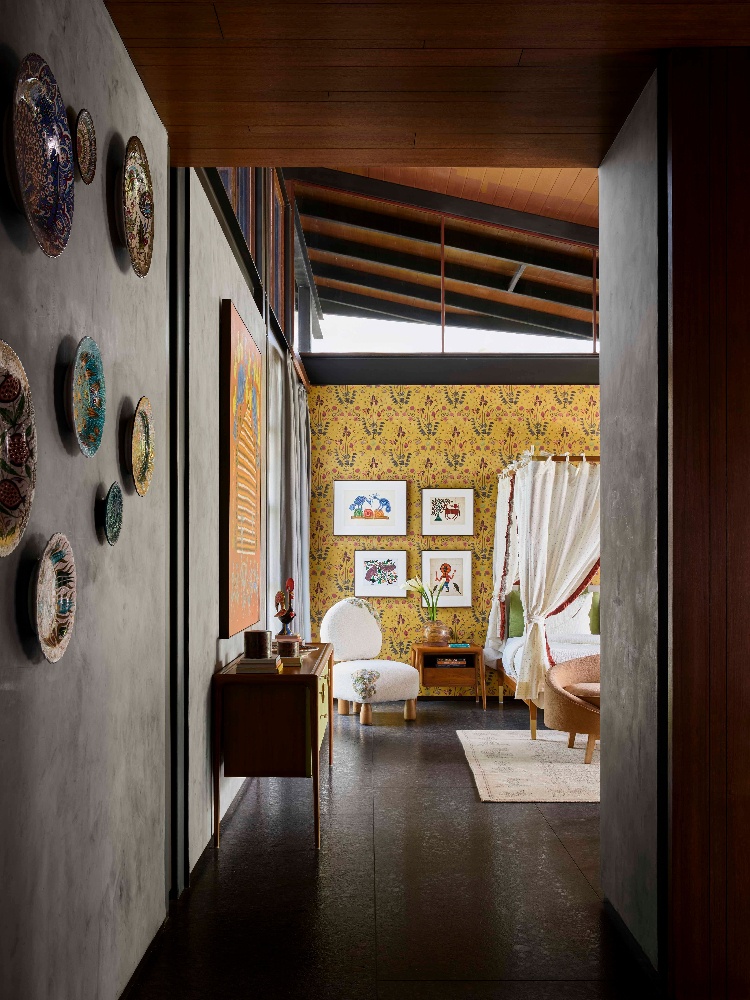
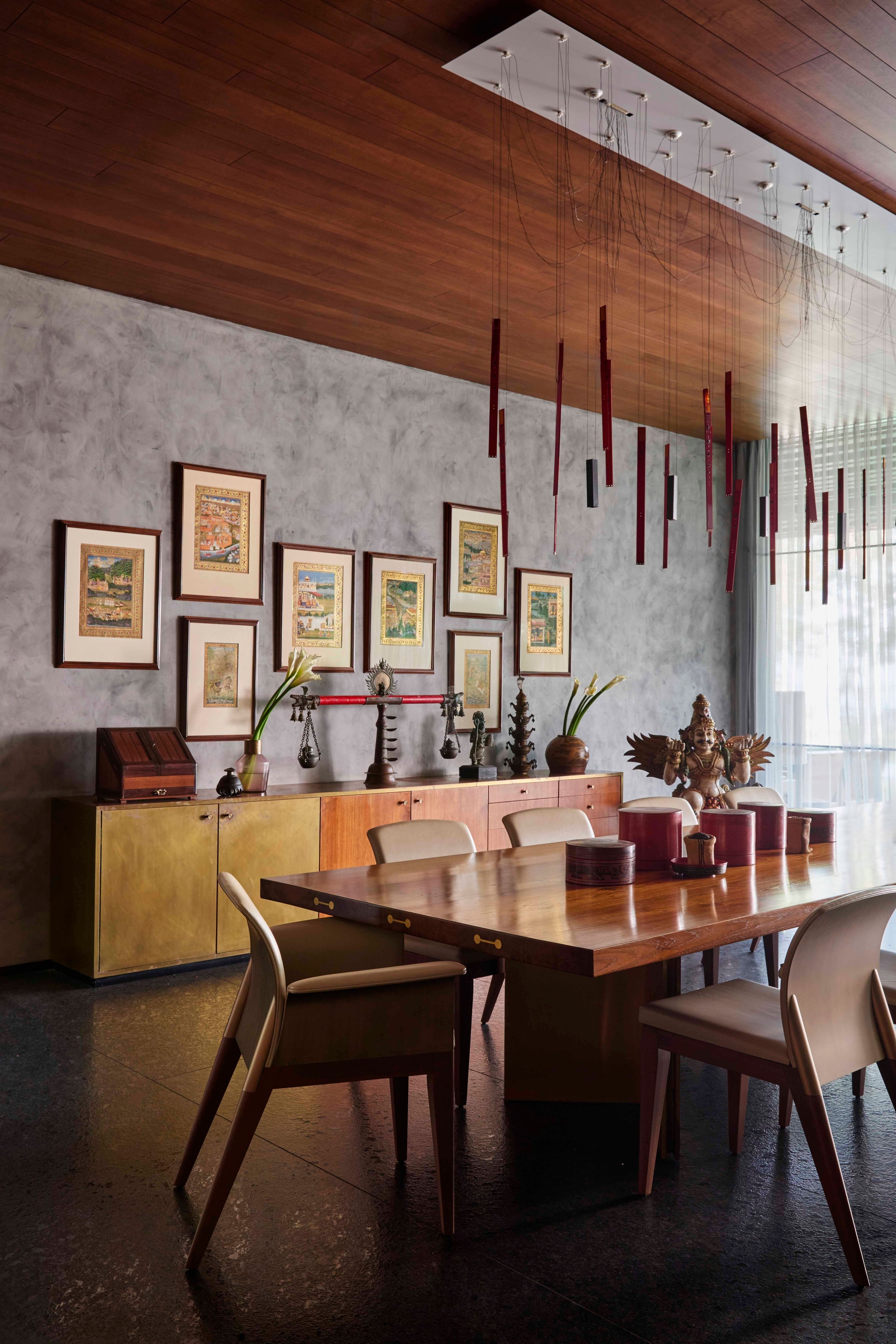
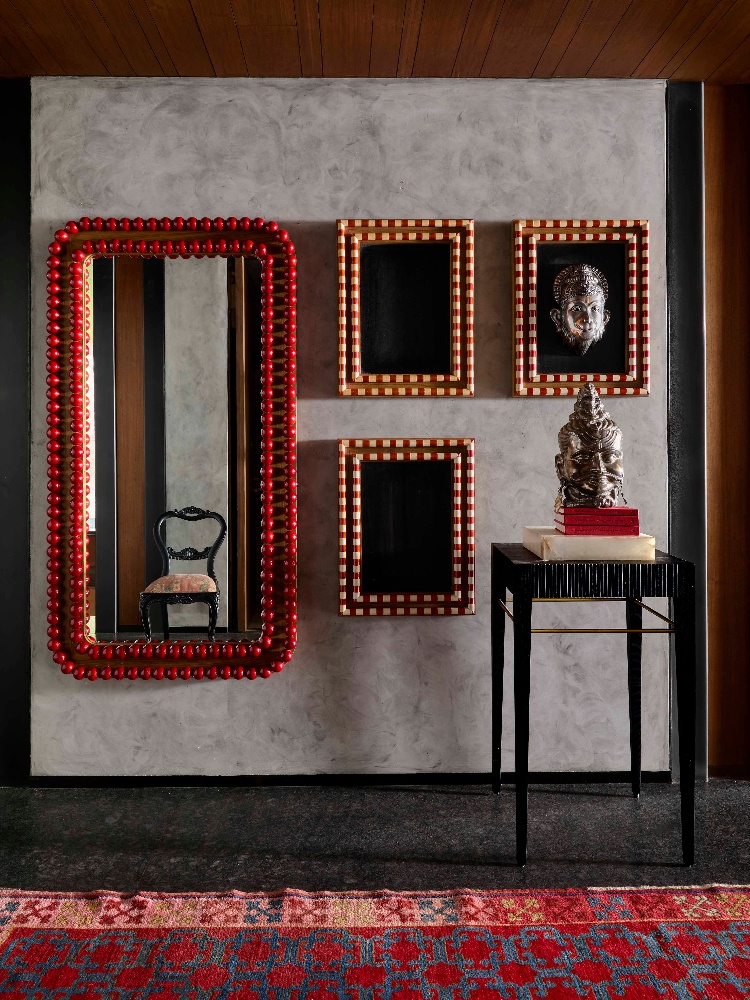
Finding each piece was only the beginning. A Spanish cabinet moved through three or four rooms before settling in the ground-floor corridor, while the miniature paintings in the dining room were rehung and reoriented. Boxes and pottery from Kochi, a writing box, and the Art Mumbai paper installation gradually joined them. The Lado Bai paintings were acquired before their location was decided. Mirpuri and Wadekar considered several possibilities, including an upstairs guest room, before the works found their place in the daughter’s bedroom, alongside wallpaper from Mind the Gap, an antique vase, a pale chair, fringed fabrics, and chosen upholstery. Even the powder room participates in the collection, with palanquin finials, a small letter-box cabinet with hidden compartments, and a carved vase bearing a peacock, a detail that speaks to Raju’s fondness for the bird.

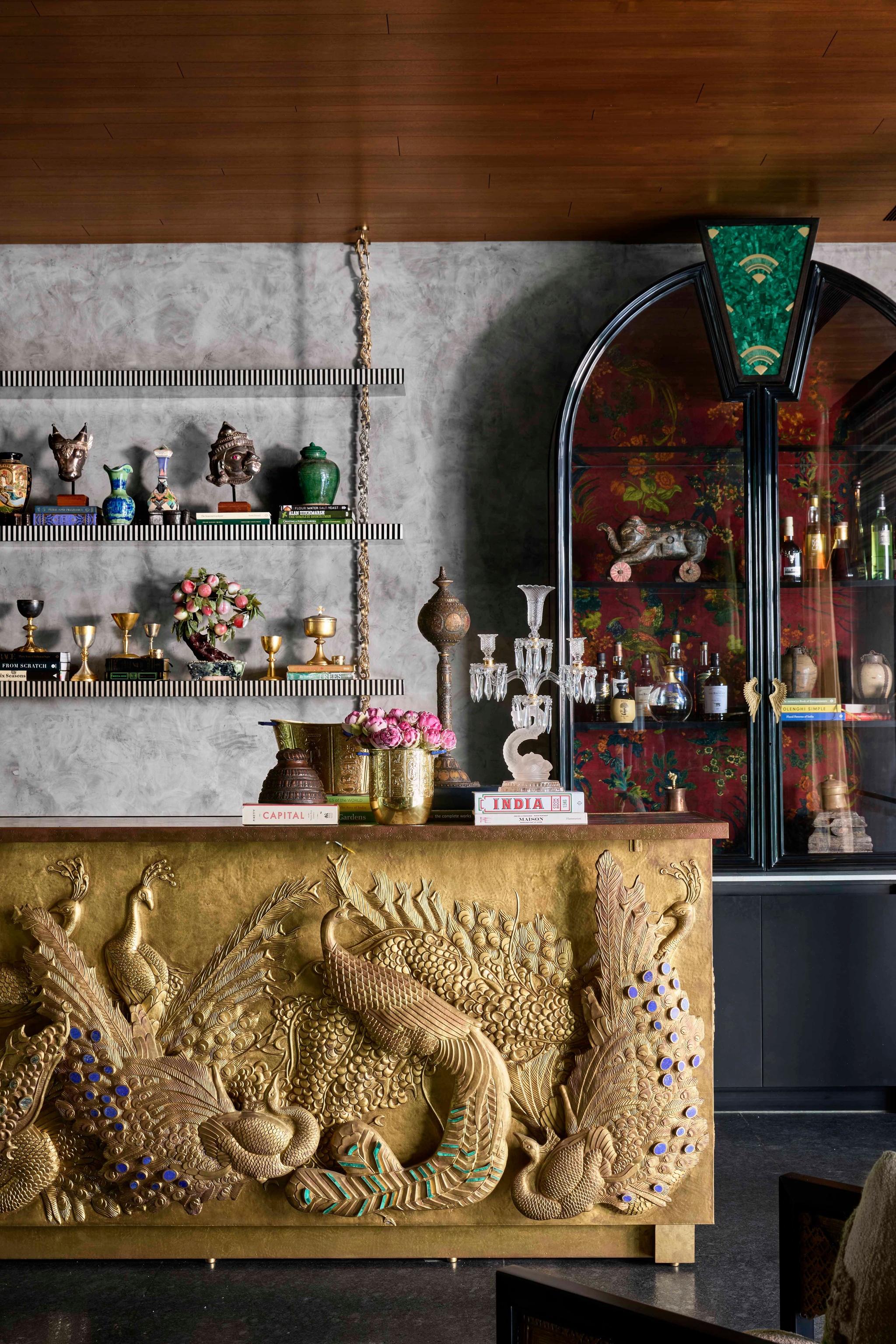
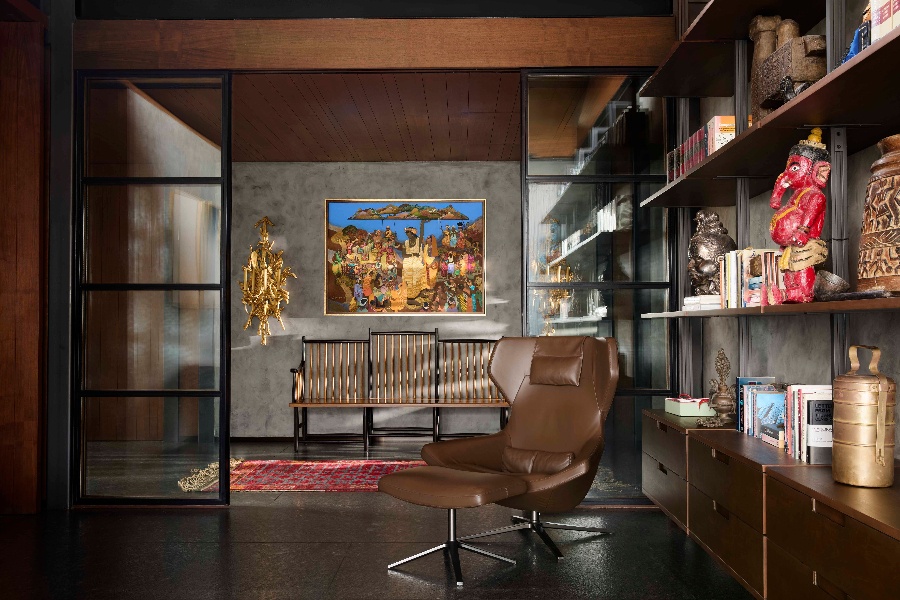
The collecting spirit reaches its most exuberant expression in the ground-floor entertainment room. Before the redesign, a substantial brass repoussé counter by Vikram Goyal stood alone beside a retained sofa and coffee table. A book and tissue box were almost the only objects in sight. Mirpuri and Wadekar kept the counter and built the room around it, suspending display shelves from antique brass swing chains above black-and-white inlay. Ralph Lauren fabric lines the bar back, emerald-coloured semi-precious stones are set into the capital above it, and the 120-year-old Pichwai presides over vintage lighting, the Baccarat candle stand, and furniture from Scarlet Splendour, Studio Orion, and Within. “Every piece in that room simply fell into place,” Mirpuri says. “The fabrics, the furniture, the objects, the bar itself—it all came together and set the tone for the house. It is probably the most maximalist space we created.”

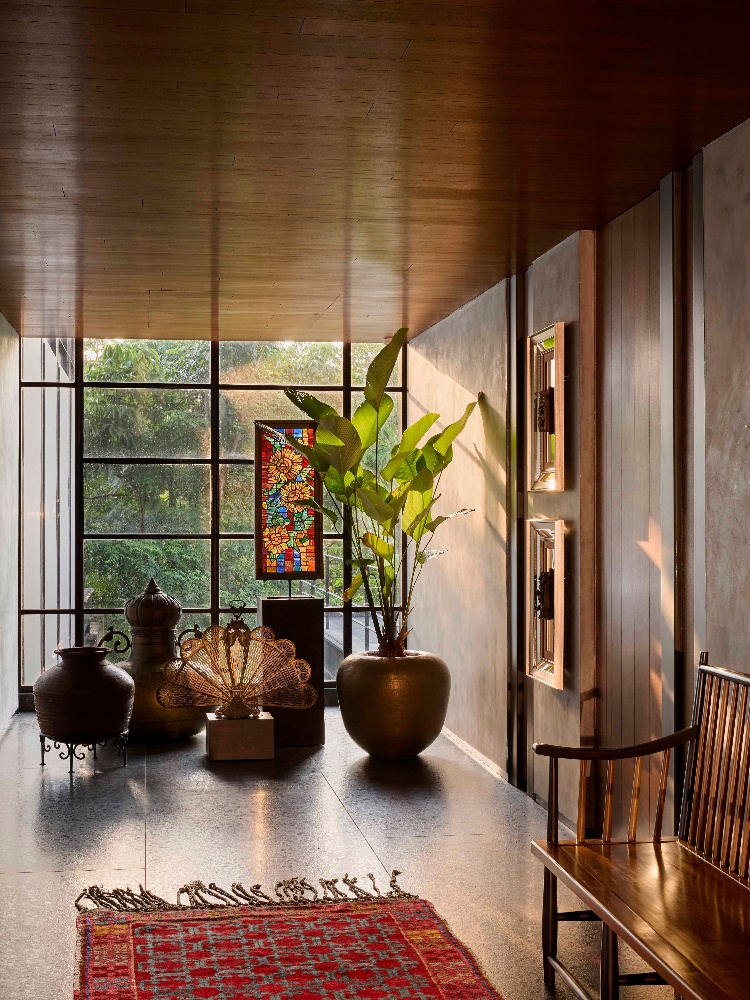
The objects continue to reveal themselves through the way Raju lives with them. In the morning, the red carpet and Ashiesh Shah’s Ganeshas near the puja area are awash in sunlight. The Channapatna beads used in the sculptures come from a town in Karnataka and return her to childhood road trips with her father, when the family would stop along the roadside to buy wooden toys. Such memories are renewed through these daily encounters, creating a relationship she can imagine deepening over the next 20 years, with something new still waiting to be noticed.

The collecting, meanwhile, has not stopped. Raju still sends new finds to Mirpuri and Wadekar, though where they will live is never fixed. Wadekar calls them “forever pieces, rather than forever spots”. Perhaps another photograph will arrive on the group chat tomorrow, and the house will make room for one more story.

The Nod Newsletter

We're making your inbox interesting. Enter your email to get our best reads and exclusive insights from our editors delivered directly to you.