



Spooky season07 Feb 20268 MIN

I went to Bhangarh Fort and got a ghost story out of it

How a visit to one of the “most haunted places in Asia” brought thrills and chills befitting a Bollywood horror movie

Image

I remember the exact moment I started finding my beliefs around the physical world—that it is only inhabited by what we can see and touch—a little naïve. The year was 2011, it was 2 am, and I was 18.

Eager to move out of Shillong, I had trekked to Guwahati to appear for an entrance test to secure a seat at the coveted Tata Institute of Social Sciences. I crashed at a friend’s house, where she, her mother, and I occupied three separate sofa-cum-beds.

In the middle of the night, I felt a sudden tug at my blanket. It was gentle at first, and then the unexplainable happened. Someone—no, something—placed its hand on the blanket right above my face and pulled the whole thing down. I was shocked, cold, and unsure of what had just happened. Immediately, I flung myself out of my bed and screamed for help.

When my friend’s mother woke up, she didn’t seem surprised at all. “The neighbours have cast a black-magic spell on us. It wanted to see who the new person was,” aunty cooed. Bisleri bottles moving on their own? “This is routine for us,” she confirmed. Needless to say, I stayed up all night and never visited that friend again.

Cut to October 2025. A multi-city Rajasthan travel plan gained momentum, and we started toying with the idea of adding the notorious Bhangarh Fort to our itinerary. For the unaware, the 16th-century fort is on the ‘most haunted places in Asia’ list. Amazingly, I was game.

“What could go wrong?” I laughed, thrilled at the prospect of a group ghost hunt.

There’s been a growing fascination with paranormality, and it’s not just on television. Beyond Bhangarh—in Mumbai, Lucknow, Delhi, Kolkata, Pune—there’s a hunger for exploring the unknown, especially among younger travellers.

Sarbajeet Mohanty, a certified paranormal investigator and one of the founders of Parapsychology and Investigations Research Society (PAIRS), has been hosting paranormal tours under the banner Ghost Encounter Tours (GET), comprising workshops, grounding rituals, and cautionary briefings. “When I was a kid, thrill meant playing hide-and-seek or cricket. But these days, people’s interest in finding something new, more adventurous, is growing. Ghost tourism is part of pop culture in the West, and influenced by it young people want something exciting beyond their routine lives,” he says.

Even if you’re not a believer, you’ll agree there is a thrill to the unexplained.

In Jaipur, the night before we were due to visit the fort, a rickshaw driver warned us: “You’re always watched in Bhangarh...and it’s not by locals.”

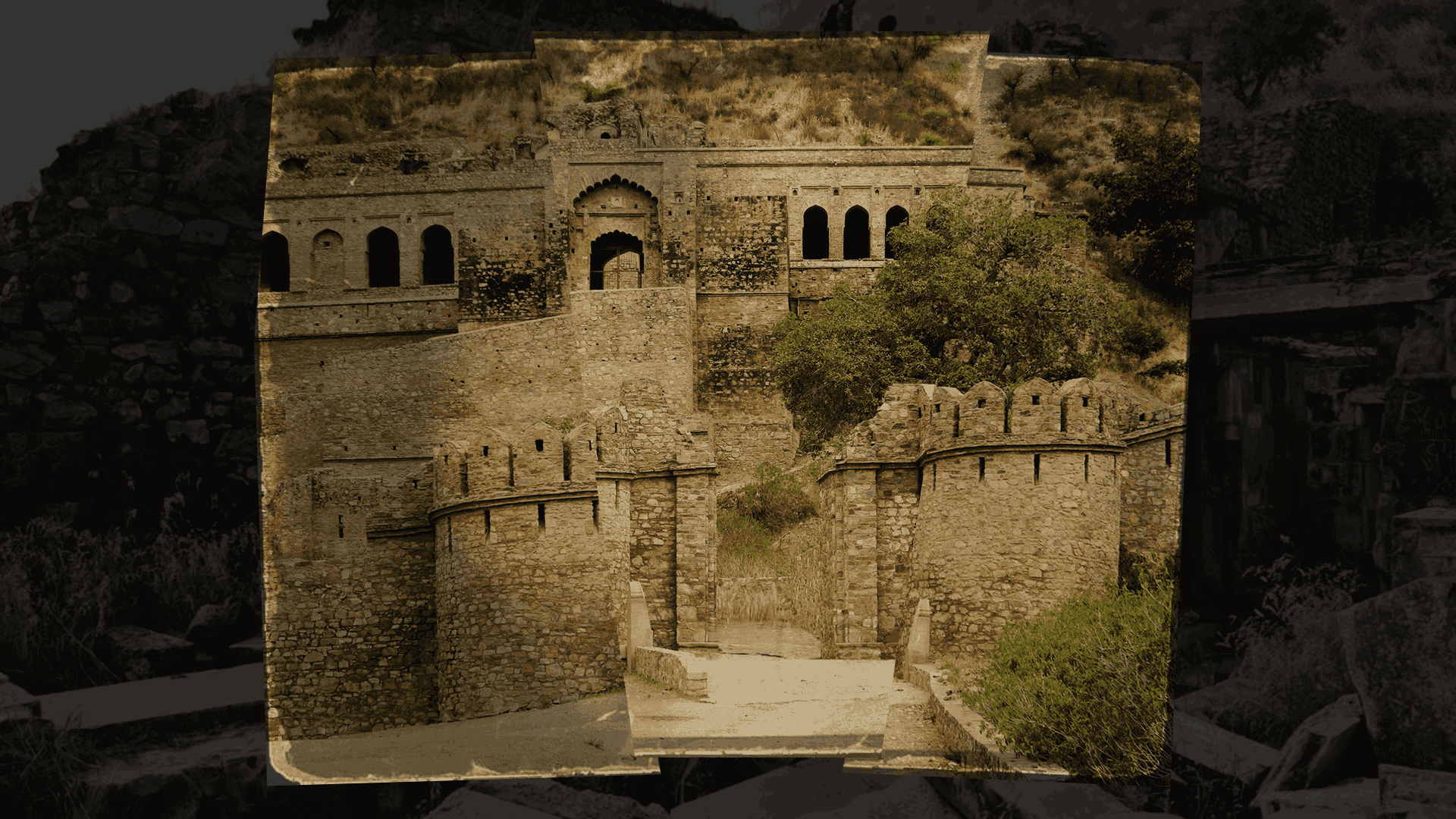
The next day, we found ourselves in front of a small archway at the entrance to the archaeological site, flanked by a large stone signboard by the Archaeological Survey of India. “No entry after sunset,” it read in big, bold letters.

Locals repeated the after-dark clause like a prayer. “Even guards do not enter after dark,” said one of my sources. “Security runs in three shifts—6 am to 2 pm, 2 pm to 10 pm, and 10 pm to 6 am. But after 5 pm, no one goes inside, not even out of curiosity.”

When I asked him why, he paused and replied, “There are things inside... Wild animals, yes. But we know how to handle them. What we don’t understand are the sounds.” Leaning closer, he added, “Sometimes at night, we hear screams from inside the fort...like someone begging for help.”
Cursed castle

Bhangarh Fort’s haunted reputation is deeply embedded into folklore. According to legend, Princess Ratnavati—young, intelligent, breathtakingly beautiful—had many suitors. One of them, a tantric named Singhia, who was also a security guard at the fort, tried to win her with black magic. He enchanted the oil meant for her skin (some legends say it was her ittar). The princess sensed malice and flung the bottle. It shattered against a boulder, and the boulder then rolled and crushed Singhia to death.

Before dying, he cursed Bhangarh: No living soul shall survive here three hours after his death. And the land shall remain barren forever. Thus, the fort—once a symbol of trade, wealth, music, and life—fell eerily silent.

Even today, beneath its grandeur lie whispered warnings, stories of restless spirits, forbidden hours, and centuries-old curses. A local guide shared an anecdote that seemed straight out of a Bollywood horror movie: “Even today, near the naach ghar, we can hear sounds of ghungroo and payal. Some may call it fear or your brain playing tricks, but we know there’s something truly evil inside the fort.” He looked over his shoulder before adding, “And the women here never leave their hair loose on Tuesdays and Saturdays. The chudails (witches) enter through the hair.”

The celebrity ghost

If there’s one thing about Bhangarh Fort that fascinates most visitors, it’s about Bollywood superstars Shah Rukh Khan and Salman Khan’s 1995 hit film Karan Arjun. Villagers claim Mamta Kulkarni danced inside the fort with her hair down—entranced, possessed, not fully herself. Some say the film crew accused locals of witchcraft and even filed a police complaint.

Vishal Rajoria, a restaurant owner from the area, shares, “The strangest thing about Bhangarh is that when people hide from the guards and stay the night [in the fort], they never come out alive.” When I pushed him, wondering aloud if the reasons could be medical—hypothermia or pure panic—he shook his head like a wise sage: “Postmortem reports do not show anything. We never talk about it outside. But everyone here knows.”

No fear

Believe it or not, there are people who will pay money to experience something eerie and terrifying. Mohanty has caveats with every paranormal excursion he hosts. “Don’t go to haunted places and drink. Don’t try pre-wedding shoots there. Don’t try to communicate with spirits just because you saw a Reel or The Conjuring,” he warns attendees. “It’s the same as walking into an operating room without being a doctor. If you don’t know how to handle what comes after, it can be a catastrophe.”

And while ghost tourism is picking up pace in India, it’s a structured niche unlike the West. Kaevan Umrigar, heritage evangelist and tour guide for Khaki Tours’ Grisly Girgaon in Mumbai, has seen an uptick in the popularity of their paranormal tours. “Grisly Girgaon was once occasional. Now it happens twice a week. People don’t always come expecting paranormal activity—they come because the idea feels fun, strange, and different.” In Kolkata, Iftekhar Ahsan of Calcutta Walks concurs. “The demand is high. Ghost tales are just stories until we tie them to occurrences and newspaper clippings.”

The things we cannot name

Not everyone sees ghosts, but there are many who sense something they cannot name. Hina Jain Agarwal, a homemaker, shares a terrifying tale from Bhangarh Fort. “When I went to Bhangarh, I could smell ittar while others couldn’t. I tried to rationalise it, but the smell stayed long after people left.”

Priya Mittal recounts her friend’s harrowing night from inside the fort. “They heard someone crying and footsteps. When they tried to leave, they kept circling the same spot, as if trapped in a maze. After they finally reached the village border, the sky looked split in two—dark on one side, bright daylight on the other.”

During our own visit, when the sun began dipping behind the Aravalli hills, a strange hush consumed the ruins of the fort. The monkeys stopped screeching. It was our cue to leave. My partner and I left before dark, riding away on our rented Scooty toward a nearby settlement.

Barely 10 minutes later, something felt off. Our Scooty, perfectly fine earlier, now refused to start. The headlights worked, the horn worked, and so did the speedometer. The petrol tank was full, too. But the engine stopped working.

A man standing by the roadside watched us struggle. Then, he smiled and walked toward us. Without touching anything, he started the engine in one attempt. I stared at him. “How... How did you do that?”

“They want you.”

“Who?” my partner swallowed.

The man wiped the dust from his palms and stepped back. Before walking away, he stepped back and replied, “You know who.”

The Nod Newsletter

We're making your inbox interesting. Enter your email to get our best reads and exclusive insights from our editors delivered directly to you.