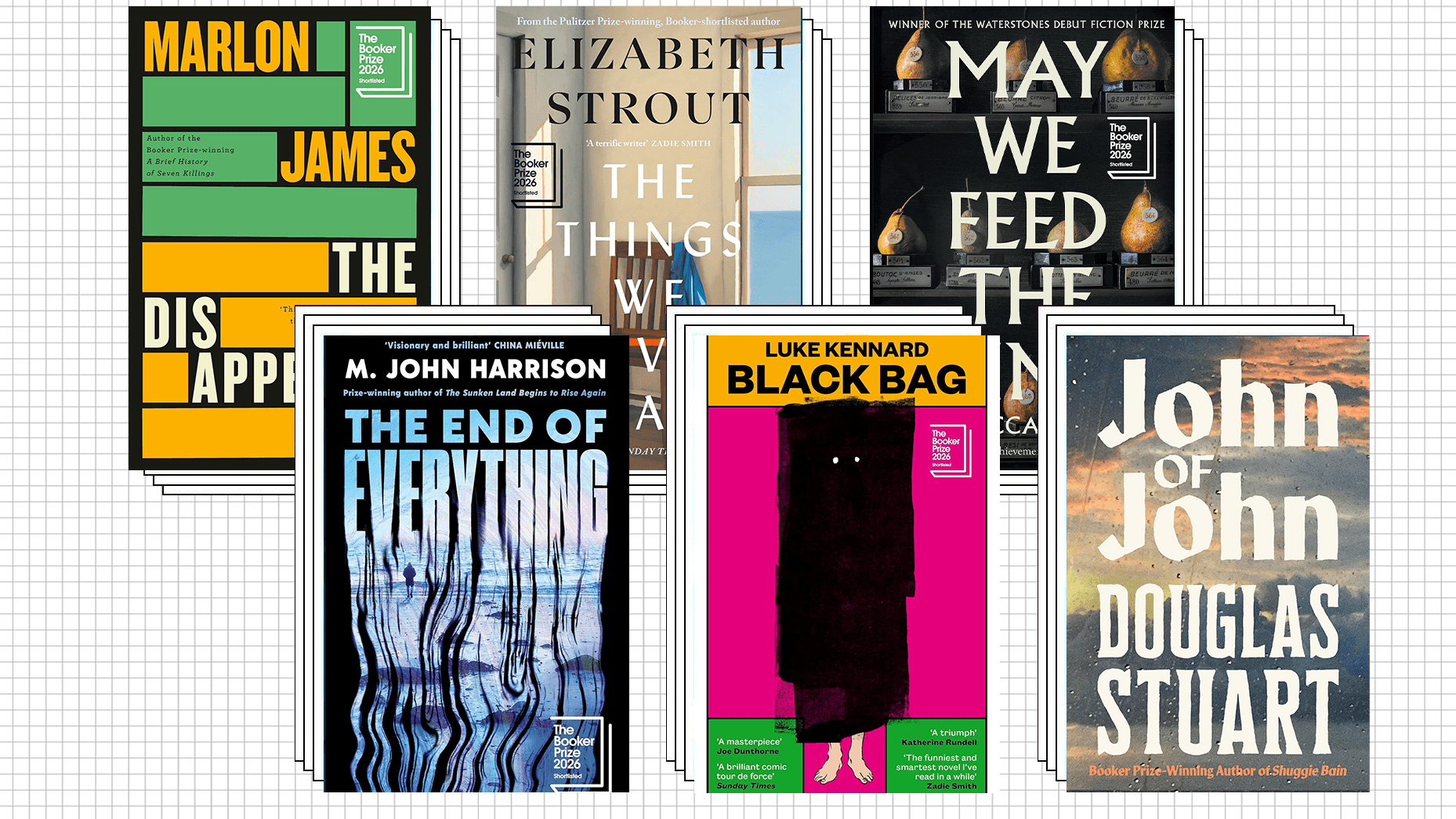

Can I please just start this by saying that I’m kind of annoyed that Emma Cline’s Switzy is not on this list. Cline’s tender portrayal of the last few days of a man diagnosed with Alzheimer’s heading to an assisted suicide facility in Switzerland wasn’t meant to be left off the shortlist. Now that we’ve gotten that out of the way, let’s look at the six books that did make it to the 2026 Booker Prize shortlist, before the winner is announced on November 9.
There’s The Disappearers by Marlon James, set in 1980s-90s Jamaica and revolving around a violent homophobic attack on a group of men trying to stage a play; Douglas Stuart’s John of John, about a father-son duo in the windblown Scottish isles; Rebecca Perry’s May We Feed the King, about a woman whose job involves recreating historical scenes in palaces and museum exhibits; Luke Kennard’s Black Bag, about an unemployed actor who agrees to don a black bag and attend university as part of a psychological experiment conducted by a professor there; Elizabeth Strout’s The Things We Never Say about an elderly school teacher who suddenly finding himself unmoored after a new secret about his dear ones is revealed; and The End of Everything by M John Harris, a dystopian novel set in an Earth ravaged by some unspecified crisis and two people trying to navigate life in it. There are two Booker Prize winners on the list (James and Stuart) and one author has been nominated thrice (Strout). Anyone can win, but we have our faves.
The Disappearers by Marlon James
📚 The gist of it: Marlon James’s 613-page novel moves back and forth between timelines and narrators. We start with 1988 Kingston, where eight gay men answer a casting call for a queer play—Fortune and Men’s Eyes by John Herbert. One day a violent mob gatecrashes the rehearsal venue and unleashes the worst violence imaginable on the actors. (It’s a Marlon James novel, so he leaves nothing to imagination; he insists that you don’t turn away.) We’re then in 1994, 1999, and 2005. Some voices feature more prominently, while others seem to have disappeared, but slowly a picture of the victims and attackers surfaces through the trauma, rage, and guilt that follow in the aftermath. It sounds bleak, but the voice of the most prominent narrator, Edmund “Eddy” Porteous, somehow gets a few laughs out of you. There’s banter, friendship, crushes, annoying siblings and friends, but there’s also AIDS and homophobia. The book is so many things.
✏️ Underlined: “From the night I saw this man, all I could think of was revenge, but only the word. Other than that I don’t know what the hell it meant. I don’t know what I’m supposed to do with it. I don’t know whether I should watch a kung fu movie or read Shakespeare.”
⚖️ Booker odds: 9/10
🤷🏽♀️ Why: It’s unmatched in voice(s) and ambition, and deeply affecting and disturbing in equal parts; you need to keep coming up for air but also go right back in. The New York Times called it “the book of the decade if not the century”. But the Booker Prize judges do have a tendency to punish front-runners, like we’ve seen with Percival Everett for James two years ago or our beloved Kiran Desai for The Loneliness of Sonia and Sunny last year.
Black Bag by Luke Kennard
📚 The gist of it: The protagonist is a largely unemployed 37-year-old actor jumping from auditions to playing detective in dinner theatre for corporate yuppies. Going through the jobs bulletin one day, he finds an advertisement announcing “male actor required for psychological enquiry”. Of course he answers it and finds himself agreeing to become part of a psychological experiment (premise unknown) where he’s supposed to get into a head-to-ankle black leather bag and attend classes in university at the behest of a university professor named Dr Blend. As the actor starts figuring a way to deal with the logistics of walking around in a black bag all day and gets a little too comfortable in his costume while spending other days having imaginary conversations with his parents’ dog, his friend and part-time roommate Claudio finds a way to monetise Black Bag. Black Bag is a satire on art in the time of capitalism, the crypto bros and NFTs, academia, and male isolation. It’s hilarious and it’s bleak.
✏️ Underlined: “One of them is holding a large chicken-and-sweetcorn baguette, obscenely open to the world.”
⚖️ Booker odds: 7.5/10
🤷🏽Why: Even if it’s not the buzziest on the list. The themes resonate with this day and age, and the combination of humour and pathos—combined with a strangely self-aware narrator with a wonderful inner monologue going—keeps you turning the page.
John of John by Douglas Stuart
📚 The gist of it: As the title suggests, John of John is the story of two men—22-year-old John-Calum McLeod and his father, John. At the beginning of the novel, Cal is in Edinburgh speaking to his dad, who’s back in Harris, on the phone. The elder John tells Cal that his maternal grandmother, Ella, is sick, that her feet are now the colour of “calf liver”, so Cal reluctantly makes his way back home. The two share a prickly dynamic, which is further complicated by the presence of Ella, in whose home they live and towards whom John Senior harbours a resentment that keeps rising to the surface. Unbeknownst to Cal, John is gay and in a long-term relationship with his neighbour Innes—a fact further complicated by the fact that John is a precent in the local parish. (He’s a weaver otherwise.) The novel is a deep dive into the repercussions of repression and long-held resentments, but in the end it’s also a love story. It’s a novel about home, land, a dying craft, and family as both safe harbour and storm.
✏️ Underlined: “Warmed by his congealing self-pity, he felt an oily resentment towards his father, a disgraceful rancour towards his grandmother’s ageing body, but marbled through this ran a vein of shame, that he should be so selfish, so reluctant to care for those who had once cared for him.”
⚖️ Booker odds: 8/10
🤷🏽♀️ Why: Douglas Stuart is a previous Booker Prize winner; he won the Prize for Shuggie Bain. John of John is the most atmospheric of all the novels on this list—the land is as much a character here as the people. It’s also rich in tactile details, which probably also stems from Stuart’s own degree in Scottish textiles. If he wins, no one’s going to sulk. Give him another one!
The End of Everything by M John Harris
📚 The gist of it: Philip Tennent makes a living combing the beach for objects that have washed up ashore. On the Strip near the beach lives his aunt Marnie, an artist who moved there from London. One day Philip fishes out a strange blob—an “artefact”—from the sea; no one knows what it is, but it makes Marnie uncomfortable. And therein the novel progresses, where nothing is quite what it is. All we know is something called the iGhetti arrived on Earth at some point, and everything changed, including the codes that govern interpersonal interactions (the book cover does a good job of conveying this everything-melting reality of the novel). It’s dystopia, sci-fi, and eco-fiction rolled into one, where moments of extreme violence appear and recede in a flash.
✏️ Underlined: “People often described the City of London as ‘the bad patch’, the most noticeable, most permanent evidence that things had gone wrong.”
⚖️ Booker odds: 4/10
🤷🏽 Why: At 198 pages, it’s a slight novel but by no means a quick read. There’s an eerie, foggy quality to it, where you don’t quite know what to make of the shadows.
May We Feed the King by Rebecca Perry
📚 The gist of it: The principal narrator is a woman who works on recreating historical scenes by looking at archives and is invited to create an installation to commemorate the 750th anniversary of a former palace that’s now open to the palace. To sum up her JD in her own words: “When you see a replica feast scene in the great hall of an old building, I am the person who placed the pomegranates besides the pie, and for a very good reason.”
Once she’s at the palace and starts poring through the archives, a picture of the most prominent erstwhile resident of the palace—the king—starts to form in her head, and we’re back in time, witnessing the inner turmoil of a monarch who’s finding the crown a little too heavy for the head, to the great dismay of his watchful court. It’s an insightful read into the nuts and bolts of an interesting career but also a contemplation on what history and its retelling means.
✏️ Underlined: “The attendant is sensing a tensing up within the court. A collective tetchiness. Similar to when a wasp, repeatedly swatted away, once again hovers at your food.”
⚖️ Booker odds: 8.5/10
🤷🏽♀️ Why: If The Disappearers doesn’t win, this will (or should). Carefully constructed, alternating between a detail-rich present and an abstracted past, it’s a slim 263-page read, easy even, but by no means light.
The Things We Never Say by Elizabeth Strout
📚 The gist of it: The author of the Lucy Barton and Olive Kitteridge novels moves to a wholly different protagonist in The Things We Never Say. Artie Dam is a much-loved 57-year-old schoolteacher in Massachusetts. He has a mostly perfect life, living in a nice house close to the sea with his wife Evie. There’s his son Rob, who, despite going through a terrible accident when he was 17, has managed to turn his life around. Then one day, Artie learns of a secret that threatens to affect all these dynamics. This is also a post-Covid novel set against Trump’s America.
✏️ Underlined: “Why could he not accept praise? This had irritated her. (Along with his white socks, which still, after all these years, drove her crazy.”
⚖️ Booker odds: 6/10
🤷🏽♀️ Why: This is Elizabeth Strout’s fourth time being nominated for the Booker Prize. While being a lovely contemplation of human beings and their rich inner lives, like all her books tend to be—which, to emphasise, is no insignificant achievement—it may lose the race to more ambitious projects.