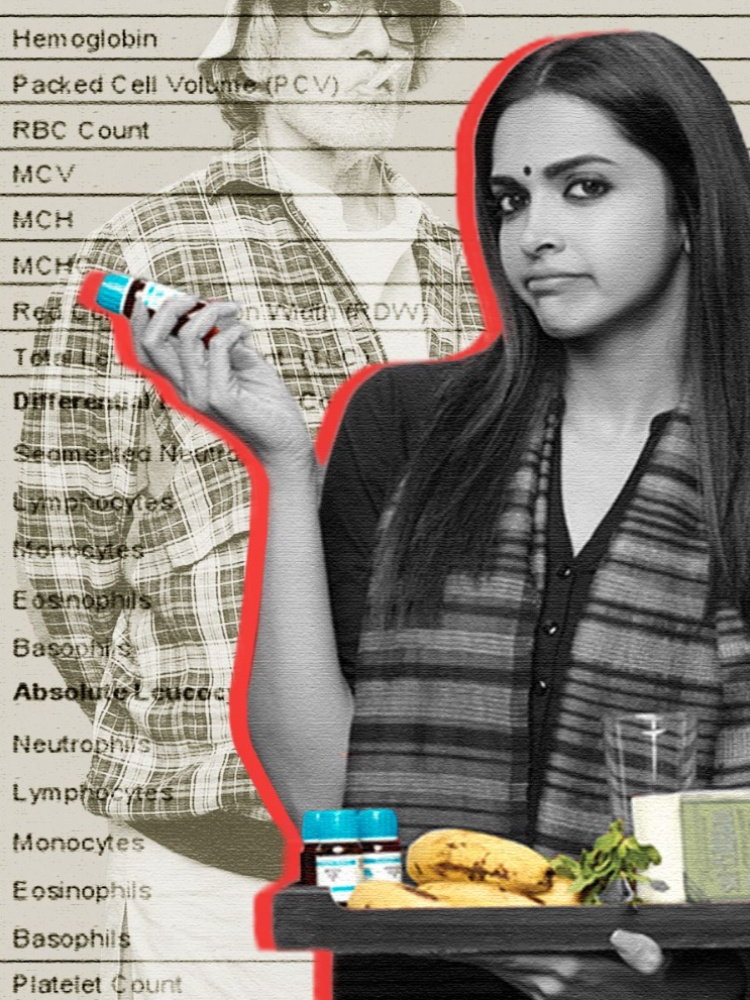

Every year, when my parents have their blood work done, the reports arrive in the family WhatsApp group in the same mildly ceremonial fashion: several PDFs, a thumbs-up from my father, my mother asking whether someone has looked at them, and, eventually, me sifting through every single one with an attention I rarely extend to my own results. I want to know whether the cholesterol has crept upwards, whether vitamin D is still being difficult or what was borderline has now decided to become a full-fledged problem. I’m not a doctor, just a daughter who needs to know everything about the health of people I love.
At some point in life, the eldest daughter—the one who has grown up being told to sit up straight and finish her vegetables—eventually discovers the pleasure of having autonomy and giving out instructions. She knows the difference between creatine and collagen, has strong opinions about her parents’ protein intake (or lack thereof), and keeps track of medical appointments and prescriptions. The result is a strange amount of mental real estate devoted to other people’s bodies. The traits that have long made her the butt of online jokes—hyper independent, unpaid third parent, anxious overthinker—translate into a hyper vigilance that makes its way into the business of looking after her parents. The 2015 film Piku portrays this dynamic perfectly: Deepika Padukone as Piku Banerjee spends much of her day managing and monitoring her elderly father’s (played by Amitabh Bachchan) health anxieties, particularly his bowel movements due to a case of severe constipation.
I asked a handful of Indian eldest daughters if they, like Piku, ever found themselves responsible for their parents’ health, and the answers ranged from the sensible to the frankly absurd.
The customary evening walk
You’ve seen them before: a group of uncles purportedly on a walk putting considerably more energy into a fervent political discussion instead of said physical activity. Varsha SB’s father considers his five-minute circuit around the neighbourhood perfectly adequate daily exercise, unfazed by her arguing otherwise. “He will say, ‘But I walked today,’ and I have to resist explaining the entire concept of cardiovascular fitness to him,” says the 27-year-old. “At this point I think he walks partly because he knows I’ll ask,” she adds during our chat over the phone from her home base in New York. What do the dads have to say?
The walk-in family medical desk
Things get wackier if you happen to be an eldest daughter pursuing medicine. “A relative once asked me if a gallstone could be removed through the mouth during an oesophageal endoscopy. I had to explain that the body doesn’t quite work like a series of interconnected pipes, and that removing it would require a surgical procedure,” shares 23-year-old Mallika Vohra, a dental intern in Manipal. Meanwhile Jana Kahma, a Chandigarh-based entrepreneur , also the eldest daughter, is still flabbergasted by that time her uncle asked her if “dehydration could make stomach acid sufficiently concentrated to dissolve a chewed hairball”.
WhatsApp forwards are partly to blame for the questionable health “hacks” that circulate among Indian households. The only thing stopping a shady supplement brand from selling its unverified stuff to a dad looking to lower his blood pressure is his first-born daughter.
Younger siblings, on the other hand, are very much the laid-back characters in this scenario. Daanyal Raza Khan, a producer and mix engineer in New Delhi, says his older sister tends to take on “the burden of emotional responsibility for the family more, in general”, and this includes health-related concerns. “She is there to pick up the pieces that might get left behind when one is doing poorly—or at least she would feel obligated to.”
This is an intervention
Sometimes the impulse is more about trying to get ahead of something before it becomes frightening. Artist and activist Mehr Kumar, 24, became much more vigilant about her mother’s bone health after an injury. “You become more aware that your mother is not as indestructible as she seemed when you were younger; it changes the way you look at her,” she explains.
For Shanivi, 23, a medical student in Gurugram, the transition happened when her parents separated and she became her mother’s only caretaker. She describes feeling “very parentified” but also glad to be depended upon. “There is a sense of filial piety being fulfilled when I can do for her what she did for me growing up,” she says.
And perhaps that is the takeaway. Somewhere between the child growing up and her parents growing older, the care begins to travel in both directions. So, here’s to the eldest daughters—we see you and appreciate you.