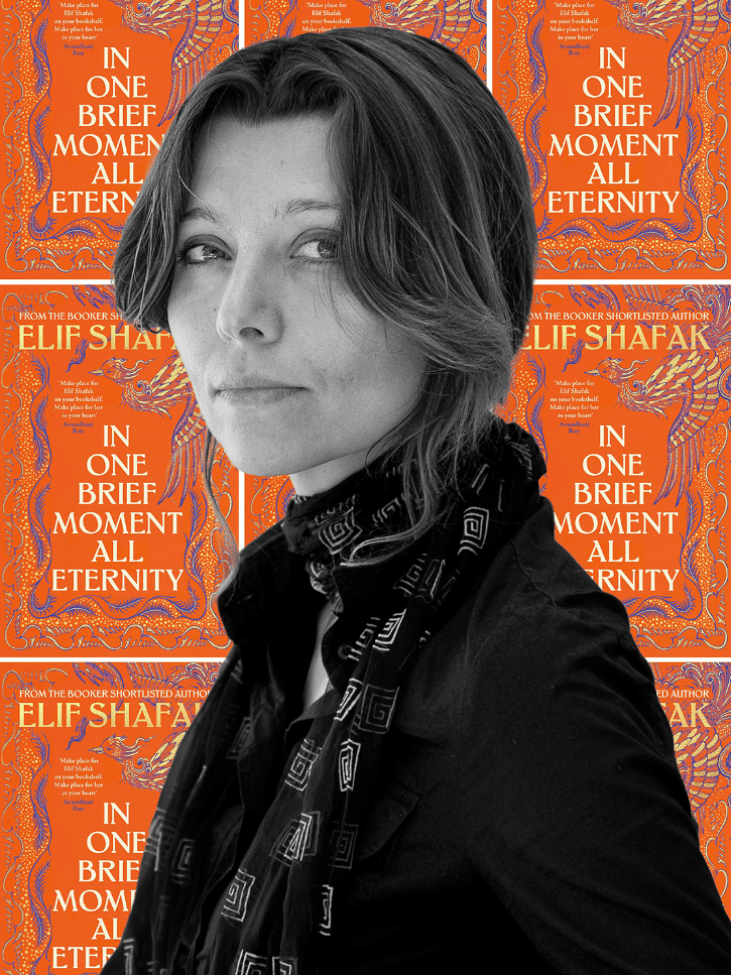

There’s a reason that novels narrated by multiple voices work, from Orhan Pamuk’s My Name is Red to Tommy Orange’s There, There and even the more recent The Disappearers by Marlon James. Those gaps between reality and self-awareness, what’s given and what’s received, what’s conveyed and what’s perceived, demand that you hold an object to the light and inspect it from every angle. Joining the canon is Elif Shafak’s new novel, In One Brief Moment All Eternity.
Shafak’s book is a tender portrait of the French writer Gustave Flaubert—from his childhood to the creation of Madame Bovary, his most famous work, and the aftermath of its publication. But in the process of one writer writing about another, it also becomes an examination of the craft of storytelling. From there, it soars and becomes her love letter to fiction itself. In the novel, there’s a clamour of voices telling Flaubert’s story—disdainful, pitying, resentful, affectionate, admiring—each wondering about their part in his life story and creative output. There’s a chapter narrated by his muse Emma, or Madame Bovary, one by his nanny, another by his sister, and, later, by syphilis too. It’s a novel about the man and the times.
Shafak is the author of over 20 books, 13 of them much-loved works of fiction, including Forty Rules of Love and The Bastard of Istanbul, the most recent being 2024’s There Are Rivers in the Sky. For the London-based, British-Turkish author, fiction has always meant drawing from Western and Eastern storytelling traditions, and that comes into play in In One Brief Moment All Eternity, too. The novel traverses regions, from France to Egypt to Constantinople and back, and despite what the 593-page length suggests, is a page-turner. And, as Shafak says—and we’d attest—you don’t need to be familiar with Flaubert or Madame Bovary to understand or appreciate this work.
Below, the author discusses turning a beloved writer into a fictional character, reading Don Quixote as a child, and her rather unusual writing playlist. Excerpts from the interview:
In One Brief Moment All Eternity is different from your previous books, both structurally and thematically. You have chapters narrating Flaubert’s story in a third-person voice, and then you have his fictional characters and the women in his life offering their stories. How and why did you choose Gustave Flaubert as the subject of your book, and how did you arrive at the structure?
A few years ago, I was feeling quite overwhelmed by everything that’s happening in the world. War, violence, divisions, lots of uncertainties… It feels like everything is unravelling and the world is breaking apart. I found myself asking this question: what’s the point of writing a poem in the midst of such destruction and chaos? What is the meaning of looking for the perfect synonym for a story or a novel when so much is happening outside the door. So, I wanted to go back to the core of literature. I wanted to renew my faith in literature. And that question about creativity in a time of crisis took me straight to the 19th century. I think in many ways the 19th century is not over yet. We’re still living with the consequences of it.
The 19th century was a time of revolution, counter-revolution, empires coming to an end, brother killing brother. In the midst of all that chaos, there lived a beloved novelist who dedicated his entire life to literature. And that was the French author Gustave Flaubert. He really changed how we write novels. Of course, as we all know, he’s the author of this iconic book Madame Bovary and he was regarded as the connoisseur of the female mind. But I wanted to take that premise and turn it upside down and let women tell his story. So, I wanted to take an author and turn him into a fictional character.
But let me add this: a reader doesn’t need to know much about Flaubert or Madame Bovary. For me, personally, this book is primarily about a little boy who was very lonely, who was very misunderstood and unloved, who was regarded as a failure, as a loser, by even his near and dearest—he was called a family idiot—and he found friendship and companionship in books. I was also a very lonely child. So, I wanted to dedicate this book to anyone who, for any reason, might have felt like the other.
The book is your love letter to fiction...
I think this is the age of three As—anger, anxiety, and AI. That in itself is challenging enough. But if this were to become the age of four As—the age of anger, anxiety, AI, and apathy—I think it would be a much more difficult world to move in. The moment we become numb and indifferent, the moment we stop caring about each other as fellow human beings.
So, for me, literature is the antidote to apathy. And it really doesn’t belong to any single ethnicity, religion, religion, class or creed. It belongs to all humanity. This was the case for centuries, for millennia. Ever since as human beings we sat around a fire and started exchanging tales to give meaning to life, we have been storytelling beings.
It takes the reader a few pages to realise you’re talking about Flaubert. Right after that, we get Emma’s perspective. She’s almost like, “You think he captured the inner workings of a woman’s mind! Let me correct you.” Woman written by men—is that something you actively think about?
I am very interested in not only stories but also silences—those who have been silenced, people who have been written out of history, people who are being moved to the margins, the periphery, people whose stories have been erased, forgotten, buried. So, if you happen to be a storyteller from a complicated country, like Turkey, I don’t think you can be only a storyteller. You have to be a silence teller as well. So, I’ve always been interested in the stories of women. I’ve always been very interested in the stories of minorities. But in general, I’m interested in the stories of anyone who has been treated as the other; my heart organically, spontaneously goes in that direction.
Coming back to Flaubert, on the one hand it’s quite admirable that he genuinely connected with Emma. You don’t have to be a woman to be able to write about women. That’s the beauty of literature; it is beyond identity boxes. The author Iris Murdoch used to call this “unselfing”. When we are writing, we can “un-self”. We all have an ego, but through these imaginary emotional, spiritual, intellectual journeys I think we can at least try to transcend the borders of the self. And I think Flaubert did this. On the one hand, he loved her. Emma is not an easy character, by the way. She’s really complicated. Obviously, she’s not a saint, but she’s not wicked either. She’s a culmination of good and bad. She’s selfish, very spoiled, like many of us are. So, on one hand I like that he empathises with her. On the other hand, he gives her arsenic, he makes her suffer—it takes her 13 pages to die! So, I think Emma has every right to speak back and ask him some questions.
There’s also this sense of ownership that a lot of the characters in the novel exert over Flaubert and his works. There’s Julie, his nurse, there’s his mistress, his sister…
I think there are so many invisible influences in our lives, maybe we don’t recognise their role, but they’ve been so important. When I think about my upbringing, surely my grandmother played an important role. And my grandma was not a well-educated woman, only because she had been pulled out of school for being a girl at the time. And this woman wholeheartedly believed in women’s education. She supported her own daughter’s independence, and that changed our lives. My grandma was very much connected to the oral storytelling of the Middle East, the Balkans, the Levant. Her house was full of superstitions, folktales, things that some people might regard as unintellectual or non-rational, but I think that world was full of very interesting stories and wisdom. So, I’ve never looked down upon oral culture and I think there are pockets of memory and oral culture that are so interesting to me.
So, in the case of Julie, we never think about this “servant” who raised Flaubert and who gave him so much love. And she was a storyteller, and I wanted to honour her and I wanted to say maybe if it hadn’t been for this nurse his imagination wouldn’t have really opened up like this. She seemed like the earliest person who could have turned his mind in that direction.
Was there any part in the book that you found particularly challenging to tackle?
There are many challenges when you’re writing a novel. This is my 14th novel, but it really makes no difference whether it’s your first book, third book, fifth novel. I think you always go through valleys of self-doubt, anxiety. As a writer, you’re very much alone, you know? It’s the loneliest form of art, the life of a novelist. You’re in a small room, on your own, for months, for a long time. And these imaginary characters become your friends. There are ups and downs of the creative process, and then you become very attached to the characters, and then you cannot let go.
There are additional challenges when you’re writing a book like this, because the life of Flaubert is very well documented. There are biographies. But as a writer, even though I need to know the subject and I need to do a lot of research, not only about him but also the political history of the time, I also need freedom of imagination. So, this is how I interpret it. And I wanted to bring together the European novel side by side with the literary and cultural heritage of the Levant, the Middle East, and the East in general.
We tend to use the words East and West as if they were mutually exclusive categories, as if they never touched each other. But it’s far from truth. In fact, people travelled, ideas, travelled, stories travelled. For instance, German writer Goethe was very much influenced by the Persian poet Hafez. So, there is a Persian poet here also whom I wanted to put in this story.
The title of the novel itself is a line by the Iranian poet Attar of Nishapur…
Yes, there is a connection, which is revealed at the end of the book, but I guess what I wanted to be able to say is many European writers had been actually influenced by Eastern philosophy, Eastern poetry. So that’s why it was important for me to show them the connection between different literary heritages. I didn’t want to treat East and West as if they were separate boxes. Flaubert had travelled extensively across the Middle East from Egypt from Cairo to Constantinople. Many of these places were Ottoman lands. And I think that changed him; by the end of that trip he was a different person. In fact, I will claim in this book that at the heart of Madame Bovary, this French literary heroine, there is an Egyptian belly dancer who has been forgotten completely by history. She’s a real person, and she was just erased. And I wanted to bring back her story into the narrative.
What are the books that made you want to be a writer?
I’ve been writing since I was a child, since I was eight years old, but that’s not because I was planning to become a writer or a novelist. I honestly didn’t even know such a thing was possible.
I was a very lonely child. I was an only child raised by a single mom, a working mom, and partly by my grandmother. I was born in France. My parents got separated and I came to Turkey with my mother. So, there were also ruptures, migrations, movements. Perhaps that increased my sense of loneliness. So, books became my friends. In my grandmother’s house there weren’t too many books, but I would read the same books over and over, imagining different endings for them. And then around the time I was 10 or 11 years old, I went to Spain with my mother. Spanish became my second language, and English became my third language. And the reason I mention this is that suddenly I was able to read a new literature in Spanish and then another new literature in English. That was a really important turning point for me. And then there was the day I discovered Don Quixote. When I read Don Quixote as a child, somehow I was there with him, this crazy knight travelling across the Iberian peninsula, La Mancha, with Sancho, doing silly things, just crossing the border between reality and imagination. I love this character, but I also loved what the long form could do. I didn’t know novels could be written like that. So, it taught me the importance of craftsmanship, not only the story.
What kind of a writer are you? Do you work in the mornings? Do you have writing rituals? Do you prefer complete quiet?...
I don’t have a precise schedule, and I think very few writers have a very punctual, exact schedule; usually male authors of a certain age are the ones who have very precise schedules. Everyone else…we struggle, we carve out spaces for ourselves. Some writers have young kids to take care of. Some other writers have elderly parents to take care of. In life, we have multiple roles. I stayed in academia for a long time, because I was not able to earn a living by just writing. I liked academia, I liked learning, but also it helped pay the bills. So, all of that taught me the importance of being flexible. If I cannot write in the morning, then I will write in the afternoon. If I cannot write in the evening, I will write through the night. What is constant in my life is every day I write. Every day I read, every day I take notes. It doesn’t mean that what you write every day will go into a book, but it’s good practice. We have to keep practising. I don’t like silence. I feel very uncomfortable when there’s too much silence, when everything is neat and tiny and very well organised.
I like being surrounded by books, notebooks. I usually put on my headphones. I listen to music. I love heavy metal.
Heavy metal!
Yeah, I’ve been a metalhead since my youth, and I know it sounds a bit weird perhaps, that a middle-aged Turkish woman is a metalhead, but I’ve always liked heavy metal, particularly subgenres of heavy metal I have moved into as I got older. So, usually, I like melodic death metal, industrial metal, progressive, metal core—really high-energy, raw energy… However, I don’t move from one song to the next. When I choose a song, I put on my headphones and I listen to the same song maybe 70 times or 80 times. It becomes a loop, like a circle of energy. That’s how I zoom in and zoom out and sit in place. It’s always with heavy metal music, but one song.
There’s a Mongolian band called Hu. They’re very interesting. They use old Mongolian throat-singing techniques. And they use some traditional instruments. They combine it with heavy metal instruments and riffs. But I usually listen to Scandinavian bands; there are many Swedish, Norwegian, and Finnish bands that I like a lot.
Does AI disturb you—what it’s doing to the world and what it may do to literature?
I think we need to talk about AI, we need to talk about technological uncertainties, and we need to be involved in this debate. Technology is way too important to be left to just a few tech firms. There are or some very promising aspects of AI, especially when it comes to health. But there’s also a darker side that we don’t talk about enough—how these technological advances are happening so fast. We need rules. We need regulations. We need transparency. And we, as citizens of the world, need to be part of this.
I’m also worried about books just being scanned by large language models without any care for copyright. Also, the knowledge that is thus accumulated is very much tilted towards Western archives. So, the stories of many minorities, many indigenous tribes, also people outside the Western world, are getting lost in this new accumulation of information.
In One Brief Moment All Eternity is published by Penguin; ₹789