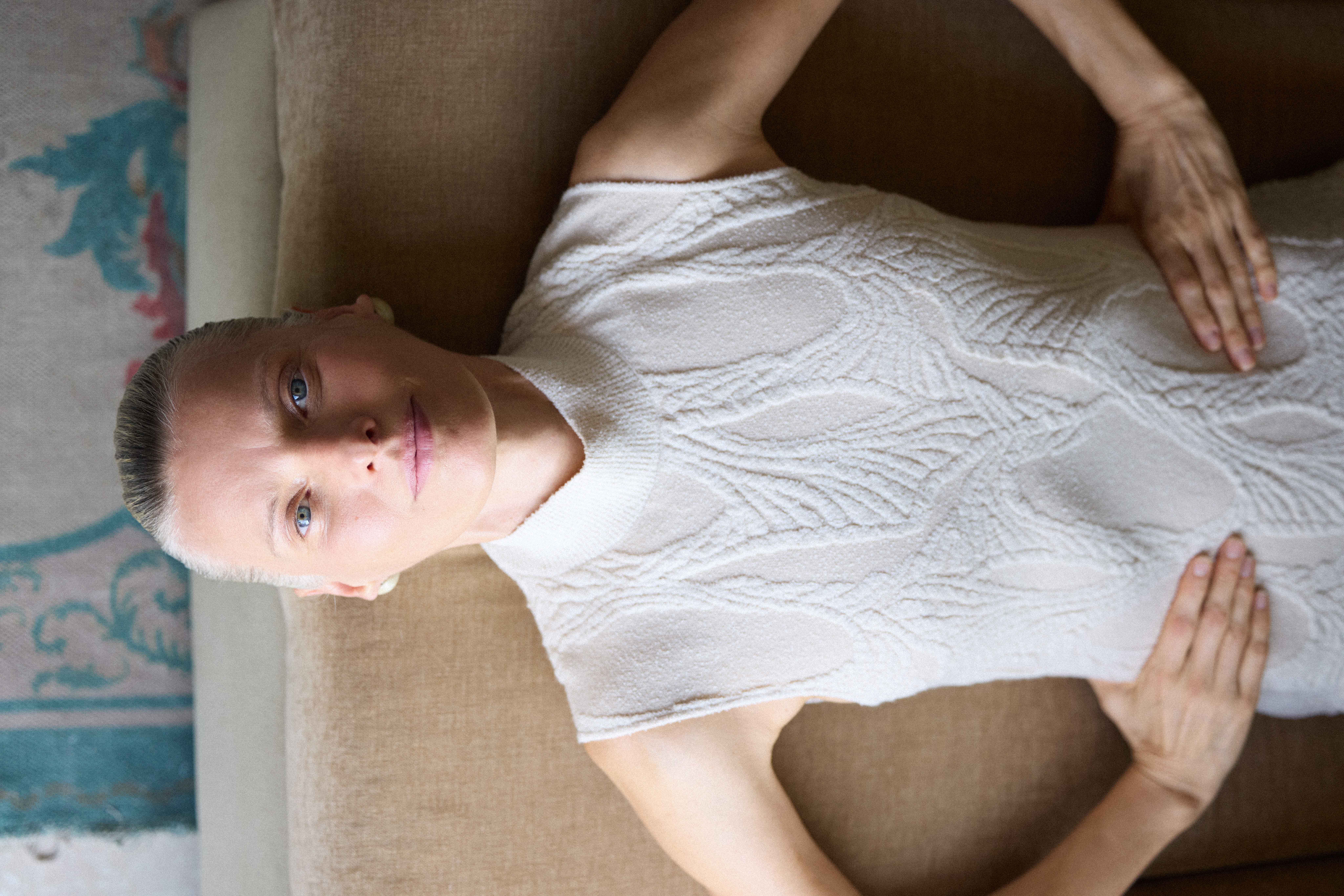
It all started about a year ago when Stobe received an email from a casting director looking for models over the age of 50. “When I received the first one, I didn’t think much about it. But then, there were four emails in a row asking for models over 50. I was like, are these bots or is this a sign?” she says, laughing. Luburic suggested sending her polaroids. Soon, she was optioned for a Prada exclusive, along with options for Miu Miu and Valentino. Between running the agency in India and visiting and caring for family in Europe, the timings ultimately didn’t work out for Stobe’s schedule, but the moment stayed with her. “I never had those options when I was modelling in my twenties,” she says.
Inclusion of older models is not a new phenomenon, of course. Simone Rocha’s autumn/winter 2017 show cast septuagenarians. London-based designer and king of the sequinned slogan tee Ashish has worked with Michele Ronson, now 70, since 2021. At Saint Laurent, Bethany Nagy, 55, has appeared on Anthony Vaccarello’s runways and campaigns for the house since 2021. Earlier this year, Jacquemus announced his grandmother Liline Jacquemus, 80, as his first brand ambassador.
Initially, these felt like isolated moments. But according to trend search engine Tagwalk, all the top 20 fashion brands included at least one older model in the latest autumn/winter 2026 season. Everyone from Balenciaga, Bottega Veneta, Miu Miu, and Prada to Chanel, Fendi, Givenchy, and Tom Ford has embraced cross-generational casting in recent shows. Runways that once prized blank-faced youth now feature silver hair, laugh lines, and age spots on women who don’t look like they’re trying to look younger than they are. Stephanie Cavalli, 50, opened Matthieu Blazy’s autumn/winter 2026 Chanel show this March. The show also included Laura Ponte and Christina Chung, both in their fifties (all three also walked the most recent Cruise show in Biarritz). Older models “bring a completely different dimension to the clothes”, Blazy told The New York Times. “They have life; they’ve seen the world.”
Closer to home, at recent editions of Lakmé Fashion Week, we’ve seen models like Sheetal Mallar, Carol Gracias, Bhawna Sharma, and Nayanika Chatterjee return to the runway in their forties and fifties.
Still, Stobe remains cautious about framing this shift as something permanent. “It’s interesting because fashion, in general, has always been a land of fantasy,” she says. “Fashion, I feel, goes through different moments. Okay, what’s in today? I’m going to champion this side of diversity. And then it kind of phases out again.” She points to size inclusivity and the once heavily discussed body positivity movement that now appears to have lost its momentum and receded from the runways.
“It could be that fashion always needs PR. It needs the press to talk about something,” she adds. “But I also feel like there’s the question: can a 20-year-old afford a high-fashion outfit? Where is the buying power? Who are the women who are going to be their customers? There is that too, rather than just somebody coming with an idea and saying, okay, let’s just put in some older models to make a little bit of a hype for the press.” At the same time, Stobe also believes there is a wider cultural exhaustion with manufactured, hyper-perfected imagery. “We’re living in this environment of Instagram, of AI, where everything is airbrushed and everyone looks the same. You can feel a real hunger for reality, for authenticity, building up.” These shifts have also broadened how Anima scouts models. While the agency represents models in their mid-thirties who’ve been with them for over a decade, Stobe says they are always looking for faces with character. “We are always looking for interesting, fascinating faces. We just scouted a girl in her forties at a concert last year.”