



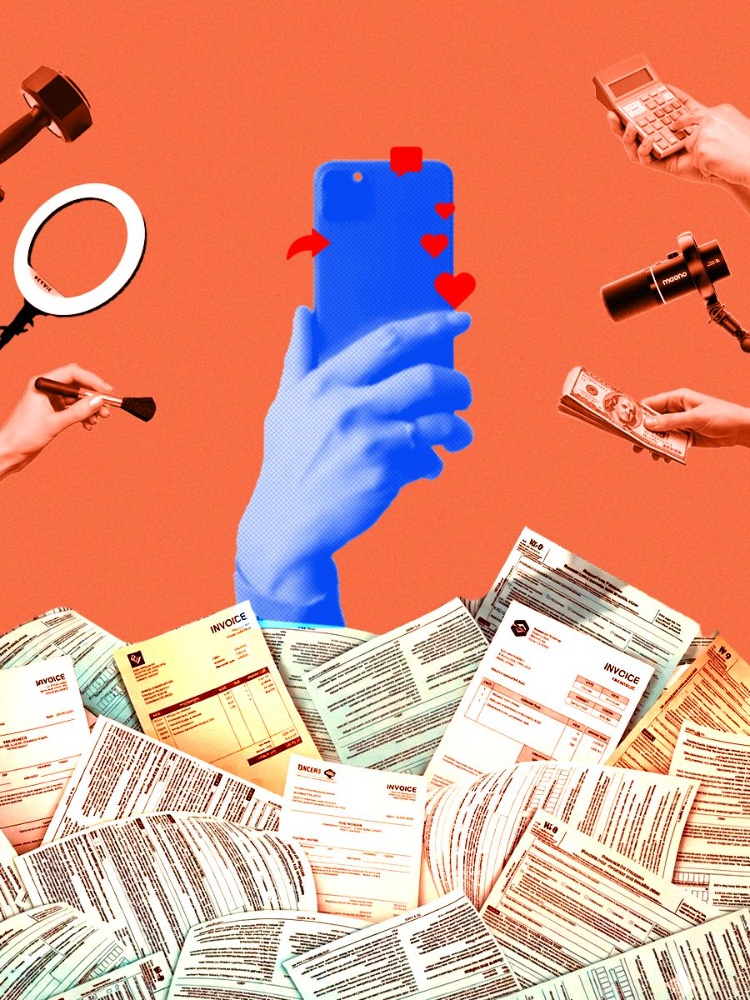

“Since I started content creation in 2023, I’ve gotten around ₹8,00,000 in deals, but of that ₹3,50,000 is still pending payment,” says Neha Tanti, 22, a lifestyle content creator in Gurgaon with 101K followers. “In the three years of doing this, only one brand has paid me on time. I’ve even chased an invoice for one and a half years.”
In April, Tanti took her story to Instagram in a Reel that has almost 600K views. In it, she says people are being given “false hope” about how lucrative content creation really is. “Every day, at 11 am, I message every brand I’ve worked with for money I have earned. It’s been months—there’s no payment,” she says. Like Tanti, several Indian content creators say brands and agencies exploit them with complicated contracts, unprofessional conduct, delayed payments, and barter deals that include no monetary payment at all.
From the outside, India’s influencer economy looks like a gold rush—it’s growing 18 per cent year on year and is expected to impact $1 trillion in spending by 2030. However, among the millions of creators looking to get rich, only a handful at the top are actually cashing in. Everyone else is barely getting by.
“I see YouTube videos of how influencer marketing is booming and becoming the highest-paid niche in India… Who they’re referring to is probably ten Bollywood faces,” says Aarja Bedi, 28, a Delhi-based fitness creator with 38.6K followers. Her instincts are on the money: according to a 2025 report, only 8 to 10 per cent of Indian influencers are able to monetise content, with macro and mega influencers (500K to 1M+ followers) earning the most. Masoom Minawala Mehta with 1.3M followers, for example, “resides in the upper echelons of Indian content creators” and could charge as much as ₹3,00,000 to ₹5,00,000 per post.
Regardless, there are more aspirants in the creator economy than ever before—a 2024 report shows that a staggering 83 per cent of Indian Gen Zs now consider themselves to be “creators”, and 75 per cent consider content creation a viable career path. As the industry grows overall, the space for each influencer is shrinking.
Until about two years ago, Bedi, for example, was getting offers for sponsored content every few days. Now, brands reach out only a couple of times a month. “I didn’t start in the era of the fancy content creator. Now everyone has mics, lights, edited transitions, voice-overs… Of course brands want to reach out to people doing more fancy output,” she says.
Even the slightly more seasoned influencers admit their work is resource-intensive with hidden costs that eat into already unpredictable earnings. Take Sakshi Rawte-Dhar, 28, a Goa-based beauty and lifestyle creator with 54.6K followers: to make daily posting more sustainable (to not only maintain the high volume of content needed to stay visible but also cater to a fickle, ever-changing algorithm), she’s spent ₹6,000 on subtitling software and is considering hiring an editor, who would likely charge ₹20,000 per month. But the cash flow needed to make such investments is haphazard. “If a brand confirms something in July, the deal is executed in August, and you get paid in October,” Rawte-Dhar explains, adding that she’s currently owed ₹2,20,000 from deals completed three to nine months ago.
Bedi too has had to hound companies to pay her for work she’s already delivered. An Indian protein brand, she says, still owes her ₹40,000 for Instagram content posted a year ago. “The agency said, ‘There’s no money, we’ll get back to you.’ Then no response for a month. I just gave up,” she says. Rawte-Dhar was also forced to write off ₹20,000 owed to her by a popular Indian beauty brand because she couldn’t bear the stress of the six-month-long fight for it. Tanti says payments reflect in her account only after she threatens to publicly name and shame brands and their agencies on social media. “We have to be mafias to get payments,” she jokes.
Money is scant and slow for anyone looking to make it as an influencer. Of the few creators able to monetise content, many earn less than ₹18,000 per month—hardly enough to sustain a life in the city and much lower than the earnings of their global counterparts.
Nainika, 32, a Mumbai-based beauty content creator with 25.2K followers, recalls feeling lost in 2020 as a newbie in India’s influencer economy that has no vocational requirements, employment or payment norms, standard contracts, or specific labour protections. “Smaller creators command a high level of trust with their audience, so they have a bigger ROI, but they’re not as experienced, so brands are totally exploiting them,” she says.
The numbers back this up: micro (10,000 to 100,000 followers) and nano influencers (1,000 to 10,000 followers) have higher conversion rates and retain more viewership compared to mega creators and celebrities, yet brands allocate juicer budgets to creators with larger followings and give smaller creators nothing-burger barter deals. “‘Barter’ is a misnomer that obfuscates the power imbalance. Brands are essentially asking for free labour. I can’t use products to pay my bills,” says Nainika, noting that people don’t like to talk of influencing as “labour” because it removes the glamorous, aspirational aspect of the gig that lures them to it in the first place.
For smaller and newer creators, barter deals also present a chicken-and-egg problem—brands don’t usually pay cash for low follower counts, so creators take up other jobs to survive, leaving them too drained to grow the following that would land them cash deals.
To pad her income, Bedi too has begun contributing to her family business. Rawte-Dhar has started a part-time consultancy job as well. “The past three months have been tough. I’ve only had ₹3,000 in my account,” Rawte-Dhar says. “It’s been super tough mentally and even in my marriage because you have to be an equal. When you stop contributing, you lose a bit of respect for yourself. You can’t pay bills with lipstick or perfume.”
There’s a Sisyphean vibe to India’s creator economy, and now that there are more creators than brands know what to do with, creators themselves circle the waters like sharks. In this saturated market, Tanti says, cut-throat competition forces creators to not only accept unfair, lowball offers but also stay silent when brands and agencies act unprofessionally. “We’re not a community that stands up for each other. A lot of us say, ‘If someone else won’t do it, I’ll do it and for less. Everyone wants to sell themselves, and brands will keep profiting off you,” she says.
India’s content creators are ready for industry-wide changes—they’re calling for a guild or trade union that will help enforce labour protections, establish standard contracts and practices, mediate professional disputes, and create more organisation where there currently is almost none. Until then, Nainika says, “You have to be your own biggest advocate. If you don’t stand up for yourself and set boundaries, you will get exploited in this industry.”