




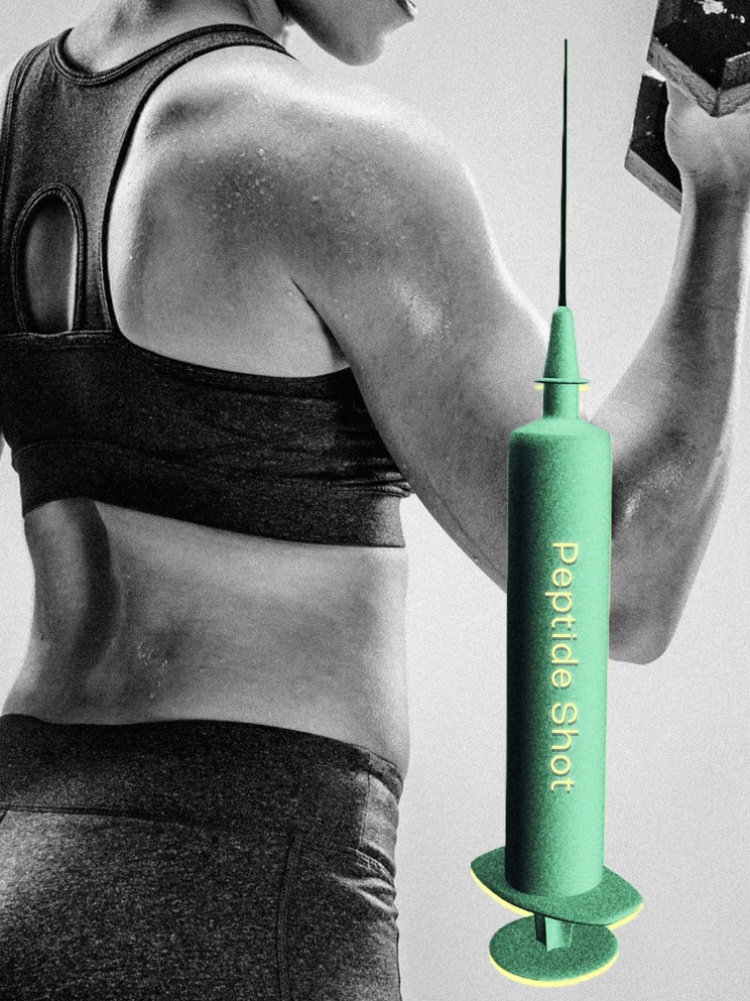

“So more peptide shots, fewer tequila shots?” This question, directed at DJ Diplo at a recent WSJ event, perfectly summarised the crux of a familiar discussion: young people are increasingly gravitating towards healthy experiences rather than drunken night-outs. Don’t fret, this isn’t yet another think-piece on run clubs, Hyrox or cold plunges. Expand your wellness lexicon to include its latest entrant—injectable peptides.
Simply put, peptides are short chains of amino acids—the building blocks of protein—that regulate the body’s healing, immune function, muscle growth, and markers such as blood pressure, insulin, and more. You’ve heard of peptides before and probably didn’t even know it: remember Ozempic? Better known by its brand name, Ozempic essentially contains a glucagon-like peptide-1 (GLP-1) receptor agonist called semaglutide, which does all the work when it comes to diabetes and weight management. Another class of recovery and regenerative peptides, however, is gaining traction among a community of health and fitness enthusiasts who are taking to Reddit, X, and YouTube to rave about its vast potential in muscle-building, accelerating injury recovery, enhancing range of motion, improving energy levels, and so on.
Meet BPC-157, TB-500 and CJC-1295, to name a few, which sound like pseudonyms straight out of a sci-fi script but are actually loosely regulated injectable peptides that are becoming part of a broader self-optimisation movement. To paint a picture, Europe and North America currently account for 70 per cent of the global peptide synthesis market, which is predicted to hit $4.2 billion this year, as per reports.
“I’m receiving a lot of enquiries about peptides from my patients, particularly BPC-157 and TB-500, which are booming in sports injury. Many are taking both; it’s known as the Wolverine stack,” says Dr Surbhi S Choudhary, a Delhi-based sports medicine specialist. This specific combination, touted as the ultimate solution for speedy joint and muscle recovery, has found proponents in the likes of Josh Duhamel and Jeremy Renner.
In India, this cohort of peptides remains in a grey area, Dr Choudhary says. “They aren’t banned, but they’re not approved per se. As a doctor, there’s a lot of burden on your shoulders when you are prescribing something with insufficient evidence, but the patients insist on giving it a try.”
With no formal approvals surrounding their use from regulatory bodies like the Drugs Controller General of India (DCGI), they are considered off-label treatments. Since one can’t pick these up on a whim from the pharmacy next door, Reddit has emerged as a hotbed for sourcing enquiries and dose discussions, but many are tight-lipped about their trusted hooks due to a fear of losing sacred stock.
Based in Gurugram, 26-year-old Siddharth S first heard of peptides from Derek of More Plates More Dates on YouTube and gave BPC-157 a try due to a nagging neck injury, but it changed nothing. “Probably because I bought it from an Instagram influencer and the stuff was bunk,” he reasons. He later moved to tirzepatide with doctor consultation to look leaner than he’s ever been and improve markers like blood pressure, sugar, and cholesterol. “Right now, I’m on CJC-1295 and retatrutide. I lost 10 kgs in two months, maintained strength, and achieved 10 per cent body fat while keeping up with a proper diet and exercise. Even after pausing use for some time, the results remained for a while,” Siddharth says, adding that he’s currently stocking up on these injectables every three months. Contrary to the appeal of Ozempic, which causes rapid weight loss, Siddharth’s approach with regenerative peptides is one shared by many—aim for boosting muscle mass while staying lean. He claims no major side effects other than empty pockets from not knowing legitimate sources and going around in circles.
These injectables aren’t just captivating bodybuilders, lookmaxxers or biohackers. HK* is a 31-year-old woman in Mumbai who juggles two jobs and was looking for something to boost her energy—her segue into the world of peptides. “I genuinely look at peptides as an investment category rather than a personal consumption category,” she says. “I think AI is going to lead to a rise in people wanting more control and autonomy over their bodies, because there is a rising dissatisfaction or dissonance with medical science after Covid-19. Now there are two levels of health ‘optimisation’: you go to a doctor for the most conservative treatment plan that is vetted and validated by legal bodies, but you use AI to navigate slightly more non-conservative or unusual plans, ie peptides. You have personal liability on whether it works or not.”
This perspective reflects an increasing appetite for experimental wellness interventions, where expert clinical opinion isn’t taken at face value and trial-and-error is embraced despite insufficient evidence, potential long-term side effects, and the risks associated with investing in murky sources.
NYC-based Nikhil Krishnan, who has spent a decade writing about healthcare and runs a non-jargon newsletter called Out-Of-Pocket to make the subject accessible and entertaining, said in a recent post dissecting the peptide boom: “In 2020 people were hoarding toilet paper, in 2026 they’re hoarding bacteriostatic water (needed to safely mix with peptide powder).” Like HK*, he also makes note of the scepticism around medical bodies, like the FDA in USA, with “people wanting more agency in their healthcare decision-making and to be able to assess risk themselves vs relying on the government to do it”.
Rahul Modi, 28, a hotel operator in New Mexico, USA, did exactly that when three and a half years ago he tore his meniscus (cartilage in the knee that helps with stability)—his first real injury, where doctors said the surgery route would most likely leave him with arthritis-like symptoms. “I started doing my own research on healing it to get back to lifting because fitness is a big part of my life. That’s when I stumbled upon peptide studies and started reading Reddit anecdotes even though there was limited data.”
After trying a two-month cycle of BPC-157 and then the Wolverine stack, Modi saw major improvement in his leg and knee strength, squatting heavily just four months after the injury. Today, he’s a peptide and fitness coach, helping clients navigate the rabbit hole of various compounds and their sources to find a fit that suits their body and purpose. His acute advocacy for the untapped potential of peptides trickled into his family: “I even put my parents on them to help relieve them of joint pain, decreased energy levels, and move easier. My dad is enjoying retatrutide, having lost 15 pounds in six weeks,” he shares.
We’ve heard from the ardent users, but what do the professionals feel about peptide shots?
“There are certain peptides that hold promise for very narrow uses in clinical settings. However, almost none of the claims made online for reversing ageing, greatly extending lifespan, growing muscle rapidly and/or repairing injuries overnight are backed up by high-quality, long-term data,” explains Dr Farhan Abdullah, an internal medicine physicist and Medical Director of Magnolia Functional Wellness in Southlake, Texas.
One dose doesn’t fit all, especially if it comes from a random vendor with little evidence that each batch is tested for contaminants. Dr Abdullah has had patients coming in with side effects like extreme nausea, debilitating headaches, fluid retention, hypertension, anxiety, rapid heart rate, abnormal glucose levels, and depression. “Lab tests revealed that the patient was not receiving exactly what they believed they ordered, with many of these peptides labelled as being available for ‘research’ use only, which allows vendors to avoid regulation,” he shares.
Meanwhile, Umar Razzaq, UK-based pharmacist and co-founder of pharmacyonline.co.uk, noticed a pattern where it’s the GLP-1 users who are already comfortable with needles that are now branching out into other peptides they’ve seen on social media. “GLP-1s have made injecting at home feel normal. Five years ago, people would have recoiled at the idea. Now it’s just part of someone’s morning.” With unregulated peptides rampant online, he heeds caution: “You’ve got no real idea what’s actually in the vial; purity, dose, sterility and contamination is not guaranteed. The black market here is bigger than people think and we’ve had patients come to us with infections and injection-site reactions.”
Despite the risks, a growing fanbase across demographics and occupations is firmly invested in the spectrum of self-optimisation opportunities proposed by peptide therapy and backed by their own research, experimentation, and experience. Pharma companies and regulatory bodies may find that playing devil’s advocate is futile, because peptide users aren’t afraid of the odds when it’s ultimate health and vitality they are betting on.
*Name changed upon request