



Entertainment04 Dec 20259 MIN

With ‘Lokah’, Kalyani Priyadarshan’s life has changed irrevocably. Just don’t tell her that

India’s first female superhero and the face of the highest-grossing film in Malayalam movie history may have achieved overnight stardom, but she’s hell-bent on clinging to some normalcy

Image

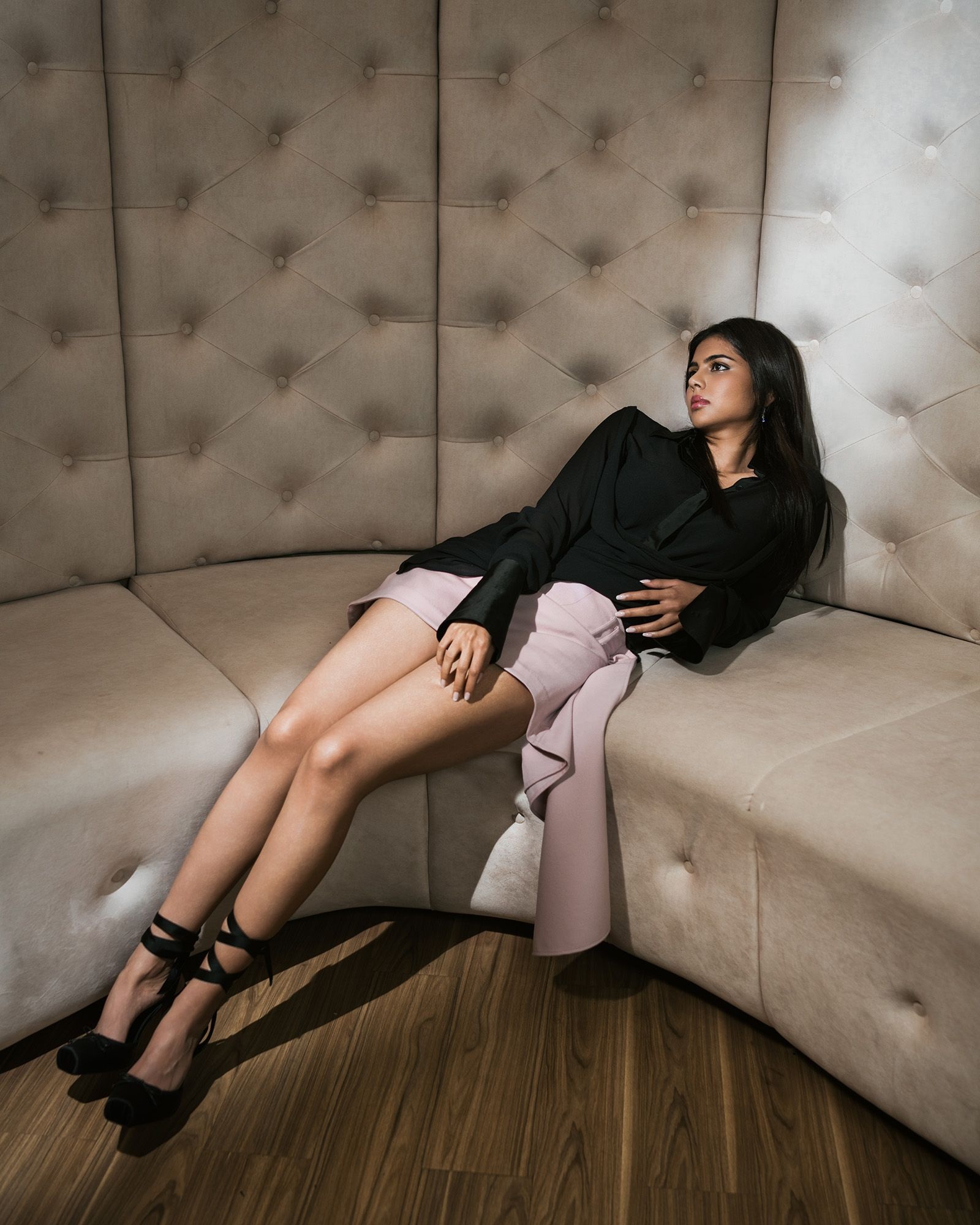
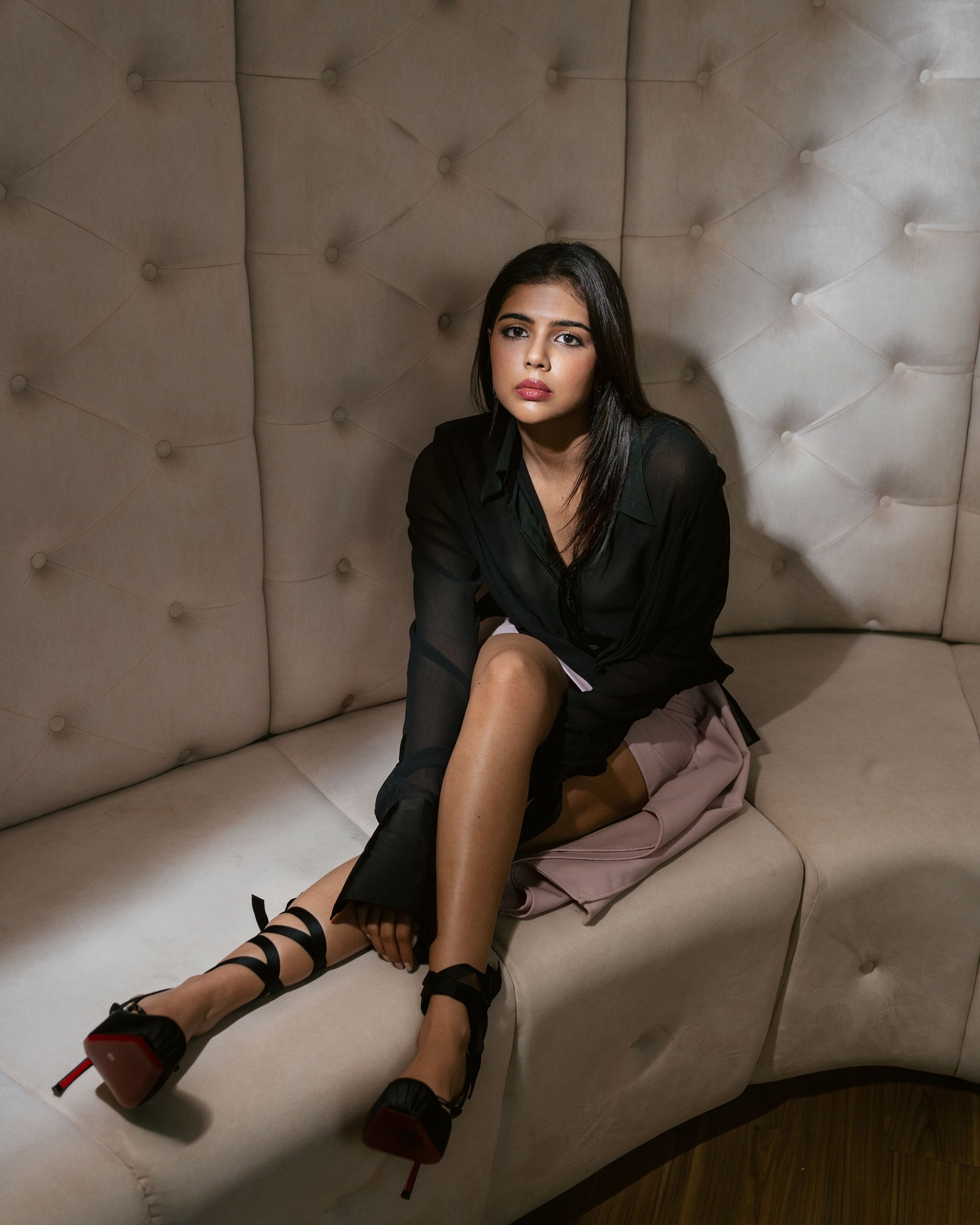
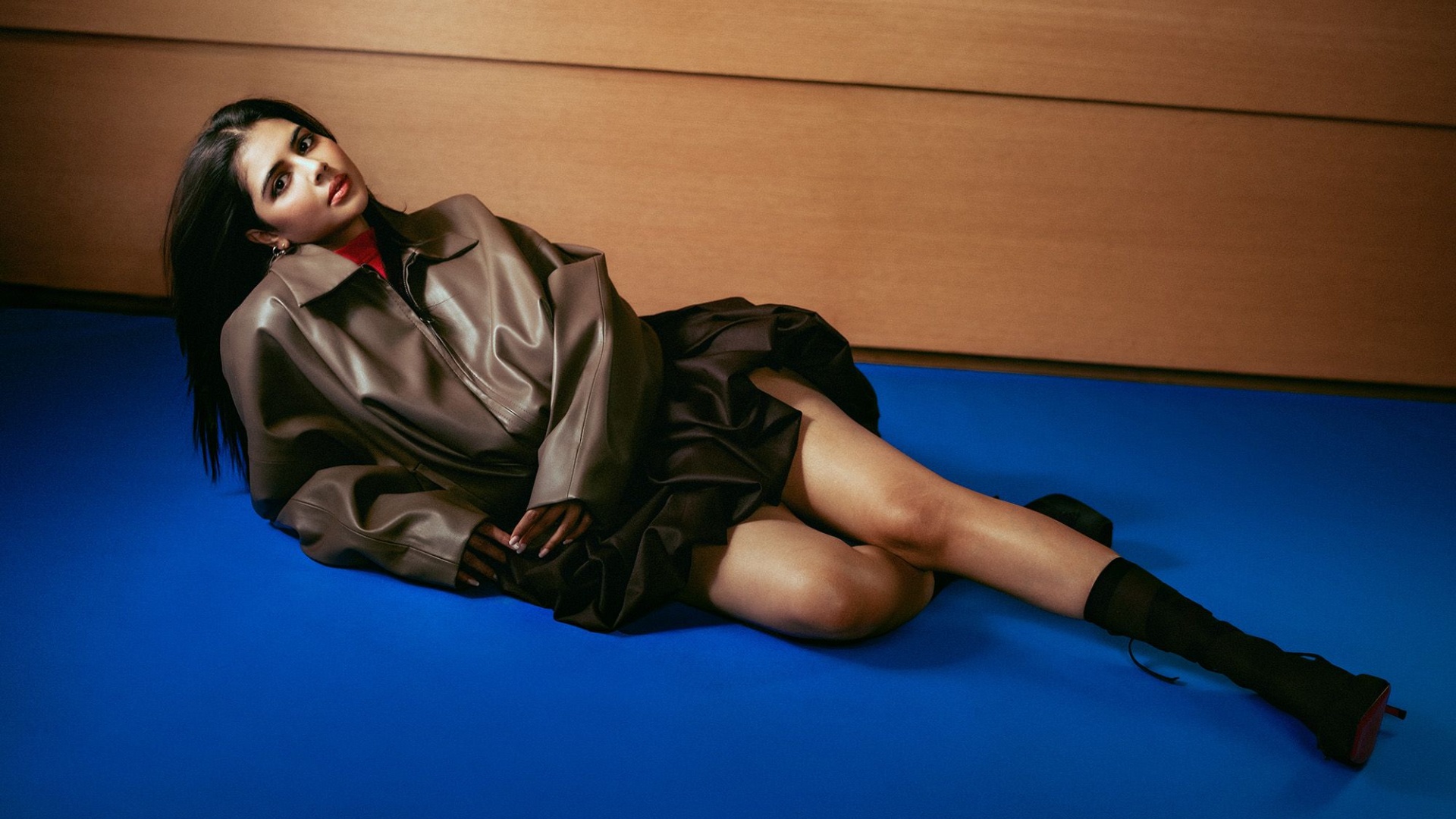
Shirt, Margene London. Jacket, URA. Skirt, Shwetambari. Heels, Christian Louboutin.

Photographs by Rema Chaudhary. Styling by Rupangi Grover

One week into the shoot of Lokah: Chapter 1, a frazzled Kalyani Priyadarshan made a call to Dulquer Salmaan, the film’s producer: “I told him that I might end up being the worst thing about the film. I was sure that I didn’t have what it takes, that I was taking too long to grasp the character. Chandra was meant to be so impassive that my director would not even let me frown. That is tough for me, as I am usually the most animated person in any room!”

The irony is hard to miss—unlike the self-possessed, hoodie-clad, septum-ring-sporting Chandra, who knew her superhuman powers all too well, Kalyani wrestled hard with imposter syndrome before she could fully trust her aptitude. What she feared most was that her character’s robotic, blank gaze would be misconstrued as a lackluster outing for a lead. “As Indians, we are used to seeing stone-cold men on screen. We rarely come across that in women,” she says. “I was afraid that people might not understand Chandra. Then again, the biggest lesson I have learnt from this film is not to make assumptions about the audience.” 

It’s true. Nothing could have prepared her for the phenomenal firsts lying in wait: India’s first female superhero and the first female Malayalam actor to helm a film that entered the ‘₹200-plus-crore club’. In fact, in an interview to a news platform, director Dominic Arun too admitted that while the team believed they had made a decent film, none of them had expected the rapturous response.

But since August 28, when it hit theatres, Lokah and its lead have been poised for a seismic breakthrough.

There is more than one reason why Lokah left no crumbs. For one, it’s a superhero movie done well—and not just by Indian standards. There’s nothing gimmicky in its cameos. The action is balanced with humour that never feels forced. Even at 151 minutes, the plot—which covers a vampire lead, a backstory wrapped in Kerala folklore and caste oppression, and a contemporary feminist lens—remains tightly constructed. And the post-credit scenes—two of them, if you stay long enough—prove that we are not too far from a good Hollywood franchise. It’s all to say, nothing in this movie feels half-hearted.

At its very outset, the movie thrusts viewers into the thick of a superhero universe. Kalyani is introduced as a sinewy young woman trapped in a building going up in flames even as she upstages the female opponent sent to vanquish her. It is too early to know she’s a bloodthirsty vampire, but just when you do, she is redefined as Kalliyankattu Neeli or yakshi (a nature spirit) from Kerala folklore.

Not many people know that Kalyani was the one to nudge for a valuable revision of Chandra’s aesthetic: “Initially, Arun had imagined her as a more gothic, short-haired character. I suggested I could grow my hair longer than my usual length to be consistent with the yakshi myth,” says Kalyani, who is a die-hard Marvel and DC fan, especially of Wonder Woman and the Scarlet Witch.
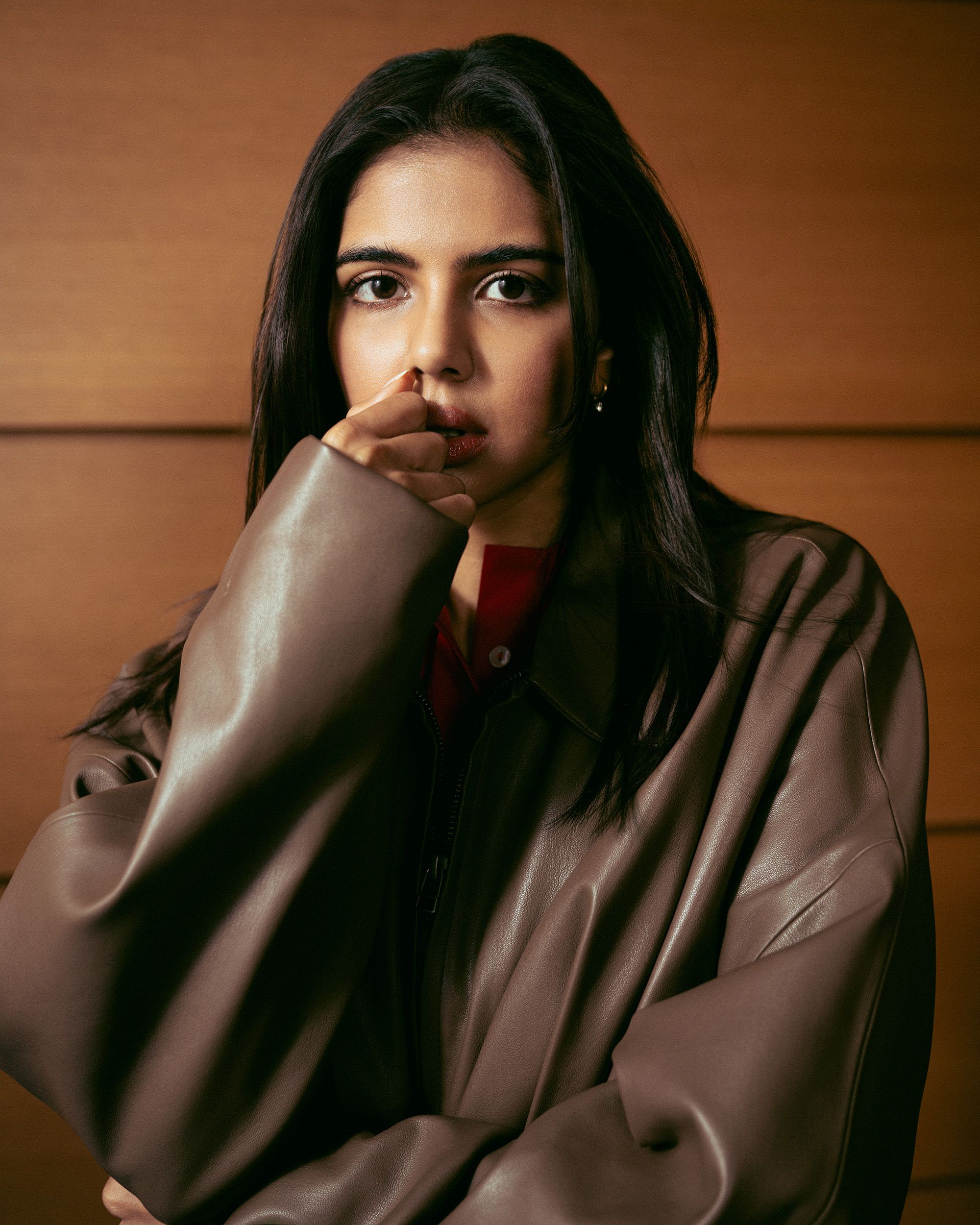
01.jpg

However, where most male superheroes are flamboyant in their quests—it’s hard to miss Tony Stark’s cockiness, Captain America’s overconfidence, and Thor’s arrogance—Chandra does not revel in her power. Chandra’s rage is not scripted out of thin whim; it is anchored in ancient ancestry and mired in a tragic episode of massacre and caste oppression.

“Although we were very excited when Dominic cracked the idea of connecting the story to an iconic character like Kalliyankattu Neeli, I think over five years [of making the film], we got used to engaging with the myth and Kalyani became Chandra—our character—to us,” says Santhy Balakrishnan, dramaturg and additional screenplay writer, who was tasked to sketch out the role of the lone major female character in the cast. Balakrishnan did it by shaping Chandra as a nuanced female superhero. According to her, Kalyani beautifully embodies the polarities of the yakshi—vulnerability and strength, desire and danger, awe and fear.

At The Nod shoot in Mumbai’s BKC, you can see why her doe eyes and fresh-faced charm make her a natural fit for romantic comedies and rite-of-passage love stories. Eight years ago, Kalyani debuted with Telugu film Hello (2017), a love story about two childhood sweethearts. After a couple of unremarkable choices, she cemented a space for herself in the Malayali consciousness with Hridayam (2022), a passionate love story about the shifting dynamics in relationships, and then Varane Avashyamund (2020), a romcom once again with Dulquer Salmaan, dealing with the complexities of mother-daughter relationships.

Before she became a ball-busting vampire, she’s played an unwed mother (Bro Daddy), a football commentator (Sesham Mike-il Fathima) and a student who forges a bond with her father’s killer in Antony (2023). But it’s Lokah that has changed her life almost irrevocably. So much so, there’s even an Amul ad that seals her place in contemporary pop culture.

These days Kalyani is almost leaving motion blur in her wake as she jet-lags through speaking engagements in Dublin and Bengaluru and circuits Chennai-Doha-Riyadh-Kuwait-Dubai-Chennai for public appearances even as she prepares for her next Tamil film. But she’s not complaining. “I cannot say that. This is what we actors work for—the recognition, the love,” she says. She understood the emotional impact of her stardom when, while promoting Lokah in Ireland, a man told her that his daughter was planning to dress as Chandra for Halloween.

In the glory and frenzy that have followed Lokah’s pan-India success, her days have only been getting more tightly packed. Too often, she tends to skip meals. “I am weird that way—I love food, but when I am running on adrenalin I can do a whole day without it. I am lucky I have an ‘assistant aunty’ who insists I shove some food in my mouth at regular intervals.” As if on cue, the said ‘assistant aunty’ interrupts our chat to thrust a plate in her hand, laid with carefully curated portions of salad. Kalyani speaks to her in Tamil, trying hard to stall the offer. When the lady strictly refuses to yield, she sighs and takes the plate obediently. “Have you all had something to eat?” she asks the team at the shoot, “Looks like we are going to have a long day, right? Please eat well.” The polite request has nothing to do with token formality or even impeccable manners. Kalyani knows firsthand the weariness of waiting on actors and the manual labour put in by shooting crews.
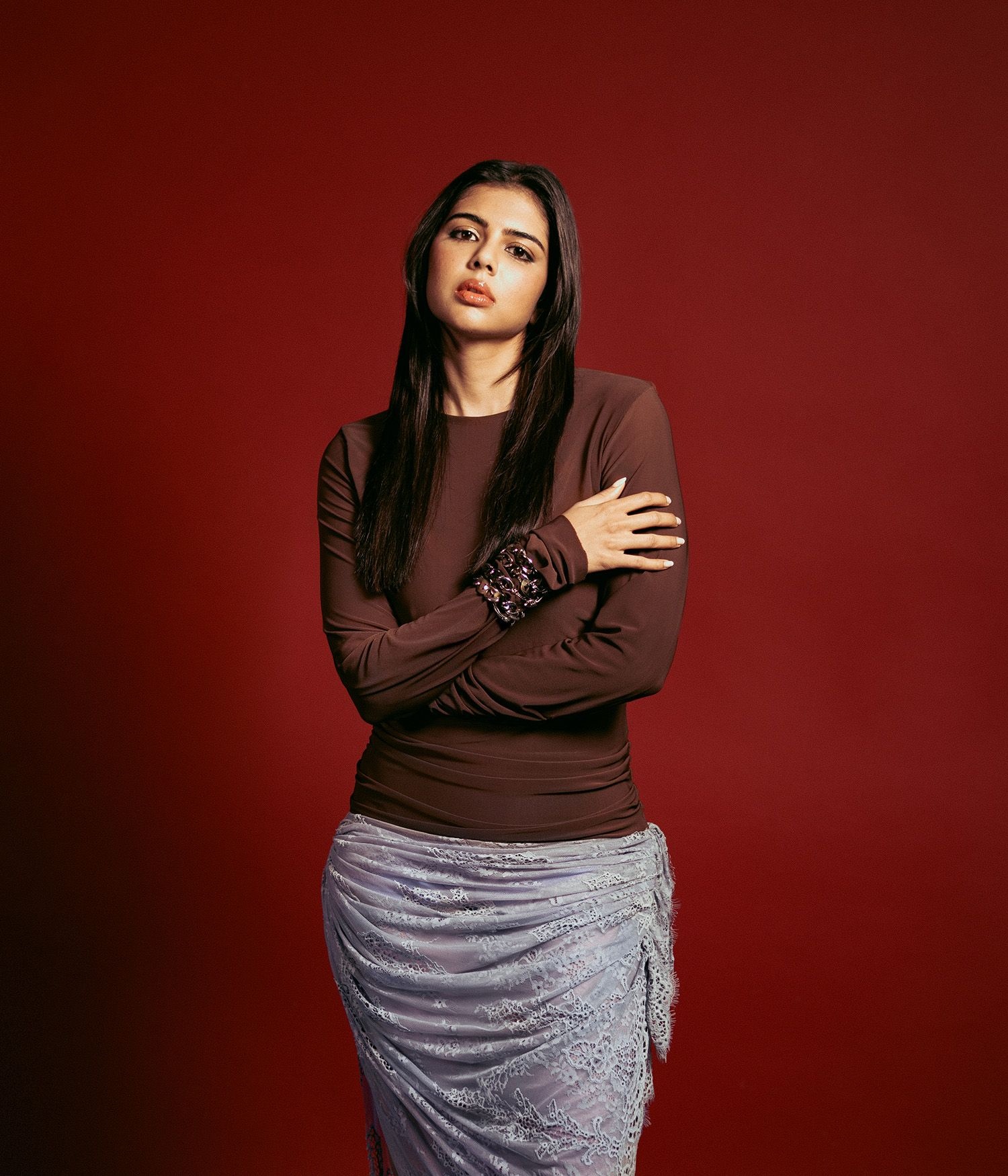
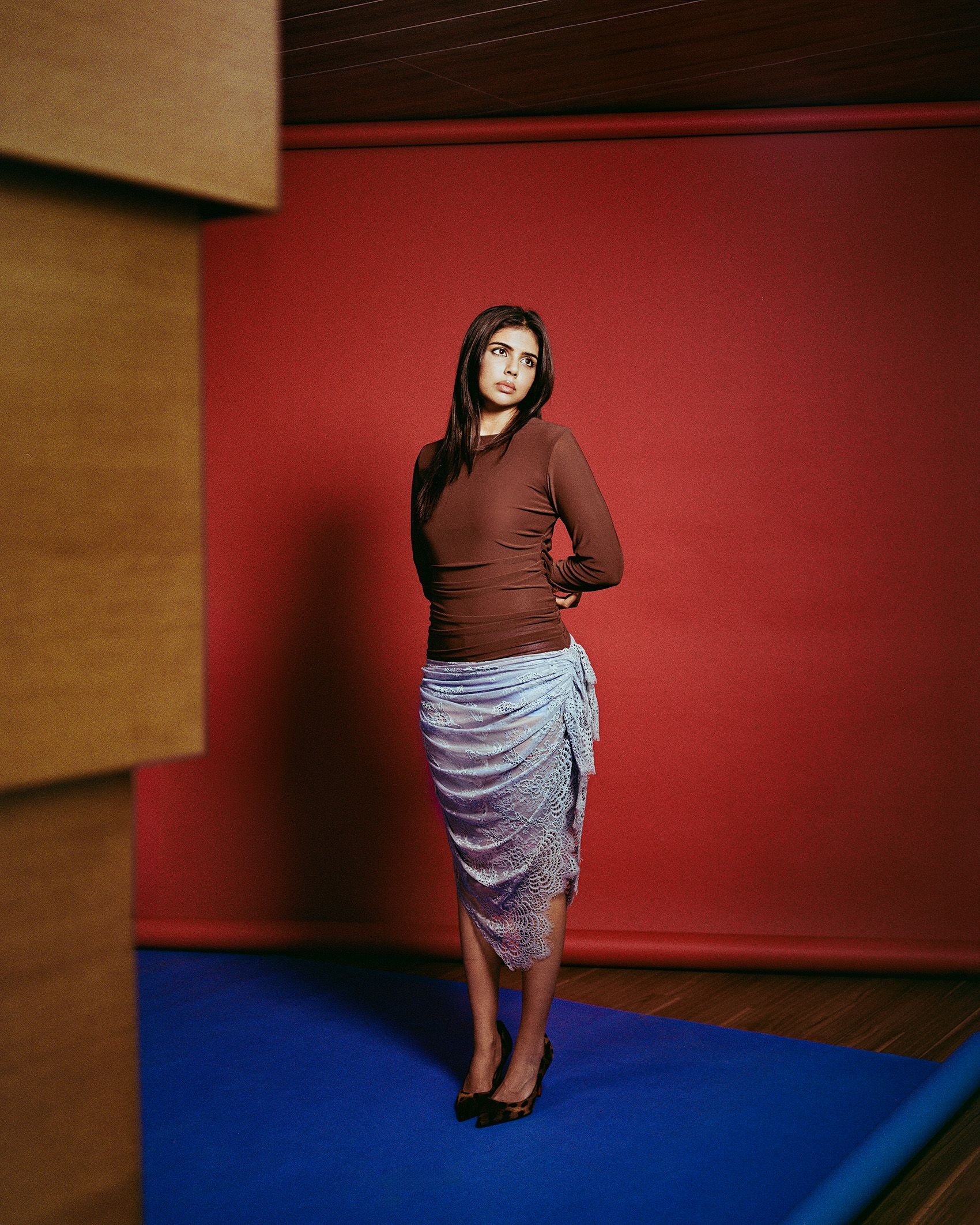
Judging by her illustrious pedigree—offspring of silver-screen darling of the ’80s, Lissy, and Malayalam cinema’s most prolific director, Priyadarshan Nair—she is no stranger to the highs and lows of the trade.

Almost a decade ago, she started her career in the movies as a set designer. Armed with a degree in architecture from Parsons School of Design and fresh from her internship stints in set design for Broadway shows, she eventually landed just where she had aspired to all her life. While her mother had intuited long ago that her daughter would face the camera, her father had firmly discouraged her and her brother, Sidharth, from pursuing a career in the movies. “He knew too well how crushing lows and frustrations can take the fight out of people. So, he didn’t want his son and daughter to experience any of it,” she says, quick to defend her overprotective dad. That both the siblings are now in the industry (Sidharth is a VFX artist) is another story.

Kalyani recalls how most of her vacations were spent on her father’s sets, where she noticed how happy he always seemed despite his manic schedules—so happy that he’d return home only to spend time watching more films and answering all her questions on editing and filmmaking. “I knew then that I wanted exactly this kind of joy for myself,” she says softly.  

Years later, her certitude left an ache in its wake when her closest friend, director Ani Sasi, shared a story with her in which a key character was inspired by Kalyani. “We had always brainstormed over stories, and till then I was happy being behind the camera. But when I heard of that character, I suddenly saw myself in that story. I really wanted to be her.”

She was in her early twenties then. But despite the twinge, she shuffled her feet at the threshold of her dream. She was not quite ready to butt heads with her dad and decided to carry on being a set designer. A few months later, epiphany came calling at the end of a bad day on a shoot set in Madh Island. Kalyani had sprained her back while heaving tables and was at the receiving end of the director’s ire: “He was in a bad mood, but by the end of the day I finally started asking myself if set design is all that I really wanted to do.”

Encouraged by her aunt, Kalyani finally summoned the courage to fess up to her dad that her convoluted trajectory through architecture and set design was actually a scaffolding that she had tenaciously erected to help her make the final leap towards acting. “I was so nervous when I approached him that he assumed I had fallen in love and wanted to tell him about the guy,” she says with a chuckle. “I was taken aback when my dad said that he had never heard more clarity and conviction in my voice, and that he knew of my dream all along! I understand when people tell me I am here because of my parents. But I would not even want to be here if my father had not instilled in me that love for cinema.” 

It’s easy to dismiss her as another nepo kid, but you cannot say the kid isn’t trying. Her fitness training—muay thai and kick-boxing—coincided with her shoot for another film. For many weeks in a row, she would wake up at 4 am to train for two hours daily, just before her call time on set. In fact, she did all the action scenes in one sweep over three weeks. “Three weeks, continuously, every day from 7 am to 9 pm was just fights,” she says. The pride in her voice is unmistakable but hard-earned. Movie-goers were riveted by the practised ease with which she is seen delivering flying kicks and beating the snot out of heavily armed thugs. “I still have a hard time believing that’s me. No wonder my father laughed when I told him that I had landed the role of a superhero,” she says with a grin.

We have seen her in romance flicks and fight scenes. And just last week she featured in a music video with Mumbai rapper Divine. But now Kalyani wants to cover other cinematic bases: She is keen to work in a horror movie, and she really hopes she gets to play a rockstar someday. “I don’t know if I am cut out for that, but then one and half years ago I could never have imagined myself doing an action film. I was never an athletic person growing up. There are enough childhood pics of mine floating around online for anyone to know I was anything but sporty. In fact, I was made fun of—a lot—for being weak. Which is why all that hitting and kicking that I did in Lokah felt doubly empowering. It felt like I was trying to tell that inner child that I could do it all.”

Kalyani’s earnestness in the face of navigating newfound fame is also admirable. Most actors hire specialists to help them curate their social feeds, but not her. Kalyani writes her captions, and posts her own content: videos featuring her French bulldog, Coco, her failed experiments with magic and travels with friends to South Korea and beyond. “Even today, I prefer to handle my social media accounts,” she tells me of her parasocial relationship with her 7 million followers. “I may forget to wish a few people on their birthday, I may forget to post certain things and that may upset a few fans. But I would rather do that and be myself than pretend to be someone I am not. Because once you start doing that, then it is for life.”

Actors, she believes, are made through trial and error, by exploring their craft, and by working with different directors. “What I want most is the liberty to fail,” she says.

She wants a bunch of other things too—the simple joys of travelling with her friends; bingeing on food in London’s Borough Market; reading Eleanor Oliphant’s novels; and listening to Ilaiyaraaja and Fred Again on loop.

Even without a cape, she needs one superpower: for things to remain the same. The thing is, while everyone is rushing to tell her she is going places, Kalyani Priyadarshan wants to make sure she is just able to return to herself.  

Editorial Direction: Megha Mahindru, Ridhima Sapre. Photographer: Rema Chaudhary. Stylist: Rupangi Grover. Visuals direction: Jay Modi. Bookings editor: Nikita Moses. Multimedia designer: Mehak Jindal. Visuals editor: Ria Rawat. Hair and Makeup: Claire Carmelina Gil. MUA assistant: Pooja Rajput. Photo Assistant: Mohitt R Gogia. Styling Assistants: Michelle, Mahek Gada. Concept and Production: Harkat Studios, Nikhat Bhandary, Mahek Rastogi, Dinesh Roundhal

The Nod Newsletter

We're making your inbox interesting. Enter your email to get our best reads and exclusive insights from our editors delivered directly to you.