



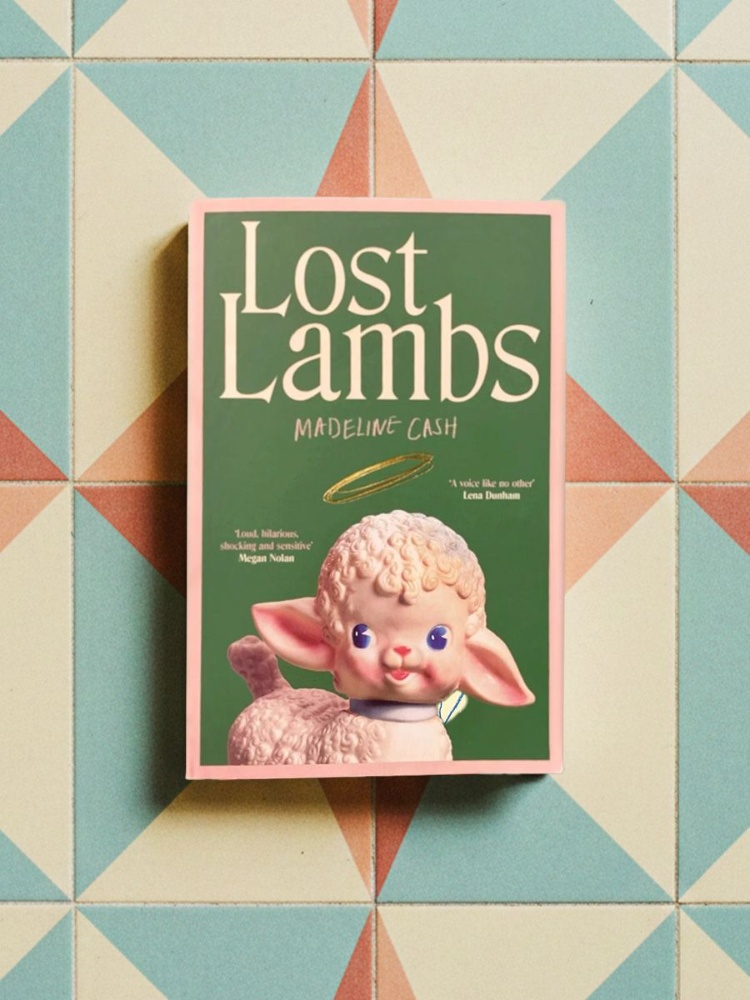

Dysfunctional families are fiction gold: apathy, estrangement, disillusion, unhappiness, rebellion, infidelity, anger, depression, bitterness, and good old logistics coalescing into a potent bomb that’s waiting one press of the scary red button. To make such a story tender, funny, and clever, with a cast of characters you want to both shake by the shoulders and hug, requires skill. To make this a satire of our times requires an ambition that Madeline Cash deploys lightly and wickedly in her debut novel, Lost Lambs.
The Flynn family is at the centre of the novel. There’s Bud and Catherine, who are dealing with a marriage that seems frayed beyond repair. Bud is living in his minivan, the passenger seat “a global shrine of take-out containers”. He has retired his guitar a long time ago to work as an accountant at Alabaster HarborTM (the trademark sign never leaves the name). His wife, Catherine, who once dreamed of being a photographer, is now wading through suburban ennui and ageing-induced insecurity, hanging wind chimes made from her children’s baby teeth in their wraparound porch, taking oatmeal baths, and rebelling against such parental tasks as stocking the fridge.
Despite Bud’s protests, the two now have an “arrangement” to open up their marriage, to which Bud reacts with anger and thoughts that involve driving aforementioned minivan into the sea. Catherine embarks on a somewhat affair with their neighbour Jim Doherty, who dabbles in crafting vagina sculptures in his basement.
Then there are the Flynn daughters: Harper, Louise, and Abigail. Twelve-year-old Harper is the precocious, youngest member—“a troublemaker with no origin myth”, a little Latin-speaking arsonist who likes snooping through everyone’s online histories and sticking a pocketknife into the tyre of the church van when the mood strikes her. Louise, 15, the ignored middle child in a family of ignored children, might be assembling explosives for her faceless online friend yourstruly while trying to compete in the Our Lady of Suffering’s Spring Inner Beauty Pageant. And Abigail, 17, the eldest and the turner of heads, is dating a discharged soldier with stomach issues nicknamed War Crimes Wes, and dreams of a life that will be “rich and full and cover every genre—travel and romance and mystery”. At work, Bud is forced to pick a local program to alleviate his tanking work performance; he goes with Lost Lambs Christian Guidance, where he embarks on an affair with Miss Winkle, the facilitator. (The title, thus, derives from the support group’s name as well as the novel’s off-course characters.)
Beside the Flynns, there’s also an eccentric billionaire whose firm runs the town and who prefers quail eggs in his ice cubes, and a priest with repressed rage and an academic background in the French New Wave, who is being blackmailed by the former. All this while a gnat infestation grips the church, reminders of which we constantly encounter in the form of wordplay through the novel: “altergnatives”, “dognated”, explagnation, extermignation, fascignated...
Throughout, there are observations that could only come from a writer who is constantly on the lookout for people’s tics and mannerisms: Miss Winkle with her tendency of tacking “I’ll say” to others’ observations, the way children leave a residue everywhere (“like little snails”), teenagers making caves with their palms in front of each other’s faces as they light their cigarettes…
Dysfunctional families are everywhere, from classics like Anna Karenina to contemporary fiction, like Charlotte Mendelson’s The Exhibitionist, but while the latter dealt with the patriarch’s multifaceted tyranny, Cash is kinder to her characters while being brutal in her evisceration of the ultrarich’s eccentricities, here represented by the shipping mogul Paul Alabaster. It comes across in the use of chess sets and pianos as decor objects, their tendency to bid on expensive dinosaur fossils at auctions and live anachronistically when it comes to the design of their homes.
Like most children today, the unsupervised children of the family spend an inordinate amount of time online: Louise with yourstruly as a way to escape others’ IRL apathy, Harper snooping on Bud’s computer and investigating dodgy paper trails, Tibet feeding her conspiracy theories... Internet culture, thus, also becomes a key driver of the plot.
In this highly entertaining setting where children come with keen eyes and adults are oblivious to things staring them in the face, Cash manages to take a dig at beauty pageants, capitalism and Big Corporate, organised religion, surveillance, and neurotic tech moguls obsessed with biohacking. And in 300-odd-pages, this debut novel, somehow becomes a must-read story for our times.
Madeline Cash’s Lost Lambs is published by Penguin; ₹598