Profession: Artist, designer, and founder of Beghairat Studio
Why you should know her: Misha Japanwala has been making breastplates and documenting the relationship that women share with their perfectly imperfect bodies since she graduated from Parsons more than half a decade ago. Her graduate collection was featured as part of a six-page editorial in Vogue Spain, and her first big commission came from Gigi Hadid when she was guest editing V Magazine. The documentary film that accompanied her first solo show, ‘Beghairati ki Nishani’, was scored to an unreleased track by Ali Sethi. In short, Japanwala could not have been cooler. Until she was.
If you thought that the most radical thing about Christopher Nolan’s adaptation of The Odyssey was the casting of African-American, Oscar-winning actor Lupita Nyong’o as a scarred Helen of Troy (the fabled beauty whose face launched a thousand ships), then sample this: in the two scenes in which Helen makes an appearance in the auteur’s three-hour-long epic, she is also spotted wearing a custom shoulder piece and a choker by Japanwala.
“I’m obviously over-analysing everything now, but being a part of this project just feels so perfect in every possible way,” says the artist as we connect on a Sunday over Zoom from her New Jersey apartment. After a year of keeping this collaboration a secret, Japanwala can finally spill the beans.
“Helen of Troy is supposedly the most beautiful woman to ever exist. But to see this imagination of her, which upends all established standards of beauty and perfection, was refreshing. Also, I see my own practice as a really sacred space to reject all those expectations placed on us and instead just document ourselves and celebrate our bodies with all their stretch marks, scars, pimples, and pores. I can’t help but see the parallels in my practice and what this character is speaking to.”
ADVERTISEMENT
A work-in-progress image of the shoulder piece
Japanwala in her studio
On sculpting the female body: “During my senior year at Parsons I made the switch from making and designing clothes from fabric to sculpting. It began with me picking up a bucket of silicone and experimenting with moulding and casting my own body. After I had graduated, I remember receiving a DM from a stylist who was working with Vogue Spain. They wanted to feature my work in the magazine, and I shipped off my entire graduate collection to Madrid. Three months later, it was in a six-page editorial on model Cindy Bruna.”
On taking up her artistic practice full-time: “I worked full-time in fashion for a little while, at a magazine and at Proenza Schouler, while I continued sharing my personal work on Instagram. During the pandemic, I was doing some side jobs to support myself, until I got the call from Gigi Hadid to create a custom piece for V Magazine.”
On naming her practice: “When I had initially started working on my moulding, casting, and documentation of the body, there was backlash against the fact that I, as a Pakistani woman, was making castings of my naked body and the bodies of other women. One of the things that came up repeatedly was that my work was ‘shameless’. Simultaneously, I was working with more and more women in Karachi, some of whom wanted to preserve their body in a breastplate before a mastectomy and some who simply wanted to celebrate their scars. Eventually I realised that ‘shameless’ was actually the best possible compliment I could receive. ‘Beghairat’ means ‘shameless’ in Urdu and I reclaimed the word for myself as a badge of honour.”
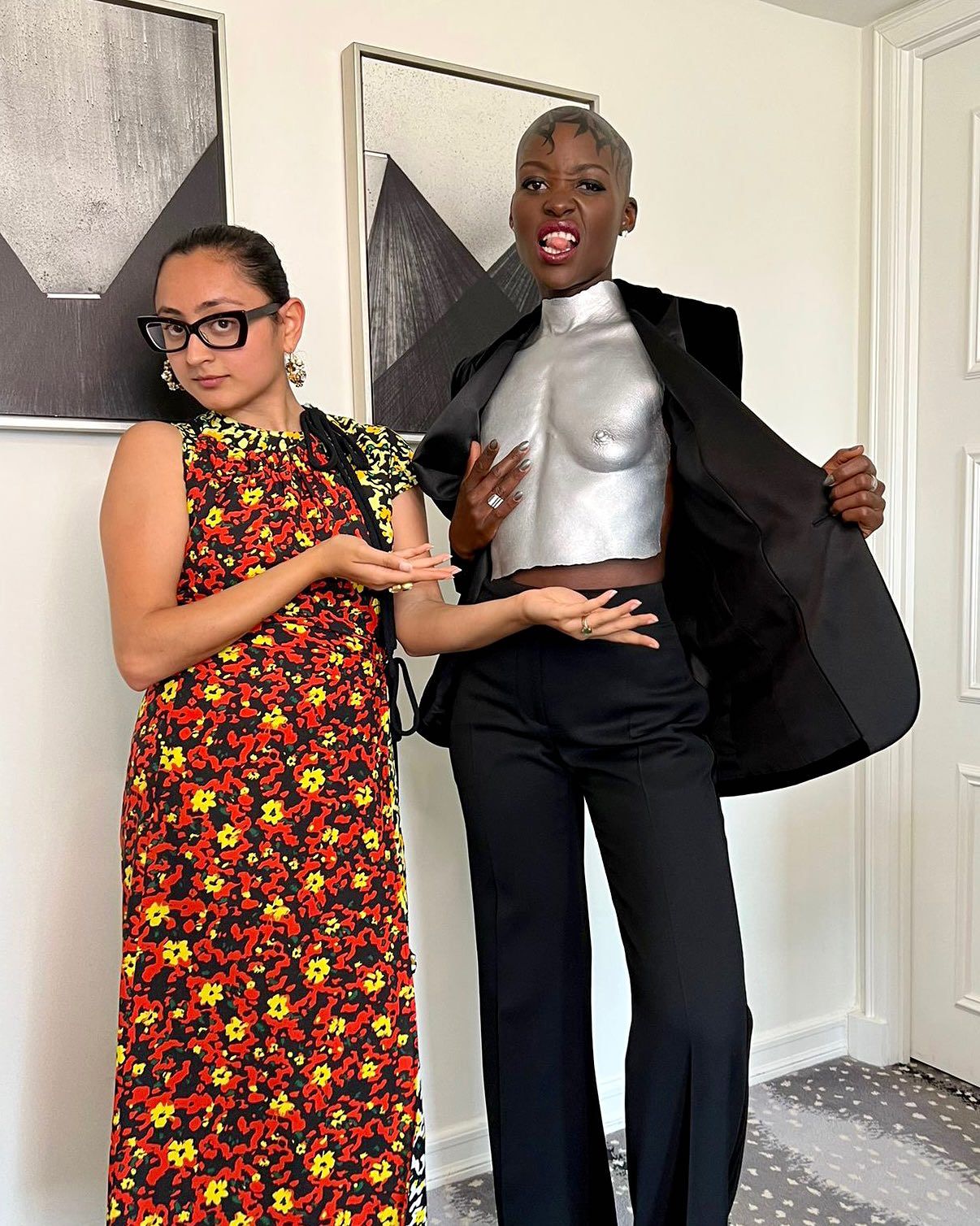
On landing the job: “Lupita Nyong’o had previously worn one of my silver breastplates for the Tony Awards and she casually mentioned my name while doing costume fittings for The Odyssey. Around January 2025, I got an email from the team about an unnamed Christopher Nolan film. I remember taking the meeting on a drive to upstate New York and being told that I had about two weeks to deliver the piece.”
The artist with Lupita Nyong’o
The brief: “Ellen Mirojnick, who is the costume designer on The Odyssey, is an absolute legend and had a very specific vision. She wanted the breastplate to look like a broken sculpture, and Nolan wanted it to feel aged and yet have a timeless quality to it. I returned to my first solo ‘Beghairti ki Nishani’, for which I had experimented with a patina and metal coating that would evoke memories of artefacts from the Mohenjo-daro civilisation. I added a patina to age the surface, but I also used copper and brass coatings as layers on top of one another. The team also wanted the piece to go all around the body, which was different from my regular breastplates, which are worn on the front and tied at the back. Making this 360-degree sculptural costume with broken seams on the shoulders for Lupita to get into it was an interesting challenge for me. After I had sent the piece to Los Angeles for the fitting, I got a message saying that Nolan loved the piece and wanted me to make a second, which is when I made the choker with broken edges with a similar metallic treatment.”
On her signature markers: “Earlier this year, when the Met Gala was underway, I received a lot of DMs from people asking if any of the breastplates on the carpet were by me. Unfortunately, they were not, but it was endearing to see so many people trying to identify my work on such global platforms. When I did announce this time that Lupita’s choker and breastplate were by me, I received hundreds of messages from people saying that they had wondered aloud while watching it on the big screen. As an artist, that means a lot to me—to know that I have developed a kind of signature that people can identify easily—because during my time at fashion school I struggled massively with developing my own voice. Seeing this response makes me want to tell my younger version, ‘Girl, don't worry, it’s gonna be okay.’”
ADVERTISEMENT
The 360-degree shoulder piece
The choker with broken edges
Japanwala with her work at the AMC Lincoln Square 13 theatre
On pushing the boundaries of her design practice: “I have been experimenting with little jewellery pieces for years now while working on my casting projects, turning a nipple here and there into a ring or an earpiece. I’m really interested in what it means to adorn ourselves with jewellery made from the parts of our bodies that we are conditioned to be ashamed of. So, currently, I’m experimenting with details of stretch marks or scars and turning them into sculptural jewellery. I also want to start developing custom sculptural brooches with the hands of one’s parents so you can carry it with you whenever and wherever. In an ideal world I want people to wear my breastplates to the grocery store, but I don't really think that’s very practical, so we will have to do with these for now.”
On her current watch list: “I’m only reading, listening, and watching TikTok. I wish I could give you a sophisticated answer about some obscure book by a feminist author that is totally changing everything about how I see things. But what I really need to do is publicly admit the urgency with which I need to get off my phone.”
The most shameless thing she’s proud of: “Right now, it would be waking up every day and continuing to engage in this work, despite people saying that I should be ashamed of what I do. It takes an everyday commitment to continue doing this, and I am glad I never gave up.”