




On a searing January afternoon in Kozhikode, the sea breathed in long sighs. Not far away, the crowd moved as one billowing wave, hats and umbrellas bobbing.
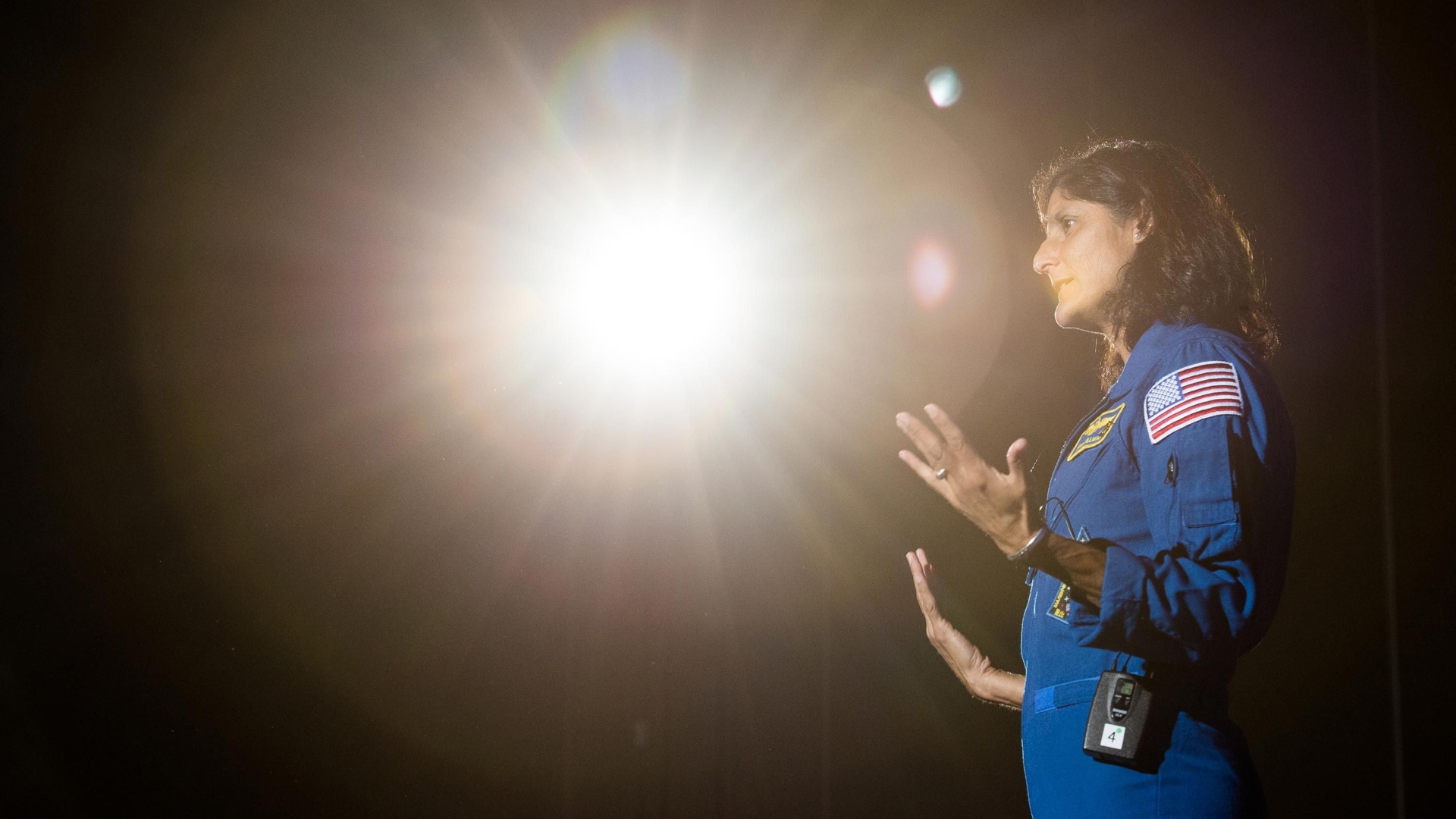
On stage, Sunita Williams, NASA astronaut, one of the longest-serving humans in space, is a mote, much smaller than the idea of her. Nine months ago, her Boeing Starliner was declared too dangerous to bring her home: to Earth. Down below, earthlings worried and prayed while she waited in orbit, patient as a planet. She could have sounded dramatic (the situation demanded a Hans Zimmer soundtrack), but instead she chooses to be funny. “It was like the best amusement ride,” she says after describing the dry irony that it takes years of gruelling training, and only about 10 minutes to actually reach low Earth orbit. “We were just rookies, screaming and cheering as we left the Earth.”
While she narrates how science and spirituality go hand in hand, the crowd keeps swelling—rickshaws keep pulling up, huffing out more of her admirers into the sand and spectacle. I listen closely for anything that would explain why, at a literature festival where novelists had flown in from Japan, from Germany, and other careful geographies of solitude, among writers who sat with a single book for 20 years, an astronaut with no book to sign is the star attraction.
(One of them, a writer whose work I would have walked barefoot across the burning sand to listen to, spoke that morning to four rows and a constellation of empty chairs. The wind moved through them like an apology.)
It is worth asking what exactly we expect from Sunita Williams. Have we assembled in Kerala’s 38-degree heat to fall in love with space again, like children pleading for a new pack of glow-in-the-dark stickers? Perhaps we are hoping Williams can give us some hint as to why we are here in the first place, sealed inside this one lone blue spinning home.
Small cities have a reputation for going weak at the knees for big dreamers. But Kozhikode is not small in that way. This is a place where porotta is torn and shared as the moon gives up its shift. The beach, even at ungodly hours, belongs to women and children as much as anyone. And yet this is also the city where Sunita Williams can walk into the Kuttichira Mishkal Mosque freely, while women who grew up a few streets away under its minarets still can’t cross that line.
Williams’s audience is here to listen to her story. Of how she became an athlete. About her father who nearly drowned as a boy and resolved that his children would swim. Around me, there are twice as many women as men, some with babies balanced on laps. I wonder how many here had once said they wanted to become an astronaut. How many had forgotten they’d said it. Would they soon thrust some unlived dream into smaller hands? The corridor between what we abandon and what our children might attempt is narrow but continuous; walk through it and time collapses. “I love animals and wanted to be a veterinarian,” shares Williams, and for that moment the difference between a cowshed and a spaceship seems merely a matter of choice.
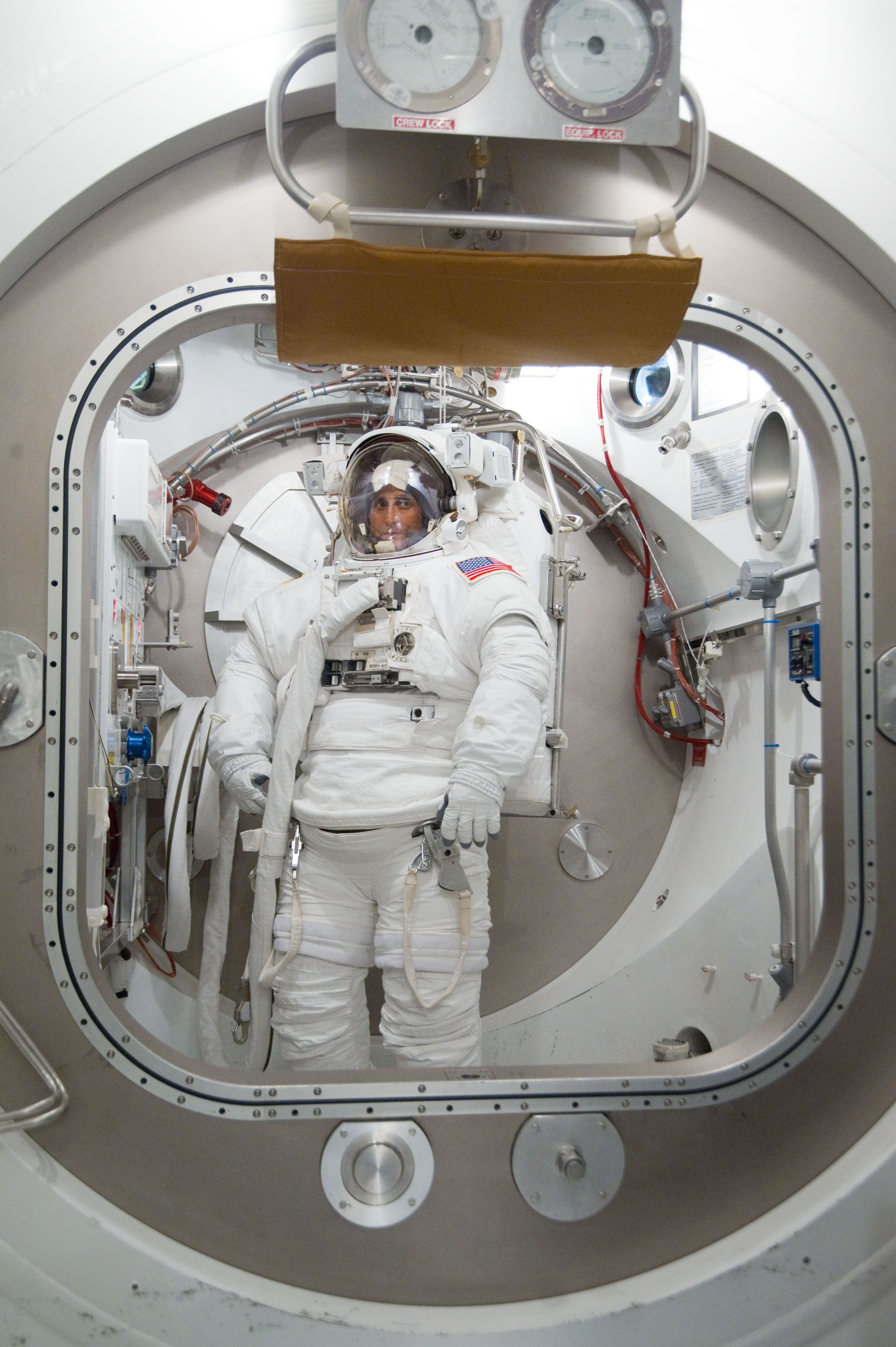
Last year, Williams was stranded on the International Space Station for 286 days
Williams talks fast and listens hard—head tilted, body in a forward slant, a slightly combative way of someone who refuses to miss a thing. She opens up about imposter syndrome and rising in a field that had not been built for women, but for me the most surprising sentence to come out of her is “I am not extraordinary”. Hearing about someone in space makes our little lives at once feel both precious and insufficient. And if she isn’t extraordinary, I don’t know who is.
“Deep in our hearts, if we get rid of all that noise, human beings are good, and we all care about each other,” she says. For a generation coming of age online, space came to our desk every time we looked away: in the form of a screensaver where an astronaut floated, out there alone, between the moon and galaxies. Space once symbolised openness, globalism, and possibility. It was also new enough to feel miraculous and it made us feel like we are connected. But today space brings to mind nationalism, defence budgets, the geopolitics of satellites and the usual competition. Somewhere along the way we traded awe for anxiety. Did we even notice?
I feel this change a little when Williams plays a video she calls ‘Vacation from Earth’. It documented the everyday in Calypso, starting from exercise on a bicycle with no seat, a toilet that brought about a lot of laughter, her work hours spent doing experiments and also the celebrations—the birthdays, the arrival of uncrewed resupply spacecrafts she endearingly called “Uber Eats”.
“To not feel rain on your head for nine months, it was terrible. To not feel the wind or sand or soil under your feet. Those are the things about Earth that I really, really missed most,” says the astronaut who poetically confirmed her retirement after 27 years, three missions, and 608 days in space here in Kozhikode.
“To not feel rain on your head for nine months, it was terrible. To not feel the wind or sand or soil under your feet. Those are the things about Earth that I really, really missed most.”
There’s a collective gasp when Williams shows the Aurora Borealis, molten green and trembling like something torn from a fever dream. “We flew right through it” she says. and suddenly a line of Starlink satellites intrude and cleave the frame. “Space is very busy now and all the people, animals and plants I know are here on Earth,” she says as the video comes to an end, with her capsule splashing into the ocean and dolphins as if scripted welcoming her home.
The space station needs repairs, she tells her audience. It will soon be retired. And I feel the audience around me do what I did, which is to immediately and involuntarily think of it as a creature, an old dog, joints stiff, dreaming of wide green lawns. It all feels uncosmic but by now we are all sappy.
Hearing Williams talk, I felt as much as I’ve felt reading my favourite novels this year. Through her talk, I realised that we have lost the capacity to feel, with too much information, too much catastrophe, too much beauty offered all at once at too low a resolution. Until something small punches through. Like the baby monkey in Japan, motherless, clutching a stuffed orangutan. Something that small and desperate got through to us. If anything, Punch’s viral popularity tells us that now more than ever we need protagonists. And storytellers.
With or without a book, we all carry stories, and more than that, questions that make life feel vast again. That’s the beauty of a good literature festival. An astronaut will be in conversation with a historian, with an actor, even children. There’s so much discourse about why a country of non-readers keeps building literature festivals. Perhaps it’s because we need a little more literature than quick hot takes that social media dishes out in the name of writing. We really need our sense of wonder handed back to us.