Every year end, Mumbai streets and seaside promenades get busy with a crowd—laced up and kitted out—that you would usually spot inside a gym: the marathoners. Those who’ve been paying close attention would have noticed a shift this year—the 20- to 30-year-olds with young knees and young-person energy have been overtaken by sinewy, grey-haired athletes in their fifties. It feels ironic, given the conversations at work where millennials are swapping notes on joint pain, back stiffness, and persistent brain fog before their first coffee.
A look at the Tata Mumbai Marathon’s IG will corroborate this—more people over 50 are running—and not casually. They’re joining running clubs, setting alarms before sunrise, training through the year, and showing up at races—like the marathon that will take place this weekend—with a level of discipline that suggests this isn’t just a tick off a bucket list.
Running, after life happens
Take Parul Seth, for example. A Mumbai-based architect, Seth signed up for her first marathon in 2005 after the sudden loss of her husband. She ran the half marathon that year. “It gave me structure at a time when very little felt stable,” she says. By 2012, she was running the full race.
Now 54, Seth is still participating in full marathons, with some adjustments. Perimenopause has disrupted her sleep and, with it, her training rhythm. “I didn’t want to run on very little sleep,” she says. Planning became non-negotiable. Strength training, once optional, is now part of her routine. She has consciously increased her protein intake. Recovery is slower. Healing takes longer.
A fall a few years ago reinforced that reality. “It took so long to recover,” Seth says. “You become very mindful after that.” The injury made her realise that it was more important for her to have a sustainable running practice than trying to get to the next personal best. “[Running] helped me rebalance my life,” she says. “It taught me to respect what my body can do.”
She’s also watched the demographic around her change, with more runners in their fifties and more women returning to the sport later. “There are runners in their seventies setting records,” she says. “That resets what you think is possible.”
ADVERTISEMENT
Parul Seth
Ashish Ghiya
Training like it’s a system
Ashish Ghiya, 52, has run the marathon almost every year since 2007. He wasn’t athletic growing up. When he first signed up, he couldn’t run 300 metres. “That’s when I decided to start training,” he says. In his fifties, prep looks different. “It’s more methodical,” he says. “The fundamentals don’t change but sleep and recovery suddenly matter.”
He trains through the year, not just in the months leading up to race day. One interval session. One tempo run. One long run. One easy run. One rest day. While strength training workouts play an important role, now it’s less about muscle building and more about endurance for him. “Earlier, recovery wasn’t even a thought,” he says. “Now it’s the strategy. I train just enough to be ready again the next day.”
Over the years, his lifestyle also shifted to support his running. Dinner is early, around 7 or 7:30 pm. Sleep is non-negotiable. “I’m in bed by 9 or 9:30 pm,” he says. Mornings begin before sunrise. By 6 am, training is done. His energy levels, he says, are consistently high. His metabolism feels fast. His focus is sharp. “It’s made me more efficient,” he says. “Not just physically, but mentally as well. I process things better at work. I’m more productive.”
He’s quick to dismiss a few familiar myths. That running ruins knees. That getting older automatically makes you slower. “I’ve seen people run faster at 60 than they did at 55,” he says. For him, a good race is no longer about time. “If I’m stronger in the last two kilometres and not struggling, I know I’ve raced right.”
Among runners over 50, this thinking isn’t radical. Training is about doing slightly less today so you can train again tomorrow. Seth agrees. “It’s not about the clock anymore,” she says. “It’s about how you cross the line.”
There’s also a mental discipline that comes with experience. “The first 15 kilometres feel easy,” Seth says. “An hour and a half in, you start questioning everything.” This, they say, is what training is for—not the body, but the mind. The city helps too. Seth lives on Peddar Road, where friends, family, and neighbours step out every year to cheer. “That validation matters,” she says. “It carries you.”
Starting late, going long
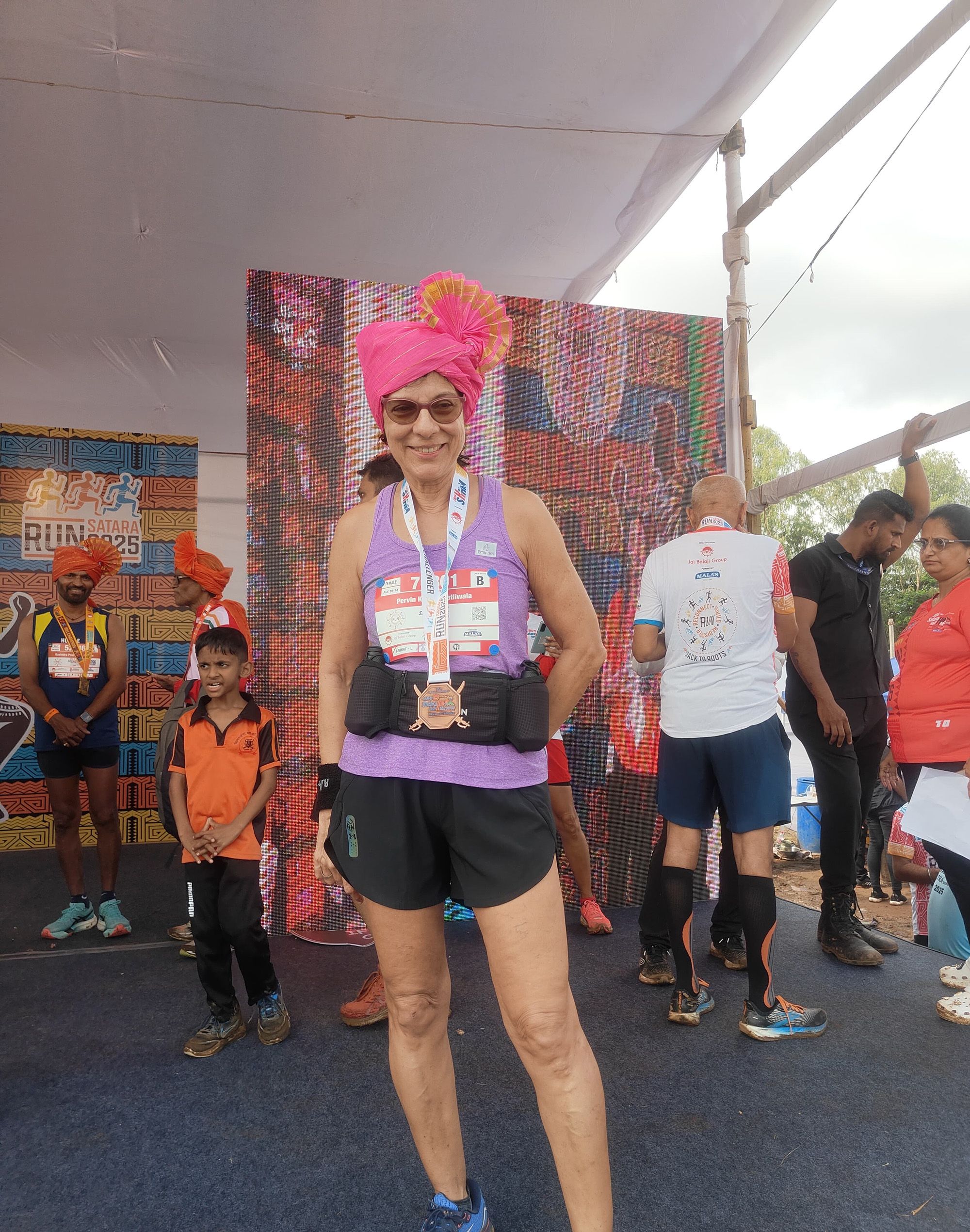
Pervin Batliwala, 71, says she arrived late to the party. “I started everything late in my life,” she says matter-of-factly. “Discos at 40. Got married at 45. Running at 50.” Now, at 71, she’s learning freestyle swimming—having already mastered the breaststroke. Running wasn’t a sudden pivot. Batliwala had always been active—yoga, dancing, strength training. But it became serious when she met popular Mumbai-based marathoner Savio D'Souza and joined his running group. “There was no looking back,” she says, “I plan to run even when I am 100!”
Since then, she’s run marathons across India, completed two editions of the Comrades Marathon (one, a gruelling 90-kilometre ultra-run in South Africa, is widely considered one of the toughest endurance races in the world), and finished all six races of the World Marathon Majors (Tokyo, Boston, London, Berlin, Chicago, and New York). This year, she’s running the half marathon at the Tata Mumbai Marathon, keeping the full distance off the calendar because she’s eyeing the Sydney Marathon later this year—recently added as the seventh Major.
Pervin Batliwala
Batliwala runs three days a week, one of them being an easy one. She swims two to three times a week. Strength training is split between free weights and machines, specifically to avoid injury. A little Pilates is sprinkled in. Sleep, she says, has never been an issue—seven to eight hours at night, and often an afternoon nap. “Half my recovery is taken care of with that,” she laughs.
Her personal best in a full marathon is 4 hours, 16 minutes. At the Tata Mumbai Marathon this Sunday, she’s aiming to finish the half marathon under 2 hours and 15 minutes. She routinely ends with podium finishes in her age category, she adds casually. But more than the medals, running gave her something else. “I found my passion after I retired,” she says. “I made so many friends through running. Waking up early and training is so refreshing.” She pauses, then adds, “Even at this age, I feel so fit. My younger friends and family think I’m too good—and that’s a great feeling.”
Finishing, not chasing
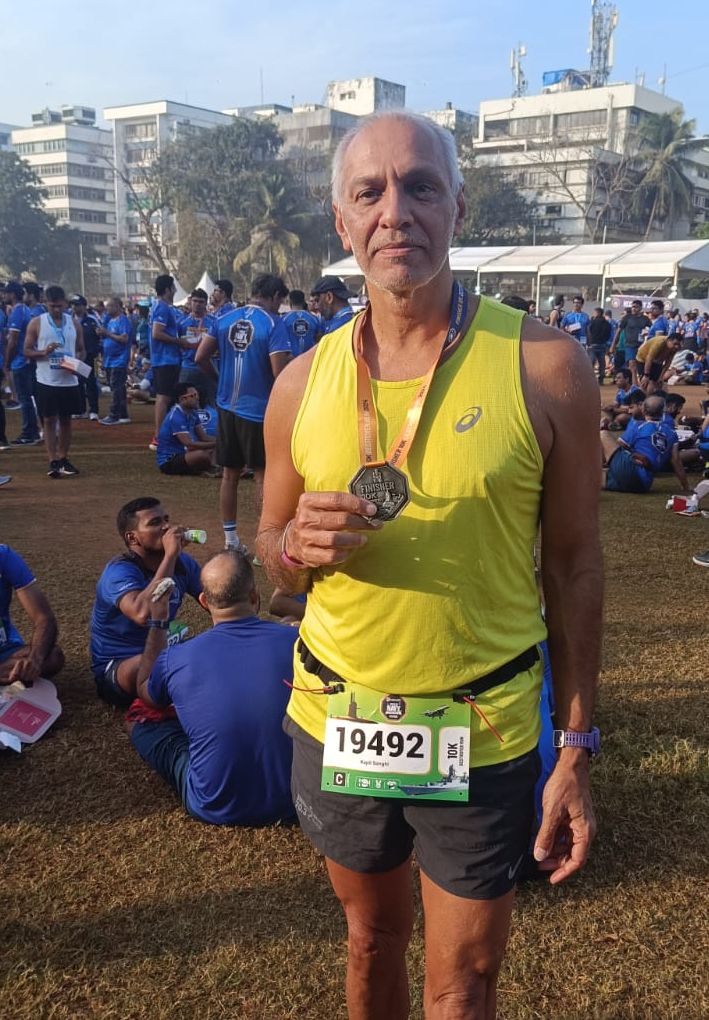
Kapil Sanghi, 61, a food consultant with two adult children, started running in 2004 “just for fun”. He’s on the Standard Chartered Wall of Fame, completing two full marathons and 15 half marathons since he locked in on the sport. “I was always a gym person,” he says. “I’d run three or four kilometres on the treadmill, three or four times a week.”
His first full marathon made news for an unexpected reason: he finished last, in eight hours. “I didn’t care,” he says. “I was just happy I finished.” A decade later, he ran the same distance in under six hours. The self-described slow runner says age hasn’t changed much for him, “Speed has never mattered to me. Finishing does.”
Kapil Sanghi
While earlier, he trained for a few months before a race, he's now started training all year. He runs three to four days a week, swimming three to four times weekly. He also cycles in the months leading up to events. He’s completed half Ironmans (triathlons that consist of swimming, biking and running). He doesn’t drink, doesn’t smoke, doesn’t do late nights or late dinners. Is it all worth it? “Toward the end of every race, I question my sanity,” he admits. “Then it ends and I realise I enjoy it—and I’m back again.”
The best part, he says, is the community. Years of shared miles mean friendships that extend beyond running. “Our lifestyles match. Hanging out is easy.” Younger runners cheer him on during races—“Hey, uncle, go faster!”—which initially annoyed him. “Then I realised they meant it kindly.” Some tell him they want to be running like him in 20 years. Even his son’s friends notice. “They tell him, ‘Your dad is running in his sixties while our dads struggle to get off the couch.’ I like that,” he says. “If I can inspire in a small way, that’s enough.”