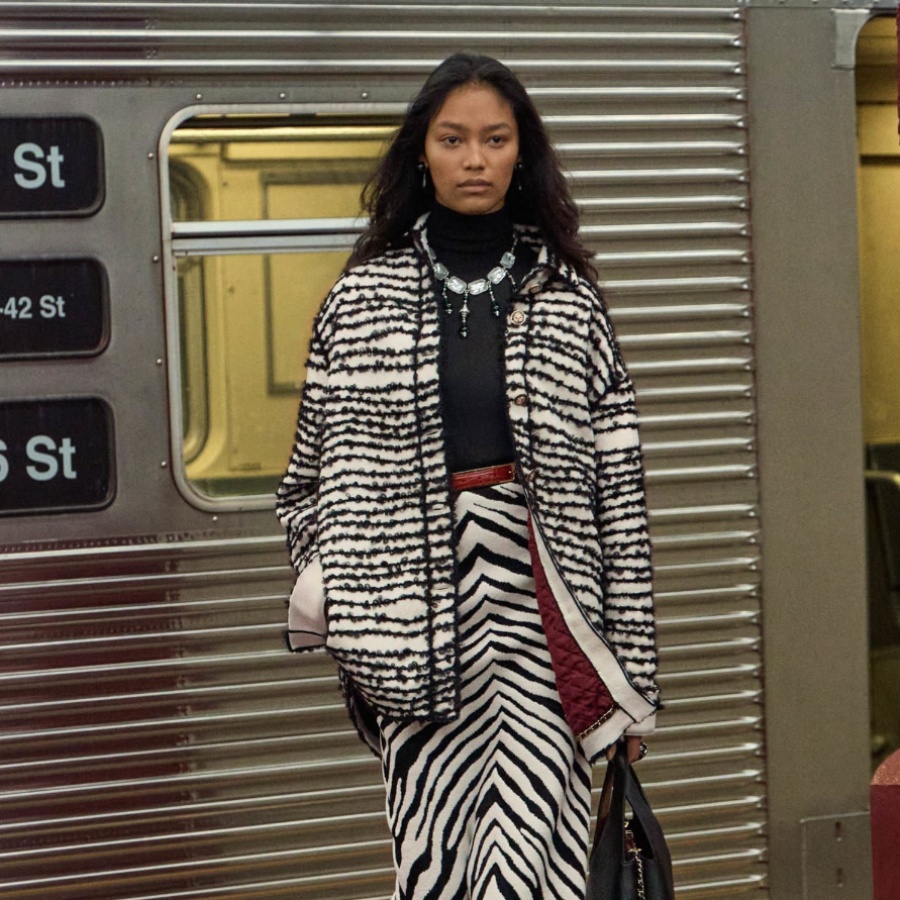
Meeting Tory Burch is like meeting America’s sweetheart. With her blonde bob, wide smile, and polite manner, the designer is a personification of the kind of athletic, girl-next-door appeal that defines the term. Her clothes could fit that description too—the mashup of off-kilter, vintage-inspired aesthetics with streamlined shapes reminiscent of sportswear and ’90s-era tailoring is perfectly suited for people who hold our attention in the same way as Burch. Women like Amanda Seyfried, Emily Ratajkowski or Alex Consani, all of whom have been spotted in iconic Tory Burch pieces, like the monogrammed Reva ballet flat, the newer pierced mules, or the quilted Bunny Knot shoulder bags.
But there’s more to Burch’s appeal than a knack for making a good It-bag or shoe. Ever since she started her eponymous label in 2004 after a career working in public relations at brands like Ralph Lauren, Vera Wang, and Loewe, the designer has displayed an instinctive understanding of the power of a recognisable point of view. Her clothes are not entirely preppy yet they’re not girly either. They are infinitely chic yet playful in the eccentric way she brings together print and colour. Today, as the brand experiences what has affectionately been dubbed the ‘Toryssance’—a term that began circulating in fashion circles and on social media in early 2024 to mark the brand’s shift towards a more experimental design language—the designer is more relevant than ever with over 400 stores around the world and a presence in over 80 countries. During New York Fashion Week earlier this year, the brand ranked first in digital engagement, achieving a score of 3.6 million, putting it ahead of peers like Calvin Klein and Michael Kors, thanks to a thoughtful mix of front-row guests and buzz-worthy looks.
ADVERTISEMENT
The Tory Burch Reva ballet flats, an early-'00s It-shoe, made a triumphant return on the brand’s spring/summer 2025 runway
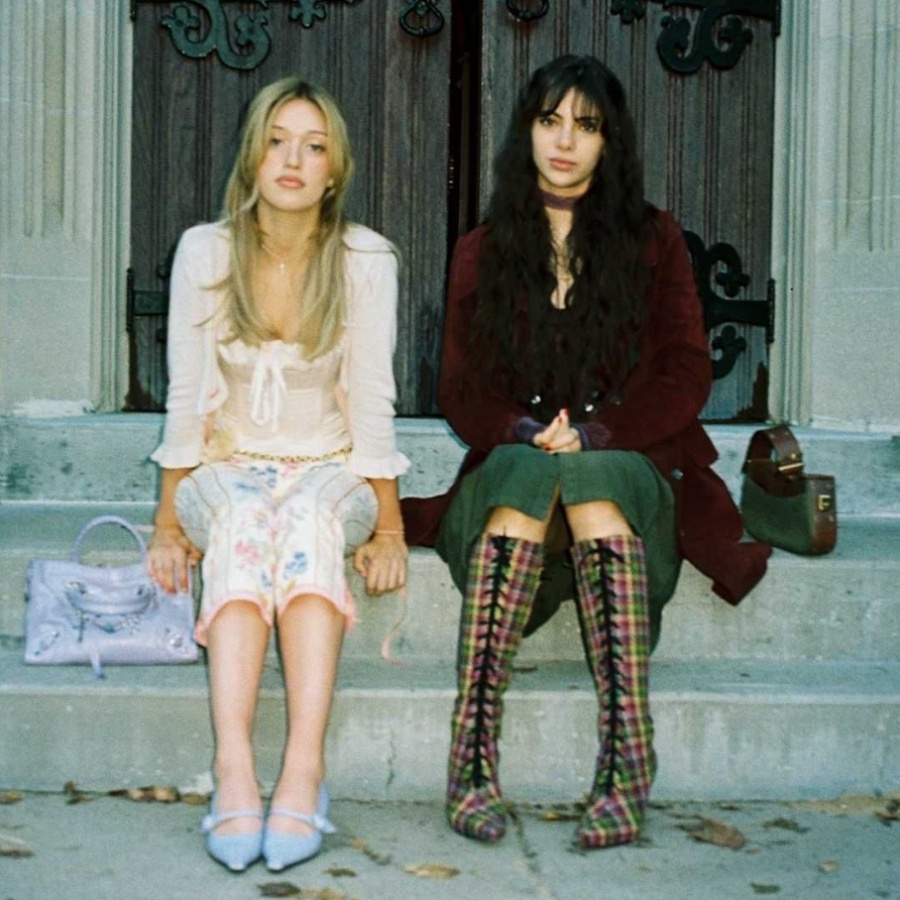
A still from the Tory Burch Ssense campaign photographed by John Yuyi
Laufey at the 2026 Met Gala in a custom Tory Burch look
Beyond fashion, Burch has also made women’s empowerment a central part of her business. In 2009 she established the Tory Burch Foundation, a non-profit dedicated to supporting female entrepreneurs. For Burch, the idea was always that commercial success and social impact needn’t exist separately. In fact, she believes one can—and should—make the other possible. Over the years she’s repeatedly referenced India—the note for fall/winter 2026 mentions cardigans gilded in badla embroidery, hand-done by artisans in India—and increasingly that’s meant spotlighting organisations that support female artisans in the Subcontinent.
Burch was recently in Mumbai for a whirlwind of events that concluded with the Earthshot Prize, an environment-focussed award founded by Prince William. We caught up with Burch during her visit to talk about the evolution of her brand, the women who inspire her, and why fashion and purpose go hand in hand.
You were hosted by Isha Ambani for dinner at Antilia yesterday. How was the morning after?
It was lovely. I’m staying at the Taj [Mahal Palace]. I didn’t work out today, but I usually do at least three or four times a week.
What’s your morning routine usually like?
If I want to work out, I have to wake up by 6 am. Otherwise it won’t happen. In New York I usually do my own workouts—although I want to do more Pilates. I go to the gym and get on the elliptical or the treadmill. I listen to music. Read a book, spend time with my dogs, [miniature poodles] Chicken and Slim. It’s really fun to have dogs; my parents raised German Shepherds, so I’ve always grown up around them. I love sports, so sometimes I play tennis as well, especially in the summer, but I’m in office by 8:30 am.
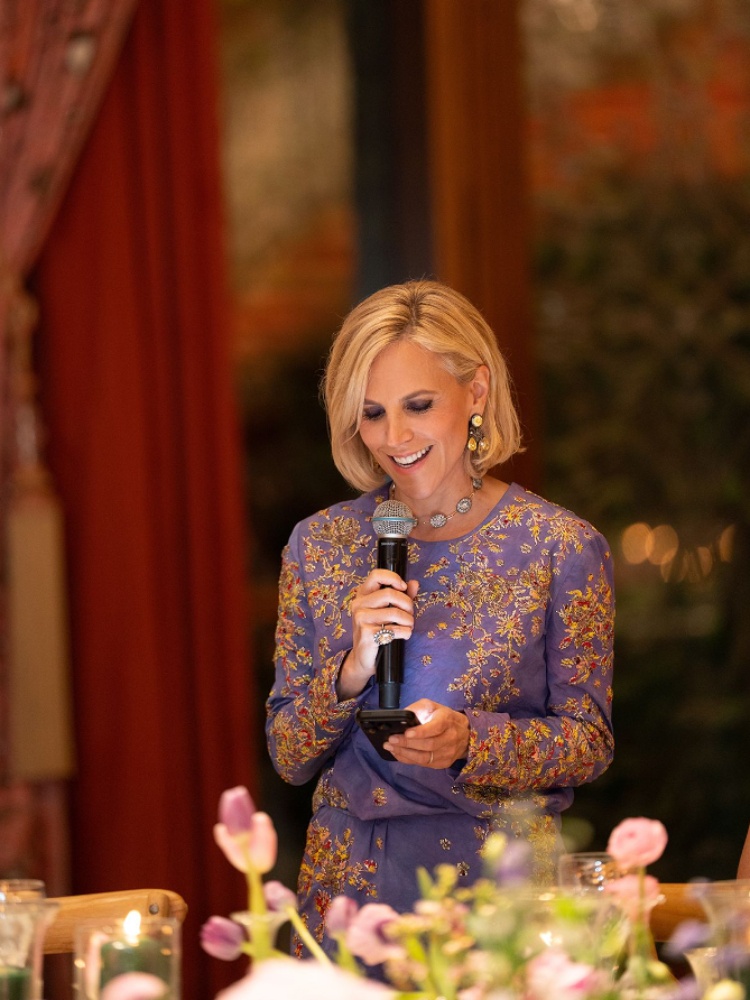
Burch at the dinner hosted by Isha Ambani in Mumbai
The designer at Swadesh, looking at a bandhani demonstration
How was Bhutan? Did you make the climb to the Tiger’s Nest Monastery?
We did. It was more intense than I thought, but it was also so beautiful. I said to my friends, “Look at all these older women and men. They’re climbing it with their bags and babies and they are fine, while we are making it seem like a huge challenge.” We also met the king of Bhutan, who was so wonderful.
You’ve travelled to India before?
I’ve been all over the north. My first trip to India was when I was 19, and I went hitchhiking around the country. It really changed my perspective on how I saw things. The use of colours, the spices, the people; the sensory experience was something I had never experienced before.
Your fall/winter 2026 collection mentions badla embroidery done by artisans in India. Why was it important to you to acknowledge that?
I’ve always been interested in highlighting the work of women. We work with a company called Nest, which specifically collaborates with women artisans in India, along with many other companies. I want to do a lot more of that moving forward. I love highlighting beautiful craft work and doing a take on it that’s not so literal.
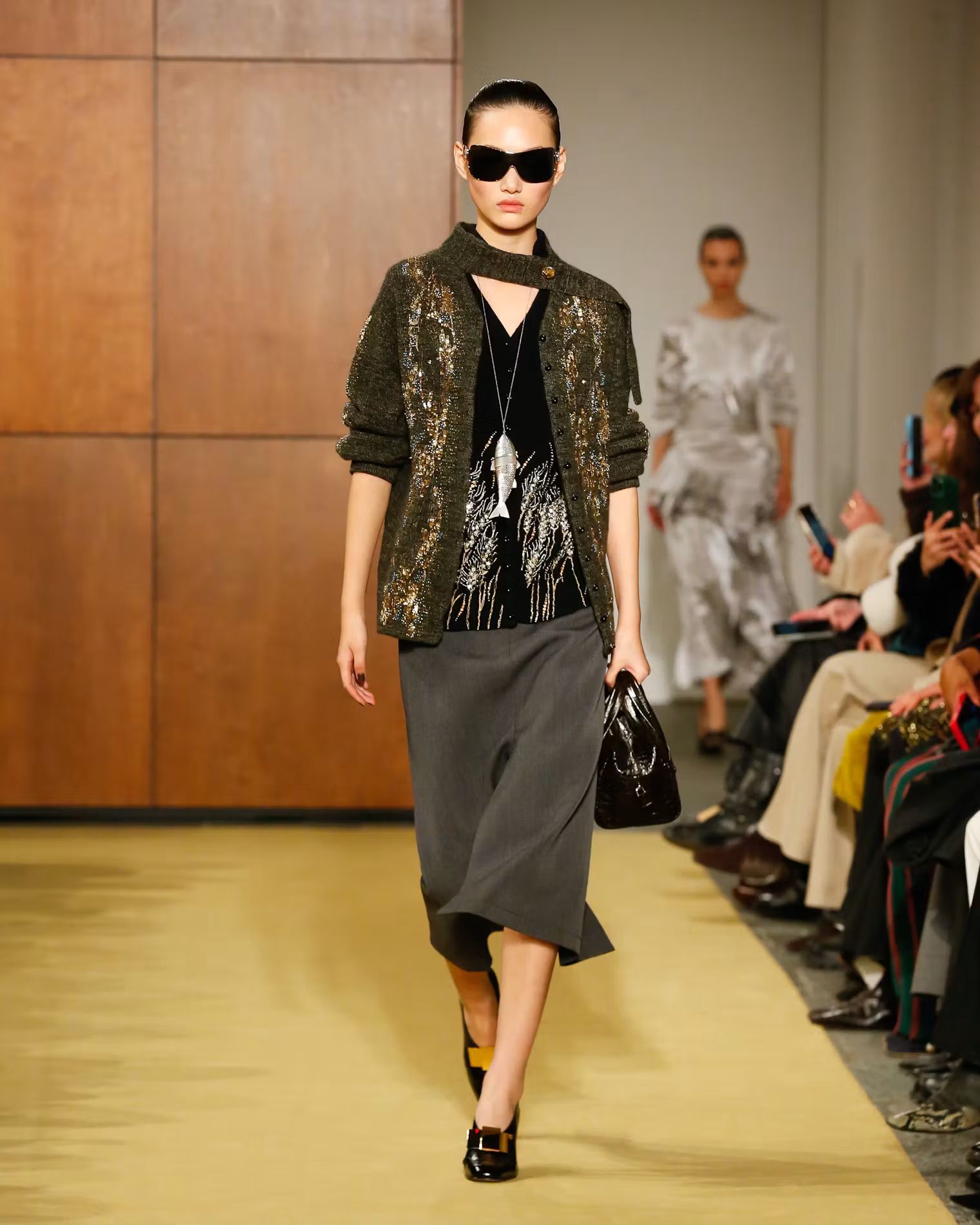
Tory Burch fall/winter 2026
You’ve always been clear that fashion is a way for you to talk about other things—like the women artisans you mentioned. When did that become important to you?
Ever since I was little, I wanted to help women and children. My mom told me that even when I was four years old I would talk about that. I’m not sure where it came from, but positive change is something I’ve always been interested in. So, when I started the company I thought there had to be a way to have purpose be good for business, and vice versa. I knew that if I could build a successful business, I’d be able to start a foundation. And the foundation would help women. That was my starting point.
Growing up, did you have many female role models?
Funnily, I didn’t have a lot of women role models. I grew up with three brothers. But my mother was an entrepreneur herself; she started a flower and party business and I think that really struck me as something very impressive and empowering, that she had something of her own. She always taught me to be independent—also financially independent. And financial independence for women is the answer.
Even with your collections, you’re constantly referencing cool women, like collector Bunny Mellon for fall/winter 2026 or socialite Lee Radziwill in 2018.
Over the years we’ve called out so many women. And it’s funny when you think of it: most of them are over 80 or 90 years old now. They are women who lived a life. Women and men too—David Higgs, Robert Kime, Lee Radziwill, Kenny [Kenneth] J Lane. For me it’s really about highlighting the women who didn’t get the recognition they should have. We have a fashion blog that I started 17 years ago and I was always using it to highlight the work of others artisans or designers, which people thought was so strange.
Is there someone whose work you’ve seen recently that you really enjoyed?
Just before I left for India I went to Alexandre de Betak’s light show at Salon 94 in New York. Alex used to produce our shows. He’s one of the most respected and renowned fashion show producers, but he’s just done his first art show. He had these big installations made of very old-fashioned lights. It’s beautiful.
You also won the CFDA award. Congratulations.
Yes, we won the Positive Change Award. It was exciting. We also just won the 2026 Hillary Rodham Clinton Award, so I’m very proud of the [Tory Burch] Foundation and our work with women entrepreneurs.
How do you see the Foundation growing?
I see us impacting millions of women.
What are some of the more interesting pitches or ideas you’ve seen get funded by the Tory Burch Foundation?
We have so many different kinds of businesses, from the food industry to science, AI, even a chocolate company. I always remember this one empanada company [by entrepreneur Pilar Guzmán]. When we met her, she had been turned away from 10 different banks for a loan. Now she’s doing $30 million in sales.
When you started out, who guided you on the business aspect of it all?
Listen, I started it with my ex-husband [Christopher Burch]. We worked on it together and around 120 friends and family invested. I was terrified of taking people’s money at the beginning. I said, invest what you can lose. That’s the only time we’ve ever raised money from outside. I don’t know if I had any specific role models in business, but I surrounded myself with people I admired. That’s something I’m very good at. Great people who I would constantly be calling for information as I learnt on the job.
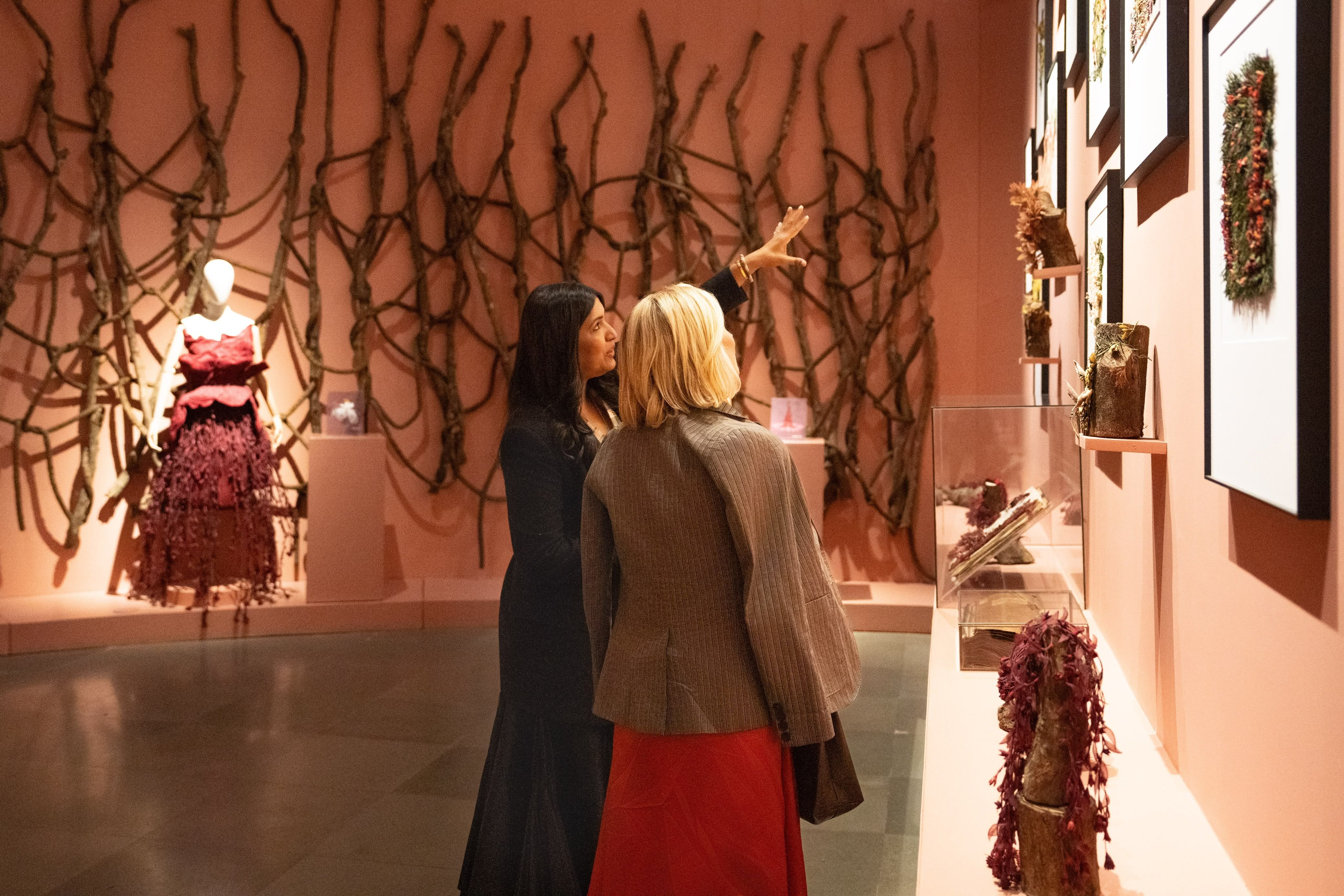
Burch with Karishma Swali at Chanakya’s ‘Garden of Gestures’ exhibition
What is your plan for the rest of the day now in Mumbai?
We have a lot of different stuff to do. We’re going to Swadesh, the Chanakya studio as well. And then of course we’re here for the Earthshot Prize too, so we’ll go for cocktail hour there.
If you had to spend a week in India just to look at design and culture specifically. Where would you go?
To southern India, maybe Kerala, just because I’ve not been there at all.