



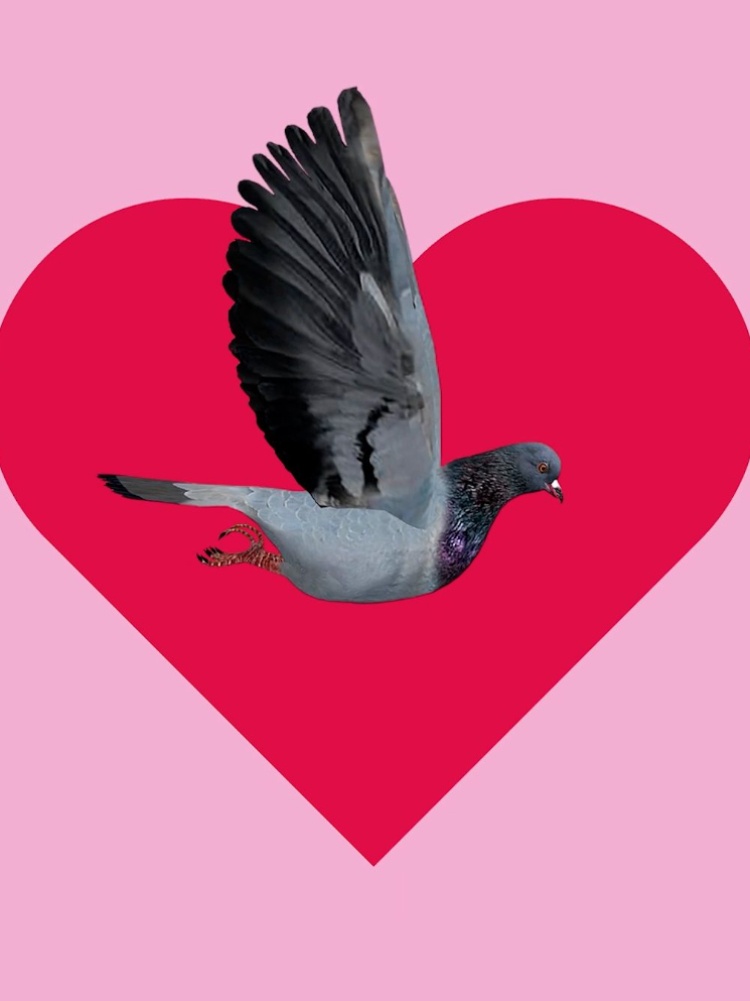

By my bedside is a pigeon with a private message tied to its orange claws, a miniature model handcrafted by Juhu Beach Studio. When it was gifted to me on my birthday this year, I was thrilled; only someone who really understood me would know how much I’ve come to adore these common city birds that we’ve been taught to revile since childhood. That you shouldn’t just ignore them but shoo them. That they’re not just plain and unremarkable (have you even seen those iridescent flecks of green and purple?) but far worse—foul pests, “rats with wings”.
Unfortunately for any pigeon haters, today you will find just as many pigeons on social media as you do offline in whatever city you call home. Some months ago, on the podcast Las Culturistas, actor Sarah Paulson passionately defended these grey birds not even pausing to breathe, as she listed countless reasons—like how they adorably mate for life—before declaring, “Pigeon hate must be stopped.” In an illustrated carousel, cartoonist Sophie Lucido Johnson asks, “Do you have any idea how lucky we are to live on earth at the same time as pigeons?”
Elsewhere on the internet, there is a story on GCN that declares we cannot leave these birds out of the queer revolution. And in Instagram, a premier resting spot for canine and feline videos, I’m one of the 1.6k people who have shared a video shot to the theme song of Om Shanti Om (2007) capturing a pigeon helpfully building a nest for a pregnant cat.
Like me, many Gen Zers are reevaluating their opinion on the common bird, realising their blind hatred is taught, unjustified, and misguided. After all, like us, pigeons too are victims of capitalism. “It’s mostly just bad PR and the fact that they’re so abundant,” responds 27-year-old Arshil Syed, giver of the aforementioned Juhu Beach Studio messenger pigeon, when I ask him why people hate these fragile birds so fiercely. “You see them everywhere, so there’s no novelty. Then you hear they’re like rats, get bird poop on your parked car and the AC vent on your balcony. All the good stuff about them is forgotten and they’re only perceived as a nuisance.”
But the good stuff is ample: pigeons can play ping pong, rule the racing circuit, do basic math, identify cancer cells, differentiate Impressionist art from abstract. Like your home pet, they love cuddles and head rubs. Even their poop, so dreaded in cities, is actually an excellent fertiliser. But mostly, as Syed says, they have a bad rep.
For roughly 10,000 years, since they were first domesticated, people have loved pigeons. Ancient Egyptians released a flock into the sky to announce the rise of a new pharaoh. Roman and Persian empires and Mongol ruler Genghis Khan had extensive networks using carrier pigeons for communication. Until the end of the Second World War in 1945, the birds served as hack-proof communication tools when regular radio comms were susceptible to being intercepted. For their service, 32 pigeons received the prestigious Dickin Medal.
In South Asia, these birds were always a bit of a hyperfixation, especially for the Mughals: Akbar kept a royal aviary of over 20,000 pigeons. Almost every noble man had a kabootarkhana in his residence; even now, the ancient art of kabootarbaazi, or pigeon-rearing and racing, is alive in parts of Old Delhi and Kolkata. Remnants of this glorious past are depicted in Jodhaa Akbar (2008), when a tearful Aishwarya Rai sits on a balcony surrounded by white fantail pigeons who don’t GAF about her tears and just want to be fed, dammit.
In fact, the bird was once Bollywood’s favourite extra: in Dilwale Dulhania Le Jayenge (1995), Amrish Puri feeds pigeons at Trafalgar Square, comparing himself to the migrating birds in his longing for home. In the iconic ‘Kabootar Ja Ja Ja’ song from Maine Pyar Kiya (1989), a pigeon becomes a messenger of love. In ‘Masakali’ from Delhi-6 (2009), these birds symbolise freedom. Unfortunately, with the narrative of pigeons as pests taking hold, this motif seems to have vanished entirely from recent filmography.
It was in 1963 that things started going downhill for pigeons, when a story in The New York Times linked them to two human deaths. The article was later proven to be untrue but the damage was done: a billion-dollar pest control industry had cemented itself and the stigma continues to follow these birds today.
Pushkar Raghuveer, who works in environmental and social governance, once had a vendetta against pigeons. The 24-year-old concedes, “Combine their numbers with rampant warnings that they are evil, deadly, disease-spreading birds, and it makes sense why there is such bias against them.” This revulsion is reflected in our daily lives as well as recent laws, with kabootarkhanas across the country being permanently sealed, hefty fines in place for simply feeding pigeons who are unfortunately domesticated to depend on us for food. The birds are also victims of frequent animal cruelty: kicked, pelted with rocks, eggs and nests destroyed, killed and maimed en masse.
But in a rare positive effect of social media, Instagram made both Syed and Raghuveer reassess pigeons. For Syed, it started with a photo of one Gustav the pigeon in the ’80s receiving the Dickin medal that led him down a Wikipedia rabbit hole. For Raghuveer, it was a comic strip in which a baby pigeon tries to make human friends and is repeatedly rejected.
For Gen Z, these birds now feel like long-lost friends, representing something deeper: that capitalism endangers lives, first exploiting, then discarding when we are no longer useful. “You can tell a lot about people by how they feel about pigeons,” reads a popular tweet. Maybe this outpouring of love comes from the fact that this is one of the few things going on in the world today that we can still fix: how hard is it to not crush a pigeon egg or to scatter some grain near your house? We can still do good by pigeons who we abandoned and forgot once technology rendered them obsolete. And yet these chubby birds still remember to love us, staying nearby, building nests in our windows in the hopes that we will protect them. As researcher Tori–who runs an Instagram account researching history–writes: “We taught them how to come home, we just forgot to be there when they did.”