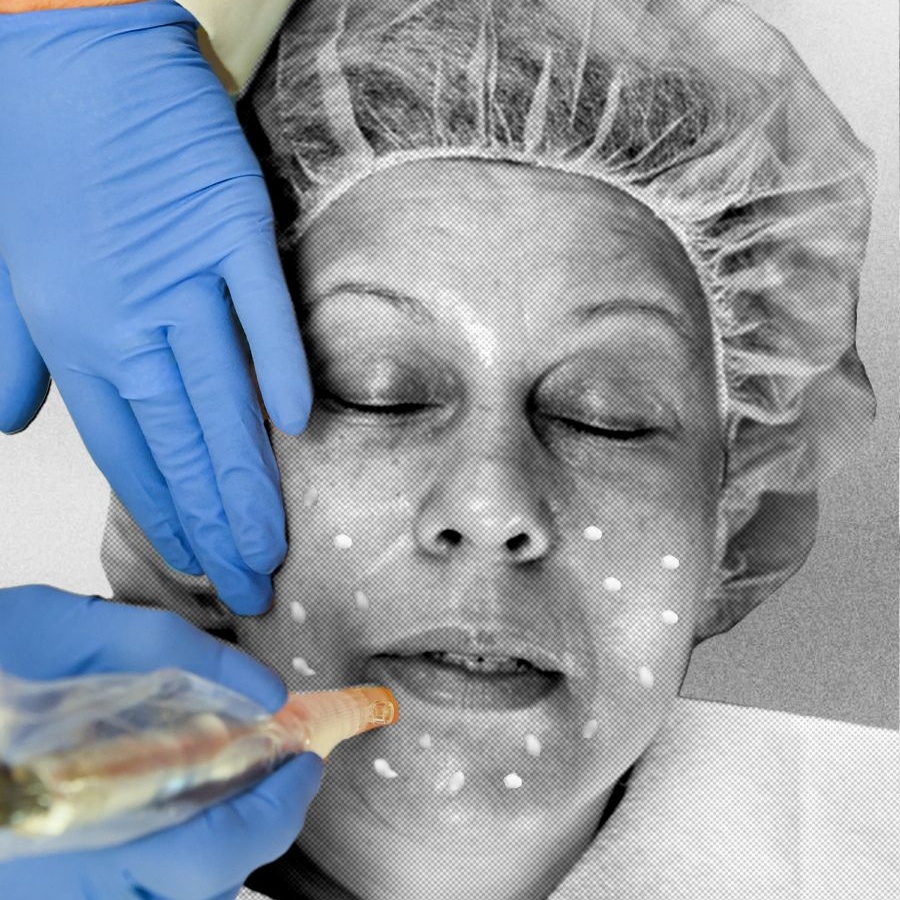

We’ve had lasers, ultrasound, microneedling, and enough collagen talk to last a lifetime. The latest treatment vying for a spot on that ever-growing list is XERF (extended energy radio frequency), a Korean radiofrequency technology that promises firmer skin without needles or surgery. Kim Kardashian has called it her “new fave tightening laser”, while Priyanka Chopra Jonas shared a video of herself undergoing the treatment in May 2026. Now, XERF has arrived in India, with sessions costing upwards of ₹1.5 lakh. But is its dual-frequency technology a meaningful advance in skin tightening or simply the next thing we’re being sold?
Double the frequency, better the results?
Radiofrequency (RF) is the old reliable agent of skin tightening. It heats the tissue under your skin, which makes existing collagen contract and nudges your body into making more over the following months. Most RF devices, including Thermage, run on a single frequency: 6.78 MHz. XERF, made by Korea’s Cynosure Lutronic, adds a second. Each pulse fires 6.78 MHz at the upper dermis, where texture and fine lines live, followed by 2 MHz, which goes deeper. A cooling spray keeps the surface comfortable while the layers underneath take the heat.
Its shallow, medium, and deep settings deliver “targeted volumetric thermal deposition across different dermal layers”, according to Dr Meghna Mour, co-founder and medical head of Skuccii Supercliniq. Translation: heat aimed at the layer that needs it. The deepest of those include the fibrous bands that hold your face up and the SMAS (superficial musculoaponeurotic system), or “the layer that is tightened during a facelift”, says Dr Madhuri Agarwal, founder of Yavana Hair & Skin Clinic, Mumbai. XERF’s other big rival, Ultherapy, isn’t RF at all but focused ultrasound, fired at fixed depths. In Dr Agarwal’s experience, ultrasound does more for contouring fuller faces, while RF does a little more for texture.
So, is XERF better? Neither doctor will say so. “Robust clinical evidence proving it reaches deeper tissue layers more effectively than these established systems remains limited,” says Dr Mour. Here’s what exists: two developer-led studies on pig skin and one human study, published in August 2026, that looked back at 16 women treated once at a single clinic in Israel. Its own authors call the findings preliminary. And there’s no head-to-head trial versus Thermage or Ultherapy. Translation: promising, not proven.
Is XERF for you?
The sweet spot, Dr Mour says, is mild to moderate laxity on a face that still has its volume, with fine lines rather than deep creases. Dr Agarwal says candidates are often in their mid-thirties to early fifties. In a small study, the upper eyelid crease improved most consistently, while pores, evenness, and oiliness also looked better at three months.
If there’s significant excess skin, loose neck tissue or pronounced facial hollowness, XERF may not be the answer. “Tightening a deflated balloon does not refill it,” says Dr Agarwal. On a very lean face, Dr Mour warns, RF “may accentuate gauntness”. It’s also unsuitable for people with a pacemaker or other implanted electronic devices, those who are pregnant or breastfeeding, and anyone with an active skin infection. Be sure to share your full medical history with your doctor.
As for the sharp jawline promises on your feed, Dr Mour stresses, “Claiming that a single treatment can give you a sharp jawline is misleading.” A jawline is skin, fat, muscle, and bone. Depending on what’s softening yours, the answer might be Botox for the masseter, filler, Sculptra or threads. RF tightens skin. It doesn’t rebuild what’s underneath.
That immediate post-treatment lift isn’t entirely an illusion. Heat causes existing collagen fibres to contract, while some temporary swelling can add to the effect. The swelling settles within a week or two. The real change builds slowly: texture may look subtly better at one month, and by three, fine lines start to soften. Dr Agarwal estimates results last about a year, though that’s based partly on other RF devices, not long-term XERF data.
The melanin question: is it safe for Indian skin?
Mostly, if the hands are right. RF doesn’t target melanin the way lasers do, says Dr Mour; it heats tissue beneath the surface while cooling protects the top layer. The trouble starts when something goes wrong up there. On Indian skin, a burn or blister can leave pigmentation that takes months to fade, especially with sun exposure, says Dr Agarwal. Cooling and temperature monitoring help, but energy settings, the number of passes, and technique over bony areas like the jawline are down to your dermatologist.
Then there’s fat loss, a known concern with high-energy monopolar RF. “The machine itself does not inherently cause fat loss,” says Dr Mour. “It occurs only when improper parameters or excessive energy are applied to areas with low baseline facial fat.” In other words, the device is only as good as the person holding it. This is not one to book at the cheapest clinic on your lunch break.
Is XERF worth the hype—and the money?
A session in India costs about ₹1.5 lakh to over ₹2.5 lakh, estimates Dr Agarwal. A full face takes 30 to 60 minutes, and you may need one or two sessions, two to three months apart. ‘No numbing’ doesn’t mean painless: she describes it as “brief, intermittent hot pinches”. Expect redness for a few hours (occasionally a day or two) and maybe some puffiness. Most people go back to work the same day.
Prep is low-key. Check with your doctor about pausing retinoids, strong actives, and exfoliating acids for a week before the treatment. Afterwards, skip saunas, steam rooms, and hot yoga for 24 hours, and do not skip sunscreen.
To decide if it’s worth it, Dr Agarwal suggests thinking in terms of “value per visible change”. If ₹1.5 lakh buys a firmer jawline for a year, compare that with what the same money gets you in threads, biostimulators or a combination plan. Dr Mour’s rule is simpler: don’t choose a clinic on price. Injectables like Sculptra and Profhilo need several sessions plus top-ups, so the math depends on your plan. She sometimes pairs XERF with biostimulators or skin boosters, but not everyone needs the full stack.
XERF is a genuinely new spin on old, reliable tech, but the evidence is early and the price is steep. For the right face, it can mean subtle, natural-looking firming. Just don’t expect a whole new jawline.