Amit Aggarwal likes his coffee strong, his stores grey, and his television silly
At the launch of his new store in Kala Ghoda, the designer talks to The Nod about his daily rituals, favourite chick flicks, and returning to Lakmé Fashion Week with AM:IT
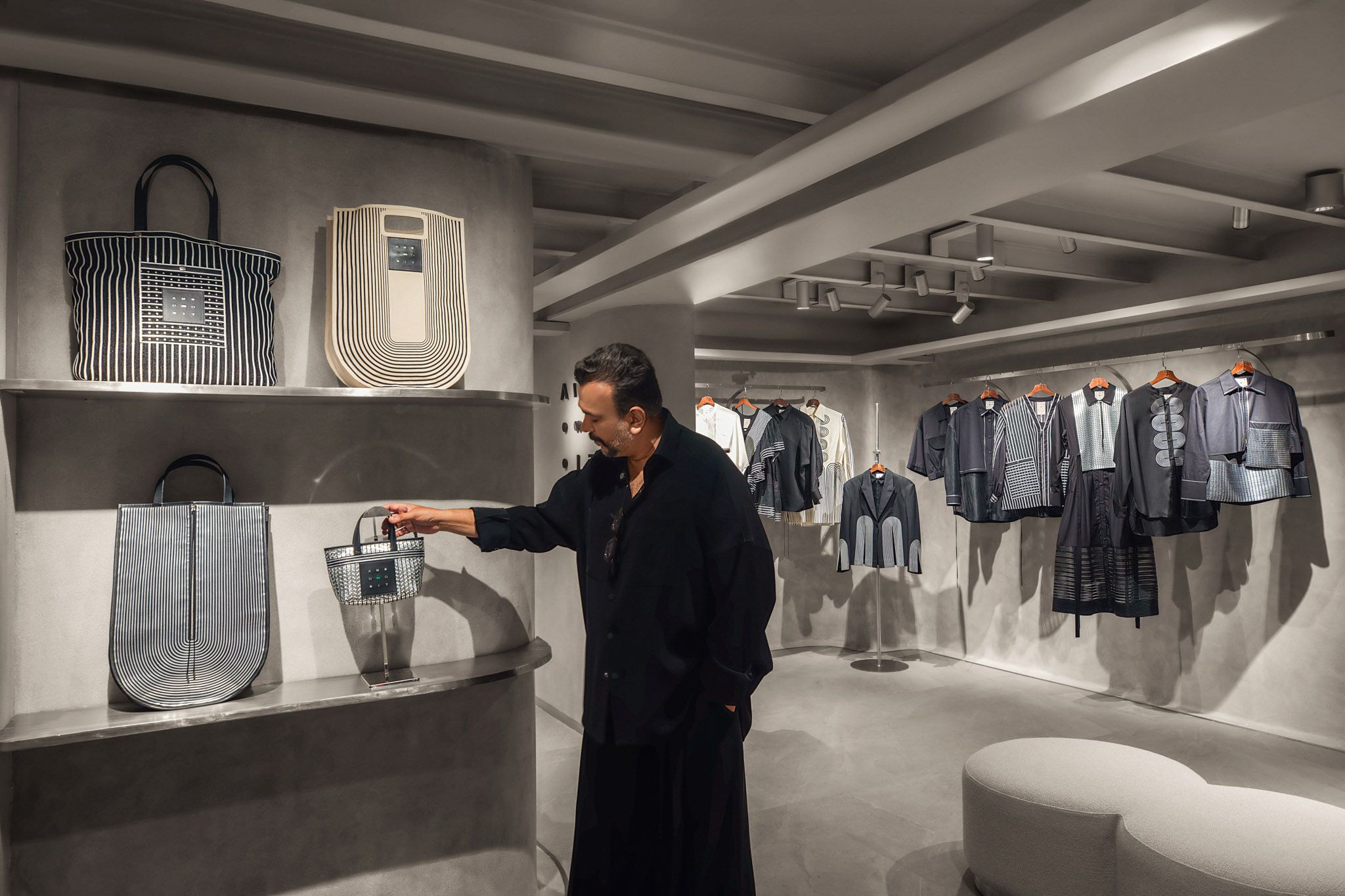
Amit Aggarwal has a new address in Mumbai. In the heart of Kala Ghoda, a stone’s throw from everyone’s favourite local haunt, the Kala Ghoda Café, the designer has opened his largest store yet: a two-level 6,000 sq ft flagship housing not only his womenswear and menswear couture and occasionwear but also his recently launched ready-to-wear line, AM:IT, alongside a preview of the brand’s upcoming accessory line, which includes brass minaudières and evening clutches.
Upon entering the main space, you’re greeted with a large lacrimiform concrete sculpture suspended from the ceiling. It’s a pod. “For me, the pod is a symbol of the seed, which can grow into endless possibilities,” Aggarwal says, while leading a group of journalists through a walkthrough of the monochrome grey store. Is grey his favourite colour, I ask. “I just feel that it doesn’t scream for attention and allows other things to take centre stage. I find it quite unassuming and non-judgemental,” he says. Interesting adjectives for a colour, but they make sense here.
ADVERTISEMENT
A 13-foot concrete pod, a recurring symbol part of Aggarwal’s design language, anchors the store
The space is designed by Niket Deshpande of Thotpot Designs
The trial rooms are spacious, designed keeping couture fittings in mind
The store also includes a preview of the brand’s upcoming accessory line
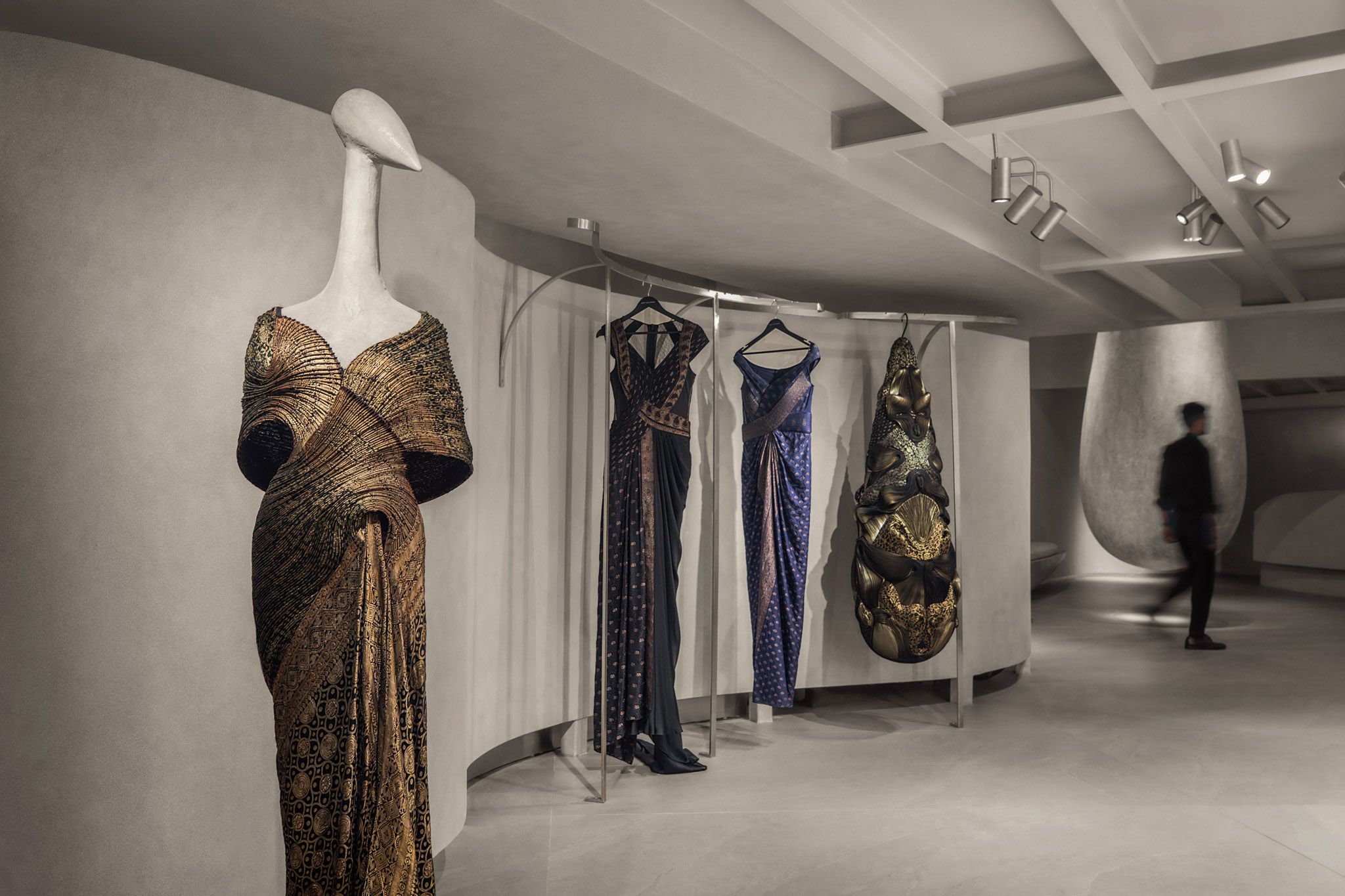
The store, incidentally, is a fantastic space to meditate. As soon as you step inside, the cell signal drops to zero bars. There are no storefront windows either, giving the space the feel of a serene, sophisticated cave. With very little competing for attention, you’re left to properly look at the garments and dive into each creation: his series of gowns that use vintage Benarasi and patola textiles that are pleated, twisted into fine tubes and encased in polymer, reworked into pieces of art; easy AM:IT separates; and Aggarwal’s latest experiments with chikankari, spliced with lace, rubber cord, and recycled glass.
Below, the designer lets us in on the rituals that structure his day, switching gears between couture and prêt, and his enduring love of “silly television”:
What did you do yesterday?
We did the first round of fittings for the [AM:IT] show [he’s the finale designer at the upcoming Lakmé Fashion Week] until 4:30 pm. Then, I rushed to the airport to catch the flight to Mumbai, which, of course, was delayed. We landed around 11pm, came to the store, and everyone had already done a fab job. I just had to tell them they’ve done fabulously. Then, Ankit [Chawla, his partner] and I headed to the hotel, had a very late dinner, and crashed without knowing what time it was.
Did you order room service?
Yes. Ankit is a big fan of pan-Asian—it’s his favourite cuisine. He went for dan dan noodles, and I did a bhetki with mashed potatoes and a little slice of white bread.
How do you start your mornings? And was today a usual morning for you?
It wasn’t a usual morning today because, of course, I don’t wake up with a fabulous sea view every day. I am a late sleeper. So, to jolt myself up, I need my day to start with a very strong black coffee with a dash of sugar. While I’m having my coffee, my two little dogs [Ichi and Tubby] are usually waiting for their first treat. After that, I shower, reach for the closest black outfit in my cupboard, and I’m off to work.
What time do you usually wake up?
I generally wake up at 8:30. I can do earlier, but I’m more active and my mind is more receptive in the later hours.
Aggarwal in the AM:IT section of the store
You opened your first Mumbai store in Colaba in 2021 not too far from here. What made you want to move back to Kala Ghoda?
I do feel Kala Ghoda is really the hub of art, culture, food—everything that’s dynamic and inherent to the growth and sustenance of art. It’s not easy to find a good retail space here. It’s been over three years since I started looking for a place that could centre all the verticals of the brand. I also feel that the kind of people who end up coming to the store here are from different walks of life, which also allows the brand to be exposed to more people.
You’re originally from Mumbai. Do you miss living here?
Strangely, no. I moved to Delhi for my studies at NIFT and I feel it’s where I really grew up and experienced a sense of freedom first. So, Delhi is what I now call home. My parents still live in Mumbai.
Do you visit them often?
Actually, they’ve been visiting me more often than I do.
Oh yes, you have a new home in Delhi! Is that also all grey?
It’s strangely not as grey. The ground floor is all eggshell and ivory, the first floor is terracotta and a warm mud colour, and the third floor—which is my floor—is grey and it’s darker than this [store].
Are there any design parallels between your personal space and your stores?
This store is closest to what my home feels like at first glance. However, at home there’s a level of tension between the floors as you go from one to the other. This is, of course, more equanimous, because I didn’t want feelings to change while a person shops. I think that once a shopper enters the store and centres themselves, the surroundings should make them feel equanimous and they should be able to make a decision with just that one feeling.
Who designed the store?
I always knew what the store needed to feel like. However, I was lucky to have met Niket [Deshpande of Thotpot Designs], who took that feeling into smaller nuances of retail—like how the customer walkthrough would happen. Just great clothing cannot always account for a customer sale. How they feel, how they experience and move through the space is also an important part of it.
This was a challenging project, because it is a heritage building. When we first got the space, the inside was as abstract as a Picasso painting, with all the corners jutting out and the different pillars coming out of the walls. Niket brought it to a great sense of coherence. We had the team at the studio come up with furniture ideas, and how our forms can translate into actual seating areas and utility products. Niket was elemental in fine-tuning those ideas and getting them fabricated.
ADVERTISEMENT
The monochromatic space is accented with furniture designed by the studio
The 6,000 sq ft store is spread across two floors
Is there anything that you must do every time you are here in Mumbai?
The minute I land, I come directly to the store most of the time, and the store manager keeps my vada pav from Aram ready. I don’t know of a lot of places now, but she recommends Aram as the finest and I really like it. That’s one ritual I cannot go without.
Are your processes for designing couture versus designing AM:IT very different?
I would say AM:IT is very fun, vibey, and in the moment—if I have met with a sudden crash of energy from something I’ve seen or a conversation. The great advantage of ready-to-wear is that you can translate your idea into an actual product very quickly. I think fun is the bedrock of its birth. Couture is like a slowly brewed coffee or aged wine that takes its own time. From the germination of the idea to the first swatch and then the final product, it is a painstaking, long process. One entails a lot of patience with a big payoff at the end, while the other injects a lot of excitement, like khat-khat-khat. However, looking at the end product excites me no matter what.
As someone who marries technology with traditional crafts, what’s your take on AI in the creative process?
Fortunately or unfortunately, I’ve had a lot of fun with AI. I got hooked on Discord and Midjourney almost six years ago. I dabbled in it for a few years, but it kind of got overwhelming after a certain point because I wouldn’t stop. Today, I feel that the tool is extremely helpful. It can help you expand your imagination in a million ways. My take is, I first like to visualise something myself and then attempt with AI and see which one my subconscious settles with more. Of course, any tool is like a double-edged sword. You can kill or save a life with it.
You have the AM:IT show at Lakmé Fashion Week coming up. Are you excited?
Nervous and excited both. I’m nervous because AM:IT comes back after many years. I was way younger then, with way lesser responsibilities, the first time around. There’s a lot more happening today than the brand was doing eight or 10 years ago. So, honestly, it feels like a lot. I am nervous about its reception but it’s going to be a fun show for sure.
How do you usually celebrate after a show?
The team knows I’m not someone who’s going to take them out to a big party, so generally the team comes over to wherever I’m staying. Because no one’s eaten throughout the day no matter how hard they’ve tried, we call in for a big in-room dining order and open a few bottles of whatever everyone likes to drink. I like to end with a big celebration with the ones that made it happen. They’re the only people I like to celebrate with.
You’ve had a packed year between relaunching AM:IT, going to Cannes, dropping multiple campaigns, and opening the new AM:IT store in Delhi and now this flagship in Mumbai. I read you and Ankit are terrible at taking holidays. Is that true?
Sometimes, we get extremely greedy. I mean, I have one of the finest photographers travelling with me, who’s always excited to shoot. Whenever we’ve travelled, we’ve always found a muse. Sri Lanka was actually planned as a quick getaway between both of us. When we were going, we thought, since some prototypes from the new AM:IT drop are done, why don’t we take that along? And that became a big production and resulted in an AM:IT campaign. By the end of the first three days, we got so exhausted that we came back. The holiday was supposed to be seven days. But yes, we are bad at taking holidays.
Do you have your next one planned?
We don’t really plan our holidays in advance. I think it is the next visa-free country that will take us. We’ll be there.
Gowns crafted from vintage textiles
How do you usually wind down?
After I come back home, it’s mostly silly television. I like to end my day with either a romcom, an old chick flick, or some K-drama. All of it is so brainless that it helps me unwind. A little chatter with the dogs but that’s it. Sometimes, a little bit of research on Instagram.
What’s a chick flick you love rewatching?
There are multiple, Bridesmaids being one of my most loved. I can have Melissa McCarthy next to me at any point in my life. I do also really enjoy Two Weeks Notice. Sandra Bullock is another favourite of mine. And then Legally Blonde, of course.
I did. I don’t think anyone can match Reese Witherspoon. This was nice, but that era, of course, is a lot more relatable to me. I do feel those interjections are a lot funnier than the new one. I did binge watch it in a day though.
Do you have a nighttime skincare routine?
I have a skincare routine. Unfortunately, I’m not great at managing that. I’ve been to the best dermats and they recommend things I don’t do and then I’m too embarrassed to go back to them. So, I’ve had to shamelessly change doctors.
I do like a splash of natural coconut oil on my face, especially in Delhi winters. It helps me feel fresh. Otherwise, it’s just moisturiser and sunscreen.
What does tomorrow look like for you, both literally and figuratively?
Figuratively, I don’t believe in tomorrow. I am a person who lives in the moment. I don’t plan for the next day. Sounds very wrong from someone who has to handle a business, but that’s what I believe in. I have a vision, but that’s not tomorrow.
Otherwise, I’m already anticipating a great breakfast, because I’ve skipped all meals today. I have an ordeal of a flight back to Delhi and then I’m heading straight to the studio, because I have a looming deadline. Very excited to see a few pieces that were in the pipeline and putting together more. It’ll be fun.