



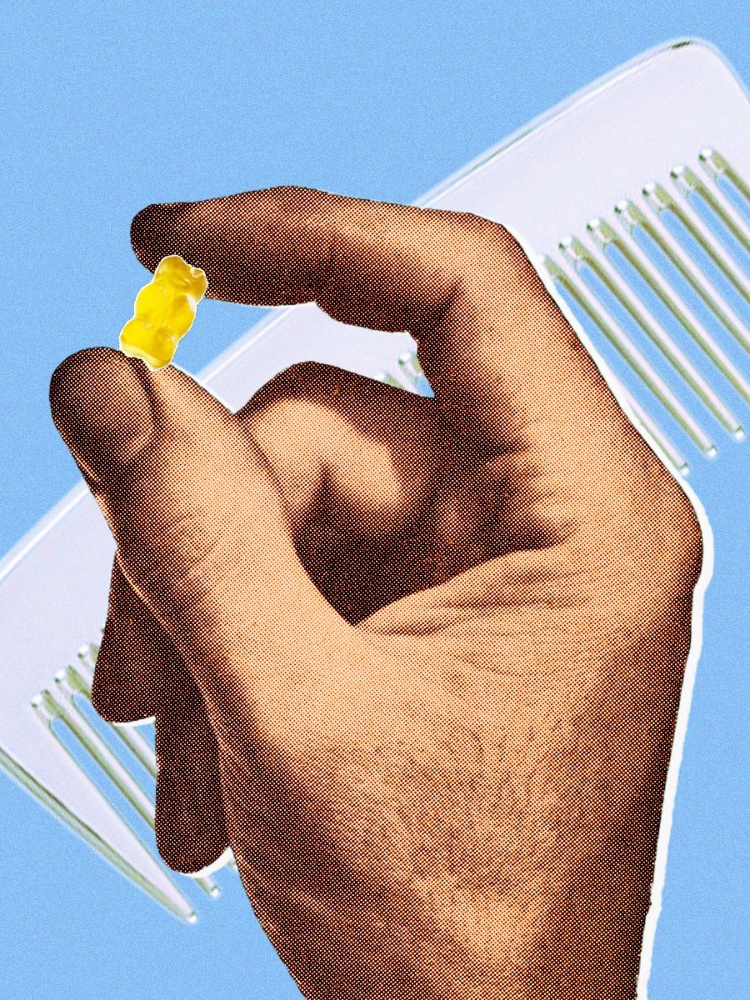

Somewhere between your fourth hair-growth reel and a genuinely alarming amount of hair in the shower drain, you probably considered it. The gummies, the amber bottles and the collagen powder that promises to make you biologically 24 again. Biotin has become the default setting so fast it’s almost impressive. Hair falling out? Pop a pill. Your friend’s hair falling out? Chug a powder. Your algorithm? Full of brightly labelled bottles with tall claims.
Your excitement for supplements notwithstanding, dermatologists are increasingly done with it. “Biotin, especially, is probably the most overhyped supplement in the hair space today,” says Dr Madhuri Agarwal, dermatologist and founder of Yavana Skin and Hair Clinic, who has seen this play out in her practice on repeat. True deficiency is actually rare—biotin is produced by gut bacteria and shows up in most everyday foods. And the thing the gummy brands won’t put on the front of the bottle is that there’s no strong clinical evidence that biotin supplementation boosts hair growth in people who aren’t deficient to begin with. First signs of actual deficiency typically show up in skin, not hair. Redditors, as always, have tried, tested, and passed their verdict: “Gummies are just enhanced lollies. Save your money.” Brutal.
But wait—is your hair fall even a nutrition problem?
Nutritionist Kripa Jalan makes a distinction most supplement marketing conveniently skips: not all hair fall is caused by or can be fixed with nutrition. Genetic hair loss is hormonal. Alopecia is autoimmune. Post-illness shedding is your body in recovery mode, redistributing resources after a crisis. A gummy does nothing for any of that. Dr Agarwal sees this constantly. “Hair fall can look similar across different causes. I always emphasise diagnosis before supplementation.” Which is a polite way of saying: please stop self-prescribing based on a 60-second reel.
Where nutrition actually plays a role is diffuse hair fall, when you find your hair feeling thinner and weaker over time. And even then, it’s less about the supplement and more about the fact that hair is, as Jalan puts it, a non-essential tissue. When the body is stretched thin—the reasons could be anything from a restrictive diet and work stress to lack of sleep—hair is the first thing it deprioritises. “What we’re seeing more often is people skipping foundational habits and relying on supplements as a quick fix,” she says. You cannot out-supplement a lifestyle running on cortisol and two meals a day. The body simply isn't impressed.
The deficiencies that actually move the needle
Here's the part nobody leads with: supplements do work—just not for everyone, and not in the sweeping way they’re marketed. The deficiencies Dr Agarwal consistently flags in patients with real hair fall are iron (specifically ferritin), vitamin D, B12—especially in vegetarians—and sometimes zinc. Restrictive diets, chronic illness, post-COVID shedding (which she says has become notably more common)—these are the actual red flags. To narrow down on your specific issue, “Blood tests are the gold standard,” she says.
Jalan also notes that it's rarely one clean deficiency. “Most often, it’s a combination of nutritional gaps over time that impacts hair health.” Which explains why one biotin gummy isn’t life-changing—and why the Reddit consensus, chaotic as it is, actually lines up with the clinical data: the people who saw results were the ones who were deficient to begin with. Everyone else just had a tastier morning routine.
Your gut might be involved
Researchers are now studying what they’re calling the gut-hair axis: the idea that your microbiome has a real, meaningful relationship with hair loss. A 2024 study published in Frontiers in Microbiology used Mendelian Randomization (MR) analysis—a method that tests for causal relationships using genetic data—and found a likely causal link between specific gut bacterial species and alopecia areata, identifying 16 bacterial taxa with significant associations. Separately, a small but well-designed 2024 randomised controlled trial published in Cosmetics (MDPI) found that patients with alopecia areata who took a probiotic combination of Lactobacillus rhamnosus and Bifidobacterium longum for 24 weeks saw notably better outcomes than the placebo group: 56 per cent experienced a reduction in alopecia plaques versus 30 per cent.
None of this means your probiotic is a hair supplement now. The sample sizes are small, and the field is early. But it does mean the conversation is getting more interesting than “hair loss pill: yes or no”. The gut affects nutrient absorption, immune regulation, inflammation—all the things that, over time, affect your hair. It's the kind of finding that makes you realise the supplement bottle was always addressing the wrong floor of the building.
Why your supplement stack is probably not as smart as it looks
The other very-2026 move: stacking. Hair gummies plus collagen plus a multivitamin plus whatever your friend texted you about at 11 pm. It sounds catchy. It feels proactive. It is also, per the actual science, not how absorption works. Nutrients compete with each other in your gut. iron and calcium are the classic example; take them together, and you're essentially throwing money into a void. “More isn't always better,” says Dr Agarwal. “Some nutrients can interfere with each other's absorption if taken incorrectly.” Jalan echoes this: those 10-to-15 ingredient blends that look so thorough on the label are often underdosed on what matters and poorly absorbed regardless. You're taking more and getting less.
According to Dr Bushra Aziz, trichologist and consultant at hair supplement brand Traya, “Two people with the same symptom—hair fall—can have completely different causes. One may have a DHT sensitivity issue. Another may have an iron absorption problem. A third has chronic scalp inflammation. Giving all three the same OTC supplement doesn’t just fail to help it delays the right diagnosis and the right treatment.” This is why one-size-fits-all wellness plans consistently underdeliver. Hair loss is a deeply individual condition, and generic supplements are not designed with that individuality in mind.
OTC supplements aren’t entirely without merit in a narrow set of cases where the cause genuinely is a specific, isolated deficiency, they can help. But that scenario is far less common than the supplement industry would have you believe. For most people, personalisation isn’t a premium add-on. It’s the only approach that actually works. “Handing them the same supplement doesn’t just underdeliver. It delays the right treatment,” she says.
Multi-ingredient supplements can be more effective, but only when they are well-formulated and used appropriately. “Hair growth depends on multiple nutrients working together, so combining vitamins, minerals, amino acids, and antioxidants can create a more holistic effect,” says Dr Agarwal. However, many of these products are also very well marketed, but not all formulations are evidence-based, and more isn’t always better. “Some nutrients can even interfere with each other’s absorption if taken incorrectly. Ideally, supplementation should be targeted and cyclical rather than a blanket, long-term intake of multiple nutrients.”
So what actually works
The fundamentals. Get bloodwork done before buying anything. Fix deficiencies if they exist. Eat enough protein, sort out sleep, stress, and hormones. Use actual medical treatments, like minoxidil, which is FDA-approved and actually has the data behind it—when needed. Dr Agarwal’s non-negotiable: “Consistency and patience. Most treatments take at least three-six months to show visible improvement.”