



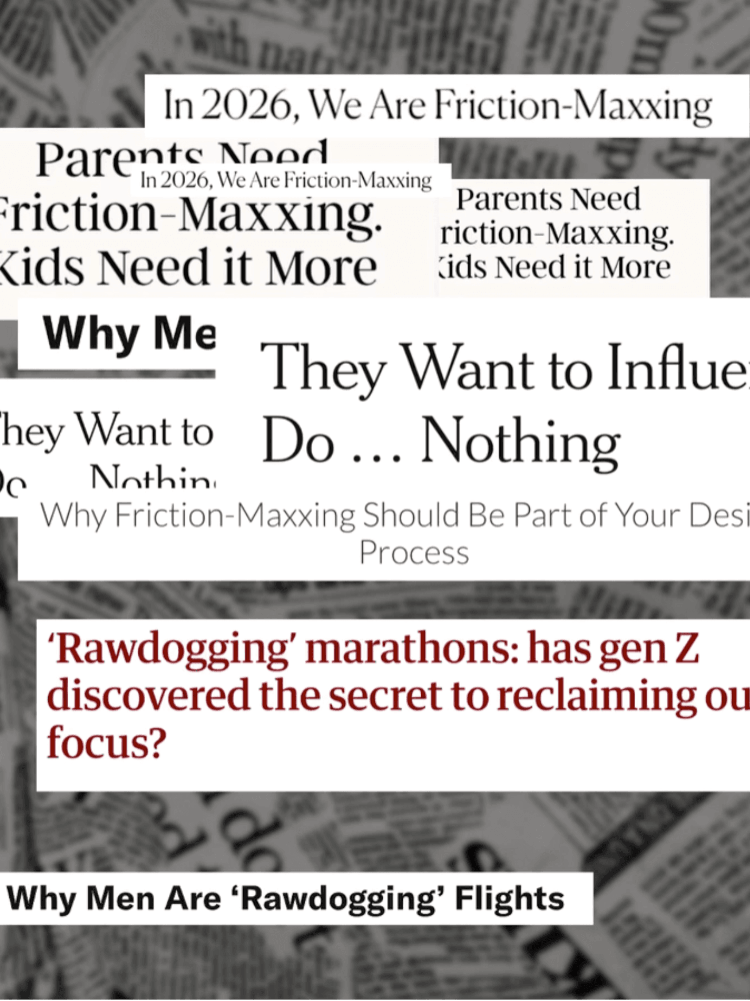
It started, as most existential crises do these days, while I was staring at a 2026 vision board. Somewhere between the “Drink More Water” sticker and a vague intention to “be less online”, I stumbled upon the concept of friction-maxxing in an article on The Cut.
The premise is simple but irritatingly accurate: We have optimised our lives into a state of relentless smoothness. We have apps for food, apps for dates, apps that tell us where our friends are, and AI bots that write our emails. But in this quest for seamlessness, have we accidentally hollowed out the actual living part of life?
Frankly, I was feeling a little slippery. So, I decided to try it. Not a Luddite revolution, and not a permanent lifestyle overhaul. Just five days of deliberately re-introducing inconvenience into my life to see if I could get some traction back.
New rules of engagement
To be clear, friction-maxxing isn’t about pretending it’s 1850. I didn’t churn my own butter. It’s about rejecting the automation of tasks that you should probably be participating in. It is about choosing “texture” over speed.
I started with raw-dogging my emails. For the last year, my inbox strategy has been “Let Gemini/ChatGPT draft it, I’ll tweak it”. It’s efficient. It’s also soulless. This week, I sat with the blinking cursor. I typed “Hope you’re doing well” and actually wondered if they were doing well. I struggled with phrasing. I felt the friction of articulating a thought rather than prompting an algorithm to simulate one.
Usually, 6 pm is when I stare at the zucchini and block of feta in my fridge and ask ChatGPT to “make me something that’ll take 15 minutes or less”. Boom. Recipe generated. Zero brain power required. This week, I pulled a physical cookbook off the shelf. I had to use the index. I had to read the preamble about the chef’s grandmother. I had to physically scan the page to see if I had the spices.
And I went shopping. Not adding supplements to a digital cart at 1 am while doomscrolling but actually walked to a pharmacy. I went to the market instead of Blinkit-ing cilantro. I prodded avocados to find the one that was perfectly ripe. I talked to a stranger about how sweet the strawberries had been this season. It took 45 minutes instead of four. I remembered it the next day.
As Mohan Kumar Korappath, environmentalist and founder of Living Heritage Foundation in Goa—who swears by in-person shopping and has renounced delivery apps—put it: “You find things you didn’t think you would. It makes shopping an activity rather than a chore.” He was right.
The science of the “thick” life
Why does this matter? I spoke to clinical psychologist and published researcher Tanya Vasunia, who pointed out that our brains are physically reshaping themselves around our tools. She referenced the famous study of London cab drivers, whose hippocampi (the memory centre) physically grew because they had to memorise 25,000 streets rather than rely on GPS. But when we outsource that effort, we don’t just lose the map—we lose the muscle.
Risha Deshmuk, who is learning to drive in at 31, is intuitively fighting this. “I look at Google Maps at home so I know where I’m going,” the US-based student told me. “But in the car, I make a serious attempt not to use navigation. I’m now learning the roads of the city where I’ve lived my whole life.” Risha is fighting an uphill battle, because data suggests we are losing this war: Dr Gloria Mark, a leading attention researcher, found that our average attention span on a screen has collapsed from 2.5 minutes in 2004 to just 47 seconds today. Plus, research by Columbia University shows that when our brains know we can easily look something up later, we stop encoding the information. We don’t remember the fact; we only remember where to find it.
In a bid to get some functioning back to this muscle, I planned a date with my husband where we jotted it down in a physical notebook instead of setting—don’t judge, my millennial brain is cooked—a Google Calendar reminder. We just had to...remember.
The antidote to autopilot
Usually, my weeks dissolve into a grey blur of “optimised” workflows and doomscrolling—Monday blinks into Friday because nothing distinct ever happens. But this week, it felt a little bit different. Hand-writing the date plans into a notebook made it feel a tiny bit more special, more than a Google Calendar entry would have been. Because I walked to the shop, I remember the colour of the sky on Tuesday. By forcing myself to do things the long way, I created memory markers that usually get smoothed out by automation.
Beyond the big rules, I tried to fill the cracks of the day with micro-frictions, too. I stopped wearing headphones on walks (the silence was deafening). I forced myself to pay with cash (which meant actually counting change). I called a restaurant to make a reservation instead of using Zomato (terrifying). I looked out of the window of the Uber instead of scrolling. Some of these felt like meditation; others just felt like inconveniences I’d happily pay to avoid again. But collectively, they made the week feel twice as long.
When I stripped away all of these, I was left with something I hadn’t encountered in years: the loud, uncomfortable echo of my own mind. Without the constant hum of digital inputs, I had to actually sit with my anxiety, my boredom, and my strange, looping thoughts.
But as the week went on, those small things—counting the change, decoding the cookbook—started to add up. They created friction, yes, but that friction gave the days a kind of traction.
Small acts of resistance
Mental health counsellor and founder of Unfix Your Feelings, Aanandita Vaghani, offered a perspective that ties this all together. She noted that while convenience isn’t inherently evil, it shapes our nervous systems to expect fast relief. When we remove every obstacle instantly, waiting, wondering or even mild boredom start to feel intolerable. Not because they are tragic but because we are out of practice. “Adding small, manageable friction slows the brain down,” Vaghani explained. It forces you out of automatic reaction and into deliberate choice.
I didn’t end the week feeling morally superior. I was often annoyed. I missed the dopamine hit of instant gratification. But I also felt more here. In a culture obsessed with optimisation, choosing inconvenience looks like regression. But sometimes, taking the long way around is the only way to actually get where you’re going.