



Delhi’s AQI crossed 700. The planet is choked by wars. A reality TV star runs most of the world. Eighteen animals have gone extinct since 2023. We aren’t entirely out of a pandemic. In the Philippines, a typhoon whipped a bridge like a ribbon in the wind. In Japan, people braced for a megaquake. ‘Chuzz’, ‘bruzz’, and ‘gruzz’ are actual words. The news is fake. AI is very real. Your parents are coming to Instagram and you have nowhere left to go. Is this a good time to bring another life into the world?
Apparently yes, because over 70 million babies have arrived as of 2025, with 40 per cent of their parents hoping they’ve made a future Zohran Mamdani.
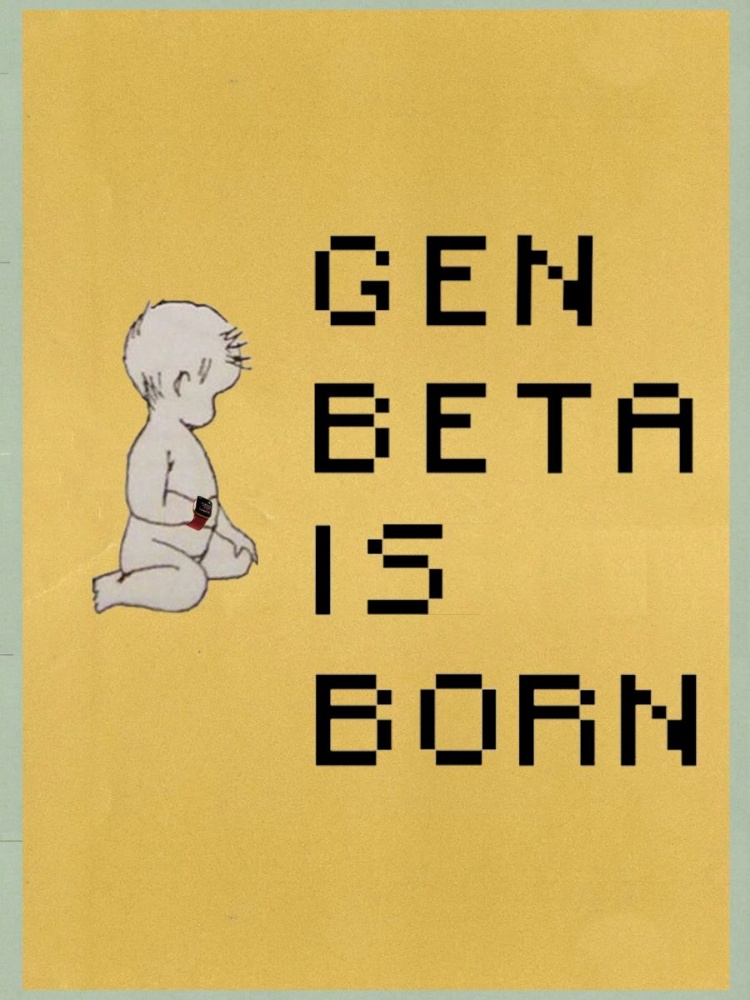
It can’t be easy bringing new life into unending political chaos, ecological uncertainty, and increasing mental health crises. And if parenting threads are to be believed, the chasms between generations now run deeper than ever. The newest of these generations entered the world in 2025, marking an age group of children born between 2025 and 2039, called Gen Beta, which is likely to live up to the 22nd century (!).
Like millennials had their avo toast, Gen Beta is likely to have AI. Mark McCrindle, the social researcher and demographer who christened this generation (and the generation that came before them), identifies this new cohort as one living “in an era where AI and automation are fully embedded in everyday life, education and workplaces to healthcare and entertainment”. The parents of Earth’s newest inhabitants are a wide mix of younger millennials and geriatric Gen Z, each of whom carry the stamp of their time in the world.
Now imagine this lot—the crew-sock-wearing Gen Z and the ankle-sock-swearing millennials—raising babies. They probably can’t believe it themselves. But here we are, with the Alphas and Betas vying for our attention with a new and nuanced set of complexities.
My child was born in 2024—he’s almost Gen Beta. Just before he tumbled into the world screaming, I had made up my mind to be pragmatic about motherhood. This meant learning to parent by being present instead of being overwhelmingly well-informed. I decided to ask friends and older women for pointers instead of leaning towards the excessive information online.
When I was eight months pregnant, I had read so many books, blogs, threads, watched IG reels, joined FB groups, WhatsApp groups and Instagram channels that I was thoroughly confused and utterly stressed. It was around then that I eagerly asked my doctor: “Should I also go for breathing classes?”
“Why?” he replied, “Don’t you know how to breathe?”
I didn’t appreciate it then, but I have grudgingly accepted this wisdom now. In a world that profits off my anxiety, my approach will be to deal with it when it happens. It doesn’t always work—one afternoon the baby’s cold turns into a severe fever that refuses to subside until one fine day it does. It’s only been a year into parenthood and I already recognise that I can’t truly prepare for anything, so I might as well learn to live.
“Don’t you know how to breathe?”
I’d now tell him: “You know what, I do it weirdly sometimes, but I can just about manage it.”
I may be doing this wrong. Because as I live and breathe, in my own weird way, there are parents who have accepted that the future is dystopian, where the jobs are taken by AI and unemployment is rife. These parents are teaching their children to work with their hands, honing skills like woodwork, plumbing, and gardening like their life depends on it. While this seems like good parenting regardless of what the future holds, there are also those who believe in teaching their children how to correctly prompt AI, so it is neither misused nor is it a threat to cognitive development.
But will jobs as we know them truly be gone for good? Will AI teach my son nine times nine is 81? Will my son have poorer intrapersonal skills than I do? The only clear answer is that my social awkwardness is hard to top. About the rest…we will live and learn.
This is how Mumbai-based Aneesh Sivakumar, founder of Done Deal, and his wife, Neha, a digital marketing head, have decided to navigate the lives of their two children, Vani and Nitya, the latter being a Beta baby. “We are more hopeful than anxious about the future, which is why we decided to have another child,” says Sivakumar, who believes that children will naturally adapt to technology without any help from parents.
You only need to look back at your life. “As millennials we’ve lived through the steepest technological curve, from using wired landlines to the dependence on the internet. We did it, so why can’t our children?” It’s true that millennials didn’t struggle to cope with the transition from analogue to digital lives because this move was slow enough to be ideal.
A comic strip by artist Violet Clair on Instagram describes this shift perfectly—millennials got everything exactly when they needed it: “MySpace showed up when I was a senior in high school and the timing was ideal; I didn’t need it before that. Facebook arrived my freshman year of college as a dinky little website that had not yet begun radicalising anyone’s uncle.”
Back home in India, the chime of dial-up internet entered my life only in the year 2000. My brothers and I would fight over it but when I did manage to get my hands on the family computer, I never really knew what to do with it. But now, tech is advancing at a pace we can hardly reckon with while being completely dependent on it.
Unlike the early noughties, social media no longer suggests bonding and connection. Information is immense but a lot of it is suspect and tailored to echo your worst suspicion. The fatigue is such that nostalgia isn’t a quiet yearning, it’s a full-blown affliction. What we are living through right now is a silent pandemic of deep-rooted loneliness that longs for connection just as much as it fears closeness.
It's the troublesome evolution of it that made Australia ban social media for children under 16. It’s a decision that has been embraced by Denmark as of November 2025. None of this mitigates the threat of AI to education or the future of employment but it does make the insurmountable issue of the internet a little less daunting.
My troubles are closer to home. I worry not about the ways in which AGI will worsen the world but the mountains of trash that will become commonplace in the very near future. In Delhi, the trash mountains already loom so large—200 feet—that they’re visible across the city. Last year, the world generated 220 million tonnes of plastic waste which, for perspective, is the weight of 3.4 million adult blue whales. My cute spawn, just like 130 million babies born this year, is unfortunately a part of the garbage problem. More than 3,00,000 disposable diapers—one of the largest contributors to global waste—are sent to landfills or incinerated every minute globally. Naturally, guilt is a reigning theme in parenthood today. As are environmental anxieties that enjoy top-of-the-mind recall amongst most of us. Nansel Stobdan, project management consultant and first-time mom, who lives between Jaipur and Leh, confesses that climate change is her primary worry. “Natural disasters, living conditions, and resource availability could lead to major political and economic shifts. And we may or may not be around when these changes happen, but they are inevitable.”
Stobdan believes we must teach our children how to adapt by providing them with the right tools to do so. But what tools? I suspect it’s not learning to build underground bunkers full of canned food. The answer lies in forging a genuine connection with nature, in ‘touching grass’ in the real sense of the term. A few parents I know believe in teaching by example: fostering a sense of community by participating in our local neighbourhoods, downsizing our needs, growing our own food in pots and plots if we can manage them, composting waste, thrifting and protecting what exists.
Here in Goa, I teach my son the names of birds and point out gold-flecked beetles, tiny frogs, and furry worms in the hope that I will make him love the world. All he can process right now are crows and roses, which he knows by sight and (on a good day) by name, but this is a win for me.
I think back to my own childhood and wonder if my parents worried as much as we do now. I spent a lot of my childhood in complete and utter boredom—a rare commodity in today’s never-without-my-smartphone age. Back then, my days weren’t dictated by classes and coaching. I often cycled alone. My friends and I took photos where we looked phenomenally ugly and laughed about it later. Our parents cared in broad, unspecific ways about soothing and nourishment, about fevers and report cards, about ghosts and bullies and making the 6 pm curfew. They weren’t obsessed with integrating us into their world. In fact, it was common practice for the adults to swill drinks (soft or otherwise) while the “baccha party” bundled into a room to watch The Lion King for the ninth time. They never knew the adverse effects of too much television, sugar (what was Bournvita, after all?), fast food, second-hand cigarette smoke or even a tight slap. The larger worries back then revolved around an inexplicable AIDS epidemic, stranger danger, cold war, a potential war with our neighbouring country, communal riots, nuclear power, terrorism, the depleting ozone layer, acid rain, our microwaves, and eventually a neat little touch of a Y2K bug that could possibly end us all.
And yet, babies were born, teenagers were sullen, brain rot was tabloid-shaped, and the slang was just as inscrutable (“as if”) as it is now. Worries about the future have been the norm for each generation of parent. Many of these worries persist, and many have evolved into lifeforms of their own but at least we’ve managed to un-deplete the ozone layer and figure out that sugar is the enemy.
In fact, there’s a substantial bright side if you choose to look for it in this sea of present and urgent worries. Because if 18 animals went extinct, five made an “epic comeback”, global access to safe drinking water is better than ever, more than a billion people have been lifted out of extreme poverty, life expectancy is the longest in human history, and as I write this piece, it appears that even Trump can’t resist the charms of Mamdani.
So, is this the best time to be alive, or the worst? In this AQI, my positivity sounds toxic. But as soon-to-be mother and art curator Sitara Chowfla puts it, “I suppose we have to go into it with an open mind and imagine our kids will want to do and be things that haven’t been invented yet.”
I’d been a mother for six months, I was exhausted and quite irritable late one afternoon when I saw my baby look at himself in the mirror and smile, pleased with just the idea of himself. It made me think about how we arrive, uncorrupted and admiring of ourselves and the world. If we could help preserve just a bit of that, shouldn’t we be alright?
Perhaps this is the responsibility of modern parenthood, to cultivate affection, to tend to hope.
As Maggie Smith says in her viral poem ‘Good Bones’:
“I am trying to sell them the world.
Any decent realtor, walking you through a real shithole, chirps on about good bones:
This place could be beautiful, right?
You could make this place beautiful.”