Bloni had 48 hours to make Lisa’s gravity-defying ‘SaWaDiKa’ look
Creative director Akshat Bansal tells us what went into creating the sculptural hooded bodysuit that makes a cameo in the K-pop sensation’s new music video
Earlier this week, Lisa dropped the music video for ‘SaWaDiKa’, a single from her upcoming Press Play EP and, as one might expect, the wardrobe does a lot of the heavy lifting. In the video, the K-pop idol cycles through a series of fantastical outfits, including briefs inspired by Muay Thai shorts, a costume covered in antique coins that nods to traditional Thai dancers, and another inspired by Thailand’s ubiquitous tuktuks.
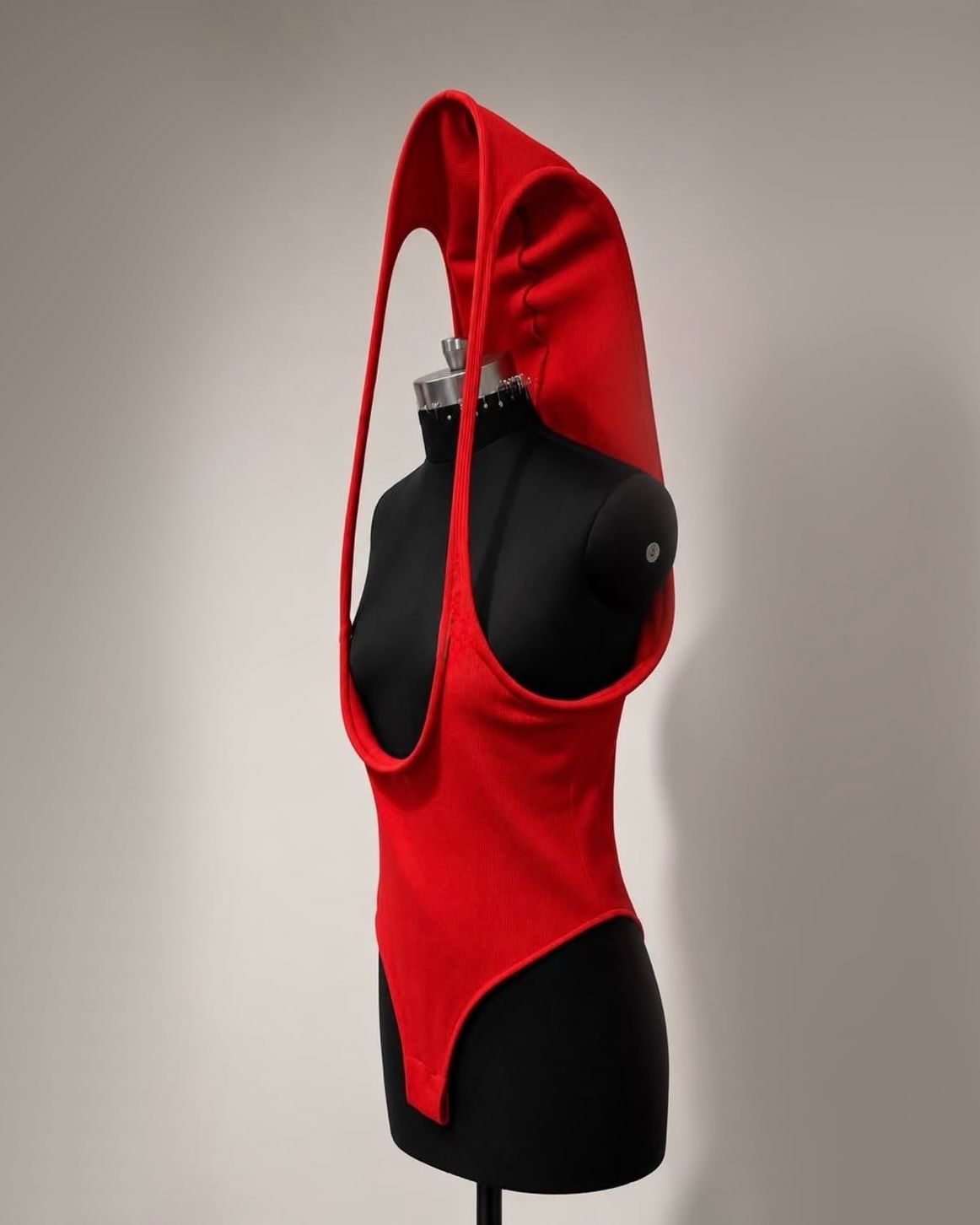
Among them is also a custom hooded bodysuit by Bloni, the Delhi-based label founded by Akshat Bansal. A version of the look first appeared at Outhouse’s 13th-anniversary runway show back in August 2025, for which the jewellery label collaborated with Bloni on the clothing.
Lisa, it turns out, had found the label on her own months before. She had stumbled upon a crystal leotard from the brand’s couture line and wanted to wear it to an event, but it couldn’t reach her in time due to shipping restrictions due to the west Asia geopolitical crisis earlier this year.
However, when the ‘SaWaDiKa’ music video came around, her team reached out again. “She said, ‘I need Bloni for this music video,’ and I was like, great. We were all very kicked about it. They said they loved [the hooded dress] and that it has been on their mood board for the music video. There was no conversation about this or that,” Bansal tells The Nod.
ADVERTISEMENT
The Red Ring dress on the runway
A sketch of the full look by Lisa’s stylist Nan Nist
There was, however, the matter of turning the body-hugging dress into something Lisa could dance in. “Since the whole idea was that she needs to dance, it needed to be a bodysuit. So, we custom-made it to her measurements and sent it across to Hong Kong, where the video was being shot,” shares Bansal.
The look was created in just two days. Lisa’s team had reached out on July 17, and the finished garment was dispatched to Hong Kong on July 20. Bansal was at the protest at Jantar Mantar when the request came in. “I rushed to the office. Somehow my metal guy was available that day, so I got the rings done. Luckily, I had the fabric in the studio, got it dyed into red, hand-stitched it, and dispatched it,” he recalls.
The structured hood was inspired by the fleeting moment when a tank top is being pulled over the head, frozen in place. “It’s basically a stretched tank in 100 per cent cotton that becomes a hoodie,” he explains. Keeping that gesture permanently suspended required a lot more engineering than the usual tank top. The hood was reinforced with metal wire, which meant it wasn’t as simple as just resizing the runway sample and calling it a day. “We had to reconstruct the entire ecosystem of the outfit. It was a lot of welding. When you put metal rods inside a garment, you can’t machine-stitch it, so it’s all hand-tacked, handmade, hand-rolled.”
The bodysuit
There was also another complication: the team didn’t have the exact shape and circumference of Lisa’s head. “We were wondering if her head curve would be similar to what we were imagining,” says Bansal. To get around, the team used an image of Lisa and AI to create a digital scan to give them a probable head measurement. Thankfully, the gamble worked.
The bodysuit also reunited the collaborators behind the original look’s runway debut. Lisa wears it with Outhouse’s Crimson Halo lariat necklace, which features pear-shaped maroon resin stones, Swarovski triangles, and carved glass shaped like droplets—all of which weigh a total of 710 grams. “She asked us if she could pull the necklace, so I called up the Outhouse team. Sasha and Kaabia are friends and I feel that you can’t succeed alone—or shouldn’t, rather—so we called them for the piece and shipped it across.” The rest of the look comprised shorts and gloves by Iwannabangkok and lace-up boots from Lili Curia.
For Bansal, though, the most memorable part about the process had nothing to do with clothes. “The stylist and her own team dealt with this whole thing as if they were reaching out to an artist they were commissioning,” he says. “I mean, they didn’t even say, ‘Can we do a pull?’ They purchased it. It was refreshing, because we in India have been trained to think everything happens for free.”