



Design08 Aug 20261 MIN

What’s the best seat in these restaurants? Doesn’t matter. Look up!

Painted ponies, digital monsoons, and Michelangelo with a wine glass—at restaurants across the country, the real drama is overhead

Image

There was a time when a restaurant’s ceiling had one job: to hold up the lights and stay out of the way. That era is over. From a Ladakhi diner at 11,500 feet to a 108-year-old Goan bungalow, dining rooms across the country are treating the fifth wall as prime real estate by frescoing it, tenting it in silk, and projection-mapping it into a sky that snows on demand.

For a while, the mood ran in the opposite direction. “There was a whole trend of minimalism, where we’d always want everything to be very quiet, letting the surfaces, the furniture, the design, and the art be the ones to talk,” says Mumbai-based architect Ashiesh Shah. “It’s been a couple of years since we started taking the ceiling as a surface to embellish.”

Designer Tejal Mathur traces the change to the way we eat now. “Ceilings have always been an important architectural element in hospitality, but over the last decade they’ve evolved from being purely functional to becoming a storytelling canvas,” she explains. Driven in part by social media and a rapidly growing hospitality industry, restaurants are competing harder than ever to be memorable, and the surface overhead, long ignored, is suddenly a place to make an impression. “As diners increasingly seek experience-led spaces, restaurants have started treating the ceiling, too, as an extension of their design narrative,” she says.

A story told overhead

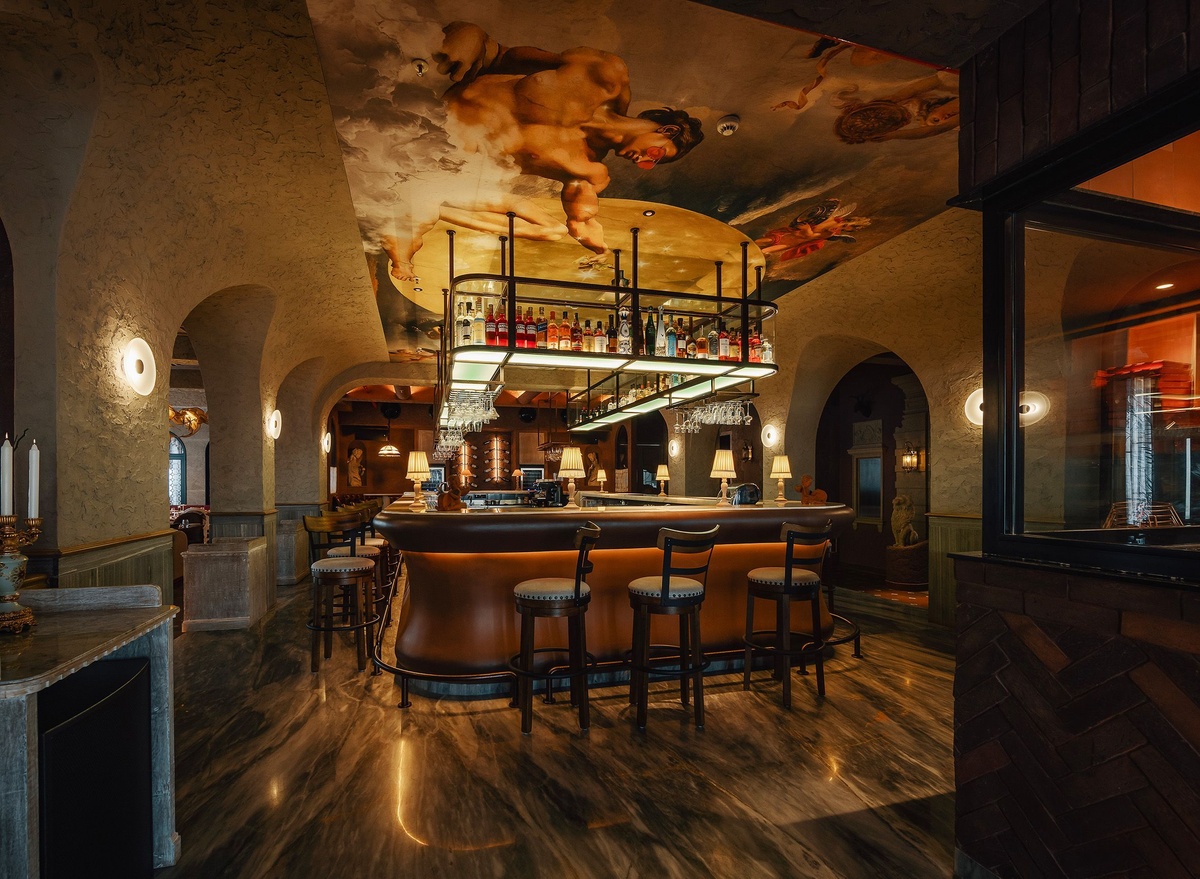
Mathur designed Adelina, in Bandra, Mumbai, as the home of a glamorous, well-travelled Italian hostess, someone with a serious art collection and no fear of a visual punchline. Above the central bar, Michelangelo’s ‘The Creation of Adam’ is recast as a ceiling mural, a wine glass slipped between the famous near-touching hands. “We didn’t approach the ceiling as an afterthought,” she says. “Since the concept draws from the romance and grandeur of an Italian villa, it felt natural for the story to continue overhead.”

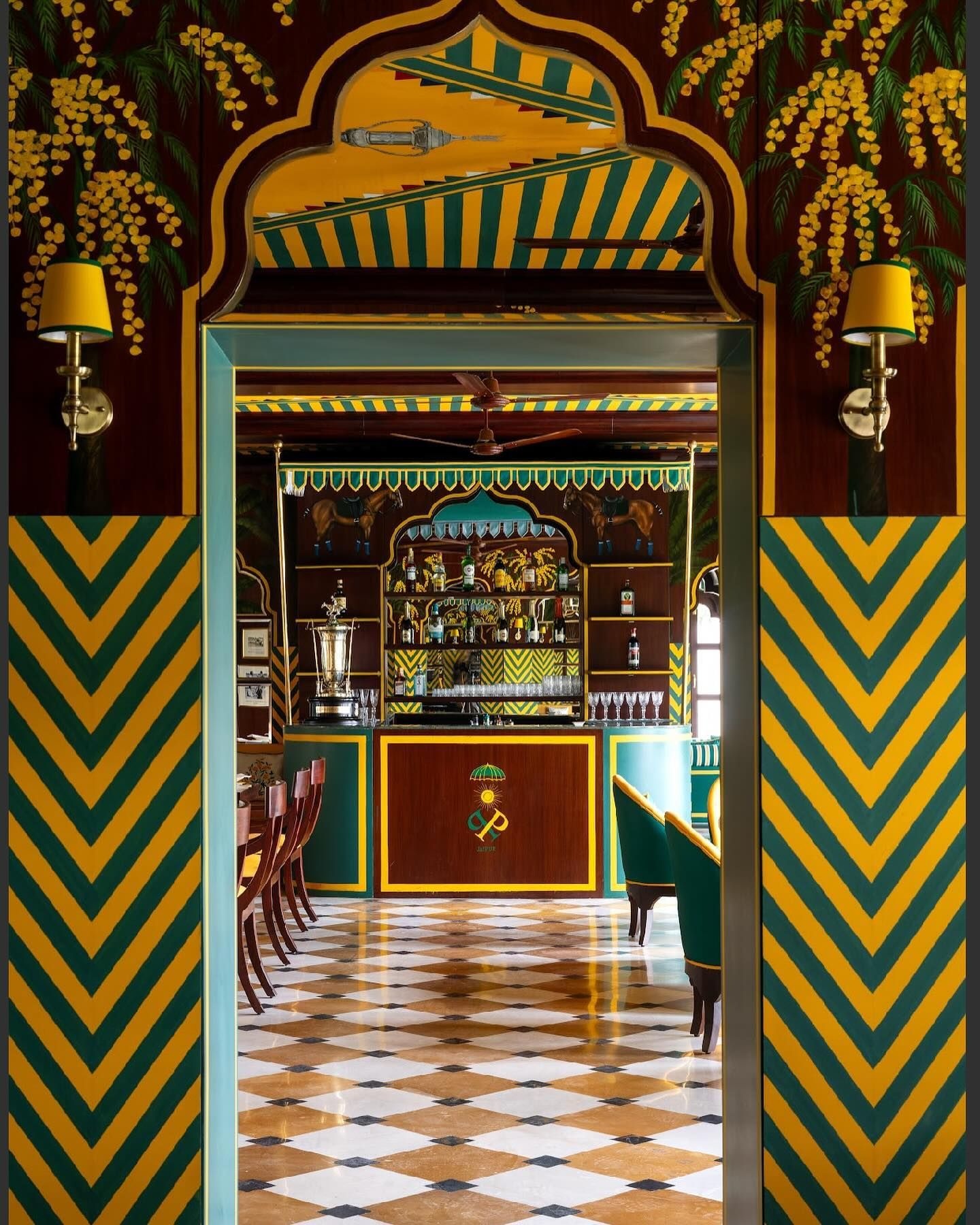
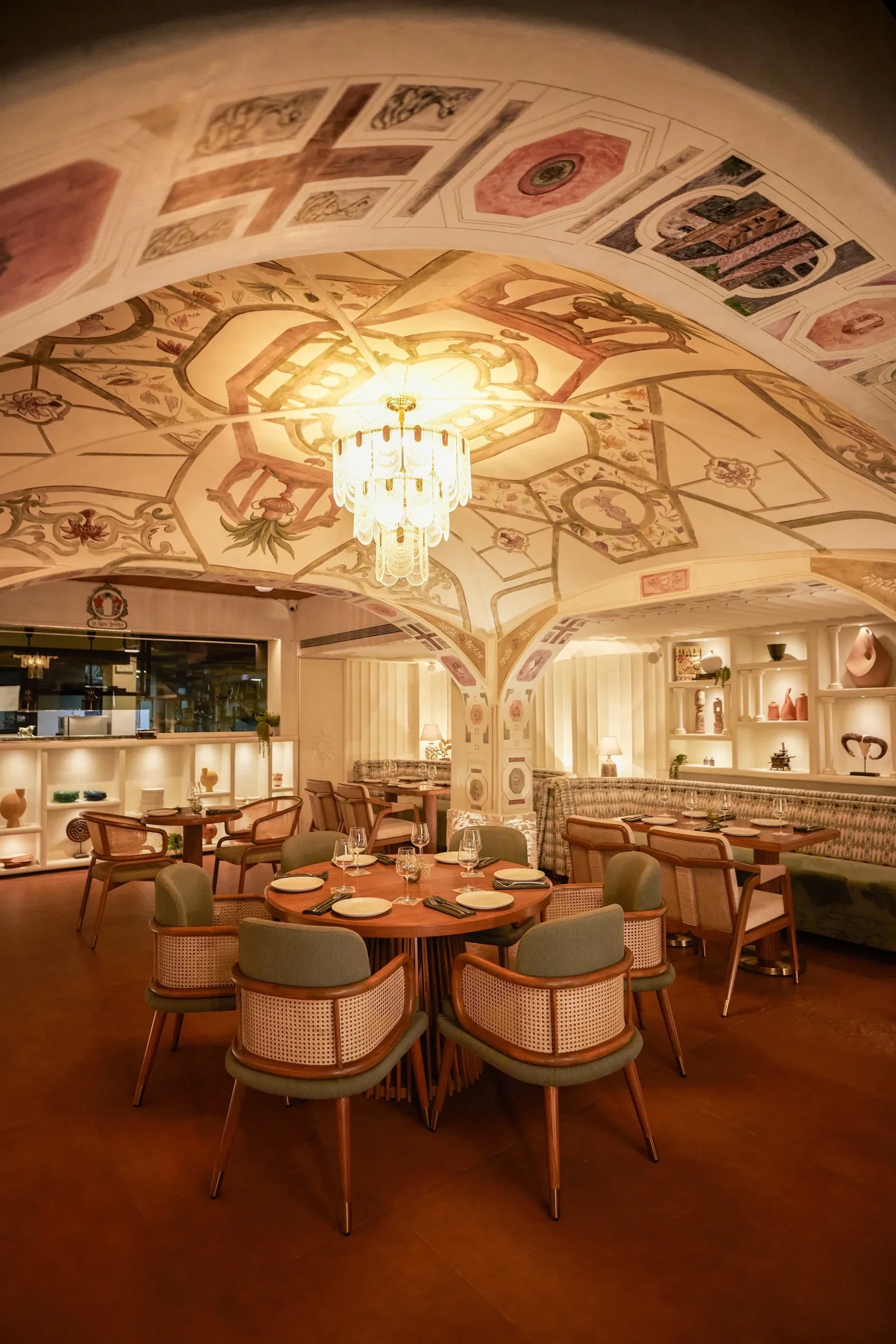
In Bengaluru, Shruti Jaipuria of Maia Design Studio imagined The Azulian House, an agave bar at The Leela Palace, as the home of a well-travelled botanist, and its 25-foot ceilings behave accordingly: a soaring hand-painted canopy prowling with jaguars (revered across Latin American cultures as symbols of power and protection), while lush creepers tumble from the spot a chandelier would ordinarily claim. Similarly in Mumbai, driven by a homesick impulse, the vaulted ceilings of chef Manuel Olveira Seller’s La Loca Maria are a watercolour-soft memory of Toledo, his UNESCO-listed hometown, hand-painted by Mumbai studio Za Works with florals, heraldic emblems, and scenes of Spanish life. And in Jaipur, Polo Palladio turns its ceiling into an archive. Designed by Dutch designer Marie-Anne Oudejans, the frescoed expanse over the century-old Rajasthan Polo Club carries hand-painted portraits of Padmanabh Singh’s polo horses (names lettered beneath each one) alongside trompe l’oeil trophies and vintage mallets.
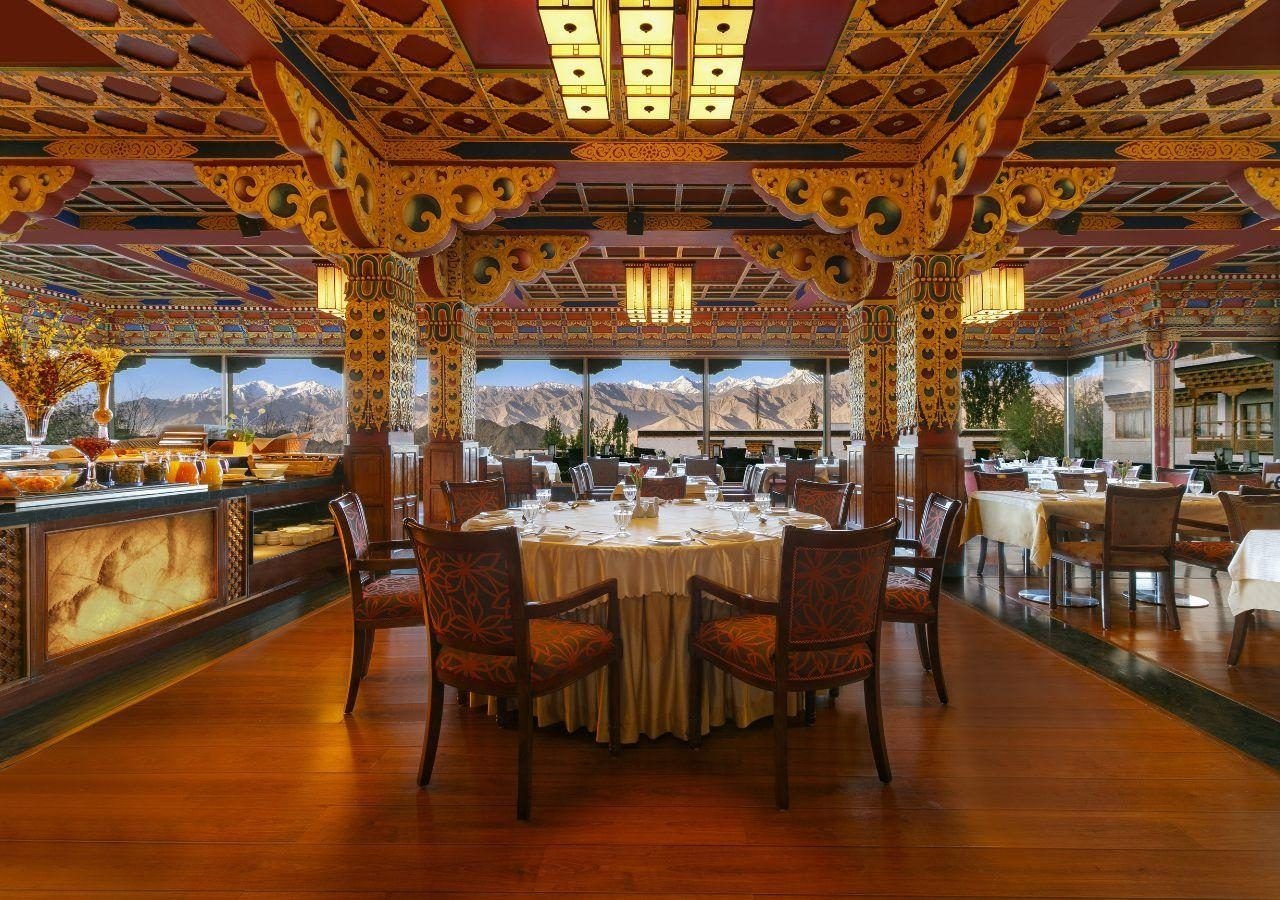
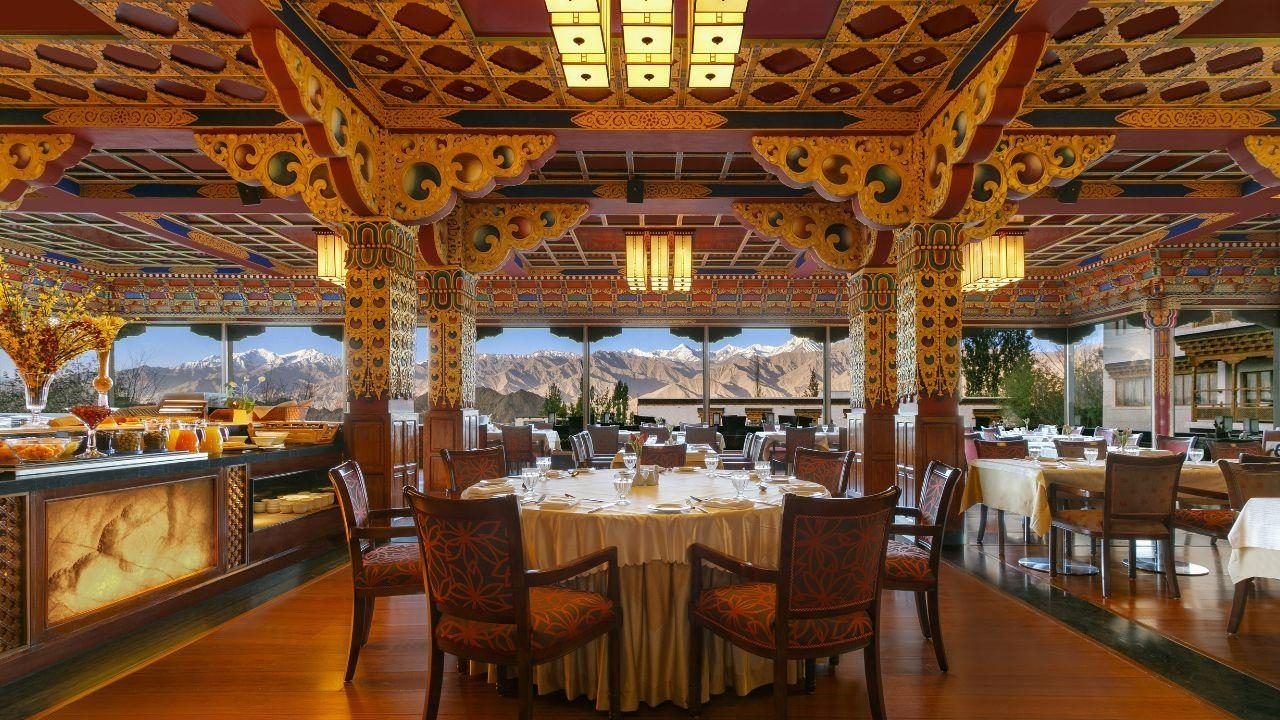
Elsewhere, the ceiling is a way to tie a room to its region. At Zasgyath, the all-day diner inside Leh’s Grand Dragon hotel, a glossy crimson lattice of painted coffers meets gilded, hand-carved pillars and tiered polychrome cornices that recall the inner chambers of a hilltop gompa, a first taste of Ladakhi maximalism long before you reach the monasteries. It’s the work of Gulam Mustafa, regarded as Ladakh’s first modern artist and a heritage conservationist of over two decades, brought to life by local artisans. In Powai, Mumbai, Mangalorean architect Sujit Kotiyan looks to the inherited architecture of south Indian homes at Gourami, stretching a woven bamboo ceiling across the dining room on a grid of wooden beams, oversized rattan pendants hanging below like illuminated baskets—a fitting canopy for a menu that travels from Mangalorean gassi to Andhra curries and podi-dusted pizza.

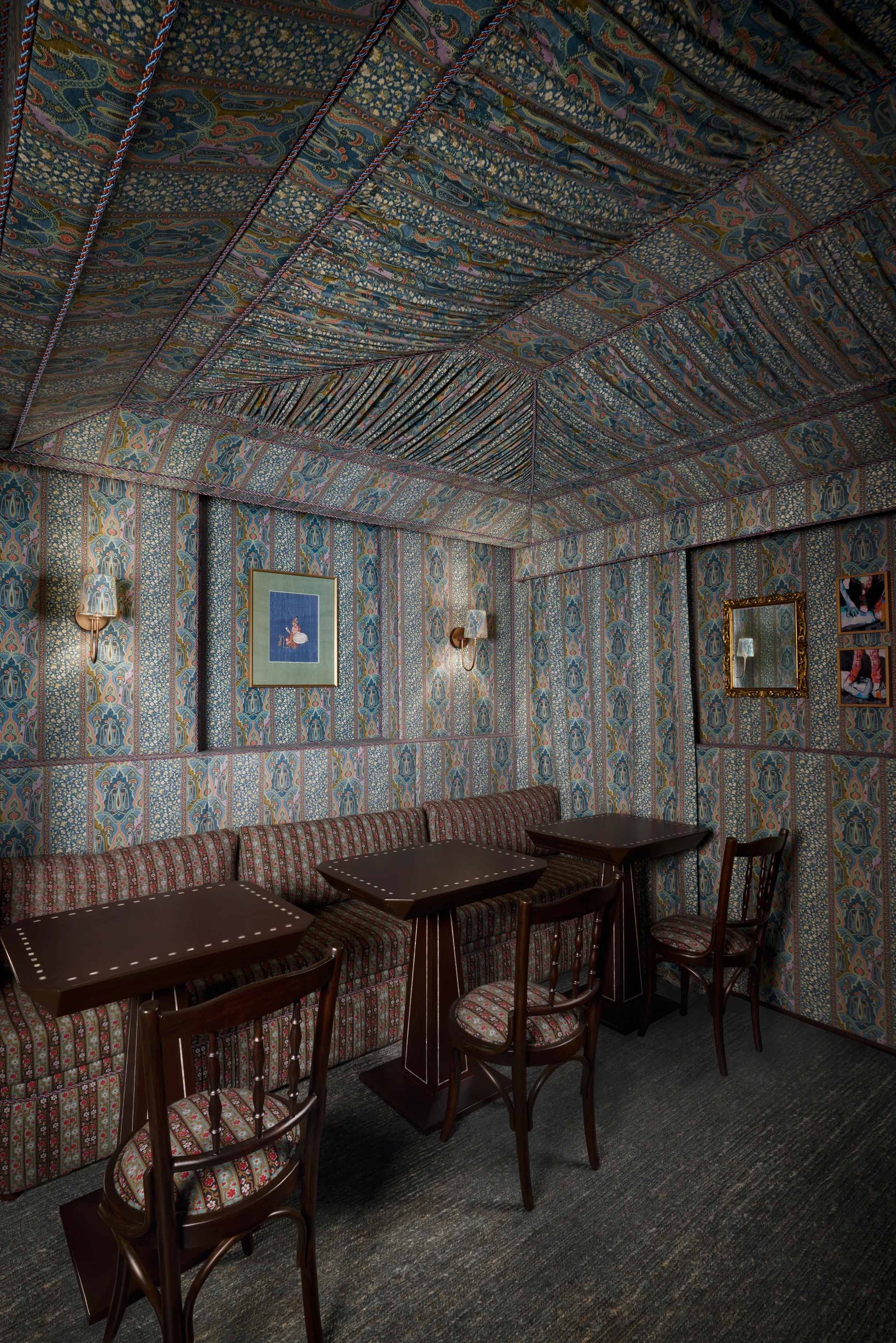
Shah, however, doesn’t see the ceiling as a space for starting trends but a problem to solve. At Bar Paradox—his full-tilt Art Deco departure from his own signature minimalism, tucked inside an old mill structure in Mumbai—each of the two floors posed a different puzzle. Downstairs, in a 14-seater dining tent inspired by a fumoir, the ceiling sat too low. “I wanted to create an element that would exaggerate that, make it feel more decorated and opulent,” he says, which is why he cocooned the space edge-to-edge in ruched, corded Peter D’Ascoli textiles, an exquisite Jamavar shawl lining one alcove overhead. Upstairs, the problem was the reverse—a room that risked feeling frozen. “We did this kinetic light movement for the restaurant opening, because the space was looking too static and really needed some kind of movement.” The result floats above the burlwood bar: diamonds of coloured light that dance to the music.

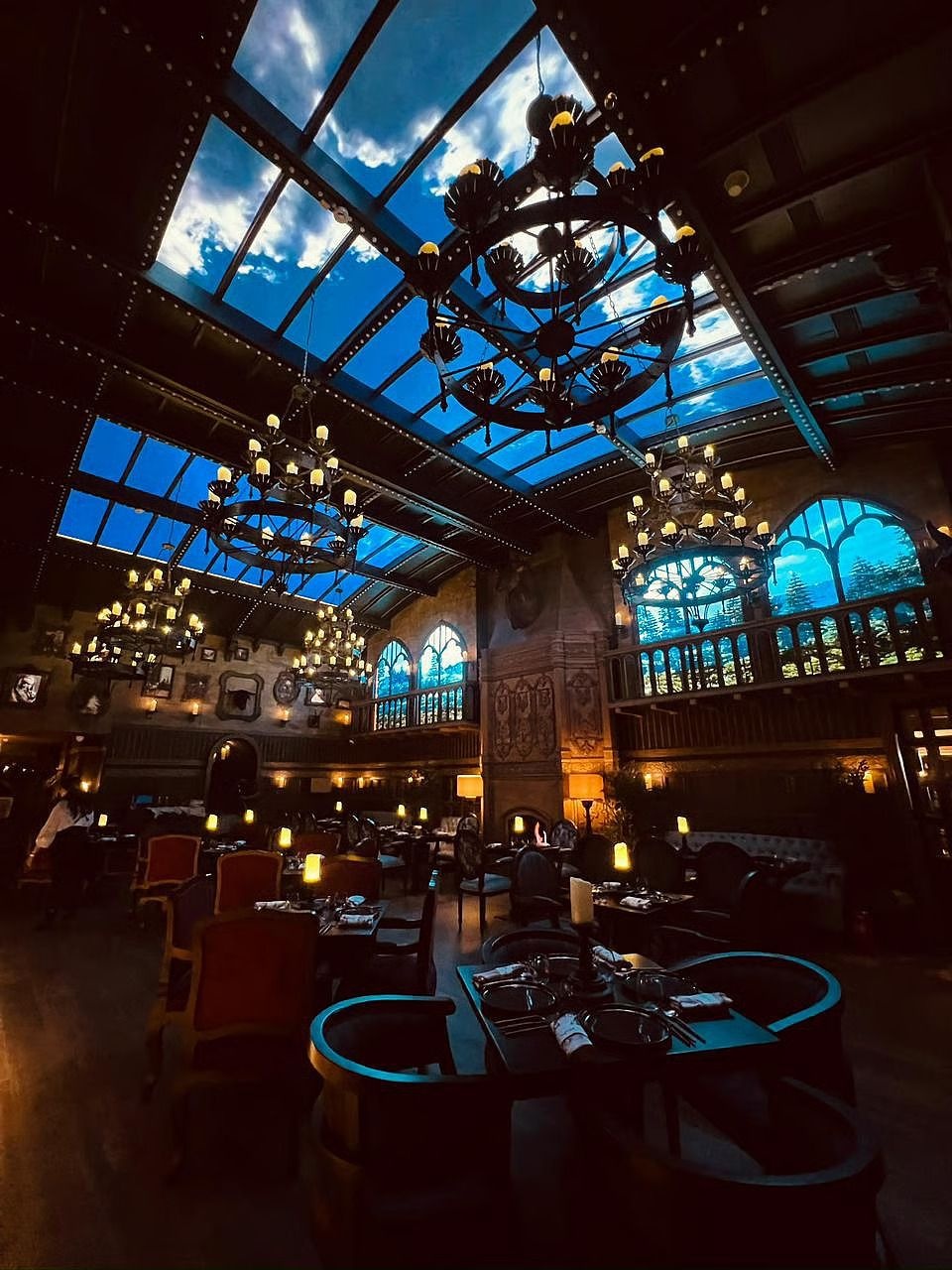
That marriage of ceiling and technology is also fast becoming its own genre. At Adam & Eve, Mumbai, the cavernous crimson basement bar beneath Hom designed by Studio 6158’s Parzan Daruwalla and Natasha Chawla, an unexpectedly high ceiling becomes a canvas for 117 custom projection-mapped visuals that loop for seven to eight hours without repeating, from floating dragons to Shiva’s cosmic Tandav. At Luna et Sol, an Alpine chalet by Jade Design Studio, the ceiling doubles as a vast projection surface with snowfall, rain, golden skies and constellations drifting overhead (until August 31, the whole thing turns wizarding-world themed for Harry Potter’s birthday). And at The Second House in Goa, billed as India’s first AI-designed restaurant and set in a 108-year-old Indo-Portuguese bungalow reimagined by Ayaz Basrai, AI-driven projections turn a principal wall and ceiling into a digital monsoon, flowers, birds and architectural silhouettes drifting across the surfaces.

No plan, just play

Not everyone set out to join a movement. At Kaspers, Mumbai, chef Will Aghajanian’s pocket-sized Bandra bistro, the ceiling came about almost by accident. He flew in his friend Kacper Abolik (the artist behind the murals at his Los Angeles restaurant Horses and the man the bistro is named after) for 21 days to paint the walls, bathroom and ceiling into one unbroken sprawl of chubby pastel cherubs, now the restaurant’s mascots (they turn up on the stemware, the matchboxes, even the butter moulds). “We didn't realise we were following a trend when it came to the murals,” admit founders Gauri Devidayal and Jay Yousuf. “It was just something fun that felt like a good way of making a small space feel less small.” Diners are handed crayons to doodle on their own paper-topped tables, and some of those creations have been framed and hung on the walls.

“One of the first things we notice is that people instinctively look up,” says Mathur. “It creates a moment of surprise and curiosity, encouraging guests to slow down and take in the entire space.” The ceiling, she adds, becomes a conversation starter, “a space that reveals itself over time”.

The one part of a restaurant nobody was once meant to notice may now be the first thing you do.

The Nod Newsletter

We're making your inbox interesting. Enter your email to get our best reads and exclusive insights from our editors delivered directly to you.