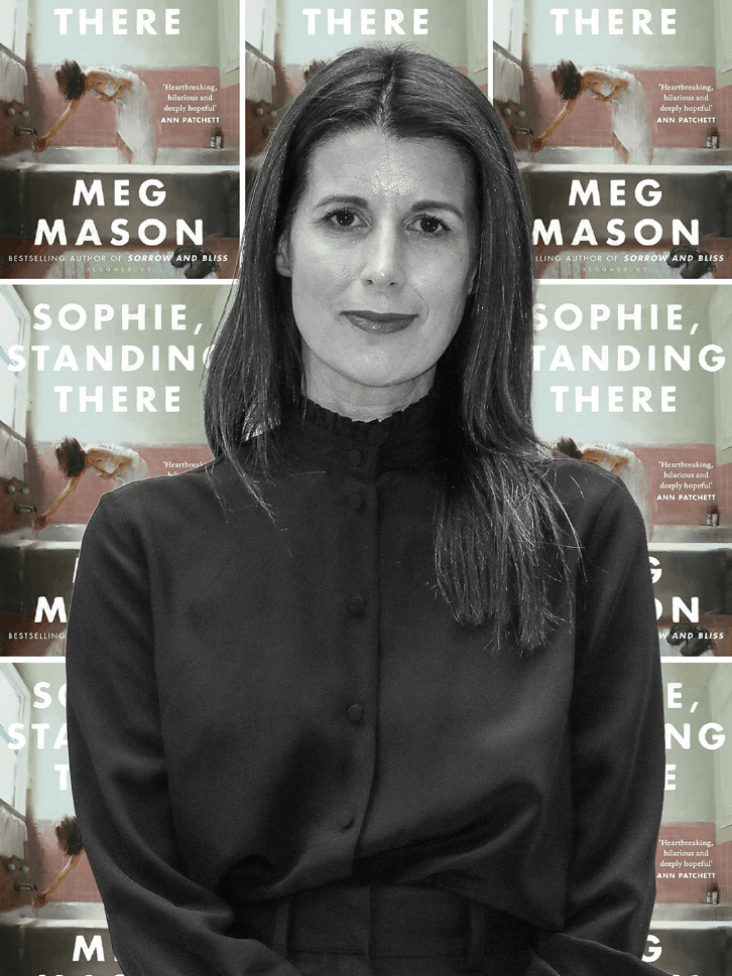

Should you meet your heroes? When Sophie, the protagonist of Sophie, Standing There, has the chance to meet her literary idol, she’s just been rudely dumped by her oafish, now ex-husband and is living alone in a dingy flat he’s rented for her. The relationship with her favourite writer Lilac Dunne starts out as purely parasocial: she obsessively rereads her books, endlessly scrolls through photos and listens to her podcasts on the internet. Dunne’s voice accompanies Sophie as she tentatively rebuilds her own life, seeking joy in small things, like a good head massage, or pushing herself to find her voice in her work as a sound technician. While Sophie is adrift, Dunne (or at least the version of her in Sophie’s head) is solid, confident, perhaps a little critical of Sophie’s bumbling attempts at living life. The fantasy unexpectedly becomes reality when, to her terror, Dunne is booked for a literary event that Sophie is working at. What follows is both heartbreaking and strange: an examination of human attachment, longing, and the distance between the people we imagine and the people they really are.
Meg Mason knows a thing or two about the complicated business of being human. The New Zealand-born, Sydney-based author shot to international acclaim with her third novel, Sorrow and Bliss, a sharply observed work about marriage, mental health, and the often-absurd business of getting through life. The book was shortlisted for the Women’s Prize for Fiction in 2022 and named Fiction Book of the Year at the 2022 British Book Awards. With her latest release, Sophie, Standing There, Mason turns her attention to the world of literary fandom. The book is witty and empathic, with cameos from famous authors such as Ann Patchett and Mick Herron that readers will enjoy, but it is also an astute portrait of the distance between intimacy and illusion and of the very human desire to feel seen.
Below, excerpts from our conversation:
You started your career as a journalist, writing for magazines like Elle, Vogue, Sunday Style and more. Did you always know you would transition to fiction?
Actually, I didn’t think that I had any ambitions towards it, but a little while ago my mother got out this shoebox-type thing full of old drawings—you know, artwork that children do. Amongst it there are all these pieces of story-writing from when I was first able to write. I would say that when you look at them, they are slightly elevated beyond the regular sort of year-one children’s story.
I also recently found a novel on my own shelf by Elizabeth Bowen, which I remember reading when I was maybe 22, and on the back page I saw that I had started scribbling bits of a novel. Clearly there was some sort of subconscious force at work. But it’s such a hard thing to admit to yourself, because if you love books it almost feels presumptuous to say that you want to write them, almost arrogant. Plus, the actual act of writing—you know, being at your desk, creating made-up people—is ridiculous and embarrassing when there are people out there doing real jobs. Like my daughter right now is doing her PhD in neuroscience and my other daughter is studying special education. Meanwhile, I’m in my little room, making up characters and giving them words to say.
It was interesting that in both Sorrow and Bliss and Sophie, Standing There, the characters talk about how they didn’t read a lot as children. Is that an autobiographical detail?
You’re right, actually, I hadn’t noticed that in Sorrow and Bliss; she does have that complicated relationship with reading. And with Sophie there are bits that are autobiographical, right down to the fact that she doesn’t really like libraries. I have this private unease about libraries. I’ve never liked them, ever since I was a child. I don’t know why.
A lot of how Sophie feels about reading—she talks about not being sure that she’s doing it right—are very much my thoughts. Even though I’ve been a reader for much more than half my life, I still don’t think that I’m a clever, sophisticated reader.
I only read Middlemarch for the first time last month. I’ve been so scared of that book, plus embarrassed that I haven’t read it so far when every writer or serious reader I’ve ever met has said they loved Middlemarch. Thankfully, I absolutely loved it so much I’m reading it again. Except this time, I’m reading it really slowly and kind of listening to the audiobook in tandem. If there are any other Middlemarch dodgers out there, just give it a go until page 75, [when] something happens, and then you’ll be into it. I’d just never got up to page 75 before.
One of my hopes for Sophie, Standing There is that it doesn’t really matter what or how much you’re reading. It’s all reading and it’s all for fun, for solace and company.
Do you often get asked if your books are autobiographical?
There’s an amazing introduction to the novel Heartburn by Nora Ephron, where she talks about how she was just relentlessly asked if her book was autobiographical. And it was. But Philip Roth picked over the bones of his divorce for his entire career but was never asked that question. So, I do think it’s a little bit gendered as well to ask the question about autobiography to female writers.
Your books are often labelled as ‘sad-girl fiction’. What do you think of that?
Honestly, I hadn’t heard of ‘sad-girl fiction’ until Sorrow and Bliss really blew up online. And then I was like no, no, that’s a terrible term to apply to us or our characters, because Martha was 40 and mentally ill. If I had a 40-year-old mentally ill friend, I wouldn’t call her a sad girl. With Sophie I had the chance to push back on that a little bit. She’s cheerful, she’s optimistic, and she’s really brave and stoic even though she’s obviously in this awful, lonely time in her life when we meet her.
For me it was interesting to spend time with this character who had a cheerful streak, because definitely I’m much more inclined towards melancholy in my nature. Having to think as this really joyful person while writing the book, I learned so much. Honestly, she made me slightly more optimistic.
Sophie, Standing There is really a book about the literary world in so many ways. Was it influenced by the spotlight you were under after your first book?
There was a period where all I did was attend literary festivals, and that experience was so wonderful and shocking. At the same time, I was so intent on not writing a book about writers. I feel like if you created a world that was populated only by fictional characters, 95 per cent of the population would be writers. I mean, there’s rarely any podiatrists or piano teachers or mechanics in fiction. Everybody seems to be a writer.
But I just had to get all that I was experiencing out of my system, which is when Sophie appeared in my mind. I remember the precise moment when she came to me as this character who wasn’t the famous author but rather the support staff. Someone who loves books and authors and wants to be near them and make a connection.
Even though it’s kind of satirical, I hope that it strikes people as warmly satirical, because I love the world of authors, books, and reading. After all, before I was ever at literary festivals, I was always in the audience and, you know, adoring authors.
Just like Sophie meets her favourite author Lilac, have you ever met your idols?
Yes. There were five books that were permanently on my desk when I was writing Sorrow and Bliss and four of them were by living authors and all were my literary loves (the fifth was Hilary Mantel). After the book came out, I suddenly met all of them. It was so ridiculous and extraordinary and previously unimaginable to me.
People say don’t meet your heroes, but I’m like no, do meet them, because either they’ll be better than you ever imagined, which was the case for me, or they’ll be hideously disappointing and you don’t need to have them as your hero anymore.
Was there anyone on the top of that list?
Max Porter, who wrote Grief is the Thing with Feathers. I have adored that book for years.
But the most incredible was meeting Barbara Trapido, who wrote Brother of the More Famous Jack, which is my favourite novel of all time. Someone arranged a lunch so I could meet her and I had to go to the bathroom maybe three or four times just to collect myself and try not to cry or gush too much.
Tell us a little about your writing rituals. Where do you write in your home?
I have a garden shed that’s like this sacred place for me. It’s so small, smaller than a prison cell, but it’s just perfect. It’s funny, because I imagine that even if it was possible for me to have a proper office, I don’t think I could ever let the shed be demolished. If we moved to a bigger house we would have to take this shed with us on some kind of semi-trailer, because I just could not watch it be taken down.
There was a period where our neighbours were renovating, so there was terrible construction noise all the time. I tried writing in lots of other places, but in the end, to escape the noise, I started getting up at 4:30 am. That’s the time when most of Sophie was written. It’s that amazing period in the day when no one else is awake. It’s dark, quiet, and you’re not going to check your email or shop on Net-a-Porter. You just get on with your work.
You’ve spoken about how you wanted to write like how you speak and avoid language that’s too florid or wishy-washy. What are your rules for that?
I’m constantly reminding myself to just write as though I was telling you a story, or I was on the phone with a friend or texting you an anecdote—just the plainest language that I could find. I have little rules, like: don’t use a thesaurus. If you don’t know the word, you don’t need the word. With Sophie, especially, I tried to make sure that I never gave an ounce of performance to the way she says things; she’s just very earnest.
The book’s conclusion was a real surprise. How did that come to you?
As a character, Sophie is a bit separate to everybody else. She doesn’t drink or smoke, she doesn’t swear. She’s quite naive in a lot of ways about popular culture. At a certain point I had to ask why. That’s when I decided that she could be from a sect, which is distinct from a cult in that it’s a branch of an organised religion that has broken off to go and do its own thing, as opposed to a cult, which is built around one leader.
I was actually in one until I was eight—my family was in a very sort of strict religious denomination—so I decided to just write a version of that.
The thing that happens when you’re raised in a really, really strict religious environment is that when you leave, everybody thinks you’re going to go out and rebel and be wild, but actually, because you’re so marked by the training, you just stay away from them. Like, I couldn’t even tell you what my star sign is because I’m like, horoscopes are evil.
I read that you don’t watch films that don’t pass the Bechdel test. What about when it comes to books?
I would struggle to read anything that’s set in a world populated entirely by men. I love interesting male characters, of course, but if there’s no women present, that’s not real life to me.
What are you reading right now?
I am re-reading Middlemarch, like I said. I also read Persuasion for the first time this year. It has the reputation of being the really serious, dour kind of Austen, but it’s my favourite now. Apart from Pride and Prejudice, of course.