




Until 2019, when The Boys premiered on Prime Video and turned the superhero genre on its head, we hadn’t thought of cape-wearing do-gooders with world-saving abilities as going rogue. But Eric Kripke’s superhero satire asked: What happens if they were just a teeny bit evil? What if Captain America was diabolical? What emerged was a bingeable series about an authoritarian leader and corporate greed that somehow felt like a present-day Trumpian allegory.
There’s a moment in the finale episode of The Boys where a baseball-cap-wearing white man in a suit approaches Oh Father in the Oval office and insists, “I’m a disruptor—I disrupt. I was thinking, why can’t Starlighters work in my factory as non-compensated employees?”
“So…slaves?” Oh Father questions.
When a perplexed Homelander walks in, Oh Father tries to explain to him who the man is: “Gunter Van Ellis. World’s richest man? 17 children? Amateur astronaut?”
If the character has a real-world doppelgänger or is a composite of a two, of course it’s intentional; The Boys has always been pretty on-the-nose.
Here, the superheroes work for a corporation called Vought International. Leading them is Homelander (Antony Starr), a narcissistic psychopath with mommy and daddy issues. The core group of these superheroes go by The Seven, and behind well-documented acts of public service, they kill, have a lot of…fishy sex, and generally possess a blasé attitude to people becoming collateral damage. A group of vigilantes led by Billy Butcher (Karl Urban) take it upon themselves to rid the world of Vought’s superheroes. Hughie (Jack Quaid), whose girlfriend turns into blood and pulp on a pavement after a superhero runs through her, is enlisted by Butcher in his quest and becomes the voice of reason that no one ever listens to.
Over the five seasons, as Homelander consolidates power and Butcher becomes more and more unhinged, there’s plenty of laughs and winces to be had.
At its heart, The Boys combines potent political satire with the schadenfreude of a horny teen obsessed with violent video games. There are evil, greedy conglomerates representing the worst of capitalism; tyrants harnessing the cult of personality, PR, deepfakes, and religion to grab power; state institutions falling prey to aforementioned tyrants; a country divided by hate… It would be funnier if it didn’t feel eerily close to global politics today.
But it makes all this fun is using every spanner and hammer in the toolkit. Guts explode like wet piñatas every minute, fresh-faced teenagers have snakes hissing out of their faces, fluffy farm animals can turn into flying flesh-eaters in a second, brains get impaled or collapse like flop soufflés, a trip to the toilet is full of peril; you can turn each episode into a drinking game based on the number of people who’ll die horrible, unthinkable deaths. It’s all very enjoyable (and no, there’s nothing wrong with me).
To understand the satisfaction the show takes in exposing bones and intestines with the glee a child would reserve for popping balloons, watch episode five of this final season. A group of comedians—Seth Rogen, Kumail Nanjiani, Will Forte, and Christopher Mintz-Plasse playing themselves—are chilling out at the home of Mr Marathon, until Homelander and Soldier Boy show up and turn each of them into a ripened tomato facing a NutriBullet.
For all the explosions and terrible events that mark the series, though, the series finale is weirdly…hopeful. And that’s what has left everyone confused.
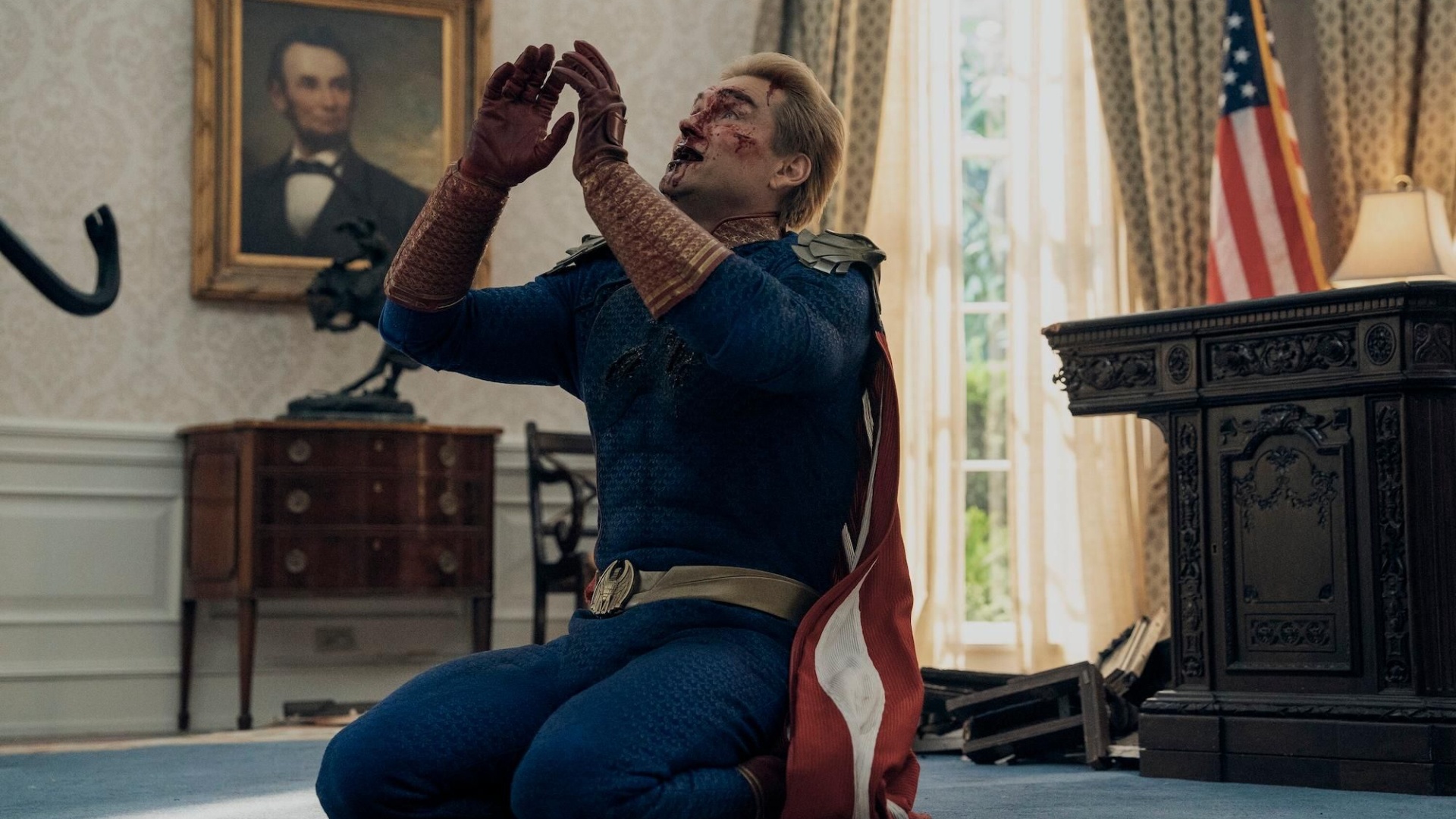
Homelander has installed himself in the Oval office as the second—no, first—coming of Christ. Butcher and company show up for one final confrontation that wraps up a little too quickly. Things finally work in the latter’s favour; the sight of Homelander trying to jump and blast lasers out of his eyes is both sad and hilarious. (On Reddit, one user commented how Homelander launches himself at Butcher with the “gentle speed of a moped”.) You’d think a greater punishment would have been to let him live his life divested of his power that was so entwined in his nature. (Instead, Butcher ensures there is no epilogue scene featuring Homelander screaming at a barkeep somewhere.)
But so much doesn’t add up. Why would Starlighter fly Deep to a beach where he is, generally, the strongest? Will Soldier Boy spend the rest of eternity in the cryochamber? Is a trip to Disneyland really the best use of Sister Sage’s time, even if she’s now “dumb” like the rest of ’em? Is The Boys really a show where the ghost of Frenchie comes to Kimiko in the middle of a fight and sweetly spurs her to use her power? Why couldn’t they leave poor Terror alone?
Going by what we’ve seen for five seasons, we half expected a close-up of a future villain opening his eyes in a dark blue-green bunker somewhere. Or at least a vial of V1 waiting to fall into the wrong hands again. The series is fuelled by a cynicism and deep distrust of our institutions and public figures, so to pat our heads in the end and go “there, there” is a tonal shift that’s jarring in its optimism, a Mickey Mouse Band-aid on a gaping wound. Our disappointment over getting love, hope, ginger candy, madeleines, sweet dogs, and sweeter eulogies is probably a comment on our own twisted brains, but our cynicism is hardly unfounded. Oi, f**k off, you c*@#s.