



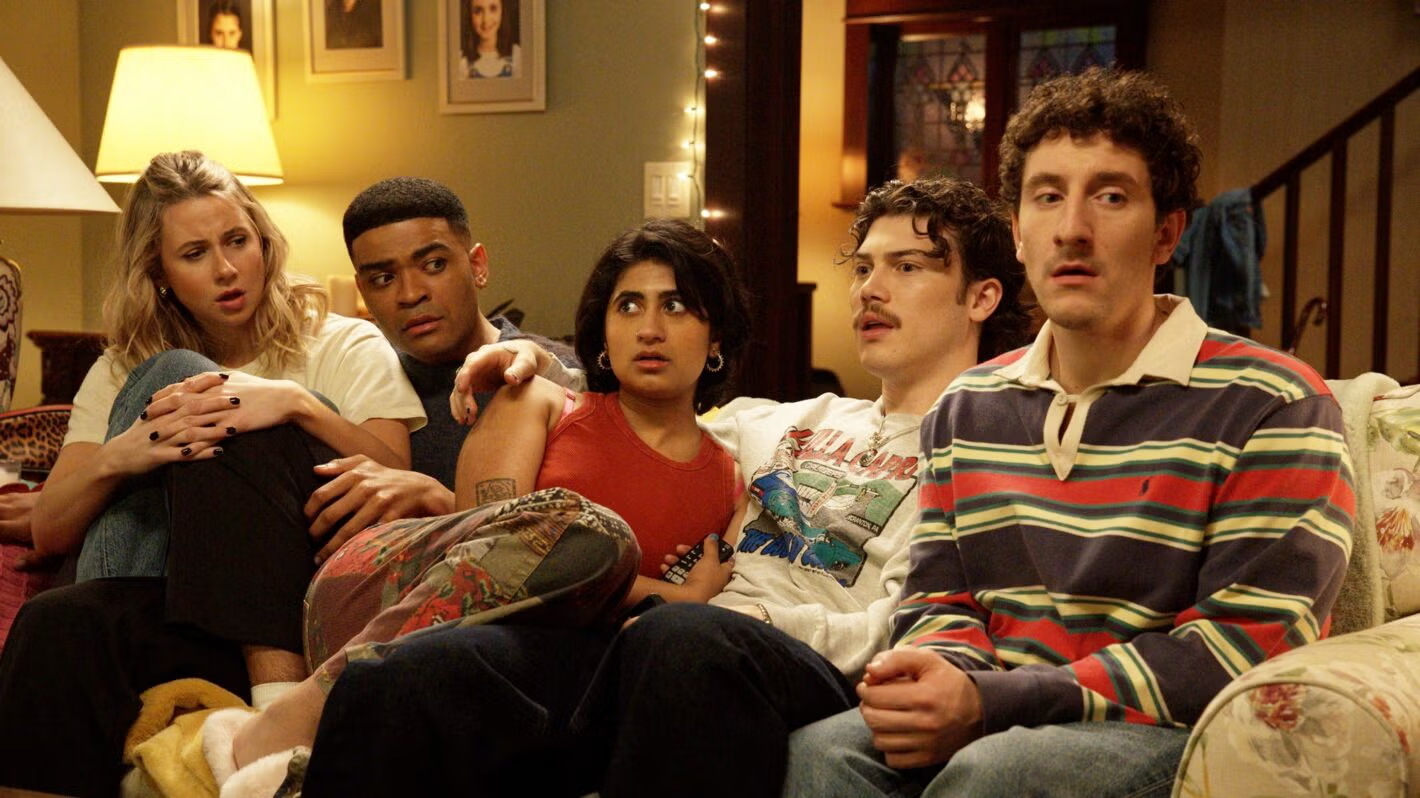
Whoever said the young aren’t drinking, having sex or doing drugs will reconsider their stance after watching Adults, the buzzy Gen Z hangout comedy that you may call the Friends of this generation. Picture this: you and your friends have just popped acid, the lights are dimmed, the couch looks sinkable, and the TV is cued for the gang to binge-watch Avatar: The Last Airbender…when a raccoon appears on your centre table. No, you’re not hallucinating already. And you have just about 30 minutes to deal with the wild animal before the acid kicks in and everything stops making sense. This is the hilarious, somewhat ingenious premise of an episode—aptly titled ‘Raccoon’—in the newest season of Adults, which just dropped its new season on JioHotstar last week. Before the acid even hits, the five Gen Z housemates scramble around their shared home in a panic, nearly have a threesome, and engage in way too many heart-to-heart chats.
When you’re not in stitches over the characters’ wild shenanigans in Adults, it’s hard not to notice how casually Issa and Paul Baker cheer “Welcome to acid night!” at the start of the episode and how easily everyone sticks out their tongues like happy children in a candy shop. The show makes doing hallucinogens seem as mundane as passing the popcorn and as cosy a group recreational activity as a chill movie night in. And Adults is not alone. Today, the riotous, hysterically funny part of the script is not relying on awkward sex and odd characters for the LOL scene but a mind-altering psychedelic trip.
“Indie films have been indulging in this trope for a long time. In Easy Rider (1969), Fear and Loathing in Las Vegas (1998), Trainspotting (1996), and more recently Midsommar (2019), altered states of consciousness are used imaginatively,” shares film writer Karan Anshuman, who has cowritten shows like Prime Video’s Mirzapur and directed series like Rana Naidu on Netflix. “Series are a natural extension, and I think it’s a result of the shifting cultural conversation around psychedelics today—they’re discussed more openly, so television naturally reflects that.”
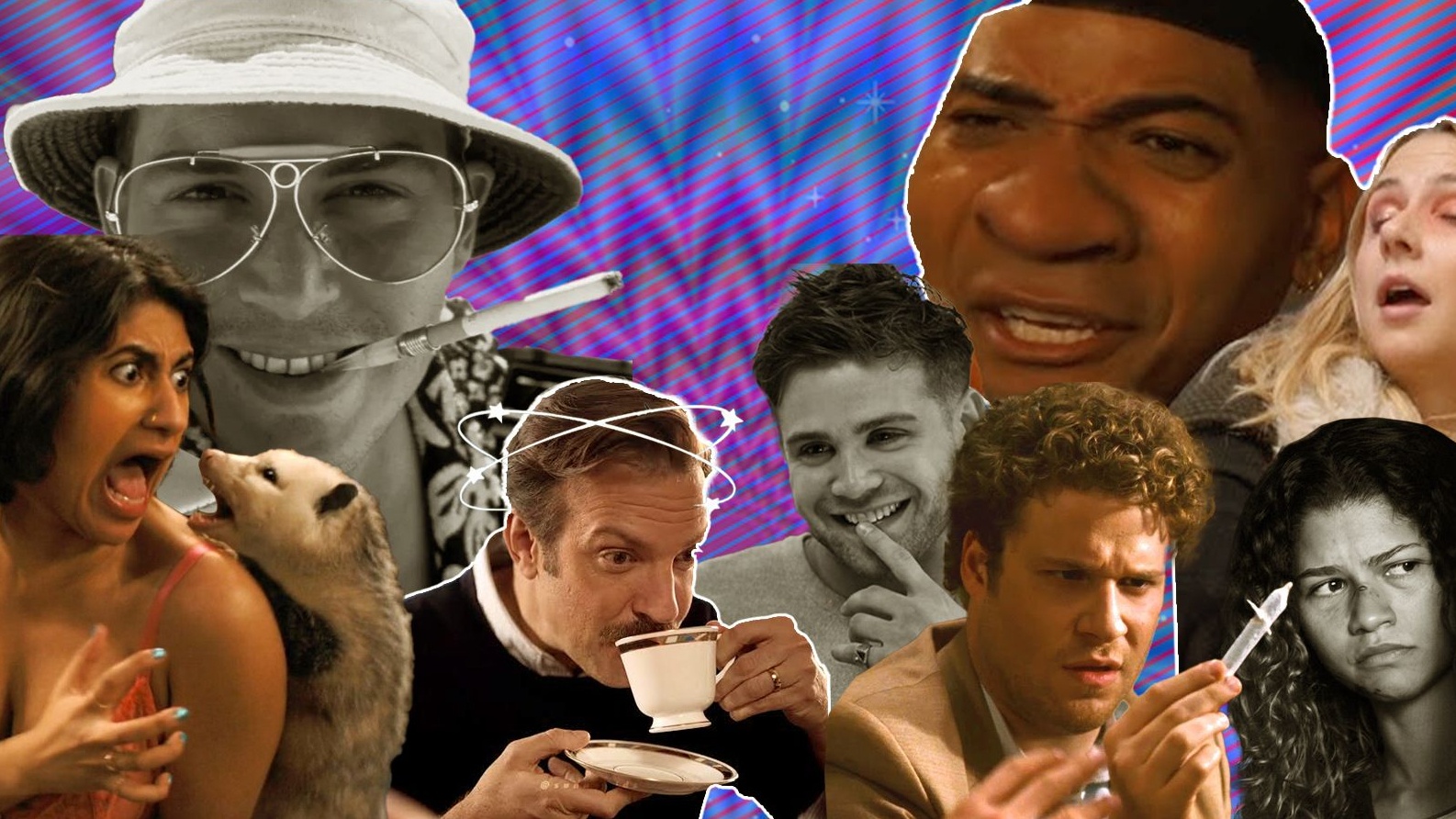
After years of black-and-white portrayals supporting the overarching belief that drugs = evil, tripping seems to have got an image makeover in mainstream media. Before, these substances were the moral compass, a sign of teenage rebellion or straight-up depravity. Take Walter White’s villain arc making crystal meth in Breaking Bad (2008), Andie McPhee’s near fatal overdose in Dawson’s Creek (1998), or most recently, Rue’s fentanyl overdose in Euphoria (2019). But now, everyone on TV is popping, dropping, and tripping. There is little didacticism around substances, no tragic lessons to be learnt, and comedies are committing to it with the promise of a laugh-out-loud sequence.
The sheer range of shows experimenting with this drug-positive arc is astonishing. In Ted Lasso (2020), the otherwise saccharine and wholesome PG-12 comedy, coach Lasso has a “Eureka!” moment after drinking psychedelic mushroom tea in Amsterdam. He starts hallucinating triangular geometric patterns and ends up devising a radical strategy for his losing football team. Only later does he find out that the shrooms he ingested were actually a “dud batch”, meaning the genius breakthrough came from his own sober mind. In Lena Dunham’s Too Much (2025), protagonist Jessica Salmon snorts ketamine for the first time. Her nose covered in powder, she watches in horror as her friend’s face turns into a cat’s, begs her chihuahua to speak with her, and writhes around groaning on the bathroom floor. The episode then retreats into a flashback as she processes the end of a toxic relationship. Both seasons of Beef (2023 and 2026) rely on mind-altering substances as plot drivers: in the first, former enemies Amy and Danny—who have frequently tried to murder each other, BTW—exchange bodies, realising that they are ultimately the same brand of wounded; in the second, Josh, a workaholic stuck in a midlife crisis, tries out a hallucinogen called “bufo”, the vapourised venom of a toad, which aids him in finally grieving his late mother.
Film analyst Karan Mirchandani has a hunch as to why psychedelics are being adopted with such ease: “I think in a time that’s sort of earmarked with avoidance and constantly distracting yourself with noise, the idea of psychedelics hijacking your brain and forcing you to confront your emotions is quite exciting.” They are also increasingly becoming popular devices for the plot to take an unexpected (and often funny) turn. “For writers and directors, a psychedelic trip is a very freeing device. I recently wrote a psychedelic scene myself in a film and it may be one of the funniest things I’ve written,” adds Anshuman. “The trope lends itself to comedy, surreal visuals, and complete subjectivity, allowing characters’ anxieties or suppressed emotions to become literal, if esoteric.”
Every season of The White Lotus has relied on this too: In season one, the resort manager’s final spiral is courtesy a lost bag of recreational drugs. In season two, a joint works as a truth serum between the two bickering couples. And most recently, in season three, Lorazepam gets a starring role, which is only shadowed by a party pill and an ensuing incest scene (between brothers Saxon and Lochlan) that truly shook the internet.
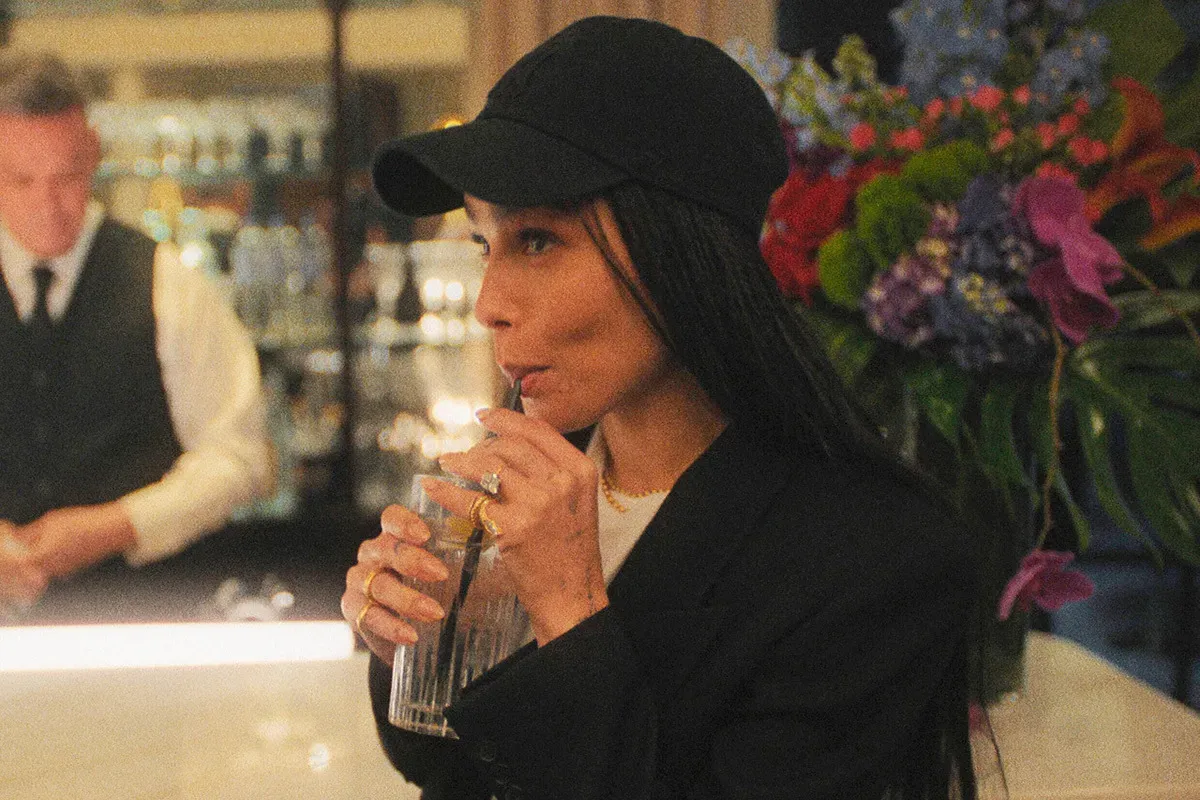
We cannot mention this trope without mentioning The Studio (2025), Seth Rogen’s manic series, which has a full episode dedicated to hallucinogens. When the usually reserved Zoë Kravitz accidentally overdoses on an “old school Hollywood buffet”, she turns into perhaps the most chaotic (and endearing) woman to ever be on shrooms.
Of course Rogen, the ambassador of premier rolling paper on the internet, has been a bit of an emissary for psychotropics. With the stoner comedy Pineapple Express (2008), he became the poster boy for potheads everywhere. In Platonic (2023), a show about two former besties reconnecting after a rift, he trips on ket with Rose Byrne.
But in 2026, it feels like a new trip for high jinks. In Dan Levy’s Big Mistakes, a Brazilian cartel pressures the dysfunctional siblings Nicky and Morgan to snort cocaine, after which they actually stop arguing for once, instead bonding over shared childhood trauma. Tom from Widow’s Bay goes completely off the rails after being slipped the “true sight” drug. In The Wrong Girls, Kristen Stewart and Alia Shawkat are “two codependent best friends living paycheck to paycheck and bong rip to bong rip”.
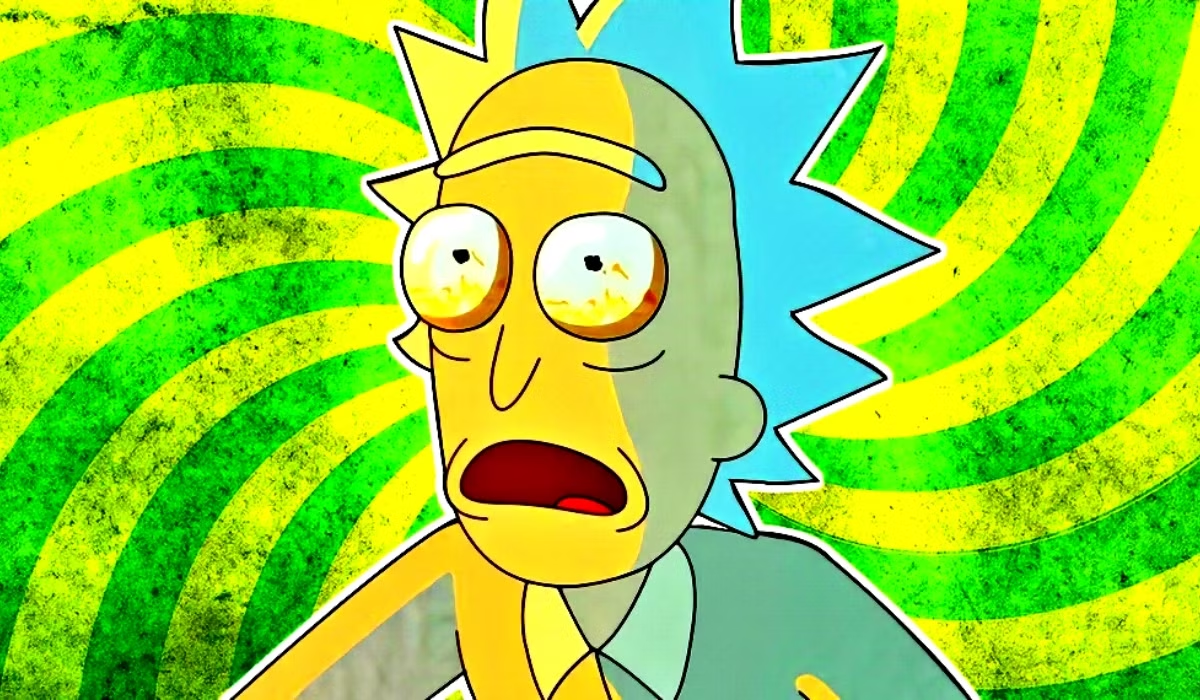
A psychoactive experience on screen functions as a catalyst that enables characters to break from habit. Emotions turn intense, images stop making sense. The usual laws of nature seem to be suspended and any restrictions placed on directors by logic and reality fall away. Instead, they can simply have fun with visuals. There is no clarity on what the viewer can trust or not: in that sense, these shows can simulate the experience of being high. Take Bojack Horseman (2014): in one episode of the animated series, Bojack kisses his friend Diane, only for her to sprout tentacles and turn into a slimy monster. In the Australian coming-of-age drama Please Like Me (2013), the world moves in slow motion, euphorically glowing when Josh and his friends do ecstasy and head to a nightclub. And in the cult classic Rick and Morty (2013), alien substances stir what is now known as one of the trippiest animated shows ever.
“Through the use of this trope, we can see inner worlds and stream of consciousness flowing unfiltered and unchecked without needing to necessarily adhere to the logic of gravity or time,” points out Mirchandani, adding that these shows can simulate the experience of being high as a kite, sucking the viewer in. “You can have someone speak to the kid version of themselves while confronting their mortality all at once. We’re often faced with exposition for characters, showing their deepest desires or fears rather than revealing them organically.” And the raccoon? Well, it’s just along for the trip.