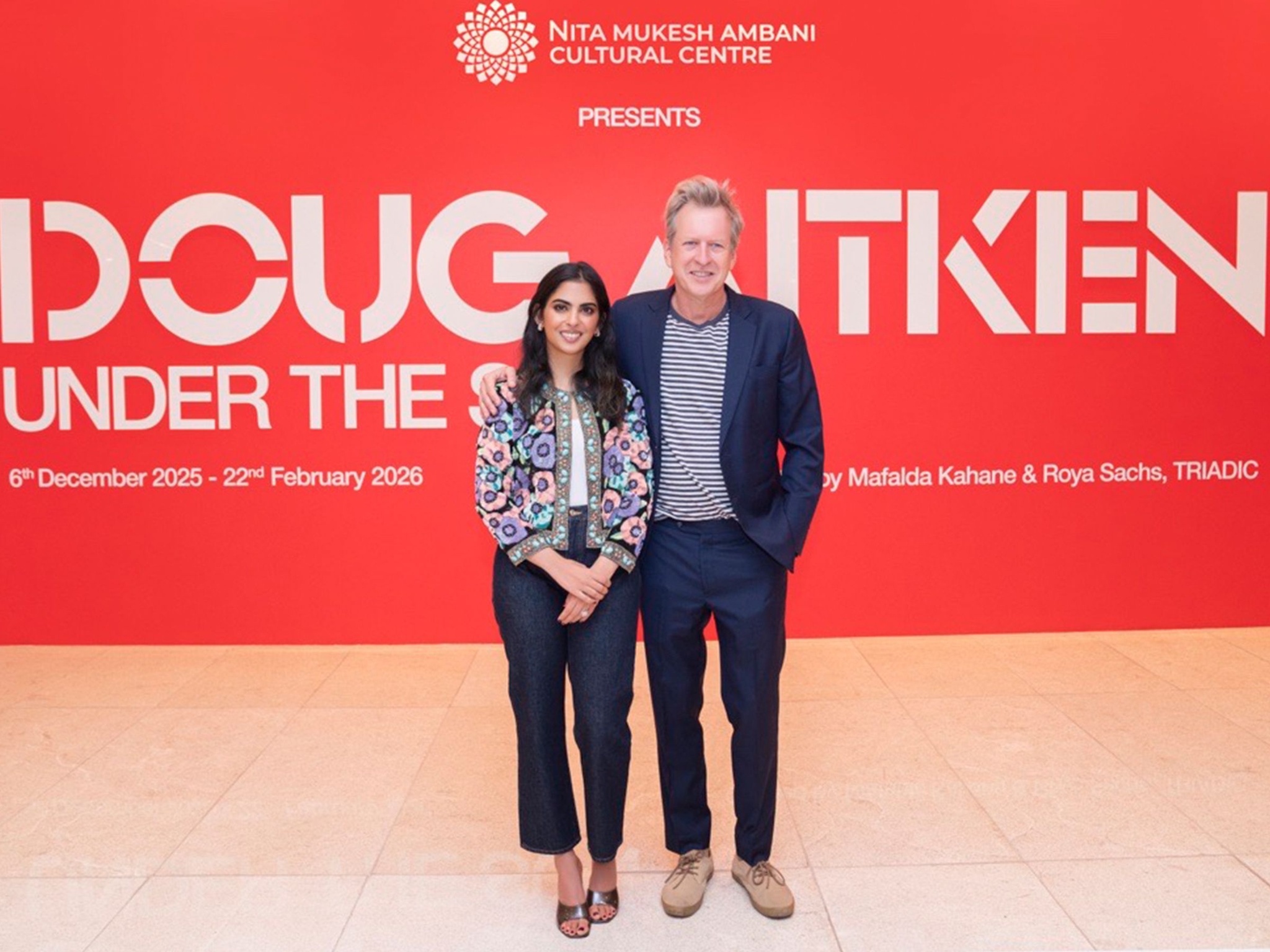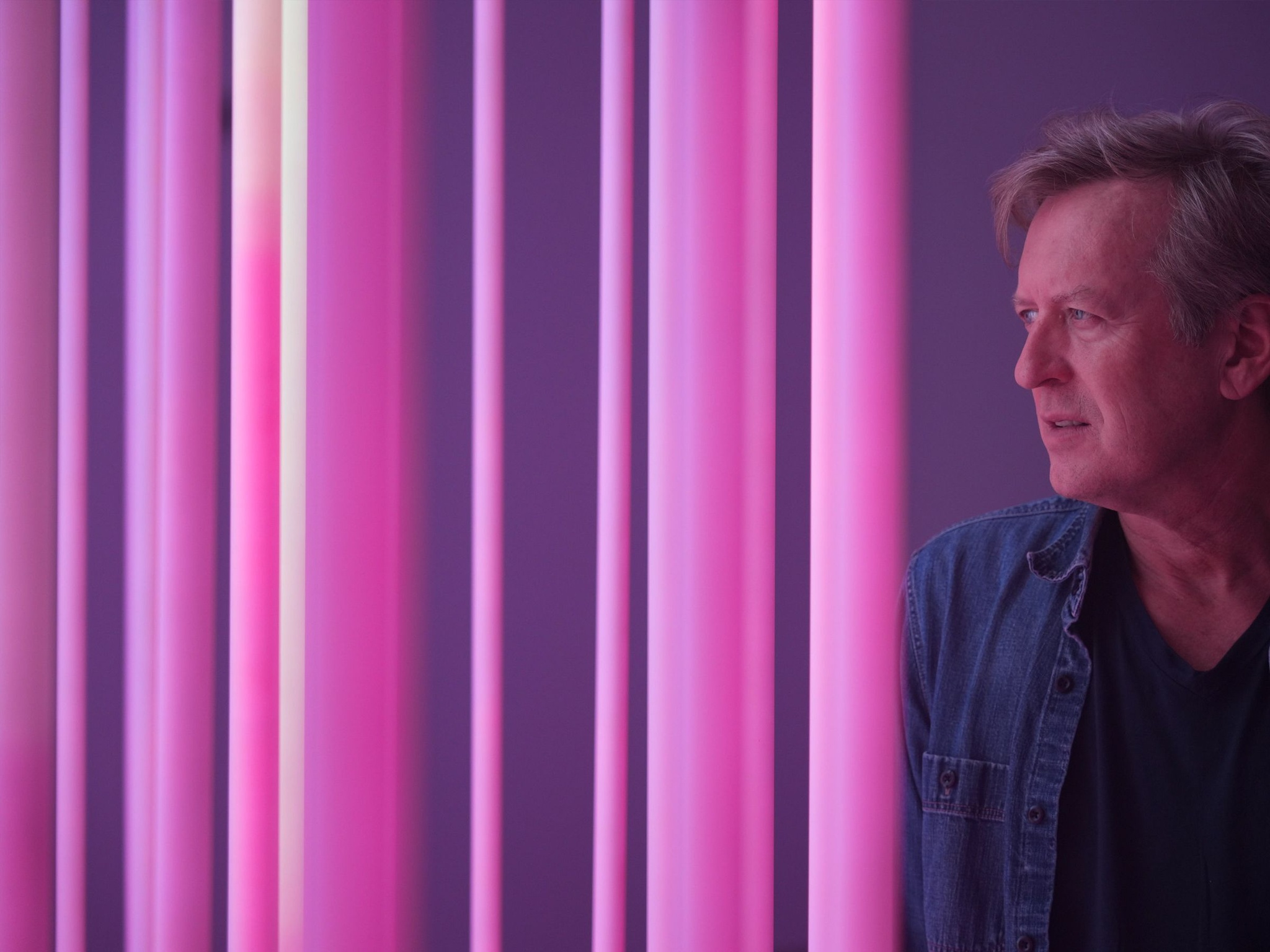





It’s two days out from the opening of his ambitious debut show at Art House, Mumbai, and the American artist, filmmaker and creative powerhouse Doug Aitken is, all things considered, relatively at ease.
We’re chatting in one of the lounges at the Nita Mukesh Ambani Cultural Centre (NMACC) while a few feet away, at the Art House, sound and light checks and early tours are in progress as photography and videography drones try to capture this site-specific body of work in its entirety.
Under the Sun, curated by Roya Sachs and Mafalda Kahane and co-produced by Elizabeth Edelman Sachs of Triadic, is an introduction to Aitken’s universe. Presenting an exhibit of this size and scale is a mammoth task, and for this particular show teams worked across continents and five time zones for almost two and a half years, fulfilling what started as a murmur when Aitken visited India for the launch of the NMACC in 2023.
This immersive, layered experience is designed as a journey across three floors, with a narrative structure encompassing and representing the past, the present, and the future. The show brings together Aitken’s fluidity with medium—film, wood, light, glass, textiles, and sound, to name a few—along with an almost instinctive use of synaesthesia and a spirit of collaboration (the tapestries were embroidered in Mumbai, taking over 600 hours, while the woodworking was done in Vadodara).
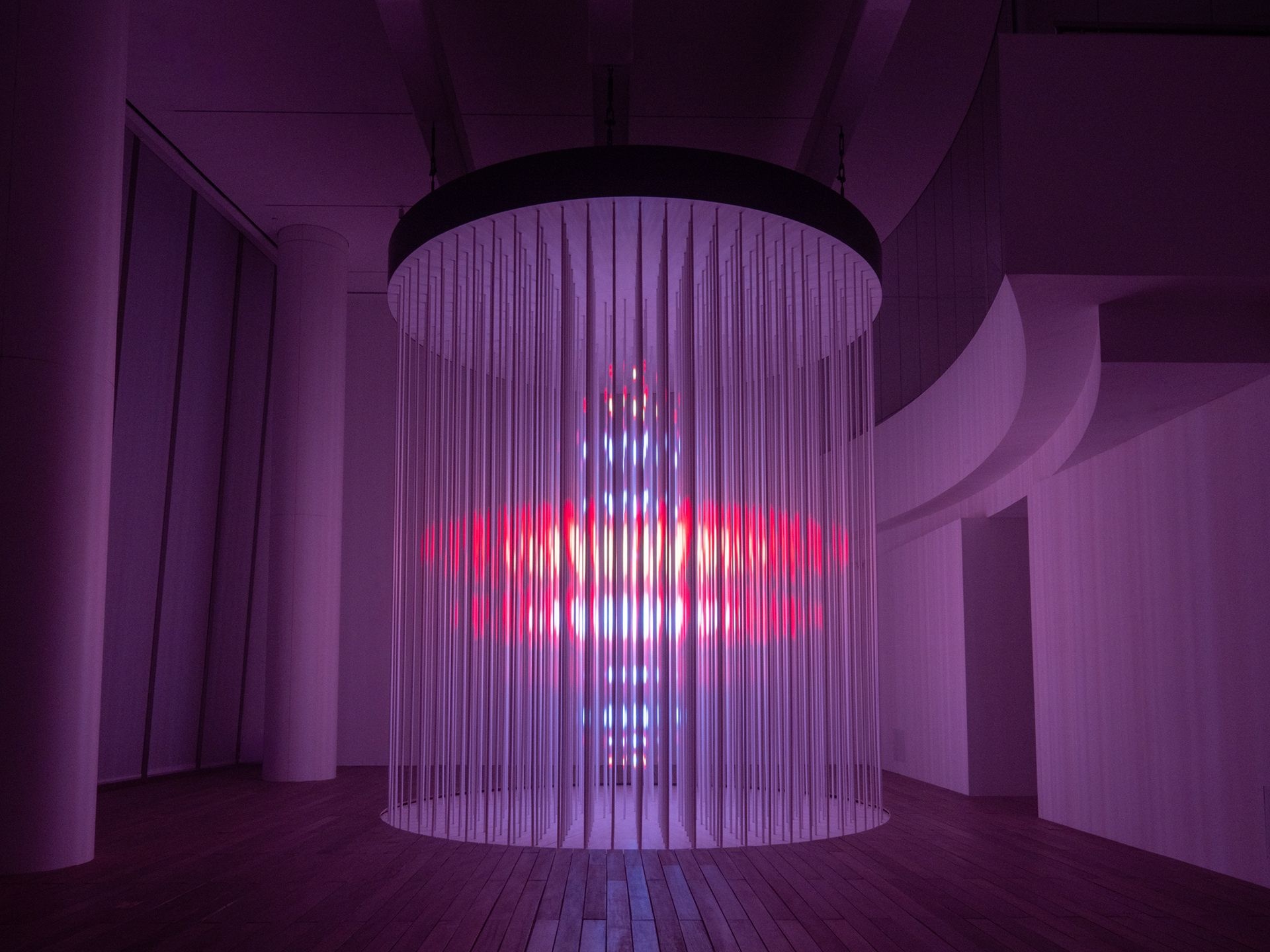
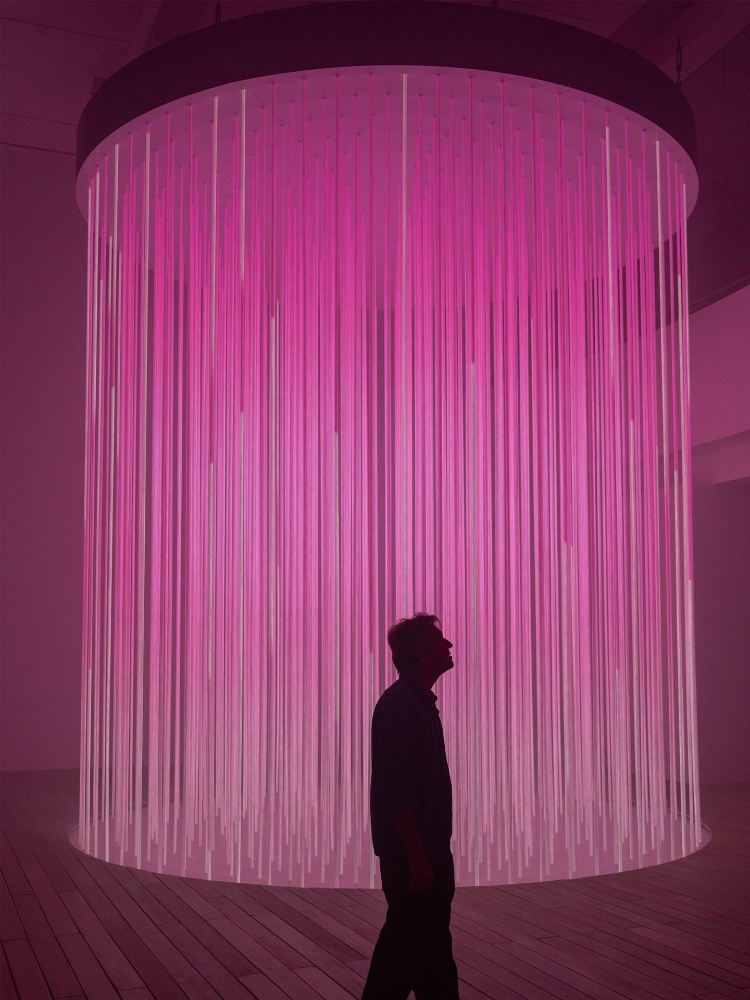
The exhibit opens with wood, reclaimed debris, and stone. Then the landscape changes as you go on to the other two floors. On the second floor is a mirrored chamber exploring the history of mobile phones, narrated by its inventor, Martin Cooper. The third floor feels hypnotic yet calming, with 7-metre-high light sculptures that feature hundreds of suspended LED tubes.
The LA-based Aitken is singular in his creation of transformative landscapes that are constantly evolving and surpass the unexpected. He is, after all, the artist who installed a mirrored home in the middle of the Palm Springs desert (‘Mirage’, 2017); created three temporary sculptures that were moored to the ocean floor off Catalina Island, California (‘Underwater Pavilions’, 2016); wrapped an entire block of New York City and the facade of the MoMA (‘Sleepwalkers’, 2007) in moving images; and created a kinetic light sculpture in the form of a train that travelled from New York to San Francisco making 10 site-specific stops along the way (‘Station to Station’, 2013).
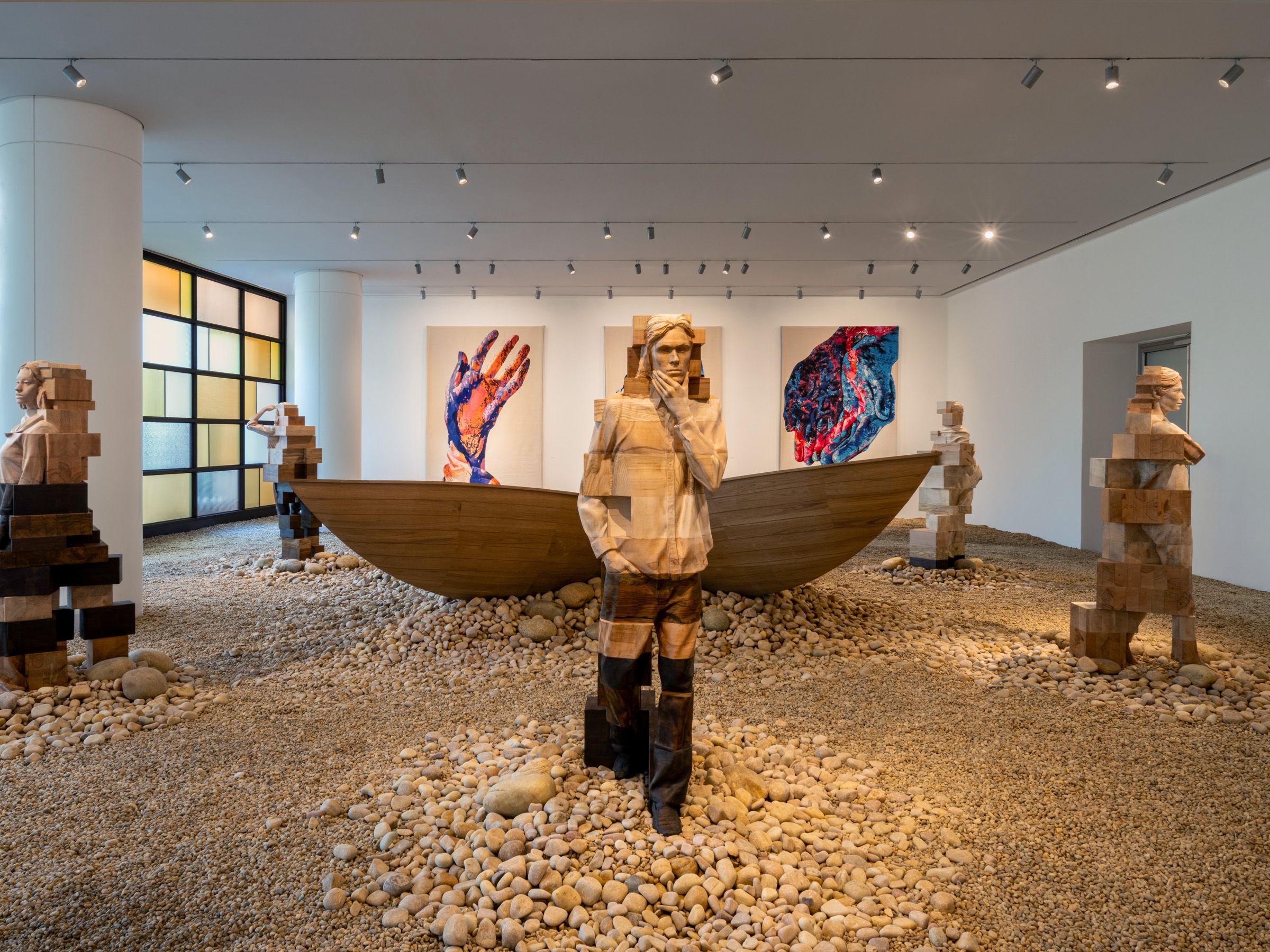
The first floor explores the past through materials like wood, debris and stone
The first thing that the multimedia artist says to me: “Bring everyone you love to the show. We’re building bridges here.” And this show is indeed a bridge between cultures, between tradition and technology, time and space, between the global and the local, between the medium and the message, in a landscape that is tactile, raw, and optimistic. Below, excerpts from our chat:
Take me back to the beginning, where this was just a kernel of an idea. What moved you to create this show for India?
I came here a couple of years ago [for the launch of NMACC] with no expectations. It was a blank slate. I’m interested in exhibitions that are site-specific—looking at the location, place, and architecture and working with that rather than just inhabiting it. And I saw that the [Art House] space was three floors and it was a little bit like how you read a book, a novel; it has a narrative structure. I wanted to embrace and really work with that. After the launch, I travelled to different parts of the country and found myself being inspired by craft guilds and artisans and the deep traditions that you find here. And I felt that there was an incredible opportunity to do something that was not the art that I would make where I live but to create a new body of work that was very much a bridge or a series of collaborations. That was the starting point. And then deciding to use the motif of past, present, and future for the different floors seemed like a clear structure. The idea was to create a series of landscapes that you move through that are quite surreal—where we have been with human history, where we are, and where we are going.
As an author, I love that you say that you saw this as a novel and that you want people to feel like they are walking into chapters of the book.
On the first floor itself, in Past, you find the materials itself. The wood sculptures are made of reclaimed, indigenous wood of the continent [done in collaboration with Sandeep Pisalkar of Creative Art Project], the six tapestries on the walls are images of the different major Indian rivers [featuring 600 hours of embroidery by Mumbai-based Milaaya], so you see this sense of geography, and the geography of landscape is filtered into these works. So, they are almost like maps and topographies, and in a sense they predate us, they predate human activity, kind of going back to the Earth itself.
As you rise to the second floor, it’s a contemporary mythology. ‘New Era’ is the story of the man who invented the first wireless phone and made the first cellular phone call. So, it’s almost like a new chapter for humanity, this side where we are nomadic but all connected and all tethered. It’s a complex work; it talks about the very new space we are living in. How do we occupy it? How do we navigate it? It’s a tender work, a haunting work. It speaks to his immortality and he sees his end is near as a human, but he sees his contribution outlasting him.
And then the third floor looks to a space beyond narrative, beyond representation, a choreography of light and sound. I wanted to create a work that the viewer falls into and is a void that is open to interpretation, emotion, perception. It’s many different mediums, diverse creatively but with a larger story. The collaborations are equal parts digital and traditional. I wanted that tension, that liminal space.