



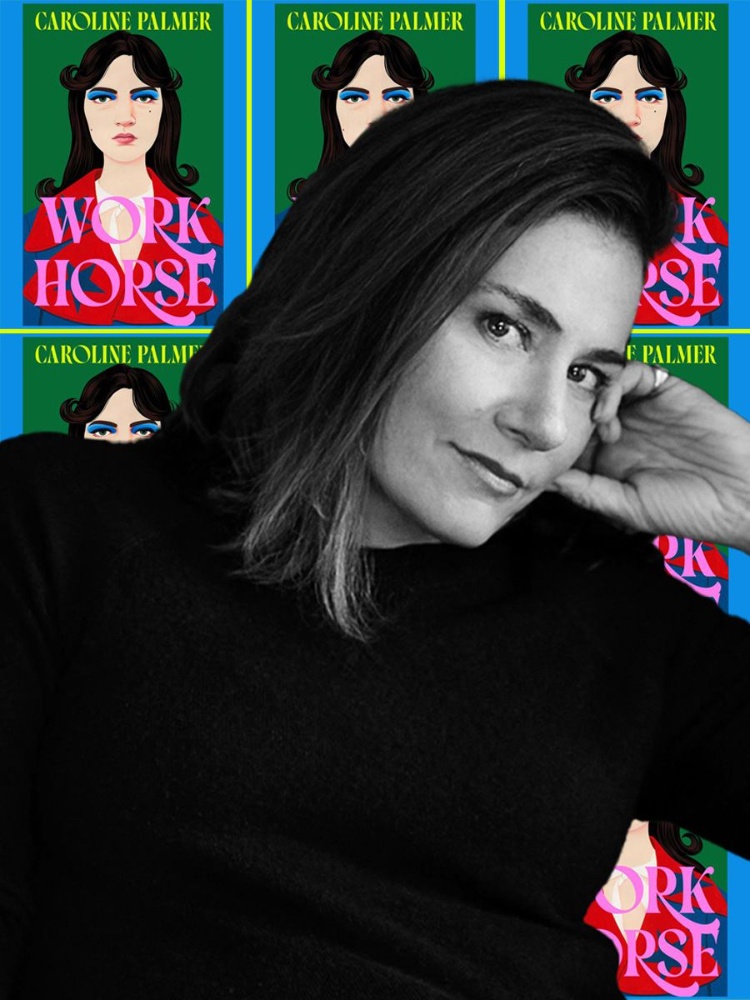

If one were to draw parallels between The Devil Wears Prada and Caroline Palmer’s Workhorse, it would be that both follow a fashion-world outsider trying to break into (and survive) the tightly guarded clique of insiders. But that’s where the similarities end. Where sweet, earnest Andy Sachs was running across NYC traffic trying to procure a Harry Potter manuscript for The Twins and getting Miranda’s extremely specific lunch order, Clodagh ‘Clo’ Harmon is lying on her résumé, pilfering petty cash for cigarettes, stealing art from a rich Hamptons house for sport, and sabotaging colleagues for better bylines—all to finally make it in the scary, intimidating world of the Vogue-esque but unnamed fashion magazine she works at. Where TDWP is the glossy, mainstream Hollywood version of that struggle, Workhorse is the unhinged A24 take.
Palmer, who, incidentally, used to be the editor of Vogue.com, knew she wanted to create a dark female lead. “In The Devil Wears Prada, you know in the first five minutes that Andy is going to be our heroine and never put a foot wrong. And, I guess, the women in my life are so much more complicated, and they don’t always do the right thing. I wanted to see a little more of that.”
Through Clo we are taken on a wild and, honestly, stressful ride as she tries to grift her way up from the trenches of the masthead. In the assistants’ bay, she, a Workhorse (the behind-the-scenes drudges) is befriended by Davis Lawrence, a Showhorse (the society girls with the right pedigree from the right pin code). Their dysfunctional friend triangle is completed by Harry Wood, the small-city guy with big ambitions. In a supporting role is Barbara, Davis’s alcoholic mother, an ageing star with her years of TV fame far behind her, who is more than a little jealous of her daughter’s youth. It’s hard to put a pin on who is using whom, or who is the worse friend—or person—as the book winds through moments that make your stomach twist in knots from second-hand anxiety.
When I speak to Palmer—she starting her day in New Jersey, me ready to wind up mine in Mumbai—she reveals that the book was optioned the week it was sold. No ETA on a show or a movie yet, though. “These things happen a lot and you kind of don’t know [what the timelines are],” she says. “To me, it’s very cinematic. I would love to see something happen with it.” The Talented Mr Ripley set in the fashion magazine world? As an old work horse from the industry, this one I would queue up to see.
Ahead, excerpts from my conversation with Palmer.
How much of your experience—your own career in the fashion world—made it to the book?
Well, it’s funny. So, the best way to explain it is that the milieu is obviously really familiar to me—the way the world works and the personalities work. But the individual stories and things that happened were all [fictional]. Like I was saying to someone, I’ve never been to Bungalow 8, but I wrote a whole thing about Bungalow 8. I literally was Googling it to see what it looked like inside. So, a lot of it was my imagination.
The vignettes were made up. The characters were made up. The plot, obviously. People were like, is this [Clo] you? I was like, no! I’m not this very dark person.
What was it like to write Clo as a character?
It was fun to do it, in a way. When I set out, anytime I was coming across a bad female character in literature or movies, [I noticed that] we were always giving them a really good handicap. Like, they’re running from a bad childhood or they have a mental illness. I was watching Homeland—I don’t know if you’ve ever seen that show—but it has Claire Danes and she goes back to work and leaves her baby and everyone’s like [gasps]. And then they’re like “don't worry, she’s mentally ill and off her meds”. And we’re like, okay, then we can keep liking her. But if a guy said, I’m gonna go back to work and leave my baby, it wouldn’t even be a plot point.
I wondered: could you draw a female character that isn’t running from something, isn’t disadvantaged, isn’t experiencing trauma or mental illness? They’re just kind of…not great. And they’re driven by things that I hoped the readers would see and think, I see myself in parts of this in a way that’s a little uncomfortable.
A lot of recent books explore this complicated protagonist—you know, the unreliable narrator. Why do you think that is? What’s the appeal of this person who’s doing the worst things that one can possibly imagine?
I think it’s very hard [to write]. I think the issue is, you still have to like them, right? We still have to like them enough. And I think that’s why I made Clo a lot more likeable in the first half. Some people read it and say that they felt this tenderness [towards her]. Then again, I went to a book party and this one woman was like, she’s awful and I hated her from the beginning. That’s also interesting to me. Not what I was trying to accomplish, but that’s great.
I gravitate towards—what’s that line?—“if you don’t have anything nice to say, come sit by me”. I think I’m very capable of being a kind, nice person, but I also have ambitious undertones. I had a friend once who was like “oh, I like everybody”. You can’t like everybody. I don’t trust anyone who likes everybody, but I don’t see that [depicted] much. I just feel our female heroines are ultimately not that detailed.
Speaking of characters drawn from real life, I saw some comparisons between Davis and Chloe Malle (head of editorial content at US Vogue). She did comment on that and you’ve clarified that there wasn’t any sort of connection between them…
It’s so funny, too, because Chloe is a friend. So that would have been dumb and mean and, like, why would I do that? Where I drew that character from was a totally personal experience in my family (sort of) and another girl I used to work with years ago, and I was like, I hope she doesn’t think this has anything to do with her. Chloe was not even on my list of concerns! I think [the comparison] was just because her being elevated to the role of editor at Vogue and the book coming out were right on top of each other. So, [people] kind of put them together. There were other characters I was actually worried about where people would be like, oh, is that…? And [the association with Chloe] never really came to my mind, until it did. But Chloe is amazing. She’s been so gracious.
It’s a hefty book. How big was your initial draft?
The initial draft was pretty close to this length. We cut probably 50 pages out of it. Going back, I probably could have cut some more. You know that saying in writing: you’re supposed to kill your darlings. I was like, I’m not killing any of them! They’re all going to just thrive and live on. My editor was great about the length. She didn’t seem too bothered by it. I panicked at first, but now that it’s done, I like the way it looks. It’s hefty.
I felt that a lot of the characters—actually, maybe all the characters—are unlikeable in their own ways. But I felt like Davis was the most morally neutral character out of all of them. She almost felt passive, like everyone was trying to do things and she was just sort of having things done to her. Was that intentional, that sort of contrast?
Yeah, having things done to her, but also done for her, right? This is someone for whom the things that maybe you and I struggle with—like popularity and money and getting what you want—all came very easily. If she had wanted to be an orthodontist, she would have been an orthodontist. But she’s also someone who, their entire life, just wanted out of the thing that they were forced into, right? They were kind of a prop, a puppet. She was more of an introvert, but she’s also not sweet. She knows exactly how to toss her hair and make eye contact. And she’s been raised by someone to get what you want, but what she wants, as the novel progresses, is to be left alone. She doesn’t have a lot of self-confidence, so she finds these broken toys, like Harry, so she can be the alpha and they can worship her and that feels good. But these relationships disappoint her or don’t last. She’s super complicated. I sort of miss her. I want to spend more time with her. She was a delight to write.
Would you say she was your favourite character to write?
Oh, no. I loved writing them all. I like that they were all different but also had some sort of similarity. They were just a nice threesome for me.
I thought I perhaps missed it during my reading, but then I went online to check: There’s a moment in the book where Davis gets assaulted after her engagement party. And then we never find out who actually did it. What was the reason behind leaving that open-ended?
So, the book has a very classic three-act structure. And I needed Davis to be incapacitated at the end of the first act. She had to be taken out so Clo could start to do this stuff. I also wanted the reader to be a little suspicious of everyone, which then influences their reading going forward. Is Harry a good guy or bad guy? Is Clo a good guy, or is Barbara a good mom or a bad mom? And my intent was to just figure it out as I wrote my way into the book.
I didn’t know [who did it] when I wrote the scene. I knew what I needed to get from the scene. But as I kept writing, there were so many other things that needed to be tied up. This served its purpose as a plot device; it made you uneasy. You were wondering if it would be answered. And then, when I got to the end, I couldn’t tie everything up because it would have been like the end of a Scooby-Doo show. So, I made the decision to let that hang. It was a hard decision. And it’s funny because people really wanted to know. It’s funny how after you write a book and publish it, you’re like, oh, maybe I should have told them. It’s a learning for the next time I do this.
What’s next for you? A new book, maybe?
Yeah, I’m writing a new book, but it’s slow. The second one is hard. I would love to write books all the time. And, you know, maybe find a part-time job while I’m writing it.
Do you want to tell us what kind of space the new book is in? Is it going to be in a fashion-adjacent world or...?
No. It’s going to be women-focused. But it is not in fashion. I have a lot of ideas. It’s just a matter of which one you are going to really invest in and which one you think the most amount of people would care about or want to learn about.
Do you have any writing rituals? Is there a specific thing that helps you get into the zone?
Well, I wear a floor-length leopard coat when I write. I don’t know what’s going to happen with the next one, but for Workhorse, I was a very early riser, which isn’t normally my way of being. I would get up at 4:15 in the morning, and I would start writing at 4:45 in my leopard coat, and I would stop writing at 7:45, when I had to wake my kids up for school. And then I was done for the day. I couldn’t write anything else.
How did the leopard coat help?
I don’t really know. I bought it for Halloween one year and I would sort of come down in the morning and use it as a bathrobe. One morning I put it on, and I thought, okay, like this is warm and ridiculous-looking. I just started putting it on every day. It was just a thing that I did. It was $50 from Amazon, and I love it. I don’t know what I’m going to do when it wears out. I should check to see if they still sell it.
Last question. This book is set in the early 2000s. Can you imagine the characters as Gen Z employees in a workspace today?
No, no. Not at all. I think a lot of the stuff people got away with then, they can’t get away with now, for better and for worse. It’s almost impossible with things like smartphones and working from home. You can’t create that same insular world that we had in the book, so, no, I can’t imagine it.