




For over two months after we were introduced in 2022, my now-boyfriend and I had absolutely nothing to say to each other. There was only one message we exchanged every day: our Wordle results. A funny text or two would sometimes accompany these as we grew used to this little ritual: “I hate today’s Wordle,” I’d grumble. Or “Today’s Wordle sucks ass”. Then, weeks later, there was a single conversation—I asked him for situationship advice. Soon, another followed. In about a year’s time, we considered each other friends. Then one night, when my phone got stolen, I opened my laptop to an email from him: “Dearest Saachi,” it read, “Losing your phone doesn’t mean you don’t have to lose to me.” His Wordle results were attached.
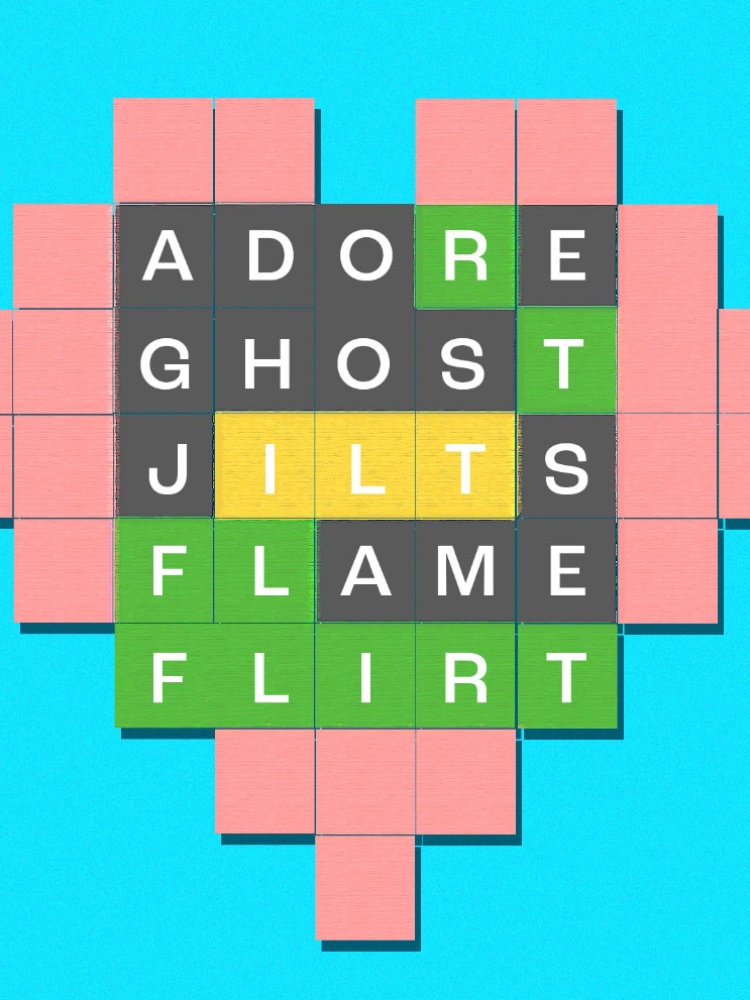
Until the release of Wordle in October 2021, puzzles were mostly associated with the elderly: grumpy grandmas and grandpas hunched over the newspaper muttering to themselves as they attempt the day’s Sudoku or crossword. The idea behind Wordle was simple: to guess a mystery five-letter word in as few tries as possible, with coloured tiles revealing how close you are to the answer. For the same 24 hours, everyone across the globe gets the exact same word daily, which means the game somehow became one of the few things we had in common regardless of age or nationality. Even its backstory was romantic: the internet swooned over how software engineer Josh Wardle had originally created Wordle in 2013 for his puzzlehead wife Palak Shah: oh, to be loved to the point of invention! For nearly a decade, this game was a private ritual shared amongst their friends and family.
And then it exploded. From only 90 players in November 2021, Wordle suddenly had over two million players at the start of 2022. “When I was on a date and this guy stopped kissing me to do the wordle,” a popular tweet confessed. “Had a nightmare I lost the Wordle,” another fretted.
Twenty-four-year-old Huda Moolji, a communications assistant in Adelaide, was introduced to the game by her dad. Within a week, she was part of a group chat created by her friends exclusively to discuss Wordle daily. “It came at the perfect time because it gave us something to do during the lockdown that wasn’t just consuming media,” she points out. “I think competing with others and comparing results every day created a sense of community in a time when we were so physically distant from each other.”
Five years down the line, the craze is nowhere close to dying. In fact, it’s evolved and expanded. Moolji and her dad still share their Wordle results with each other on most days. Thousands post them on social media. Wordle currently has over 10 million monthly players. It seems that the hottest thing a Gen Zer can do now is solve daily puzzles online (“I would climb him like a monkey,” my friend Parnika Agarwal texts me about a TikToker who posts himself playing these). In India, physical newsletters like Press Play and Silly House—mailed to people’s homes regularly—include puzzles, number and word games, quizzes and more. There is no dearth of options.
On her Instagram Story some weeks ago, psychotherapist and researcher Sanjana Nair posted a list of games she plays daily—Wordle, Connections, LA Crossword, Globle, DSM-dle and Krillion—asking others for more recommendations. Later, she texted me this list of approximately 30 puzzles she had put together. “One can never have enough,” the 26-year-old insists.
‘You have to play Poople,” Agarwal texts me around the same time, and soon I become addicted to the game where one must “get to ‘poop’ in as few steps as possible” by changing only one alphabet of a random four-letter word on each turn. Agarwal also took a full day to teach herself the Minute Cryptic, a complicated and very convoluted crossword that brought me to my knees on the first attempt. Another friend is still offended I made fun of her for playing a game called Tradle.
Three people I know have recently purchased the Games subscription at The New York Times. In fact, so popular is this daily ritual amongst millions that movie theatres in the US are planning to roll out an interactive NYT Games pre-show experience. Even LinkedIn—supposedly an online professional network—has 8,30,000 daily subscribers on its Games newsletter as of May 2025, with 84 per cent players returning the next day. In the same way that we make time for our skincare routines, Gen Zers now take out an average of 15 to 30 minutes of their day to solve puzzles.
The design of these games is simple, non-stimulating: they feel like the only thing on the internet created not to be addictive, and limited to being played just once a day. Their graphics are shareable, leading to heated discussions amongst friends.
My boyfriend and I have moved on from Wordle to Crossplay, NYT’s Scrabble app—which I am so pitifully incompetent at that it took me 16 games to win a single match. At any given time we are in the middle of a game against each other, playing so much that “I nudged you!” has become part of our vocabulary. Of course, we are not above gloating over our victories or being sore losers. “In your honour, my first word for tomorrow will be fluke,” he once texted me after I won a match.
But this healthy competition can be a necessary outlet: Agarwal sometimes binge-watches Reels of people finishing six games in under six minutes. She dreams of achieving this level of mastery. Maybe the highest point of her life, the 23-year-old confesses, dead-serious, is the one time she solved the Minute Cryptic in just 30 seconds. “Every time I solve the Minute Cryptic, I feel so good about myself. And when I give a rare answer on Krillion and it tells me I’m better than 94 per cent of players, I’m like, me? No way!” gushes Nair.
But these puzzles are irresistible for another reason. Dedicating even a tiny chunk of your day to a simple pastime, a stimulating brain exercise, feels productive, rewarding the time we devote to doomscrolling through piles of brainrot and AI slop. Ironically, the stress of trying to win a game can be relaxing, almost mindful. It is why more and more Gen Zers are picking up ‘boomer’ hobbies: arts, crafts, sports, and now, solving puzzles.
London-based editorial assistant Neeharika Nene and her partner end their days by playing a series of games together, from the NYT package to the trivia quiz Krillion and Minute Cryptic. “It feels like we have something fun to look forward to, a way to wind down,” the 25-year-old admits. “And there’s this sense that you’re competing with hundreds of thousands of people but are also involved in something bigger with them.” Agarwal, on the other hand, solves these puzzles first thing in the morning to avoid going through her texts or looking at Instagram immediately after waking up. “I make myself a coffee, open my laptop, keep my phone aside and play. It’s meditative, almost.”
These gaming rituals are now so intertwined with our lives that almost everyone I speak with has a story to share. Moolji recalls telling a boy off for spoiling the Wordle for her best friend on a particularly rough day. “I explained that this was something she’d been looking forward to because she was feeling low, and that he’d ruined the day for her. It was just that serious,” she says. For Nair, solving these puzzles with her co-workers makes going to the office seem like less of a chore. “Sometimes our manager sneaks up on us to see why we’re all huddled around a laptop—and ends up joining us,” she reveals. Nene remembers a ritual she shared with her best friend in the early months of Wordle: “We’d create our own Wordle but the words had to be inside jokes. We’d put a crazy amount of effort, responding with coloured squares and everything.”
As for my boyfriend and I, we now have much more to talk about—yet only two nights ago I was sulking again over going down in flames at a game of Connections.