The storefront, a stone’s throw away from Hyderabad’s iconic Charminar
Photographs by Rahul Cheguri
A stone’s throw from Hyderabad’s iconic Charminar, 65-year-old Haji Sahab, runs a modest 300 sq ft store selling all kinds of embroidered goods. “The practice was started in 1947 by my father, Afzal Miyan,” says Haji Sahab, 65, who now runs Afzal Miyan Karchob Wale. “He learned zardozi from his mamu (uncle), a 12th-generation weaver, and then taught me.”
Karchob is a Persian term (kar meaning ‘frame’ and chob meaning ‘wood’) used to describe the wooden frame essential to zardozi and other intricate hand-embroidery traditions. The shop has operated out of the same premises (spread over two levels) since 1977, and this family-run business has a storied legacy that outweighs its real estate footprint. Among its early commissions were three zardozi garments for the 1967 coronation of the last Nizam of Hyderabad, Mukarram Jah—a long coat for the prince and two saris (one that was encrusted with gems) for his wife, Princess Esra. Almost five decades later, for the 2023 titular coronation of his son Azmet Shah, Haji Sahab completed a dastaar (ceremonial headgear) in just six hours, including dyeing, starching, and stitching.
Designers such as Sabyasachi Mukherjee, Manish Malhotra, and Tarun Tahiliani source from here, as do design houses like Good Earth and Ogaan. The store also created a bright red zardozi cloth—embossed with Radha-Krishna motifs—for Akash Ambani and Shloka Mehta’s wedding in 2019.
Closer to home, it is something of a local institution, frequented by everyone from celebrated designers and aristocratic matriarchs to curious influencers and even Miss World contestants who found their way here when the pageant came to the city last year.
ADVERTISEMENT
A selection of their handcrafted lace: Hyderabadi lampi and kiran
The proprietor Haji Sahab
A ceremonial zardozi cloth featuring a central circular medallion with a Radha–Krishna motif made for Akash and Shloka Ambani’s wedding
What sets this blink-and-miss establishment apart is the sheer variety practised here: rare embroidery techniques linked to the broader zardozi tradition where artisans use metallic threads, wires, spangles, sequins, and beads to create ornate, opulent designs on fabrics like silk, satin, and velvet. There is kamdani (metallic thread embroidery), tila (metal thread stitch), dabka (coiled wire embroidery), marod (surface metallic stitch), and fareesha (decorative stitch/embellishment), among others, all executed by hand, all increasingly hard to come by.
Patrons also make a beeline for their unique Hyderabadi lampi—hand-embossed metal lace—produced in five styles: box, cross, waves, flower, and mixed. Inside the store, shelves are stacked with glinting trims, borders, and textiles that shimmer and shine, waiting to transform the ordinary into the ceremonial.
“There is a wide range of handcrafted work that we do, now at the risk of vanishing,” says Haji Sahab. He points to badla work, where flattened gold or silver wires are stitched or twisted onto fabric, and pitta, where metal threads and sequins are hammered flat by hand. Both are painstaking, and both demand time.
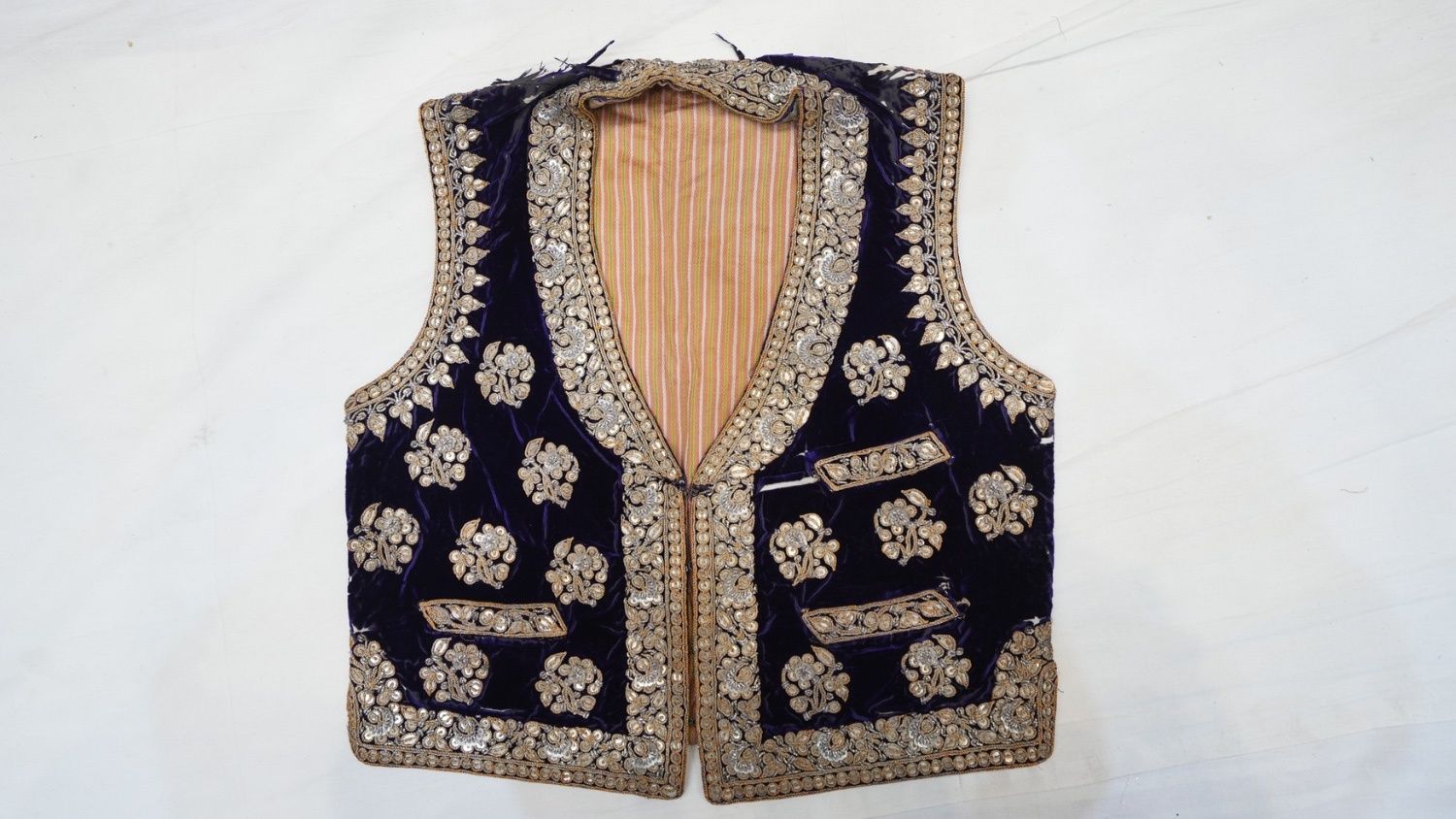
A 150-year old traditional sadri made by Haji Sahab’s ancestors in silver zardozi embroidery
Many of these styles are seen less and less today owing to a combination of factors: the intensive nature of the work, the dwindling number of skilled artisans willing or able to learn the craft, and the growing preference for faster, machine-led embroidery. Rising material costs, especially precious metals, and shrinking patronage for true handwork have further pushed these techniques to the margins.
That hasn’t stopped the family from continuing to make textiles that once formed the backbone of Deccani ceremonial life: masnad (or masnath), the richly embroidered wedding seat for bride and groom where rich textiles like velvet were decorated with silver and gold embroidery, and changer (locally pronounced chaanger), the decorative cloth used to carry garlands and symbolic offerings.
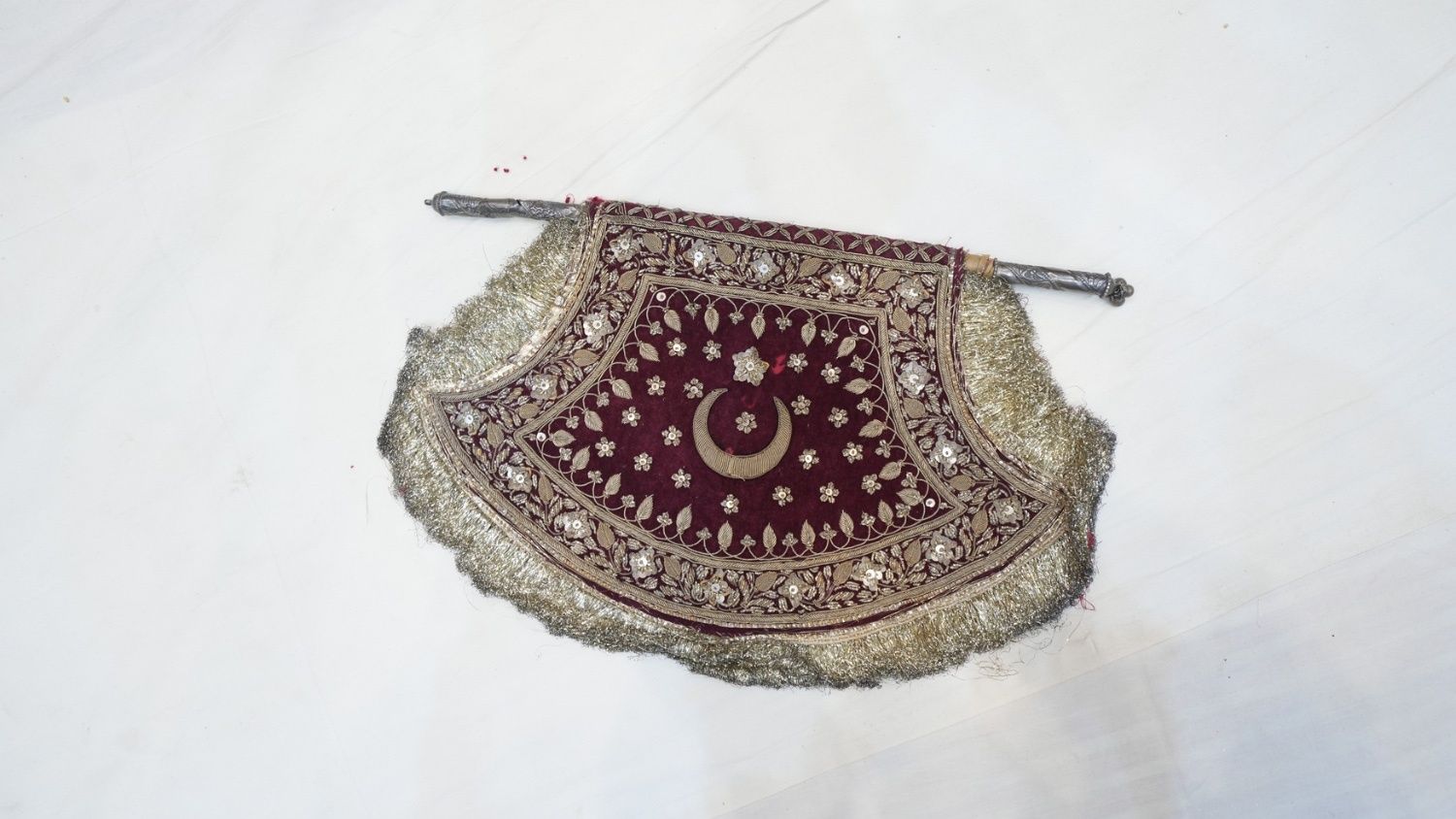
An antique pankha with a sliver handle and zardozi work, passed down through generations
Haji Sahab’s son, Abdul Quadir, 34, has been coming to the shop since his school days. “Once these skills disappear, they cannot be recreated,” he says. “Some of our work, like a form of gota called cross masala, is twisted entirely by hand, using just the thumbs.”
Time, here, is the true currency. A 16-inch lampi cloth can take 45 days for one artisan to complete. A pitta-work sari takes a month. Badla is the most exacting of all—two artisans and up to six months for one sari.
Today, the store also makes jewellery boxes, bangles, clutches, headgear, wall hangings, carpets, tray covers, and other wedding accessories (even hair ornaments in zardozi decked with beads and sequins), all done up in different styles of hand embroidery. Apart from a collection of Benarasi brocades, they make khada dupattas on order and do not replicate designs, ensuring that each piece is singular (“True designer wear,” chuckles Quadir).
The owners are custodians of both exceptional craft traditions and the legendary Hyderabadi hospitality. Visitors are treated to piping hot Irani chai and Osmania biscuits (from another icon, the nearby Nimrah cafe), and they are equally patient with both textile connoisseurs and scholars and curious passers-by in generously sharing their story.
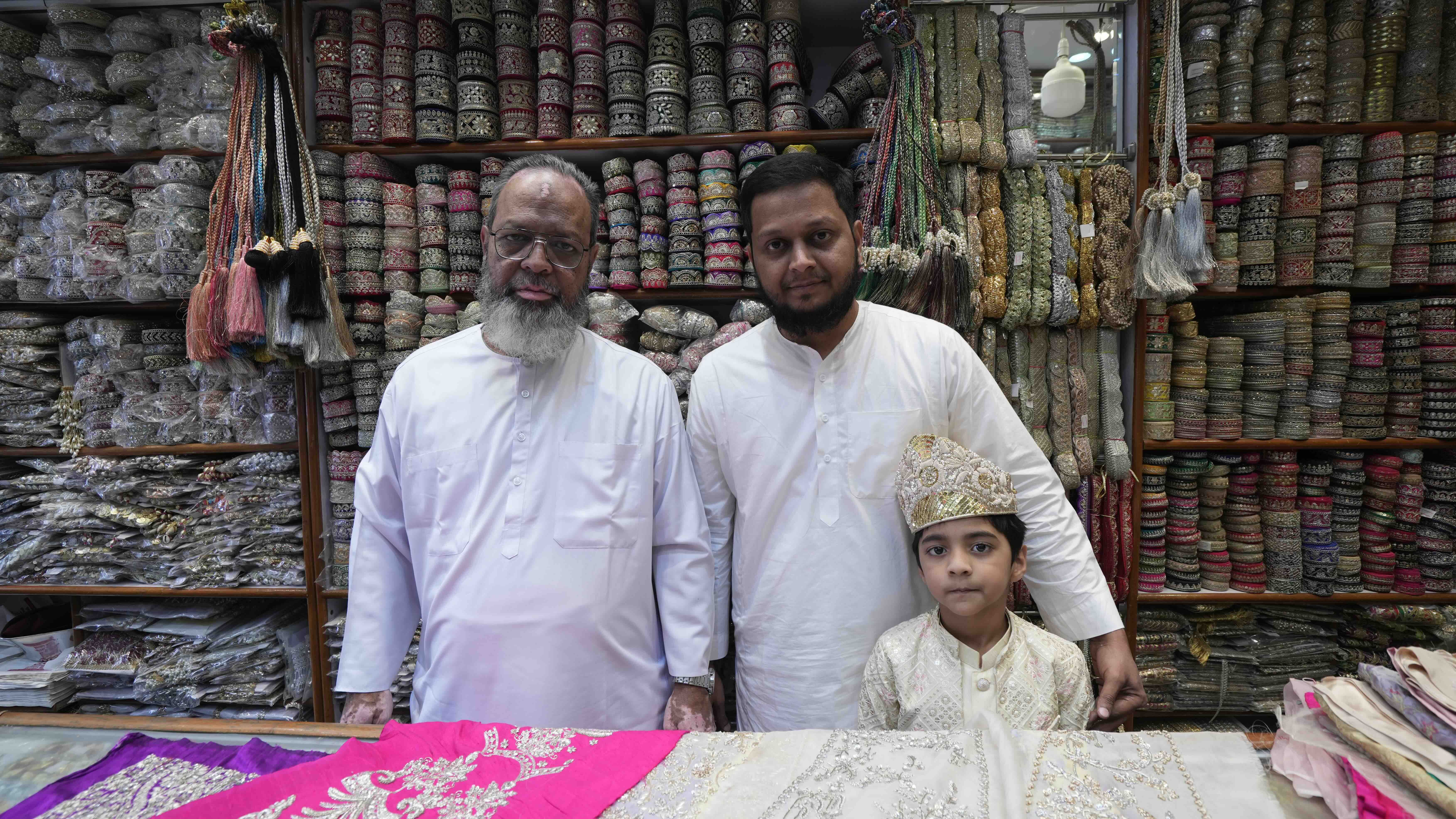
Three generations of the family: Haji Sahab with his son Abdul Quadir and grandson Saleh Al Quadir
The future is not without its challenges. Quadir states, “Most young people are keen on moving abroad instead of learning these handcrafted techniques. Also, not everyone understands that quality comes at a price, which makes space for duplicates.”
For now, the father-son duo is happy continuing to do the same work as their ancestors: quietly, patiently, and with a deep sense of pride.