



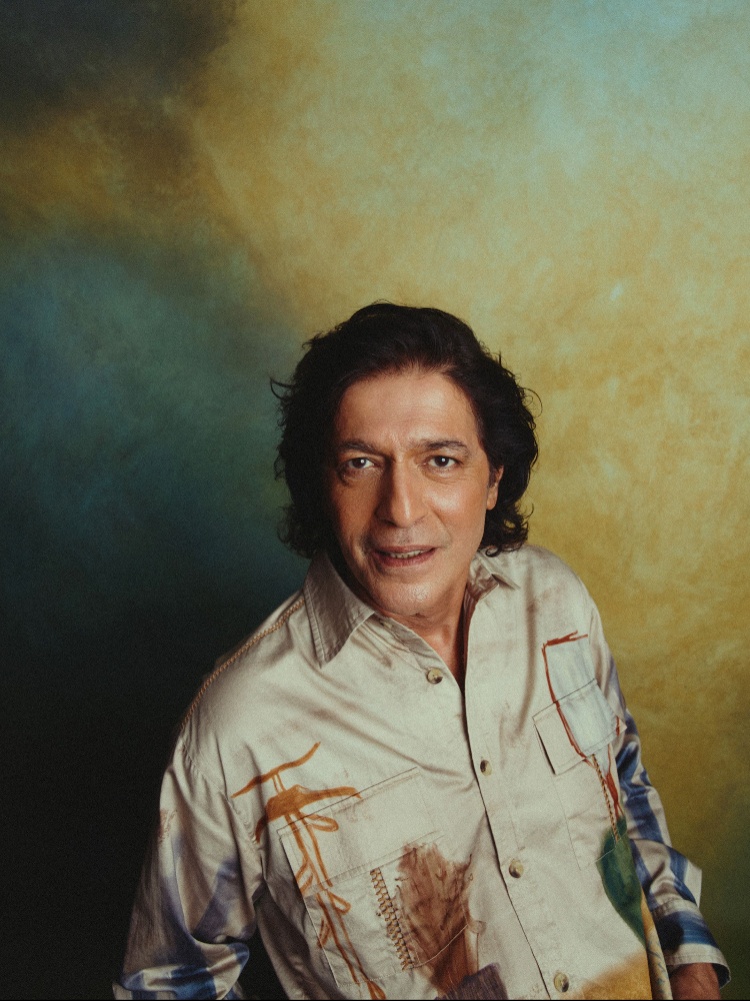

Chunky Panday is standing in the doorway of his living room in Bandra, phone in one hand, as he greets me in. He’s almost unrecognisable in a worn-out green polo T-shirt and grey track pants. There’s none of that theatrical, flamboyantly dressed, and eccentric personality we see onscreen. But there is that unmistakable tousled mess of hair that must feel like a thing of pride to any 63-year-old.
He is welcoming in a formal sort of way. When I hold out my hand to shake his, Panday looks surprised, almost retreats, then shakes it. There are fires that need to be put out, he tells me, brandishing his phone and asking me to give him some time to sort things out. As he leaves, he asks, “Americano?” and I nod before taking a seat on one of the peach-coloured couches.
The room is spacious but sparsely furnished. It seems like the kind of space that is designed to reveal nothing about its occupants. It’s minimalist in style, and nothing here—not the oversized television, the lone piece of art or the massive mirror stretching across one wall—tells me anything about its maximalist inhabitant. The only thing that stands out is a treadmill, flush against the window overlooking a hospital—a hospital, I later learn, his father helped set up.
Ten minutes later, Panday emerges with his cup of Americano, takes his place across from me and origamies one foot under the other. He lets out a sigh of an overbooked artiste as he leans back comfortably on the sofa. Just this month, his film Baby Do Die Do, an action-thriller also starring Huma Qureshi, received the sort of critical attention that has eluded him so often in his 39-year-old career. His latest role, that of a bespectacled, mustachioed, silver-streaked mentor to an assassin, is so far removed from Munnu, the mischievous brother in Aankhen (1993), that you could call this a reinvention of sorts for an actor who has worn the mantle of absurd comedy proudly for a large part of his career.
Baby Do Die Do’s box office response has kept him busy and filled his calendar with promotional events across India. He’s also working on a project that he signed with the late Pahlaj Nihalani, the same man who gave him his first break in movies. “He’s making it for Ekta Kapoor. We are launching Govinda’s son in it,” he says, recalling a bathroom incident from many years ago that sealed his acting debut and made Nihalani sign him for Aag Hi Aag (1987). Then comes a Hansal Mehta production by award-winning Malayalam director Lijo Jose Pellissery, later this year.
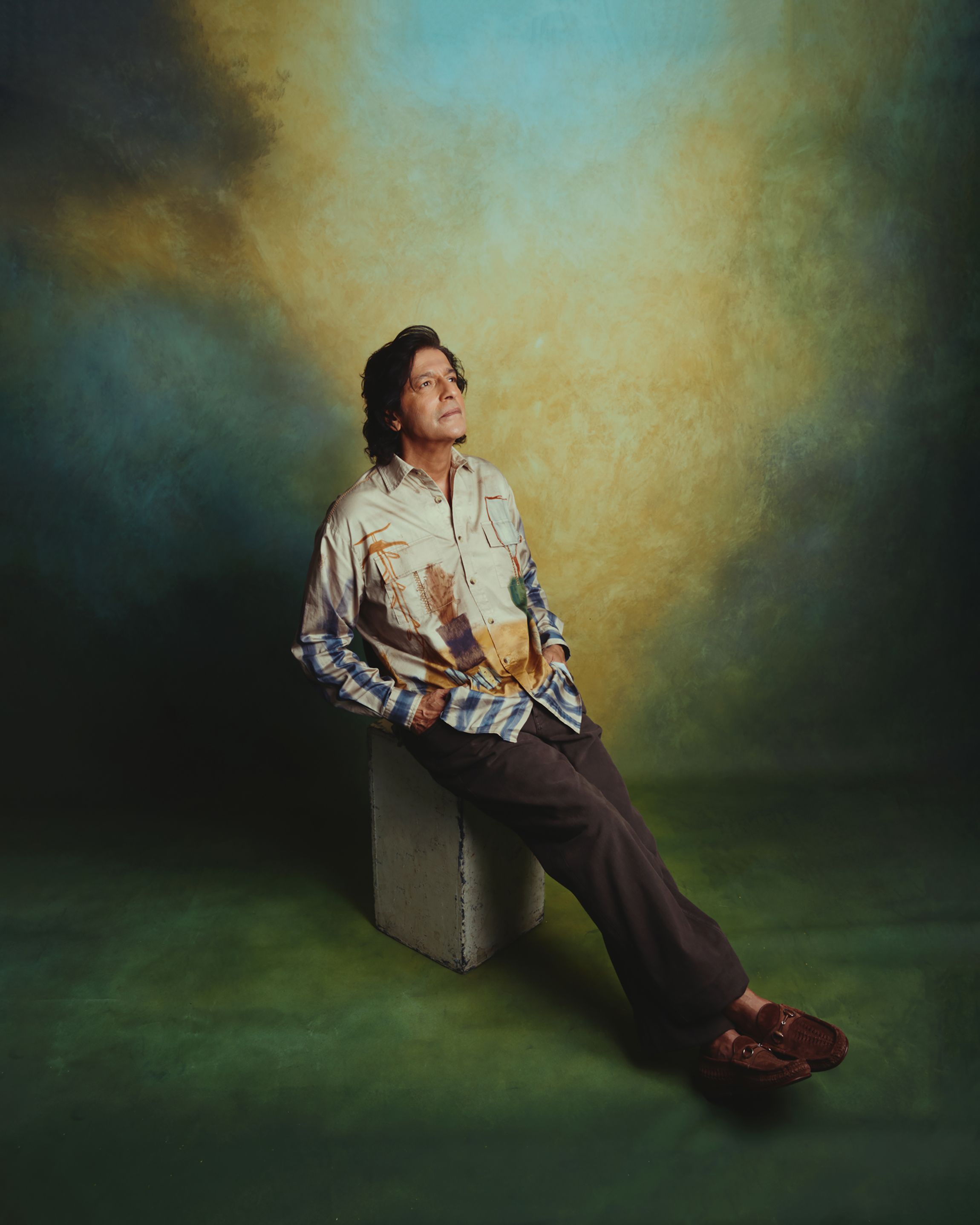
It’s been a hectic year, but Panday is not complaining: “I have to be busy. I’m like a shark. I have to keep swimming,” he says. “In our film industry, you don’t have to take a break. It gives you a break. Suddenly, if five years pass without work, you say, ‘Shit, man. Now I’ve got nothing,’” he says with the conviction of someone who has weathered both success and failure going by his IMDB history.
In our film industry, you don’t have to take a break. It gives you a break. Suddenly, if five years pass without work, you say, ‘Shit, man. Now I’ve got nothing.
Panday started his career in the peak ’80s era of Bollywood stars—the same time when Govinda, Shah Rukh Khan, Aamir Khan, and Salman Khan were entering the industry. Ask who is the funniest of them all, and Panday immediately names Govinda, Akshay Kumar, and Sajid Khan. “I’m Akshay’s professor... I taught him bad acting,” he says, taking a jab at himself. Over the last 40 years, Panday has, after all, churned out so many movies at such an astonishing rate, but critics, unanimously (and sometimes fairly), have hated his work.
Few know that acting came to him much later; initially, he wanted to be a doctor, just like his father. “Imagine me being a doctor,” he says, “I would’ve reduced the population of the country, for sure.” When that dream fell through, he briefly toyed with the idea of becoming a pilot. “My mom found out and she freaked out because she was very scared of air travel. She even threw me out of the flying club.” He later earned a degree in Economics, dabbled in modelling and a few small businesses, before eventually finding his way to films.
His phone rings and I wait for him to pick it up, but he ignores it, continuing to recount how he got his first job in films. It started as a spot boy, a job that happened by chance. Kishore Kumar was to perform at a show in America and his spot boy was unable to get a visa. Panday, who had a valid visa then, agreed to take his place. “I mean, I’m a big Kishore Kumar fan. So, I went on that show… I had no intention of being an actor till then,” he says. “But then I saw Kishore Kumar performing and I saw the adulation and love he got, and, you know, the kind of money he made… I was just blown away. I said, ‘Man, this is what I want to be.’”
Of course, I ask him about his name, and how this lanky man came to be called Chunky. He recounts how his cousin could not pronounce his name—Suyash—and how it had been mangled to Monkey. ‘Monkey’ evolved into ‘Chunky’ thanks to a governess who misheard. Of course there were other stories: how he was so thin, ‘a scarecrow’, and that ‘Chunky’ was supposed to be ironic.
Chunky speaks wistfully about the pre-internet era, when celebrity looked very different from the social-media-saturated culture of today. “I feel bad for the people now. We had such a great time. And we could commit murder and get away with it, literally! It was that bad,” he says. I laugh nervously.
It is hard to square the actor, the bulk of whose career is built around the niche of playing an overgrown child performing doofus gags, with the measured, thoughtful person I find sitting before me. He has this vibe of an older uncle who smiles good-naturedly after telling a in-my-time story. In the comfort of his home, he speaks plainly about how he will take on whatever work comes his way, like some hungry young star. Of late, he’s been getting as many offers for movies as commercials, selling everything from cooking ranges to pasta masala, many of them alongside his daughter, actor Ananya Panday. “I started my career as a model, but landed up becoming an actor and then, of course, never got ads after that. Now, suddenly, in this part of my career, I’m getting a lot of ads. And a lot of them are coming with Ananya.”
With Panday, I sense that his biggest role today is playing a sidekick to his daughter. “I call it reverse nepotism,” he says with a laugh. It’s as if his existence has now been crystallised into that of Ananya Panday’s dad. And his eyes, I notice, light up every time he speaks of her success.
So, which medium does he enjoy working in the most—television, commercials, OTT platforms or films? Films, he says without hesitation. “Cinema theatre is a group experience, where you go with people and they all have to be in the same kind of… thing enjoying it,” he says. Watching his own films in theatres still delights him. He remembers seeing Khatron Ke Khiladi (1988) at Liberty cinema. “There’s a fight sequence between me and Dharmendra, and one of the guys shouted, ‘Arey, Chunky Panday ko zyada maro!,’” he recalls, breaking into a soft laugh.
At 63, with a famous reality star wife, and a daughter with a burgeoning career in Bollywood, Chunky Panday likes to believe he is the OG. (And he is.) But even with the enduring popularity of the gloriously over-the-top Aakhri Pasta in the iconic Housefull film series, and his most recent turn as antagonist in roles like the ruthless contract killer of Begum Jaan (2017), the baddie in Saaho (2019) or the physically transformative part of a serial killer in season two of Abhay, the version he really wants to be remembered for is that of an action star from his ensemble films such as Tezaab (1988) and Vishwatma (1992). “A lot of people have forgotten that version,” he says, “Even my kids never saw it; they were not born yet.”
Throughout our conversation, I get the sense that what Panday fears most is being rendered useless and, by extension, falling into obscurity. Acutely aware of the temporality of fame, he has spent a lifetime slipping into new selves, each identity shaped by the demands of the moment. The intervening years may have been quieter, but he is grabbing the recent spate of attention with both hands. Stepping back is not an option: “Don’t let it stop. It’s the worst thing for an actor. He has to be famous till the day he dies. He can’t take it.”
Editorial Direction: Megha Mahindru, Ridhima Sapre. Photography: Sarang Gupta. Director: Sainil. Fashion Lead: Naheed Driver. Bookings Editor: Nikita Moses. Multimedia Designer: Mehak Jindal. Visual Editor: Ria Rawat. HMU : Eleni Chatzinikolidou. HMU assistant: Kavita Koli. Styling assistant: Kashish Jain