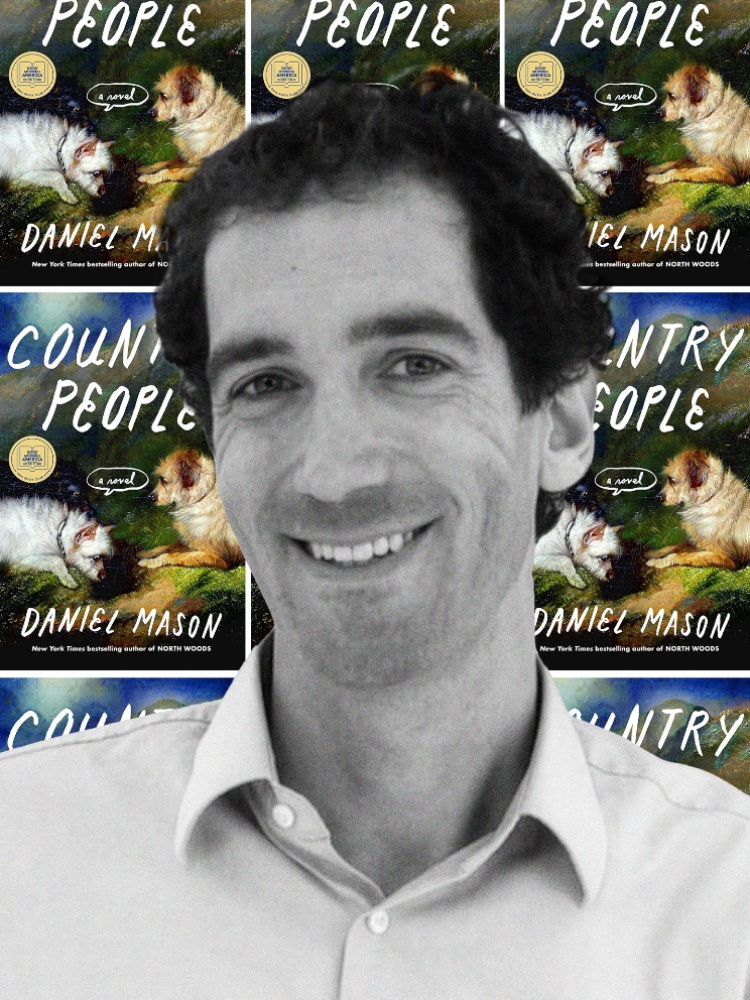

Daniel Mason’s novel Country People begins with a road trip where a family of four—Miles, Kate, and their two children, Wesley and Olive—and a dog are on their way from California to Vermont as Kate has been offered a one-year professorship in a college in Vermont. The plan was to take the scenic route, but the logistics of children-plus-dog-in-a-cramped-moving-space mean that at some point that gets abandoned for a more direct approach. And thus begins life in a new place, with new friends and neighbours, a house with its own secrets, and a group of hollow-Earthers who convene regularly to discuss subterranean matters. (Read our review of Country People here.)
Country People is Miles’s story, but it’s also a story of male loneliness. It’s also a post-Covid novel where the pandemic casts a shadow even if it’s not a looming presence. Funny, satirical, relatable, it pokes fun at academia, at our ultraprocessed food aisles, and at the country-life pretensions of urban folk.
Below, Daniel Mason, who’s also an associate professor of psychiatry at Stanford University, talks about Country People as a coming-of-age story, discovering Jane Austen, and the pet who keeps him in line.
The Covid-19 pandemic hovers in the background in Country People. Was it playing on your mind a lot when you were writing the book?
Yeah, I think that it was there. The book is very contemporary. It’s not set in a specific year; it’s a little vague about whether it’s 2022 or 2023, but it is post-Covid. And I think that Covid was important for the story because it’s a story in part about isolation and about finding connectiveness. And Covid was such an intense period of isolation for so many people that I think it ended up being an important part of the plot, not only for Wesley connecting to friends through role-playing games, but also for someone like Miles, who, I think, lives a certain kind of isolated life that would have been probably worsened by the Covid epidemic.
In a moment of self-pity, Miles is thinking that nobody wants “to be stuck in the coming-of-age story of a 45-year-old man”. Did you see the book the same way? Obviously, he’s the central character—you get an insight into how he thinks and approaches things, his isolation, his friendships—but he’s in a state of flux.
Yes, very much. He’s in a state of constant coming of age. He’s never quite grown up. But I think that the book captures him at a time where he really does grow up quite a bit in recognising that the career that he’d imagined himself following is probably not the career that eventually he’s going to follow. And you might say not just his career but also understanding that the important things for him are things in his life outside his career, like his relationship with his wife and his relationship with his children. That’s part of his grand realisation in the book.
The book starts with a road trip, where you have an unnamed family—husband, wife, son, daughter—making their way to Vermont with their dog in their car. You don’t name anyone till page 29, even when you do provide a detailed explanation on the name of the dog, Giuseppe. Are names something you think about a lot?
I think all writers are thinking of names all the time. Most writers that I know keep lists of names that they like. I’ve heard a lot of people say something that is very true for me, that a character often doesn’t click until you find the right name for them. And so in this case, a couple of things happen. One, when the book began, I began writing it like that, and I hadn’t chosen their names yet. And then I experimented with a couple of names. But once I decided that the book was going to be about storytelling and fables, I thought about how a particular sort of pattern to a lot of fables is to be introduced to a kind of archetypal character and then maybe learn their name later on. A lot of times a typical fable will begin with “Once upon a time was an old man who dreamed that he would one day find a wife for his son”, right? We don’t know their names. We may never know their names.
And so, since Miles studies fables, I thought that would be a good way to begin the book, that I would preserve that even though I hadn’t begun it with that intent. I think that discourses into the different characters’ names is an interesting question. Like: why do I do that if I don’t have to do that? I have to come up with a name for Miles’s kids as a writer. But this is something that Miles would have also had to have done as a parent. And it seems then like a good possibility, a good opportunity, to show what he’s like and what Kate’s like. In that moment, this was a chance to see what this couple was like at an earlier stage of their life. I think it also is a chance to show a little bit of the contrast between them and the other people that they’re meeting in this rural area who are going to have different kinds of naming conventions.
Why Miles is Miles is something that I thought about constantly. The book doesn’t deal with that, but it’s something that I was thinking about because I wanted something that fit him. In the US, Miles is a name [from] a slightly older generation. It’s a gentle name. It looks like the words ‘smile’, it looks like the word ‘mild’… It kind of captures a lot.
Besides the family of four at the centre of the novel, there are several interesting characters populating the town where they move in. One of them is Miranda, Kate’s friend, who has a habit of taking an anthropologist’s lens to the community around her, writing papers on such topics as ‘Community Threads: Tracing Social Change Through Clothing Labels’ and ‘Can-throwing Behaviors of Rural American Males’. Did she feel like a stand-in for you, the author, an dispassionate observer?
I think that the family needs to learn about their new home. And so there are different ways in which they do that. I stumbled upon Miranda as being this great way of doing that in this humourous, light way that, at the same time, gets a certain amount of information across. She is a kind of a guide who they and the reader learn from. But it’s like this very warped lens, because it’s applying this hyperactive, academic lens to something that really doesn’t need it. A children’s clothing sale doesn’t really need all of this incredible statistical apparatus that a sociologist might apply to it. But having her do it did two things. One, it gave the reader their background. Two, it poked a little bit of fun at academia. Three, I think for me it provided a chance to riff on the sort of academic language that I hear all the time, which sometimes seems like a joke itself even though it’s often very serious.
There's this idea of “marooned academics” here—the men who are adrift, dabbling in all manner of hobbies, hanging at the fringes of groups in parties, trying to find a topic of conversation. There’s Miles, there’s his new friend Andrei who’s growing apples. Was male loneliness a big theme for you with this novel?
Male loneliness is certainly a big theme. I think that I was drawn to the scene after seeing this kind of dynamic playing out in my life and in the lives of many of my friends. At this midlife stage it’s very clear amongst most of the couples that we know that the women have often very complex and sort of webbed relationships with each other, whereas increasingly it seems like outside of work, most of the men have very few contacts outside their immediate family. I was also seeing this in newspaper study after study, where a week couldn’t go by without another article about how there’s an epidemic of male loneliness in the United States. And so it felt like a larger question that was also maybe about the country at large.
A big part of the novel is also the Jeremiah Wylkes Society, the group of hollow-Earthers who meet regularly, that Miles gets attached to. Where did that come from?
While writing my last two books I found that I like to have a general idea of where I’m going but then let the characters develop themselves and see what happens. It’s more interesting than having everything planned before I started out.
This time, accidentally, Miles and Kate are on a hike and they meet this guy who is telling them all sorts of crazy stuff. At first I thought, well, maybe he’s a flat-Earther. Then I thought, maybe I can find something that sounds a little bit more absurd. What if he believes that the Earth is actually hollow? I looked it up, and it turns out this is something that people have believed over time. Across great literature and mythology, lots and lots of people have fantasised about the possibility of the Earth being hollow. It was a great theme to explore in the book, because it’s two things. On one hand, it’s just silly and wacky and strange and nonsense, but at the same time it’s also present in [the works of] Jules Verne and Dante and most mythologies around the world.
You’re an assistant professor of psychiatry at Stanford. How does that align with your writing?
Part of my year is divided into time working at the hospital and teaching and the other part is for writing. I find it very difficult to do both at the same time. But the two careers do complement each other nicely. Writing is such an isolated activity that I always am very relieved to stop writing and return to the hospital where I work with other people and patients. At the same time, writing slows me down a bit and makes me think about things in a way that maybe I wouldn’t if I was just jumping into the medical aspects of the patient’s life. So, they complement each other nicely. There have been a lot of doctors who become writers, and not surprisingly, because you’re hearing stories all the time. Even though I don’t write specifically about my patients, nonetheless, I am around people who are dealing with crises and disease and illness that make the normal part of being human. Those experiences are part of literature also.
Do you have authors whose works you keep going back to?
Yes, a lot. A person I go back to all the time is Flaubert. I’ve gone back to Madame Bovary far more than any other book, just for the perfection of his sentences and the vividness of his material world. I’m very much drawn to using a material world to describe or to reflect a character’s inner life, and I think he does that really beautifully. I love the Russians, so I love Tolstoy, Chekhov. Chekhov was a doctor in addition to being a writer, and I think that his interest in the body and his interest in moments of crisis is something that overflows into his writing in a very powerful way.
I’m reading now, really for the first time in my life, Jane Austen. There were a few moments in my life where I tried to read her and I found that it was very difficult for me to get into her worlds, which are entirely social. For someone who’s drawn to material worlds, she’s an interesting writer to read, because she often dispenses with physical description entirely. She doesn’t care. I mean, in Pride and Prejudice, literally, there’s a line saying something like, we don’t need to describe what this trip is like, whereas Flaubert would have spent 10 pages describing what the trip was like. She’s entirely interested in the social world.
For a long time, I found her hard to read for that reason but I picked her up again and now I find her very funny. I just read Northanger Abbey, which has to be one of the funniest books that I’ve read, and it has a couple of scenes that are just totally magnificent and moments [that make it a] comic masterpiece. Now I understand why people love her and I’m sad that I have two only books left.
Do you have any writing rituals?
Some. I like to write in the morning. I try to write every day. Maybe less common is that I like to work with my dog, Figaro, on my lap. He’s very practical for me. Firstly, I spend a lot of time walking around with him, so I can see the woods through his eyes—or I guess his nose, because he’s mostly sniffing everything. Secondly, like everybody I get very distracted by my phone. But I’ve found that if I put the phone in the far end of the house, the second I sit in my chair—there’s a particular chair that I always work and I sit in—the dog hears the sound of the chair and then he runs over and he jumps in my lap. He keeps me there and he doesn’t like me getting up. So, he keeps me writing.
Is Figaro Country People’s Giuseppe?
It is certainly the most autobiographical part of the book. He’s that kind of dog; he loves digging. He hasn’t dug a hole down into the hollow Earth, but he’s dug a lot of holes. And he experiences the world through smell because he comes from a breed that was bred to dig for truffles. He’s completely attuned to these invisible aspects of the world that I can’t see.