




Less than a minute into our Zoom interview, there is a crash, a yelp, and a guffaw. The video is turned off, then the mic. A few minutes later, Shefali Shah reappears on the screen, dressed in a pink Lucknowi kurta, looking bemused. “We dropped the iPad, then we dropped the entire glass of water, and now my jeans are wet, so I moved location,” she rattles off in a single breath, laughing at the chaos that just ensued.
On occasions like this, and on her Instagram, you get a glimpse of Shah’s off-screen persona. Candid, in on the joke, easily laughing at herself. Scroll through her grid and you’ll come across a video of her giving ChatGPT a dressing down for “judging” her. In another, you’ll see her trying, failing, and finally nailing a charcuterie board. In our conversation, she looks visibly thrilled about her writing debut.
It’s quite a contrast to the eerily composed, intimidating, and sometimes solemn characters she plays on screen. Hers is an enviable filmography, one marked by no bad performances. She’s been around since the early days of private broadcast channels in India, first drawing attention for playing Savi on the popular TV drama Hasratein (1996). Later, her role in Mira Nair’s Monsoon Wedding (2001) brought her wider acclaim. More recently, she’s played the unhappy mother in Dil Dhadakne Do (2015); OTT’s favourite lady cop, Vartika Chaturvedi aka Madam Sir, in Delhi Crime (2019-); and a woman struggling with dementia in Three of Us (2022). All far from the ‘Bollywood heroine’ trope and firmly rooted in storytelling and the character’s journey.
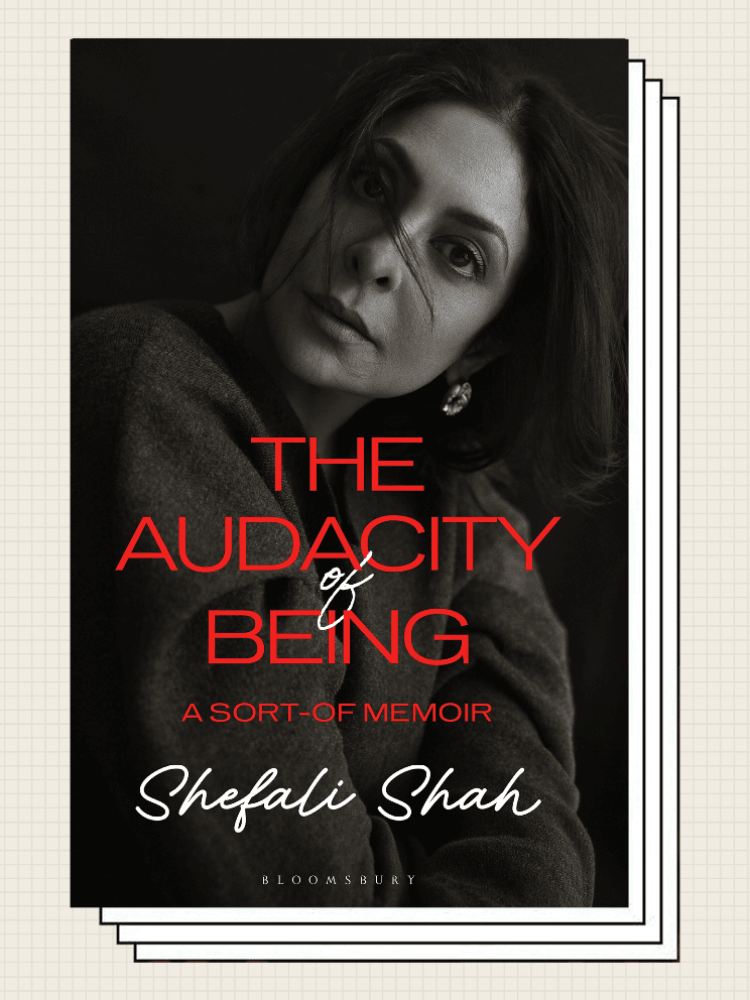
It’s a body of work she’s built consciously—with patience and a steadfast refusal to settle—and it’s something that’s held her in good stead even today. “I did not know how to be a ‘heroine’ yet, but I definitely knew I did not want to be a sidekick. I might not have been ‘heroine material’ in their eyes, but I was not going to settle for less. And hence I excused myself from the film and walked away,” she writes about walking out of Rangeela (1995) in her book The Audacity of Being: A Sort of Memoir, published by Bloomsbury, which released last week.
In the 224 pager, the actor, in no particular chronology or format, bares open her life’s many truths. The relationship she has with herself, her first marriage, her ideas of beauty, her vulnerable moments, relationships, friendships, being a mother (to her children and her pets), the journey behind some of her career-defining roles... It is a little bit of everything. Some chapters are just a single poem; some are interspersed with images, and so on. “The book is not very curated. It has a little bit of everything, because that’s how I speak and think,” she says. The ‘sort-of’ in the title, then, is befitting.
Below, excerpts from the interview, where she talks about being her harshest critic, the role she wants to play next, her beloved Kaftan Cartel and why she swears by a good blow dry, among other things.
Was writing a book, especially a memoir, always on the cards for you?
I love writing. My publishers [Bloomsbury] came to me and wanted me to write a book. I had a novella that I wanted to pitch to them. However, they thought my first book should be a novel or, ideally, a memoir or a biography. They know the business better. I call it a “sort of memoir”, because I am not convinced that I am at a stage in life where I could write a memoir. This is my version of a memoir.
The first chapter sees you obsessing over a bad-hair day and how it makes you feel for three whole pages. There’s also an elaborate discourse on Spanx. Are you your harshest critic?
Yes, I am very critical of myself. Every thought that I have mentioned in the book has come to me every single time I have seen my hair without a blow-dry. My brain stops when my hair is bad. All my confidence comes from my blow-dry. Of course, then the chapter leads into how you have constant self-doubt or are not very happy whatever you are.
This is your first book. What was your writing routine?
I did not have one. I’ve been writing sporadically. I would write some chapters and send it to my editor and disappear for long periods. Now, I realise I should have set aside some hours every day to write.
What’s your favourite memoir? Did you have one as a point of reference or starting point for your book?
No, and I think it’s a good place to begin, because I would have probably then chosen to follow a parameter or a rhythm that I had no context to. So, I created my own rhythm. Although, I remember, when I was growing up I had read the works of [American humourist] Erma Bombeck, who wrote in this very self-deprecating voice. It was ridiculous almost. And I used to find it extremely hilarious and great fun to read. Then as you read more and grow older, you go into the deeper meaning of a book and start reading between the lines and find the relevance in your life and give that meaning. But at that point I was just reading a book and I found it very entertaining. So, I think that stayed—that it has to be fun to read.
Who are the audacious women in your life?
The entire Kaftan Cartel [her inner circle of friends]. I mean, they are mad women and that’s why I love them so much. They are fun, they are poignant, and they don’t hold on to failure for too long. We are all there for each other all the time. I am really blessed. And I hope most women have their crazy bunch, because this is truly your lifeline.
If your book had a chapter for your future self, what would its title be?
It would be: On your marks, get set, go. There’s so much to do. So much to see. So many more roles to play. And just so much to learn. I wish I had started this self-discovery journey—traveling solo or learning to not give something power to affect you negatively—a lot earlier. I just wish I had learned to have more fun.
One role you wish was written for you and you would lap it up?
Years ago I read a book, Sybil, where a woman has 16 distinct personalities, two of which were men. Portraying her would be unbelievably exciting. I would love to do love stories. They don’t write romance for women after a certain age—it’s tragic and stupid.
The Audacity of Being: A Sort of Memoir is published by Bloomsbury India; ₹419