



Books11 Jul 20266 MIN

Meena Kandasamy’s new novel takes on incels, cancel culture, and toxic masculinity

Delving into the Indian manosphere via a viral deepfake sex clip, ‘Fieldwork as a Sex Object’ is as much a sharp and witty novel about digital memory as it is about the ethics of storytelling

Image

What are the stakes involved in writing about that which is considered taboo and cannot—or should not—be said? In today’s world, where images are manipulated and distorted to gross effect, and AI impacts creativity and authenticity, what does it mean to prioritise the truth through fiction? What are the failures of feminist solidarity, and how much of this is toxic masculinity and patriarchy in action? Can storytelling play a role in liberation?

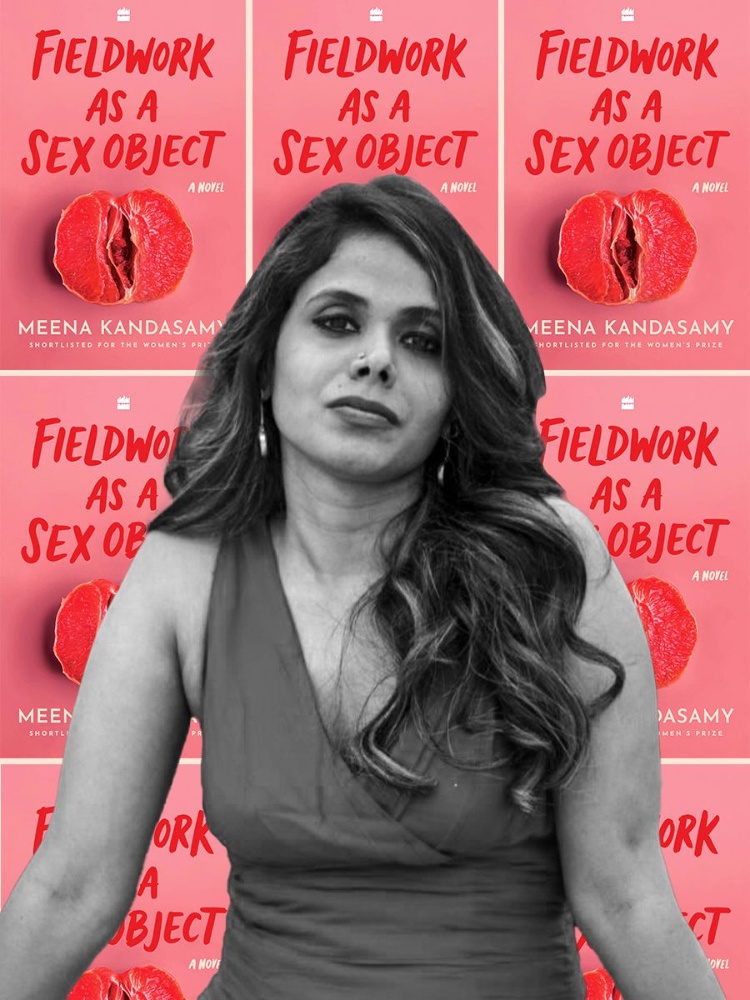
Meena Kandasamy’s new novel, Fieldwork as a Sex Object, moves from theory to praxis, imagination to action, the digital to the real, as it follows Amrita (Amy) Chaturvedi, a student activist living in London, whose life comes apart when a deepfake pornographic clip of her begins to travel and morph: through social media, WhatsApp groups, the ecosystem of Hindu incels and the manosphere (“all fascists sound the same because fascism is the enemy of individual expression”).

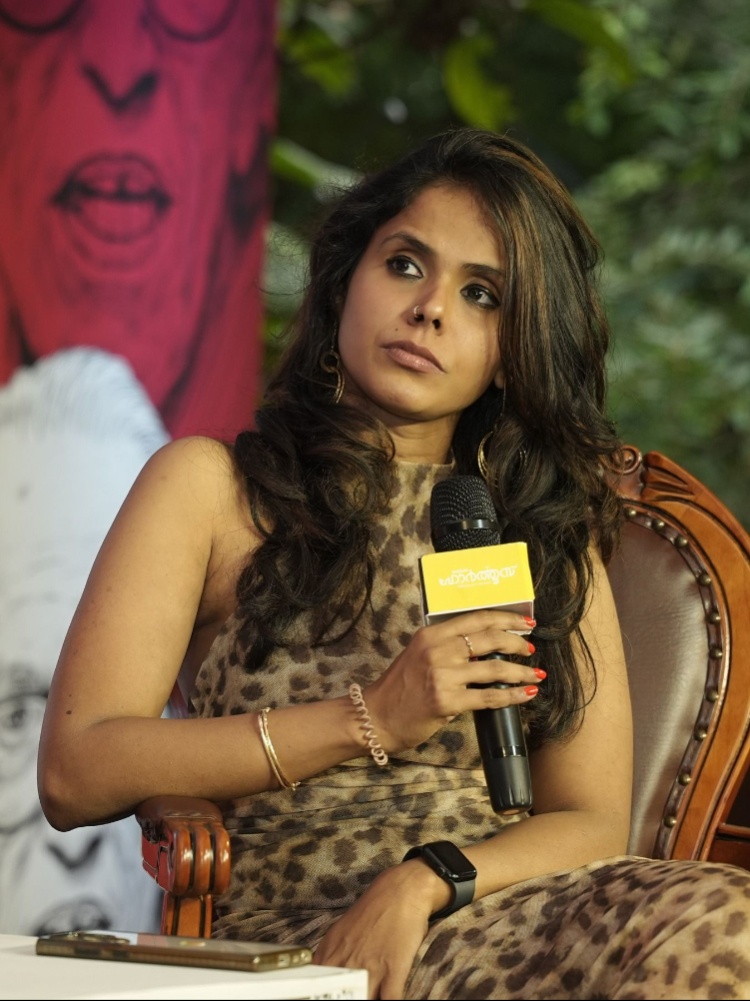
Darkly funny, deft, and provocative, this is, I think, the most Meena Kandasamy novel ever. Below, excerpts from our conversation at Waterstones bookshop in Birmingham this June.

How did you come to—and why did you choose to—write Fieldwork as a Sex Object?

There were multiple things I was trying to do with this novel. One was the female nude, not as art object or cultural artefact, or even as something scratched on a public restroom door, but as something produced (consensually or non-consensually) on any phone––and with the ability to turn into revenge porn in an instant. It could have been a thought experiment. Sadly, there have been so many women who have become its victims.

The other aspect was to chronicle the internet as we know it—not just emails (which are epistolatory novels for our era) but in a form and shape and tone and voice and style that captures what it is to be online. Because we are living in the moment, it feels hyperreal, but one day all this will be history. Twitter hate will be stored as files somewhere. How do we archive this moment in real time? How do we capture its mindlessness, the cancel culture, the baying for blood that has come to characterise social media? And for me, inevitably, the oligarchs controlling social media and the far-right using it to set narratives are geared towards one thing only: political capture.

You use the foreword and afterword to frame the novel. This felt reminiscent of Exquisite Cadavers, where you explain in the preface that the dual structure of the book was born from the response to your previous work, When I Hit You, a novel which drew from your experience in an abusive marriage. You published When I Hit You explicitly as fiction, but reviewers and critics across the board read and responded to it as memoir. What I find incredible across your wide-ranging body of work is how you simultaneously hold fiction and fact, a story imagined and a story found. Can you talk about playing with genre, and perhaps also readers’ expectations?

I learned something the hard way with When I Hit You. I wrote a novel—which, we all can agree, is an act of imagination, of shaping and selection and craft—about a violent marriage, and it was received as memoir. Even within autofiction, a woman can only be seen as doing an act of transcription, not an act of composition. This assumption made me realise that something bigger was at play: the border between fiction and fact is not neutral at all, and when writing about violence and intimacy, a brown woman is seen as leaking the material, not making the art.

So, I had to find a way to hold up the border and interrogate it fiercely. It was no longer my problem, it was everyone’s problem. So, in Exquisite Cadavers, I put the scaffolding on the outside of the building, so to speak. I showed my readers the choices, the margins, the making, and most of all, the beautiful alchemy between genres. Fieldwork as a Sex Object does something similar with its foreword and afterword: I frame the novel so that you can never quite forget you are being told a story by someone with reasons to tell it in that very particular way. I do not want the reader to believe that stories or histories are accidental. I want her to be alert to the artifice so that every emotional or political truth lands harder.

Let’s stay on this idea of a found story. In the foreword, Amy says she’s been writing. “Let’s call it a ‘novel’,” she says, “given that everything is sub-judice.” She clarifies, “It is my story.” Can we talk about this layering conceit and the ethics of storytelling? As a writer, what does it mean to hold someone else’s story in your hands?

Her declaration—“it is my story”—is the ethical spine of the book. The deepfake is a theft of narration—others seized her image and made it say (or rather, perform) what they wanted. So, the act of writing it as her novel is the very radical act of taking authorship back, wrestling that story out of the hands of the people who turned her into a spectacle and the centrepiece of a lynch campaign. She is a fictional character, but she has a very real-world imperative to control how she goes down in the history books. As for me holding her story: I am not innocent in this either, and I did not want to pretend to be. There is a kind of extraction in all storytelling, a risk of doing to your subject a gentler version of what the villains do. I built the layering conceit partly to keep that danger visible, so the reader (and I) never get to forget that holding someone’s story in your hands is also a form of power over them.

This brings me to the title of this book: Fieldwork as a Sex Object. It’s punchy and provocative. There’s an element of ethics to fieldwork, sociology, anthropology, research, storytelling…

The title was the very first thing I came up with, even before a single word of the novel was written. I wanted something to hold together the project I had in mind. I wanted a title that holds a woman in two positions at once and then watches her refuse the second one. “Sex object” is what has been done to her, and, really, to all of us online (read Joanna Walsh’s Girl Online if you ever get the chance). When we are women online, we are sex objects and we are being held by the incel’s gaze, the consumerist gaze, the algorithmic back-end machinery that reduces her (and us) to a thing for use. But the “fieldwork” in the title is hers (or, we could argue, mine). She is the one doing the fieldwork. Reduced to a specimen, she picks up the instruments and turns anthropologist-theorist against the very world that pinned her under glass. She gives her novel the title ‘Lovers, Losers, Loners: An Intimate Study of the Indian Manosphere’. She studies the manosphere, catalogues their mentality, reads them and their performative outrage the way a researcher reads a culture. The gaze that was trained on her, she trains it back against them.

That reversal, that juxtaposition between “fieldwork” and “sex object”, is everything for me. We all know that “fieldwork” carries a long and not-so-innocent history: colonial data collection, the racism in ethnography, the woman as data, the male authority looking down at its native subject (and all women). Here, the inverse becomes possible. Amy refuses to be under observation, she refuses to only be the object being consumed; she also wants to be known as the one taking notes.

The fragmentary form of this novel, suffused with online jargon and lingo, reflects the subject matter of the story accurately and cleverly. Would you call this an internet novel, indeed a political novel? How helpful are such labels in defining your wider literary project?

The form of this novel had to reflect the experience of being (chronically) online: the doomscroll, the hundreds of notifications, the click-baits and the rage baits, the way our attention is shattered, reassembled, and reconstituted by the feed. I felt that a tidy, continuous narrative would have lied about what it feels like to be inside this world. The online jargon was inevitable––but I also wanted to preserve it because years later we are going to look at all this with a mild surprise and treat them the way we treat old curiosities and antiquated things.

The internet presents itself as an eternal present (often the composition happening in the past for a future audience), an endless now, but it is actually hurtling towards being and becoming a graveyard. Everything on it is dying or already dead: deleted accounts, broken links, screenshots of people who have scrubbed themselves with no digital trace, an archive that never forgets even as it constantly decays. A novel that takes the internet seriously is not writing about a passing fad; if I felt that way I would not have embarked on this project. I wanted to write about how a record is forged and how memory is destroyed in real time. In that sense, it is both a history novel and a news bulletin: it is about ruins, about what survives and what is unmade, even as all the screaming for attention goes on.

Fieldwork as a Sex Object by Meena Kandasamy is published by HarperCollins India; ₹529

The Nod Newsletter

We're making your inbox interesting. Enter your email to get our best reads and exclusive insights from our editors delivered directly to you.