Fashion17 Jul 20266 MIN

Gen Z brides can’t get enough of Gaurav Gupta’s couture

With his latest couture collection ‘Light Song’, the designer turns a forbidden romance between the sun and the moon into bridalwear for a generation that wants both tradition and fantasy at once

Gaurav Gupta bride Rhea Kapoor in a custom gown for her wedding in Marrakech

Digital creator Rhea Kapoor in a bespoke Gaurav Gupta gown

Courtesy Gaurav Gupta

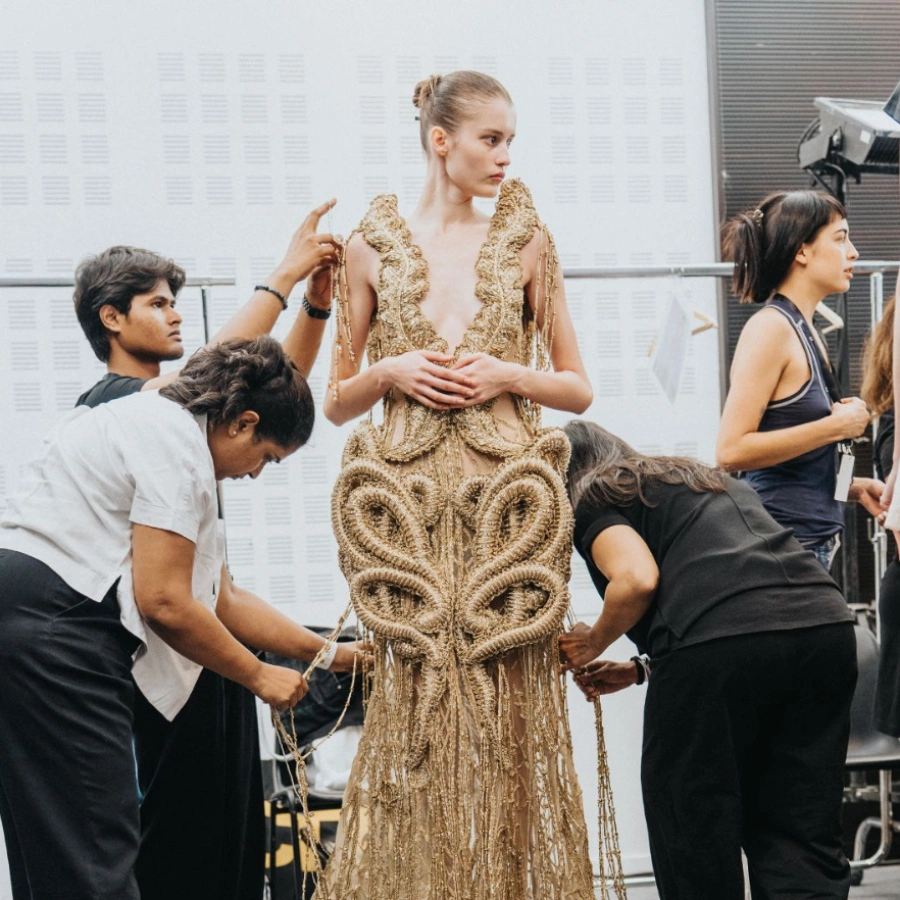
For his second bridal couture show, titled ‘Light Song’, unveiled tonight in the pavilions of the Jio World Convention Centre in Mumbai, Gupta began with a simple question: What is the ultimate source of light? The answer, of course, was the sun. But the sun inevitably led him to the moon—and to the imagining of a forbidden cosmic romance in which the two celestial beings can only be together during an eclipse.

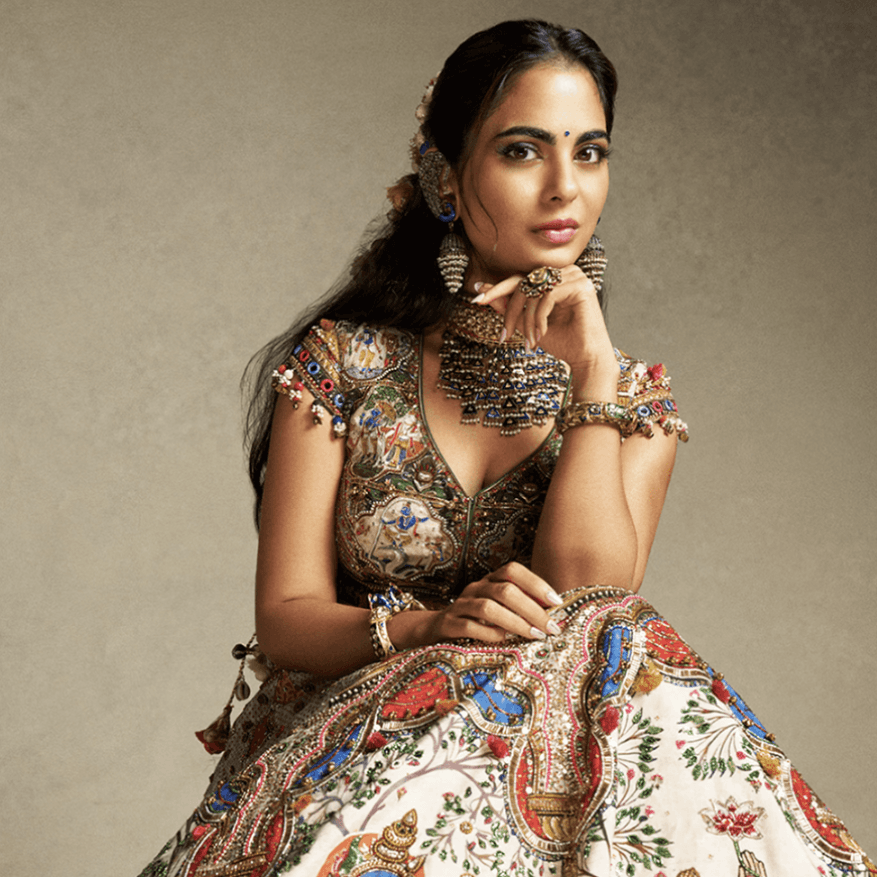
It’s an appropriately grand premise for a designer whose work has never been easy to encapsulate in one word. Gupta’s collections often look like they’ve arrived from another galaxy, but their emotional and technical foundations are old—cosmology, indigenous embroideries, and ancient truths. He makes mythology sexy, filters symbolism through alien silhouettes, and pushes traditional Indian handwork into the future through a philosophy he calls “Future Primitive”.

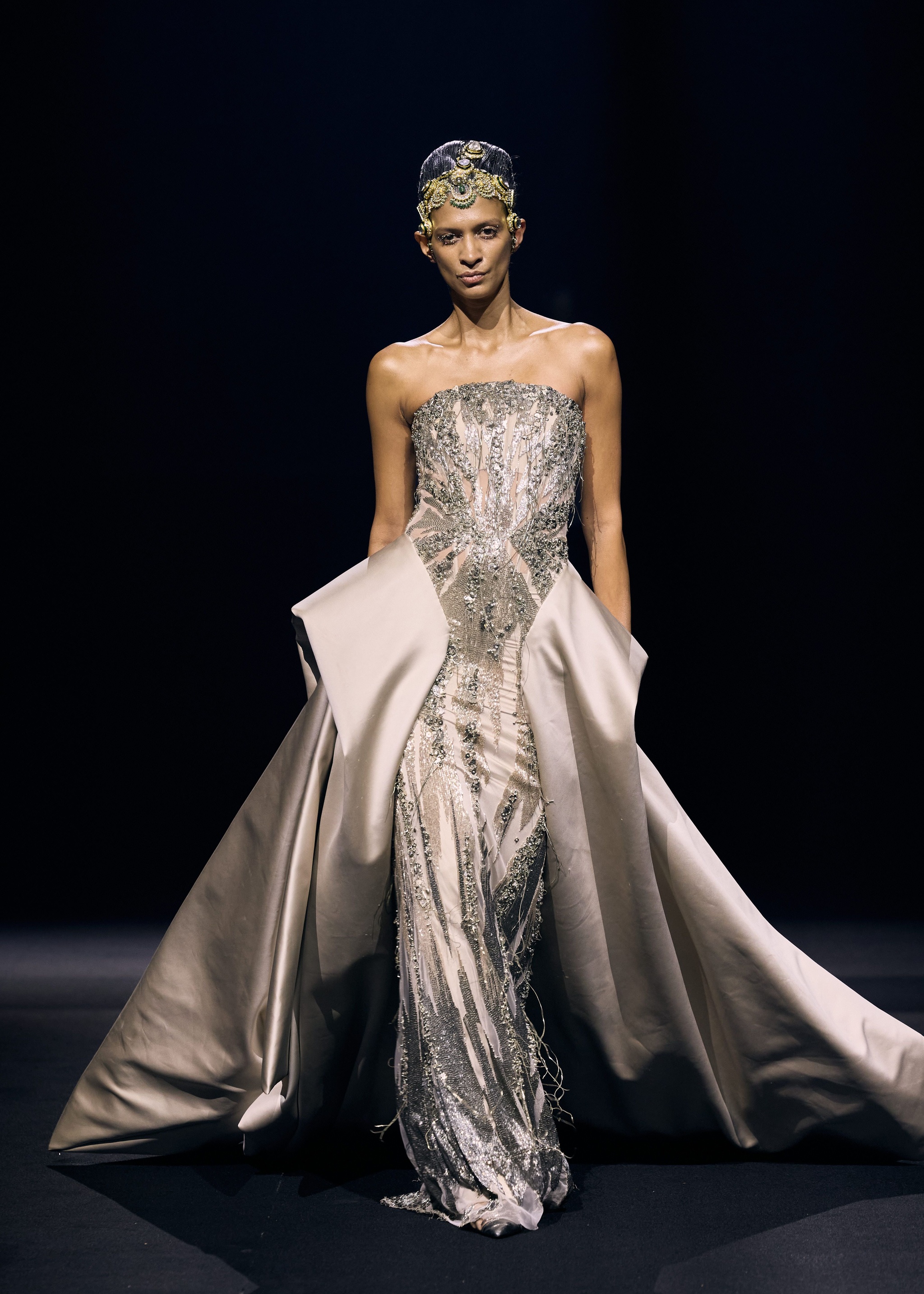
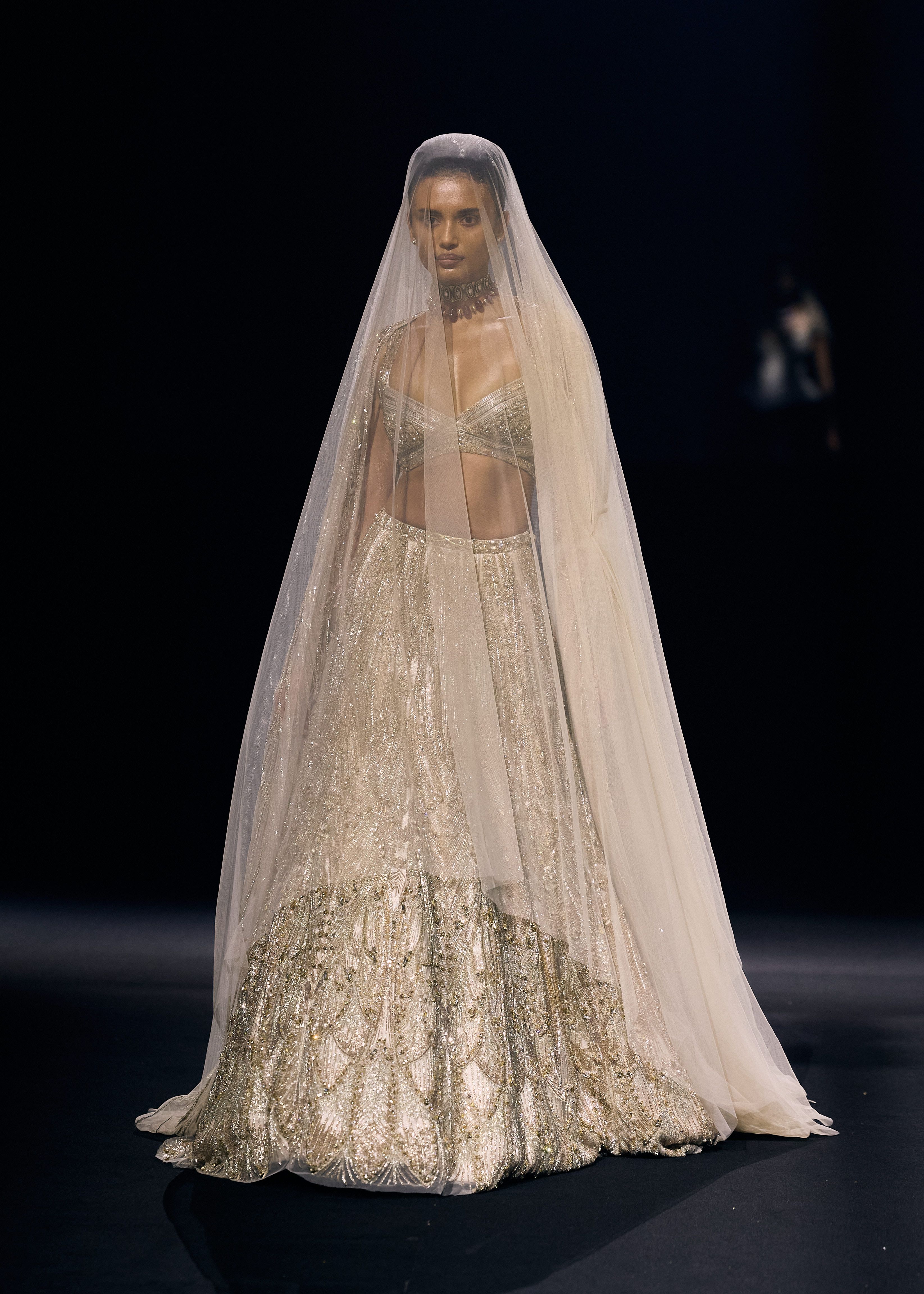
‘Light Song’ unfolds in three acts: lunar, solar, and finally, union. In the first half, lunar-inspired looks emerge with crater-like textures and crystallised in shades of blues and dusty greys. The solar half is warmer and more opulent, glowing in shades of gold and champagne (as well as a new deep fuchsia) with zardozi and bugle beads embroidered to look like molten glass, and lehengas that look like they’re dripping with jewellery. The “union” brings the two aforementioned sections together in an emotional and aesthetic resolution. “We’ve been dwelling upon the idea of duality since ‘The Divine Androgyne’ last January in Paris, the Ida and Pingala, the sun and the moon... It’s all interconnected,” says Gupta.

The exchange between the ideas showcased in Paris and India is fluid. A laser-cut technique first showcased on a gown in Paris can be translated on a lehenga in the Indian market; an embroidery developed for Indian couture may resurface in Paris. “There’s a whole Paris-India roundabout that keeps happening,” Gupta says. “We tend to do more conceptual looks for our Paris couture outings, because that’s kind of setting up our global base for the brand. For India, we innovate on things, like this bridal jewellery lehenga we’ve just shown. Sometimes it’s actually more work for us to do these bridal embroideries than making a conceptual breastplate. So, we’ll do something new and amazing in India couture, which then lends to the next Paris collection and vice versa.”

It isn’t just out with the old and in with the new, either. “Our brand is such that we keep discovering new house codes and reinventing them,” says Gupta. Some looks in ‘Light Song’ revisit embroideries that he introduced in 2013. One segment riffs on a chikankari sari that he first designed in 2006, while a series of black looks are realised through an engineered lace technique introduced in Paris in January.

The refusal to choose between the old and the new is what makes him particularly suited to a new generation of Indian brides and grooms. For instance, a bride might want a traditional red lehenga for the pheras and an otherworldly couture gown for a Surrealist-themed after-party. Gupta believes Indian weddings have changed because the people getting married have. Although, he won’t say that the Gen Z bride is abandoning tradition entirely. Rather, they’re creating their own visual worlds. “What’s beautiful is that they’re forward-looking, but clients still find soul in it,” says Gupta. “That primitive is very important as well.”

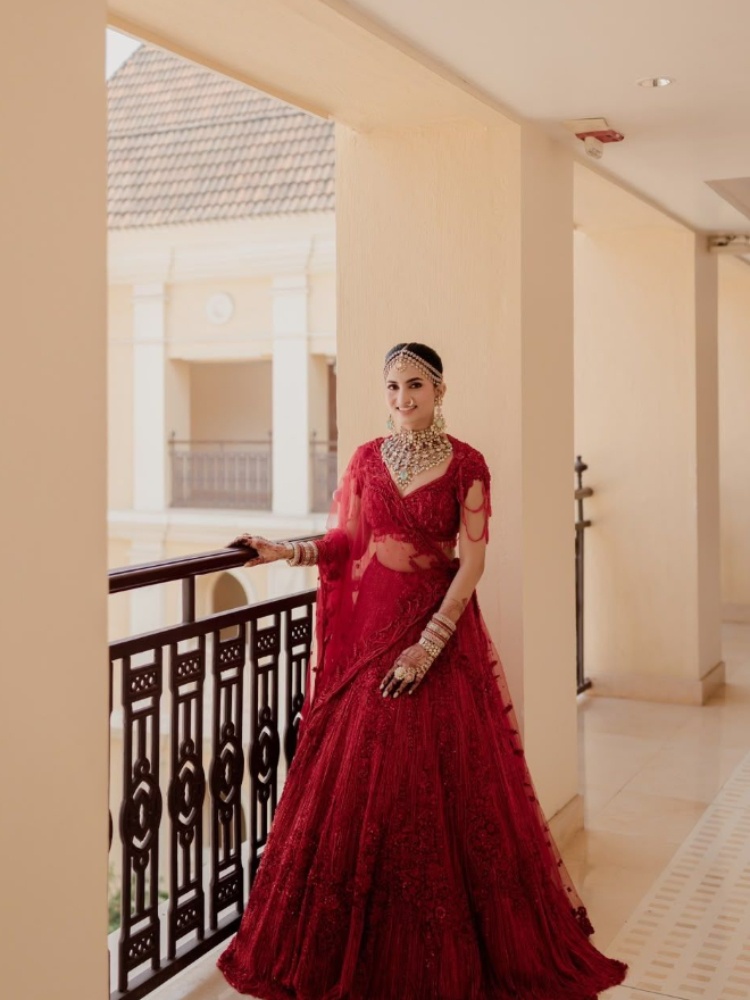
Ahmedabad-based architect Dharmi Vasani, 26, wore two Gaurav Gupta ensembles for her wedding in Goa this January. Her sangeet lehenga was gold, shaped with the designer’s signature sculptural swoops. For the pheras, she chose a monochrome crimson lehenga with a matching veil.

Vasani had originally planned to wear another designer and spent three days in Delhi trying about 15 different outfits. Her final stop was Gaurav Gupta. “The first outfit I saw there I immediately knew I was gonna wear, because I fell in love,” she says. She knew she wanted red on red but struggled to find a fully crimson outfit elsewhere. At Gupta’s atelier, she found both the colour and the distinctive vision she was looking for in the traditional silhouette.

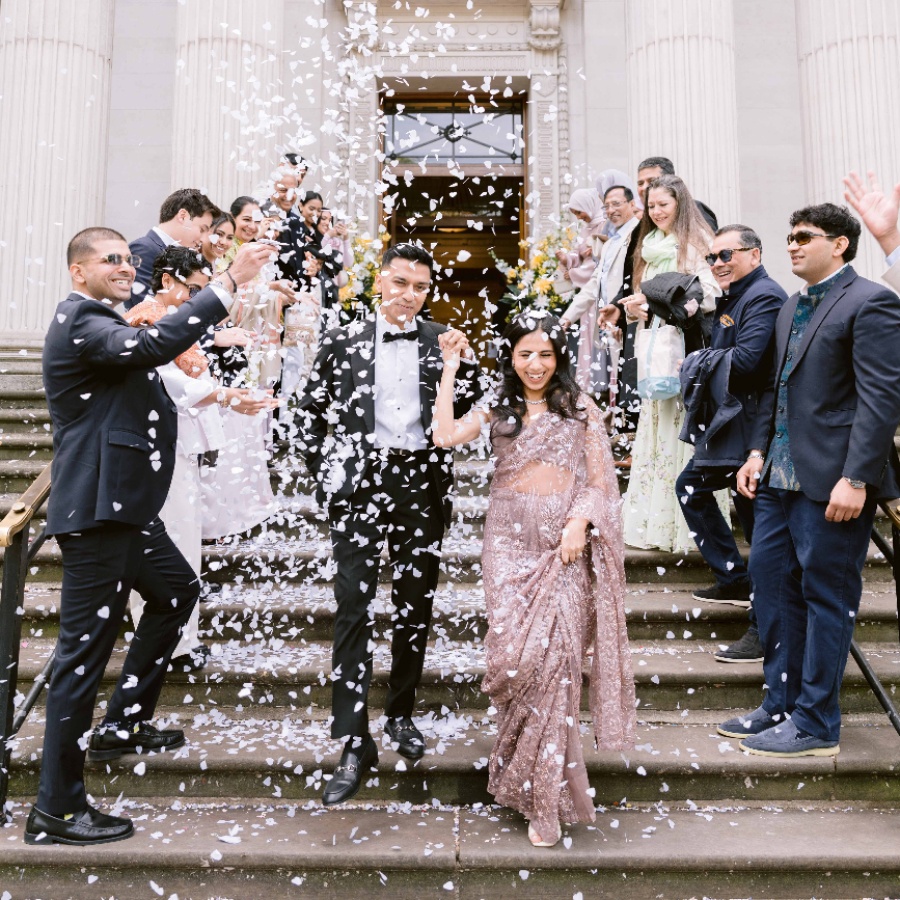
New York City-based brand strategist and content creator Aviva Mehta, 27, knew she wanted something fitted, almost moulded to her body, for her coastal wedding in the Hamptons. She had been following Gupta’s work for years and had initially selected a different dress from his latest Paris couture collection. Then, she learned that her grandmother would no longer be able to attend her wedding. When Mehta saw a sheer, ivory corseted look covered in delicate mogra, the decision felt obvious. Her grandmother’s favourite flower was jasmine. The minimally embroidered gown with jasmine buds creeping up the body gave her the mermaid-like silhouette she had imagined while also becoming a private tribute. “I think a lot of times, when we think of our weddings, we think of wearing the sparkliest outfit or one with the most amount of embroidery. But the design just stood for itself in such a huge way with this look. Anybody that looked at you could tell you were the bride. It was just so beautifully constructed,” she says.

Similarly, Rhea Kapoor, 27, had long imagined wearing Gaurav Gupta for at least one of her wedding events. She had followed his couture shows and admired his ability to blur the lines between fashion and sculpture. “He has such a distinctive creative vision, and his designs have an unmistakable identity, which is what drew me to him from the very beginning,” the Delhi-based digital creator says. The brief for the opening festivities of her multi-day wedding in Marrakech was ‘Mystical Medina’, which called for something dramatic and sculptural. Together with the atelier, she designed a bespoke champagne gown featuring an architectural, pleated halo bodice and a swooping trail that cascaded behind her. But the gown did more than just fit the theme and inhabit the world around the celebration; it altered her relationship with her own body.

“It had an extraordinary sense of movement, as though it was breathing with me,” she recalls. “It transformed the way I stood, moved, and carried myself. There was a sense of fantasy and freedom that came from surrendering to the artistry of the garment.”

Together, the three brides illustrate the range Gupta’s bridalwear can accommodate. With Gen Z brides and grooms now building visual worlds, his garments are helpful because they come with a plot but not an interpretation. Despite their volume and theatricality, they leave room for the wearer to attach their own meanings.

“Indian global” is how Gupta describes the feeling his clothes can offer. It’s a phrase that can sound like marketing-speak, until one considers how accurately it describes the cultural balancing act of the modern Indian wedding. The bride and groom are expected to honour tradition but avoid looking dated, the photographs must look timeless but also unlike anyone else’s on Instagram. No pressure.

As a final addendum, he adds that the GG bride is “hot—in her head, at least”. He laughs. “It’s just a hot girl or boy who travels, works out, and is with it.” And who doesn’t want to be hot on their wedding day?

The Nod Newsletter

We're making your inbox interesting. Enter your email to get our best reads and exclusive insights from our editors delivered directly to you.