A day spent in the company of the enterprising designer, business owner, and new mom reveals design epiphanies, snack preferences, and why she’d rather be the boss who keeps her door open
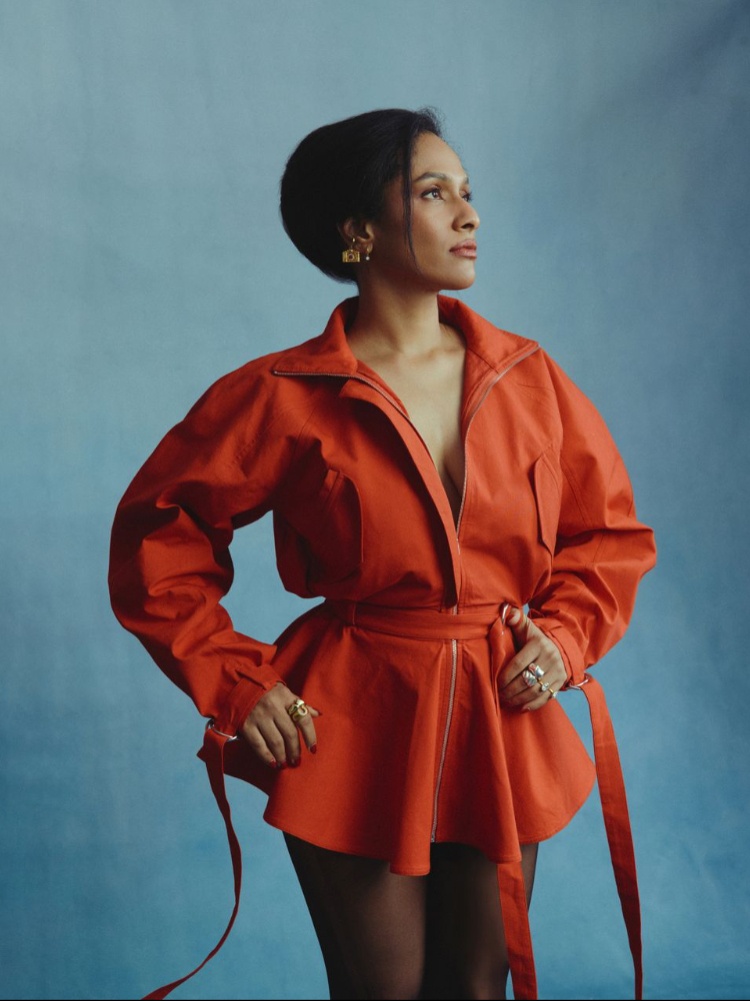
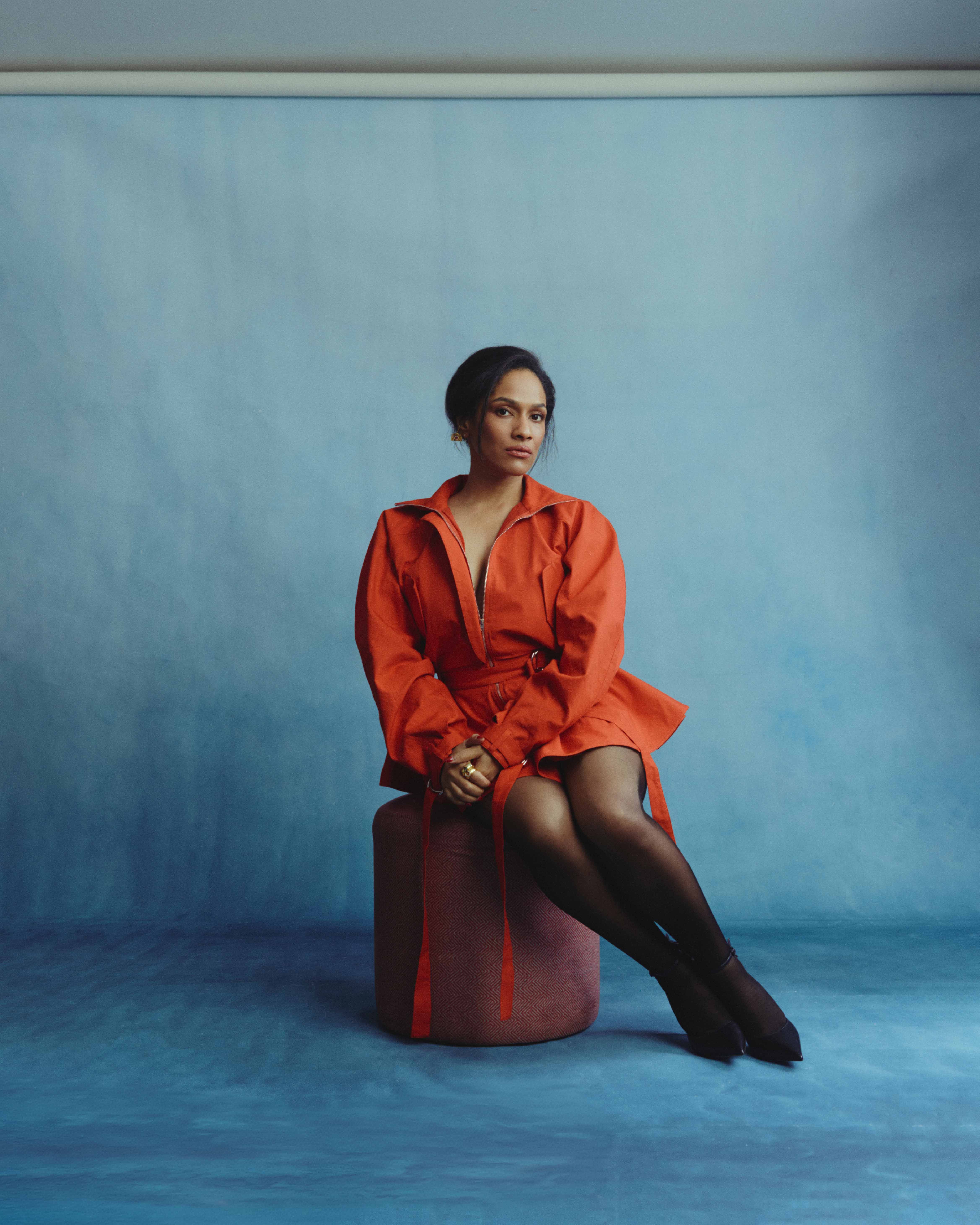
Utility jacket, Lovebirds. Earrings, House of Masaba x Amrapali Jewels Fine Jewellery. Rings; all Viange. Stockings, Theater xyz
Photographs by Sarang Gupta, Styled by Naheed Driver
Even if you know nothing about Masaba Gupta, at the very least you know that she’s famous. Although, fame is just one part of the vast fashion-beauty-celebrity iceberg that she’s built for herself. Some people know her simply as Masaba, founder of the fashion label that for the last 17 years has been making playfully printed contemporary Indian clothing. Others know her as the star of a Netflix show, the makers of which clearly knew she was famous because they put her name in the title twice, Masaba Masaba (2020), as if underlining who the draw was. To the chronically online, she’s the powerful influencer, the person brands go to when they want a cool, articulate personality to represent them. Forevermark, Maybelline, Lenovo, Puma, Fevicryl, Titan... You name it, she’s promoted it. The makeup-obsessed know her via LoveChild by Masaba, the beauty brand she started in 2021, which has taken her authentic obsession with makeup, grown an audience around it, and created products that tap into a market built specifically around Indian skin tones.
She has masterfully leveraged her celebrity for her brand, but Masaba, the creator of highly pigmented lipsticks and serum tints, knows being a celebrity founder is not enough for a beauty brand to thrive. It’s about creating a vibe. And what this polymath has created with her different practices is just that—something that is recognisably Masaba.
For her that means a few things: That it will be Indian but irreverent. That it will be inspired by pop culture but elevated. Most of all, you’ll relate to it, just like you relate to Masaba.
Just last week, she took to Instagram flaunting a T-shirt inspired by her latest lipstick shade. The white tee in a bold red san serif read ‘Thak gayi’, a catchphrase that went viral for capturing our collective burnout—socially and parasocially. “So, originally the name of the new Batua shade was going to be like ‘Cupcake’ or ‘Cute thing’,” she says with a roll of her eyes. “I was like, no. The thing is ki hame apni feelings ko product banaana padega… Everybody is tired, everyone is talking about how they’re exhausted. Hence came ‘Thak gayi’,” she says of her dusty, shimmery rose-pink lipstick drop.
Masaba has always been able to tap into the zeitgeist. Or perhaps the zeitgeist is actually an extension of her forceful personality. In 2009, when she launched her eponymous label at Lakmé Fashion Week, she sent out striped saris, dhoti pants in electric colours, and waistcoats covered in her now-signature cow print. It was the age of Indian pop, of Manish Arora’s psychedelia, Tarun Tahiliani’s bedazzled T-shirts, hot-pink cows on mugs.
Yet, as she continues to do it all, there is a change underway. Right now, it feels like Masaba is moving into a new era, one where she’s more of a founder and businesswoman than a niche fashion designer. After a day of trailing her at work, I learn how she plans to restructure her fashion label to focus on the increasingly significant bridal market. She talks about how LoveChild—a brand that contributed 38 per cent to the company’s growth last year, pushing House of Masaba’s revenues from ₹70 crore in 2024 to ₹115 crore in 2025—is “taking on its own destiny”, and how her life has changed since baby Matara, her daughter with husband Satyadeep Misra, came into her life two years ago. Below, a day in her life.
ADVERTISEMENT
Embellished bodysuit, trousers; H&M x Stella McCartney. Rings: all Viange. Heels, Aquazzura
April 27, 2026
9:50 am – Early bird
I’ve arrived 10 minutes early to the House of Masaba offices in Andheri East’s Marol, where it’s all business as usual. Masaba is already busy at work. A member of the 5 am club, she usually arrives just before 10 after spending the morning with her two-year-old and squeezing some time to catch up on emails, running errands, and working out (she alternates between strength and conditioning and is a devotee of long walks). “I’ve realised I want to be really productive during my work hours. I don’t want to spend the whole day firefighting. So, I’d rather do the firefighting before the day starts, because I want the rest of the day to be creative time,” she tells me, ushering me into her office.
10 am – A desk and a crib
The space is light and airy; one wall is lined with bamboo blinds, another has a wallpaper that depicts a landscape at dusk. There’s a console covered with awards (Vogue, GQ, Forbes, something called Pride of India) and her wedding photographs, while hanging on another wall are stills from magazine shoots featuring her alongside old newspaper clippings about her work.
At the centre of the room is a massive wooden office desk and chair, and opposite that lies a sweet surprise: a mini nursery set up complete with IKEA crib, rocking chair, and a little chest of drawers for linen. “At the start I thought my baby will come here and nap. It’s never happened, of course. She’s come and played, but there’s too much energy to nap,” she says with another eye roll.
Masaba is casually dressed in a red and white checked shirt by Péro, loose jeans, shiny brown leather clogs, a Cartier bangle watch on her wrist, and Miu Miu glasses in tortoiseshell. The lipstick shade for today is a “mix of Spicy Imli and Crunchy Mirchi from the Batua line”, she tells me, as if reinforcing that she isn’t just making social media Reels but swears by what she creates.
10:30 am – No Vit C to see here
The office is her home away from home. “I don’t care. If I’m not dying or there isn’t something that needs my attention elsewhere, I’m in the office. I even come in on days I don’t have meetings,” says the 37-year-old as we start our tour. “I started my career when I was 19. I never needed a push. My parents could have taken care of me my whole life, but I think it’s hardwired into me that my validation comes from the work I do,” she says.
Before she started her eponymous label, she studied design at SNDT University. Until then, she had considered being a dancer, a singer, even a professional tennis player, before realising she enjoyed fashion too much to be an athlete. “I was a self-starter. If I think I should try something, I try it. If I’m not good at it, I fail fast and move on. I don’t dwell on failure beyond a few hours.”
Walking past rows of desks, people plucking away at their computers, busy conference rooms, and loaded racks of clothing, we reach a corner office filled with beauty products, where Gupta is excited to show me the latest LoveChild fragrances. Today she’s wearing the Antiguan Decaf, a warm, sweet scent that fills this room. “Our beauty customer is the person who got tired of M.A.C. They want more variety, a point of view. They want a homegrown brand that’s wearing India on its sleeve,” she says, before revealing that the brand’s next step will be skincare. “But I’m not going to sell you another Vitamin C serum. I just can’t do it.”
11 am – Into the archives
We move to the top floor that houses the fashion production unit, past a machine the size of a Mumbai apartment that is rapidly embroidering borders. Then we land on her favourite floor, the fabric storage area and archives. Thanks to a ₹90 crore acquisition by Aditya Birla Group in 2022, the company was able to move into this three-storey building, consolidating production, design, and business development under one roof. “We started with barely 10 people in an apartment in Juhu and now we have almost 520 employees,” she shares with a founder’s pride.
11:30 am – Snacks and solutions
Masaba heads back to her corner office for a call to discuss LoveChild’s presence at her stores in the south. Before she begins, a quick check to see if anyone in the office has a snack, preferably chips (legit model boss behaviour). “I want something salty, not healthy,” she says to the voice that offers her one of those oven-roasted pseudo-vegetable wafers. Cue another eye roll.
Masaba can talk your ear off about anything, especially her makeup brand. But during the meeting she puts down her phone to listen intently, leaning in towards the screen where something is being presented. The team’s approach is to build a 360-degree world online and IRL. They discuss everything from visual merchandising and early snafu to staff training, body language and the fact that LoveChild sales have grown 300 per cent on Blinkit.
You can actually see her thinking behind those Miu Miu glasses, offering solutions, considering gaps, setting timelines, and showing how involved she is in everything from conception to launch and beyond. “The era of cold retail is over,” she declares. “I remember waiting in line outside a Loro Piana store for hours, I used to be obsessed with buying bags, then walking in and still being treated with a bad attitude. The least you expect in a store is warmth. That experience completely changed how I feel about retail.”
Right after the meeting she pauses our interview to answer the phone. Matara had a fever in the morning, she explains. She’s better now, munching on bhakri over a video call.
Utility jacket, Lovebirds. Earrings, House of Masaba x Amrapali Jewels Fine Jewellery. Rings; all Viange. Stockings, Theater xyz. Heels, Jimmy Choo
12 pm – Food for thought
It’s a Yauatcha order today: fried rice, mapo tofu, chicken, and edamame and truffle dumplings, scoffed at her desk. I point to the nursery-like nook and ask her what kind of parent she is. “I consider myself a high-performing anxious person. To some extent I think you just need to let children be. This generation of parents is so much more involved than ours was, and everything starts earlier—nutrition, activities, school—and you don’t want your child to feel left out. But I also don’t want to approach parenting like a checklist.”
Masaba has frequently spoken about growing up in a household filled with strong personalities; her mother is the actor Neena Gupta and her father is cricket legend Sir Vivian Richards. Their home was the sort of place where the entire West Indies or Indian cricket team might turn up for dinner or where actor Soni Razdan and singer Ila Arun would swing by for tea. “You’d imagine my mother would be running around trying to make everything perfect. She wasn’t. It was just, come, have a great time, be with us.”
There are some things she’d love to learn from her mother. Neena never hid from her daughter the harsher realities of living in the limelight. “She was very honest with me and I think it saved me because I grew up in the era of the tabloid. There was always stuff written about us. She never hid it from me, so I never had to discover it somewhere else. That was probably the best she could do at that time,” she adds, sipping on her coconut water.
1:30 pm – A change of course
As we walk out of her office for the next meeting, Masaba casually drops another piece of news. “I’m moving away from ready-to-wear entirely. I think spring/summer 2026 is the last one we’ll do. The focus is going to be on occasion and bridalwear.” So, no more pocket saris printed with candies, cows, and cameras? “No, we’ll just do prints in a different way. The fact is, I’m a retailer now, not a boutique designer. We have 23 stores to fill, so I have to think about what my audience wants.”
It’s a pretty big declaration and a timely one considering that later this month Masaba will be part of FDCI Hyundai India Couture Week in New Delhi, her first time on the bridal-focussed calendar.
She thinks of it as a natural progression. “I’m so drawn to things like beautiful tissues or silks; it’s how I’m dressing myself and it’s my new language,” she says of her wardrobe evolution. “I feel like somewhere I evolved but my brand hadn’t.” And with that she pulls pieces from the racks: a lightweight sharara and dupatta set, an embroidered lehenga in shades of green, and a striped kaftan and pyjama combination. “If you look at our numbers, essentially we are a kaftan brand,” she laughs. “Kaftans and corsets, but that’s because women either want to be super cinched or just relaxed.”
3 pm – Notes on the boss template
It’s her final meeting of the day and the team is discussing their upcoming campaign shoots and potential models for the show at Couture Week. Masaba has an opinion on everything: on models, on photographers, props, and even production, never second-guessing herself but ultimately letting the team make their own decisions. When the team suggests a Kerala-inspired shoot for the festive season, she’s clear that it can’t just be a set decorated with banana leaves and palm trees, instead pushing for something more disruptive, distinctive, more uniquely Masaba. “I keep telling my team we’re in the business of lifestyle and culture. We’re not in the business of fashion. Fashion is just a by-product of lifestyle and culture.”
As chief creator and boss, she has found her way around the office. “I have enormous respect for people who can be kind, hold people accountable, and hold themselves accountable at the same time. That’s a very difficult balance,” she tells me. “I tried being the hard boss. I tried shutting my office door. We grew so fast and I was constantly asking myself ‘Who am I now?’. Eventually I realised I’m exactly who I always was; I just have a lot more people to deal with.”
So, even though she admires people like Nikhil Kamath (Zerodha), Arindam Paul (Atomberg), and Deepinder Goyal (formerly Zomato), she knows she doesn’t necessarily have to be them. Instead, she’s been thinking a lot more about her own experiences. Her time as fashion director at Satya Paul comes up a lot—her one and only proper ‘job’, as she describes it—a role for which she briefly moved to Delhi. “I had to grow up overnight in that office. It was a huge corporate and it was run so well,” she reminisces of her two-year stint.
5 pm - EOD
By the time I leave, Masaba is ready to wind up. Tomorrow she’ll wake up at 5 am again, answer emails, prepare Matara’s meals, and return to this office to build both House of Masaba and LoveChild. It’s tempting to see all of it as legacy building. Gupta once thought so too. Then her mentor and banker Harminder stopped her. “I remember, I once told Harminder I was doing all this work for Matara and he immediately called me out. He was like, ‘That’s bullshit. Kids have their own destiny. No matter what you do or don’t do, you’re doing this for yourself.’”
It’s refreshingly unsentimental and, after spending a day watching her work, probably the most accurate thing anyone could say about her.