



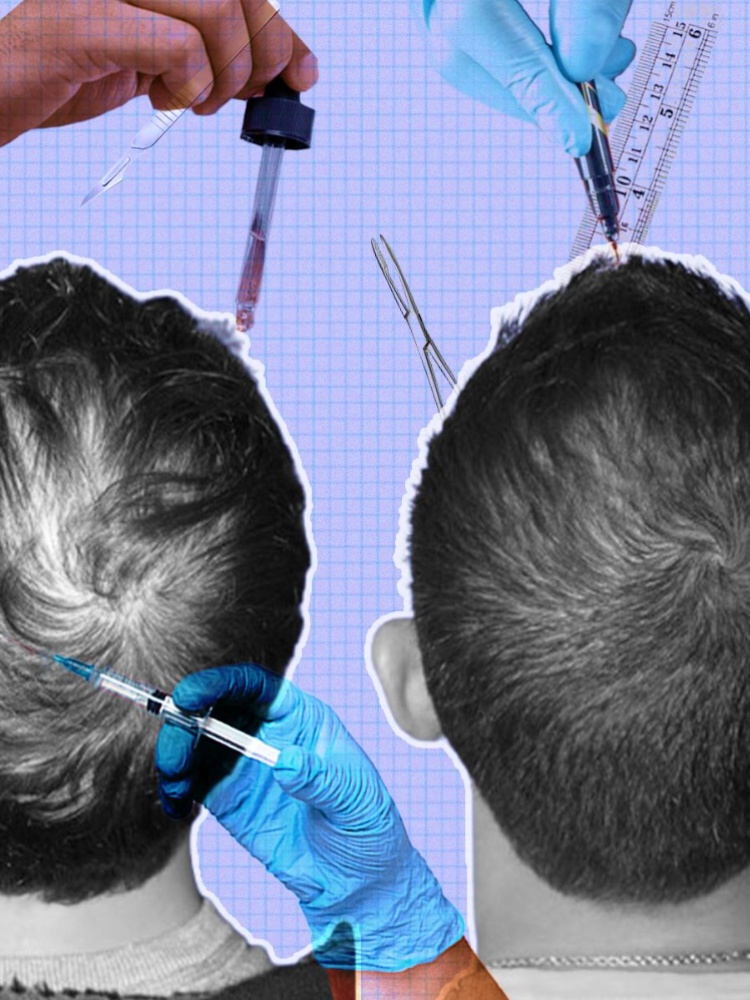

Farhan Balapuria is 28. He hasn’t booked a hair transplant, but he knows exactly how one works. He has an approximate idea of how much it costs (including a round trip to Turkey, of course), how long it takes to heal, and the hierarchy of alternatives—minoxidil, finasteride, PRP—ranked by how much he’ll need to shell out, invasiveness, and diminishing returns. As a full-time content creator, he’ll often joke about his receding hairline or his hair thinning out on Instagram. “I’m not insecure to the point where if someone else made a joke it would bother me,” he says. “You just change what you can’t accept and accept what you can’t change.” What he can change, he has. He’s currently on a combination of minoxidil and finasteride, and it’s working well enough to keep the anxiety at bay, though not enough to kill envy. “Every time I see a guy with good hair—like, not even amazing hair, just a decent hairline—I’m like, you don’t deserve that. That should be mine,” he says. “Obviously, I’m joking. But also…not really.”
Initially, Balapuria was resistant to the idea of hair transplants because it felt excessive. “I don’t want something in my life to have so much control over my thoughts and emotions that I need to get surgery for it, but then it just kind of changed. I’d be cool with it if it was safe and not as expensive,” he says now.
That pipeline from reluctance to serious thought has become common among many of my own friends too. Hair transplants, a procedure once associated with men in their late thirties and forties, are increasingly skewing younger. According to the 2025 practice census conducted by the International Society of Hair Restoration Surgery (ISHRS), first-time hair restoration surgery patients were much younger than the general adult population in the previous year, with 95 per cent initiating hair restoration surgery between the ages of 20 to 35. With the rise of preventative Botox and preventative everything else, it doesn’t come as a surprise that even hair transplants—once a corrective procedure—are now being treated like early maintenance.
Doctors say they’re seeing it play out in real time. Patients in their teens and early twenties are showing up in clinics with noticeable thinning and, just as often, with anxiety about balding that has barely begun. “If it’s diffused hair loss, we go for preventive options. But in some cases, I’ve seen the client almost totally bald even at 22 or 24,” says Dr Chandrashekhar Azad, senior surgeon and head of medical governance at Kibo Clinics in Mumbai. “If the hairline is anyway gone, then even minoxidil and finasteride don’t help.”
Dr Madhuri Agarwal, founder and medical director of Yavana Skin & Hair Clinics in Mumbai, too, has seen a steady shift for nearly a decade. Men as young as 17 and 18 come in with hair loss patterns that once showed up much later—usually in one’s fifties—though actual procedures are far more limited. Over at Darling Buds Clinics, which has outposts in Mohali, Chandigarh, and Mumbai, Dr Tejinder Bhatti reveals men as young as 15 have enquired about the process. “Baldness is changing and is part of the evolutionary process now,” he explains. “It is basically when you don’t need an organ, the body does away with it. The basic function for hair was temperature control, and now we are controlling our environment’s temperature by artificial means.”
Dr Viral Desai, medical director of CPLSS Mumbai and the pioneer of NHDT (natural high-density hair transplant) in India, believes the biggest factors affecting how patients are losing hair today are lifestyle and nutrition. “Earlier, it was thought of as more genetic. But now, hair loss is patterned where a lot of factors come in,” he says. “Stress inflammation, or reactive oxygen species (ROS), is one of the biggest factors of ageing and hair fall.”
The biggest motivation amongst teens and 20-somethings seeking surgery, according to all the surgeons I spoke with for this story, is tied to self-image and perception. For a generation that’s grown up with selfie cameras and spent hours looking at themselves on Zoom, it’s impossible not to be more aware of how the hairline looks. And unlike previous generations, they know what can be done about it. A speedy prompt on ChatGPT or a quick look through the r/tressless subreddit will give you everything you need to know within minutes.
“When you’re balding, you look older. It may go against you in the arranged-marriage process, at the workplace, and then, of course, social relationships,” Dr Bhatti says. “I have parents coming in with their sons saying, ‘Shaadi hone tak baal theek kar do, baad mein ka baad mein dekh lenge,’” adds Dr Agarwal.
Dr Bhatti recommends waiting until at least the age of 25 for the pattern of baldness to set in and suggests medical treatment before that. Though, in rare cases of non-genetic hair loss, he has operated on patients as young as 18. Dr Agarwal suggests waiting until at least 30. “We try to push them to wait so the hormones and the thinning are more stabilised. Most agree and would rather do medications,” she notes, adding that there’s more openness towards treatments like PRP and GFC in recent years. “A lot of them come in thinking, if I get a transplant, I’m sorted for life. That is not the case.”
While many think a hair transplant is a one-and-done solution, in reality the surgery is the beginning of a long-term treatment plan that may include medication, follow-up procedures, and a willingness to keep going. The donor area, which is a finite reserve of hair at the back of the head, can only stretch so far, and using too much too early can restrict future options.
That hasn’t stopped younger patients from opting in. Yavisht Zandbaf, a 29-year-old who runs a liquor store in Mumbai, just got his hair transplanted a couple of weeks ago. He did 2,000 grafts in a single session. For him, the trigger was a picture of him from the year before. “It made me realise, dude, fuck, I had so much hair before. I looked at myself in the mirror and saw my hairline receding and my hair getting thinner. Those signs were good enough for me,” he says, adding that he’s very conscious about the way he looks.
With many of his friends’ weddings coming up next year, he decided to take the plunge. The experience, according to him, was far less intense than he had anticipated. “My father is bald, so I’ve always known I’m gonna have the bald genes in me. So, I was like, dude, I’d just rather get it done now and not wait to get bald,” he says. “You just need to have a decent amount of patience because you’re just lying there for nine hours. The anaesthesia hurts, but that’s about it. Once the procedure is done, you’re home for seven days, and then you’re out and about.” When asked if he faced resistance from the surgeon, he replies: “I’m giving them money. They’re more than happy to do it.”
Given the location of Dr Bhatti’s clinic in Andheri West, he sees a lot of young aspiring models and actors coming in for consultations. Dr Desai recalls operating on a patient at 19. “There was the son of an actor who was being launched at 21 and didn’t have a hairline. It was a professional hazard. Given a choice, I generally tend to not before the age of 24 and 25,” he says. But it isn’t just camera-facing professionals who are getting it done.
Anish Jhunjhunwala*, an MBA student at the Massachusetts Institute of Technology, got his hair transplant at 25 in Mumbai while he was applying to programmes in the US. It was a decision he had anticipated for years. “I knew I was gonna get it done when I was in the 10th grade because I started losing my hair very early. A friend of mine got it done a couple of years before me, and when I saw his results, I was convinced,” he says.
Like Zandbaf, the goal for Jhunjhunwala wasn’t the permanence of hair but timing. “For me, the thought process was: I don’t not want to have hair till I’m 30. The point is to have hair that I go to the beach with, and it gets wet and I don’t give a fuck.” In his case, nobody could really tell he was balding because of how he styled his hair when it was dry. “I just wanted to be able to shower and walk out immediately and not have to style myself for 15 minutes or run my hand through my hair without feeling conscious.”
He opted for 3,500 grafts. The surgery, for him, was fine. He even watched Netflix in between, though recovery did hurt in the first two weeks. He recalls having to take the maximum amount of painkillers and steroid medication he was allowed, which messed up his stomach. While he had been prescribed a medicated shampoo and minoxidil, he hasn’t been disciplined about daily topical application, stating that he’s happy with the way his hair looks now and doesn’t want to add an additional step to his daily routine. When asked if he would do it again, he confesses he would if it were the same surgeon and the same experience—even with two weeks of pain. “I can technically do two more [surgeries] but if patchiness does come in, say, 10 years, I think I’ll be fine. Everyone’s bald by 40 or 45 anyway, so it doesn’t matter.”
Pune-based Felix Galande* got his hair transplant in Mumbai at 23 and calls it “the best decision of his life”. He tried minoxidil for a while, but when he realised it didn’t work for him, he too got restorative surgery. “I was very acquainted and comfortable with the concept because my dad had a hair transplant and I had the opportunity to sit down with [my surgeon] a couple of times because my uncle is friends with him and my cousin got it done before me,” he explains. “I’m sure I’ll have to do it again and I’m very open to it. There is no other better solution than a transplant for hair loss.”
After the surgery, he quit smoking for two months and was on finasteride for about a year. Finasteride inhibits the conversion of testosterone into a hormone known as DHT, which over time shrinks follicles and results in hair thinning. According to studies of the drug, a small percentage of those who take it orally may experience side effects like low libido, erectile dysfunction or a low sperm count. “It didn’t happen for me, but people don’t realise that more than half of the bad habits you indulge in on a daily basis cause that, including smoking, drinking alcohol, and pollution,” he adds.
All three seem to understand the reality: it may not be a permanent fix. But that doesn’t seem to deter them. If anything, it fits into the logic: if you can fix it early, why wouldn’t you?
So, as TikTokers and Redditors like to put it, is Gen Z actually cooked? According to surgeons, some Gen Z patients do come in with a very distorted idea of how they look. Dr Azad has seen young patients with perfectly normal hairlines for their age come up with pictures of actors and say, “I want this type of hairline.” He says, “Under this scenario, we weigh the pros and cons—if it’s actually ‘ruining’ their life [as they put it] after a consultation with a psychiatrist.” He adds, “The fear of future baldness is much stronger now than actual hair loss. Many also suffer from anxiety and irritable bowel syndrome. It’s a vicious cycle: because of the increase in cortisol, they start losing more hair.”
At Dr Desai’s practice in Mumbai, patients come in with unrealistic expectations too. “They come in and draw what I call ‘monkey hairlines’—how apes have really round and low hairlines,” he says. “The trend that worries me is that patients want hair instantly. They come in and say ‘Doc, just put hair in’ and bye-bye, and don’t want to maintain it,” he adds. “You need a lifetime commitment towards it. If you apply sunscreen, it protects you. The day you stop applying it, the sun will damage you. Similarly, hair transplant cannot be done once and forgotten. The day you stop taking medicines, you will have hair fall.”
For Balapuria, the decision remains unresolved. The medication he’s on has shown noticeable improvement, which has made the situation feel manageable for now. But he’s also aware that its effects may plateau over time, and that some degree of hair loss is inevitable. “I’m sure after a year or two when the improvement essentially maxes out, I’ll once again be in that zone of ‘oh I wish it was better’,” he says. “It’s just far too expensive. Maybe if I were much, much wealthier. But even then, I just feel like there’s so much more stuff I could do with it.”
*Some names have been changed upon request