




In March, Rachna Rao, a Bengaluru-based management consultant, went to her hairdresser for a quarterly refresh. When the stylist asked what look she wanted, the 26-year-old didn’t demand bangs or a cut and colour. “I said give me anything that hides my bald spots,” Rao says. “And then my hairstylist insisted that I’m not going bald. We have this conversation every time I go in.”
Back in 2023, Rao was diagnosed with PCOS. While scrolling down a Reddit wormhole, she discovered that hair fall is a possible side effect of the condition. Three years later, that little fun fact still weighs heavy on her mind and her hairbrush.
For Tanvi Phansekar, a ceramics artist in Mumbai, this panic around hair loss kicked in last year when her 27th birthday rolled around. “Everyone says your late twenties is when your hair starts thinning. Well, this is my late twenties,” she says. “I got AI to predict what I’d look like with frail hair and it’s not a pretty picture.”
To confirm, Phansekar’s dermatologist also insists that she has absolutely nothing to worry about; her shoulder-length mane is perfectly luscious. As odd as their Rapunzel-themed hypochondria sounds, Rao and Phansekar are far from being the only young women panicked about early-stage baldness.
Recently, content creator Sakshi Shivdasani also posted a video with the caption “stressed about getting bald, getting bald by being stressed”. Similarly, “Is this hair loss or am I being paranoid?” is among the most asked questions on Reddit hair threads.
Women often post unflattering bird’s-eye POV images of their scalp and ask strangers to “be honest” if they should start saving for transplants. In the comments, fellow nervous wrecks share advice ranging from the highly specific (egg yolk and onion oil) to the unhelpfully generic (stress less and sleep better).
First things first, is there any truth to this trend? Are young women, in fact, suffering from worrying hair loss? Should we stock up on Parachute hair oil? As per a 2025 study from Traya—a direct-to-consumer brand that specialises in hair regrowth kits, so take it with a pinch of salt—71 per cent of surveyed Indian women are battling partition widening.
But Dr Sravya Tipirneni, a Bengaluru-based dermatologist, believes it’s largely a case of people crying wolf. “While we are seeing a genuine uptick in early-onset thinning, we are simultaneously witnessing a surge in trichological paranoia,” she says.
Recently, the doctor had a visit from a 19-year-old student who had comically been measuring their hairline with a ruler (!) over a period of six months to gather proof. As expected, expert opinion confirms that their hair was perfectly fine. “I spend about 30 per cent of my consultations simply reassuring patients that they are not going bald,” Tipirneni adds.
She blames algorithms for fuelling this panic. If you look up hair growth products even once in a weak moment, your social media will likely cue up countless videos of people battling the same. Suddenly, a string of solutions show up with glossy captions like ‘ultimate guide for healthy hair’, ‘products that give you instant results’ or ‘hair serums that actually work’.
All these videos come with extreme before-and-after transitions that promise you the world if you start using the same products that they do. There’s also DIY cures containing magical rosemary oil, methi, and sesame seed paste that will apparently take you from Tangle Teezers to Tangled, the film, in just 30 days.
The hard truth is most hair loss content online is low-quality and misleading. A 2025 scientific review discovered that less than 18.9 per cent of hair growth posts come from actual experts. The sizeable chunk that dominates social media comes from amateurs who contribute to building anxiety and distorting perceptions of hair loss.
Unfortunately, many hair care brands also play into this terror for sales. Whether it’s sensationalised “breaking news” posts that make hair loss feel threatening or memes that couch genuine alarm in relatable humour, the language leans on urgency and fear. Another classic but deceptive approach is when brands show what healthy hair fall should look like with visual references of 50 strands versus 150 strands.
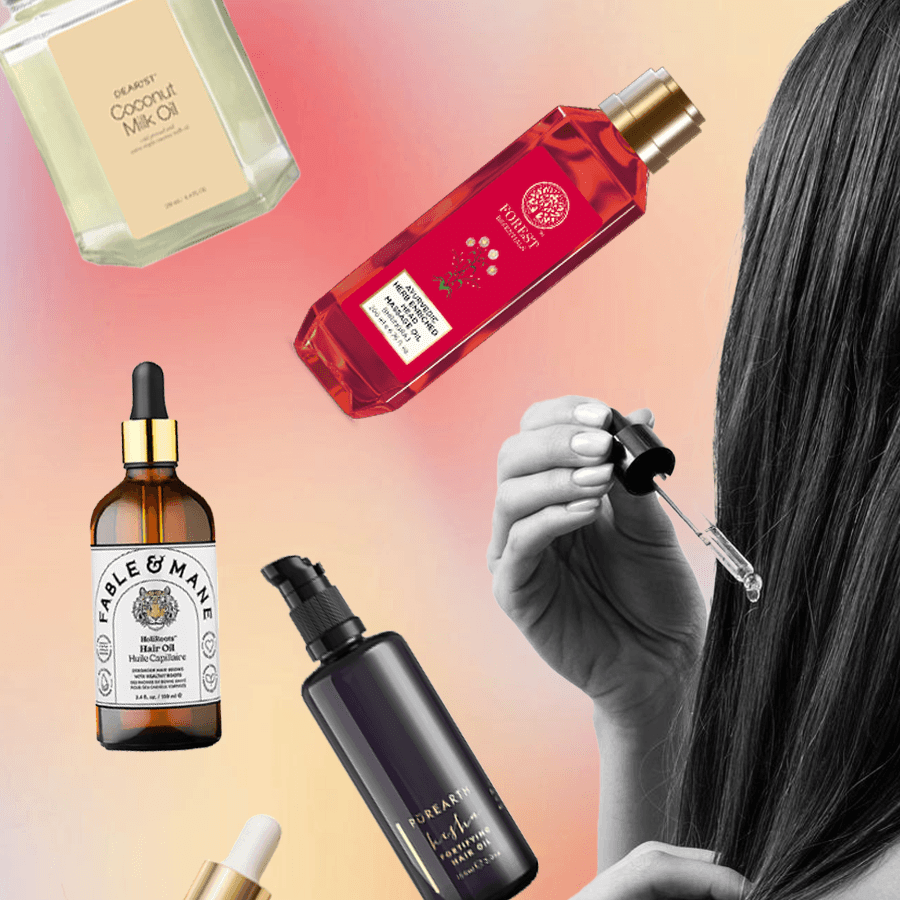
It might be stating the obvious, but hair loss looks wildly different for varying hair types. The same clump of 50 locks will look heftier and more dangerous for people with longer, thicker hair than the thinner counterparts. Soon, you’re ordering champi hair oils, shower filters, scalp stimulating massagers, Dyson hair tools, silk pillowcases, Mason Pearson boar bristle brushes and scalp toners, determined to take control of your hair routine. (Do not Google any of these. Stay strong. You don’t need another product!)
Then there are brands who make towering claims of what their formulas can do, like this product that promises 214 per cent hair growth in 10 days. “These claims are so, so misleading. The brand has cited an ex vivo study, which means the experiment was conducted outside the body in a controlled environment,” says dermatologist Dr Govind Mittal. “Of course, the same conditions don’t exist inside the body. You can’t even ensure that the amount of peptides you have applied on your scalp actually stimulates hair growth. This is how brands capitalise on the anxiety of vulnerable young people.”
As much as Gen Z would like to claim they read the fine print better than previous consumers, even data can be strategically posed to lure you in. The blurred lines between pharmaceuticals and cosmetics furthers this agenda. You can easily order over-the-counter hair gummies that promise to add shine and strength to your locks. You’re probably already having vitamin D, vitamin C, lion’s mane and collagen, so adding another supplement that tastes good and looks good feels like a win-win.
Meanwhile, minoxidil, touted as the global fix to hair loss, is swiftly becoming a household staple, a weeks away from gaining Dolo 650 status in medicine cabinets. “Remember how hyaluronic acid was all the rage in 2020 and you wanted to use it because everyone was? Yeah, on my group chats minoxidil creates the same FOMO,” Phansekar shares.
It doesn’t help that we’re constantly exposed to hair transplant content either. What was once reserved for online story times from Turkey is showing up closer IRL. A 2024 study shows that 3,50,000 hair transplants are conducted in India annually, with the industry growing 192 per cent in the last decade. Many of us know at least one person, or are at most twice separated from someone, who underwent a hair transplant. This quadruples the fear by posing the question: if it could happen to them, how long before it happens to me?
Blend this in with other inescapable factors like rising AQI, post-Covid hair loss and skyrocketing stress levels, and you suddenly see why everyone’s convinced they’re going bald. With so many odds pitted against healthy hair, the loss feels inevitable. But if you go by facts, the reality isn’t as bleak. A recent survey found that 23 per cent of women believe their hair is thinning but only 14 per cent found clinical proof of harmful hair loss.
Just like Dr Tipirneni, Dr Mittal also sees numerous patients that come in believing they have a hair issue without substantial proof. “The best way to handle such cases is by spending adequate time with them, understanding all possible triggers for their perceived hair loss and to see their mental framework,” he says, adding that simply disregarding the claim doesn’t do any good.
Especially as historic data shows that women are often misdiagnosed or not taken seriously enough by medical professionals, Mittal emphasises a detailed examination is necessary to ensure young patients feel heard.
Tipirneni adds, “If you must check hair health at home, try the ponytail test to see if the overall thickness of the gathered hair is reducing. You can also keep an eye out for seasonal shedding, which means heightened hair loss in certain periods. It’s important to escape the feedback loop of anxiety.”
Oh, and if you’re looking for express advice on what not to do, Rao has a suggestion: “I know people say losing 50 to 100 strands is normal. One time, in an embarrassing moment of mania, I sat in the shower and tried to actually count them. No matter what, do not do it.” We repeat: do not succumb to it.
Say it after us: my hair is long and luscious, I am not going bald. And if you really, really need it, here’s a healing incantation from Rapunzel herself: Flower, gleam and glow/ Let your powers shine/ Make the clock reverse/ Bring back what once was mine...