




One night in Tokyo, two women meet at a nondescript restaurant. Their sharply contrasting wardrobes make them a strange pair, highlighting their differences. One has the sleek, structured style of a high-flying corporate. The other is dressed casually, radiating laidback comfort. Yet conversation flows comfortably between them. They laugh and, as they leave, they tell one another that they should do this again soon. Everything seems in place for a picture-perfect female friendship, but life and relationships are never so simple or straightforward in an Asako Yuzuki novel.
Yuzuki arrived on the global scene in 2024 when Polly Barton’s translation of her 2017 novel Butter became an international bestseller. In Butter, an unusual friendship blossoms between a journalist and a serial killer, fuelled by food and cooking. The novel was a tale of self-acceptance folded into a study of how women are straitjacketed and stifled in modern societies. It also left readers craving hot rice with butter and soya sauce.
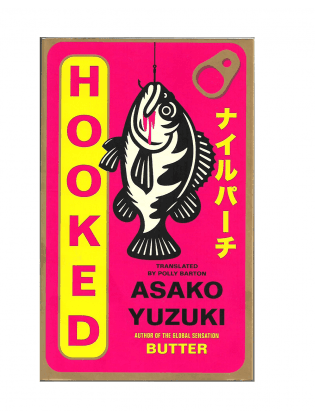
For Yuzuki’s English readers, Hooked (also translated by Barton) is a follow-up to Butter even though the Japanese original was published earlier, in 2015. Hooked covers similar ground. Two women—one of whom has a dark secret in her past—forge a connection. There’s food, there are judgements from society at large, and there is the rollercoaster ride that is a woman’s internal monologue. Yuzuki is particularly skilled at creating women characters with rich and messy internal lives. However, if Butter was on the nose with its earnest messaging about how glorifying thinness has led women to the edge of a psychological cliff, Hooked is decidedly more heavy-handed. This time, in addition to taking issue with body shaming, Yuzuki suggests patriarchal society has used female friendships as a weapon that effectively pits women against one another.
Set mostly in Tokyo, Hooked follows two women in their thirties. Eriko is an executive at a seafood company, poised to climb the corporate ladder. She lives with her parents, works long hours, looks immaculate, and her life seems perfect, but she is consumed by the anxiety that her accomplishments amount to little because she can’t make friends with other women. Shoko is a homemaker who runs a blog titled ‘The Diary of Hallie B, the World’s Worst Wife’. In it, she writes humorously about slacking off on housework and presents nuggets from her neighbourhood, which also happens to be where Eriko lives. Shoko’s blog becomes a companion for Eriko, who doesn’t so much read it as much as scour the posts for clues to locate Shoko. When Eriko meets Shoko, she decides Shoko is the friend she needs to turn her life around and make her feel complete.
The relationship between the two protagonists of Hooked feels like a reaction to saccharine depictions of female friendships in popular culture and online discourse. Yuzuki doesn’t tell us the source of Eriko’s idea of a best friend, but it’s clear Eriko is trying to replicate images she’s seen elsewhere. Eriko’s manic quest for a bestie is rooted in her need to put up a perfect facade to distract both herself and others from the uglier parts of her persona.
It wasn’t until the 1990s that female friendships entered the mainstream, thanks to shows like Golden Girls and Sex and the City. Even now, except a few anomalies like the Derry Girls or Grey’s Anatomy’s Meredith and Cristina, it’s rare to find depictions that feel genuine rather than glamorised and stereotypical. If ‘girls’ hanging out feels like a fixture in popular culture, it’s because female friendships have been tapped for commerce in recent times through marketing strategies like all-women tours. Hooked feels like Yuzuki’s frustrated response to reducing female friendships to a glossy gimmick. The support women can provide one another is a distant ideal in Hooked and one that none of the characters can hope for because they’re crippled by their insecurities. Instead, Yuzuki looks at the power dynamics that can curdle cordial relationships into manipulation or bullying.
Focused on what she thinks she needs, Eriko expects immediate chemistry and companionship from Shoko, without taking the time to either discover Shoko or nurture their relationship. What Shoko and Eriko end up with is an awkward, half-baked bond that defies definition and is characterised on Eriko’s part by an obsession that teeters between sapphic and stalker-ish. Eriko’s longing for companionship morphs into something toxic and destructive, threatening Shoko and her own wellbeing. Meanwhile, Shoko has her own unravelling, for which Eriko is the catalyst but not the cause. “We’re both victims here,” Eriko observes at one point. “We’re strays who’ve fallen from the intricate net of rules ensnaring Japanese women.”
A recurring motif in Hooked is the carnivorous fish Nile perch, which Eriko’s company is considering importing to Japan. Two decades after it was introduced to Lake Victoria in Tanzania, the Nile perch population exploded and attacked the lake’s resident species of fish to the point that they’ve been practically wiped out. Yuzuki’s point is that women are like Nile perch and will turn on each other if they’re desperate. Incidentally, the Nile perch is referenced in the novel’s Japanese title, Nairuperchi no Joshikai (Nile perch’s ladies’ night out). Joshikai is a gathering of girls or women, usually referring to a supportive space where they can eat, drink, and chat. In Hooked, joshikai turns into a competitive, predatory arena where women duel one another.
Compelling as Yuzuki’s worldview is in the early chapters of Hooked, the novel soon feels as though it’s putting excessive pressure on female friendships to be the one-stop shop for solutions to every feminine problem. At the same time, a minor character (who ultimately reveals herself to be a violent bully) suggests that being able to make friends isn’t enough of a talisman against society’s male gaze. Hooked also has some bizarre twists and pronouncements, like this revelation that Eriko has while spiralling to one of her lowest points: “To a woman with no female friends, the only way of ascertaining her own existence was to sleep with people of the opposite sex.”
Rest assured, there are other ways.
Shoko’s blog and her interactions with other bloggers also let Yuzuki touch on some troubling aspects of parasocial relationships at a time when everyone is performing on the internet. For instance, Eriko feels like she knows Shoko because she’s read Shoko’s blog. She also feels a sense of ownership over Shoko by virtue of being a dedicated reader. Yet, even though Shoko’s blog is rooted in honesty, it holds up to the public only one aspect of her life. A post may tell Eriko which snack Shoko picked up or which cafe she visited, but Eriko has no idea that Shoko’s marriage is listless or that Shoko is saddled with emotional baggage she has inherited from her parents.
While it is not as accomplished as Butter and tests the limits of credibility, particularly after the halfway mark, Hooked is still a page-turner. As the novel progresses, the plot points are often excuses for Yuzuki to deliver pronouncements on modern Japanese society’s tussles with tradition, sexism, and capitalism. Yet for all the clumsy interludes, Hooked feels perceptive and Yuzuki writes complex and unpleasant women characters with a sensitivity that is refreshing. Much like Butter, Hooked is at its best when Yuzuki takes us into the minds of her women protagonists, following a breadcrumb trail of scattered thoughts and gathered anxieties. You may not want these messy women as your friends, but they will nevertheless hook you in with their stories.
Hooked: A Novel of Obsession by Asako Yuzuki, translated by Polly Barton, is available in India on HarperCollins; ₹699