



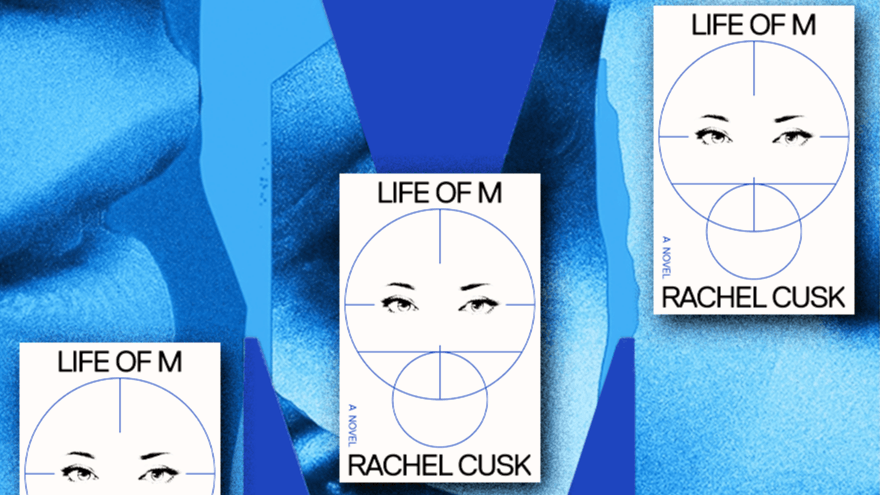
Months before its release, the discourse over whether Rachel Cusk’s new novel, Life of M, is based on the life of actor Natalie Portman dominated most discussions about the book. It’s a little unfortunate; a Rachel Cusk novel merits interest even without a likeness between her characters (she’d hate the word) and a Hollywood star. (The Guardian called it the “rise of the biogossip”—novels that generate speculation about the identity of the person on which they may or may not be based.)
Like many around the world, I came to Rachel Cusk’s literary world through her Faye novels—Outline, Transit, and Kudos. The idea that a woman, her outlines as ill-defined as a shadow’s, would just go about her day holding philosophical conversations with co-passengers, fellow authors, strangers and strange billionaires seemed like a dream. Realising that the books were part of the “Faye trilogy” came as a surprise—the narrator’s name hadn’t mattered and hadn’t stuck, along with other biographical details that we consider crucial for a narrator. The idea of profound chats taking place in unremarkable settings seemed impossibly glamorous. It was through her that I moved to the other autofiction great, Deborah Levy, author of the “living autobiographies”, which applied “in media res” to a whole life. Cusk’s narrator was at once immersed and speaking from a remove, the instigator of a conversation but hardly an equal participant, inviting confidences that she was always reluctant to give.
In Life of M, the unnamed narrator meets an actor, here referred to only as M, and suggests writing her autobiography. M is “a good sport”. “Would you just make it up?” M asks, setting the stage for the shifting-sands quality that pervades the rest of the slim 147-page novel.
The narrative voice in the chapters alternates between the “I” (the narrator, who meets M and suggests that book on her life), the life of M narrated in third person (by whom, though?), and “we”—the mass of city dwellers going about their lives with both intention and apathy.
Cusk excels in digging out gold nuggets in the sand; she tends to take you by surprise by articulating things you’d have experienced but never bothered articulating. “My partner’s refusal to be comforted by this institutional food struck me sometimes as pointlessly obstructive and at other times as a sign of self-respect,” the narrator muses when her partner has been admitted to the hospital. If you have experienced that awkwardness that ensues when you’re wondering whether to acknowledge or ignore the strangers you’re brushing past in a movie theatre or party, you relate when she says: “We pass by these groups, smiling, as though we are conferring our benediction on them.” You nod when you read a television being described as a “rectangular void in the wall”. There are thoughts on dogs, on going out in the evenings, on the light in the windows in the house across the street.
Physical spaces assume great significance in her novel, whether it’s the inside of a limousine, a spa, a meeting room, or a bookstore converted into the venue for a literary “salon”.
Amidst this is M, the actor, who seems to be performing off-camera too. She’s the person who has “selected goodness”, but when a friend comments on everyone being on antidepressants, M isn’t sure that depression is real. Cusk’s characters tend to have that ability to slip into the space between the rain, and M, too, is one. M is mostly warm, often apathetic, occasionally cruel, admiring a nanny’s face while glad she didn’t have her “sturdy” legs that surely would have altered the course of her career.
The Natalie Portman comparisons are understandable. M is petite. Like the actor, M too has starred in a film that marked the end of her childhood. As autumn bleaches the city of all colour, “M remained wreathed in the pink flowers of spring” invites references to Portman’s Dior ads. There’s, of course, the ballet film (“perhaps her highest achievement”). The similarities probably work as gold coins leading you forward.
There are, however, parts of the novel that lose you as a reader due to their prolonged abstraction. Like this: “It was as if we had deserted our own conscious minds, and the return of consciousness afterwards was often painful and strange. It has proved more difficult to bring this mechanism to the creation of ourselves.” Reading it, my mind processed it as something being read aloud in a fake whisper by Nara Smith—which is not something one would usually say about Cusk’s writing. From Rachel Cusk, you just want the real.