Fashion05 May 20264 MIN

At the 2026 Met Gala, nipples take the spotlight

Attendees at this year’s Costume Institute benefit proved one thing: breasts have moved from taboo to couture

Image

Instagram.com/poupayphoto

Have we finally freed the nipple? A quick scroll through the Met Gala red carpet seems to say we have. We saw pointy nipples, sparkly nipples, nipples covered in flowers or some that were just barely hidden under a whisper of fabric. As a worshiper at the altar of the female body, I couldn’t have been more pleased, but all these nip slips reminded me that not so long ago, we were busy fighting the Free the Nipple movement. Does that mean the battle has been finally won?

There was a point when female bodies were widely censored in media and online spaces, and platforms like Instagram regularly policed women’s nipples (but not men’s, of course). The fight against their censorship quickly became a larger conversation about bodily autonomy, sexuality, and politics, and that same rhetoric has played out in high fashion as well, where the nipple is both a political statement and design motif.

Take Madonna’s iconic Jean Paul Gaultier conical bra from the ’90s; with its sharp, BDSM-esque protuberances, the pop icon dared anyone to doubt her supremacy. Later, in 2014, Rihanna birthed the naked dress at the CFDA Awards when she wore nothing, not even pasties, under her sheer Swarovski Adam Selman mesh gown. For Madonna, the nipple was armour. For Rihanna, it was freedom. For others the nipple can also be a site for humour and play. Take Coperni’s irreverent Nipple Pinch tank top or Schiaparelli’s ongoing exploration of our most sensitive of body parts through creations like the nipple coin purse or their metallic breast plates, some even with breastfeeding babies attached.

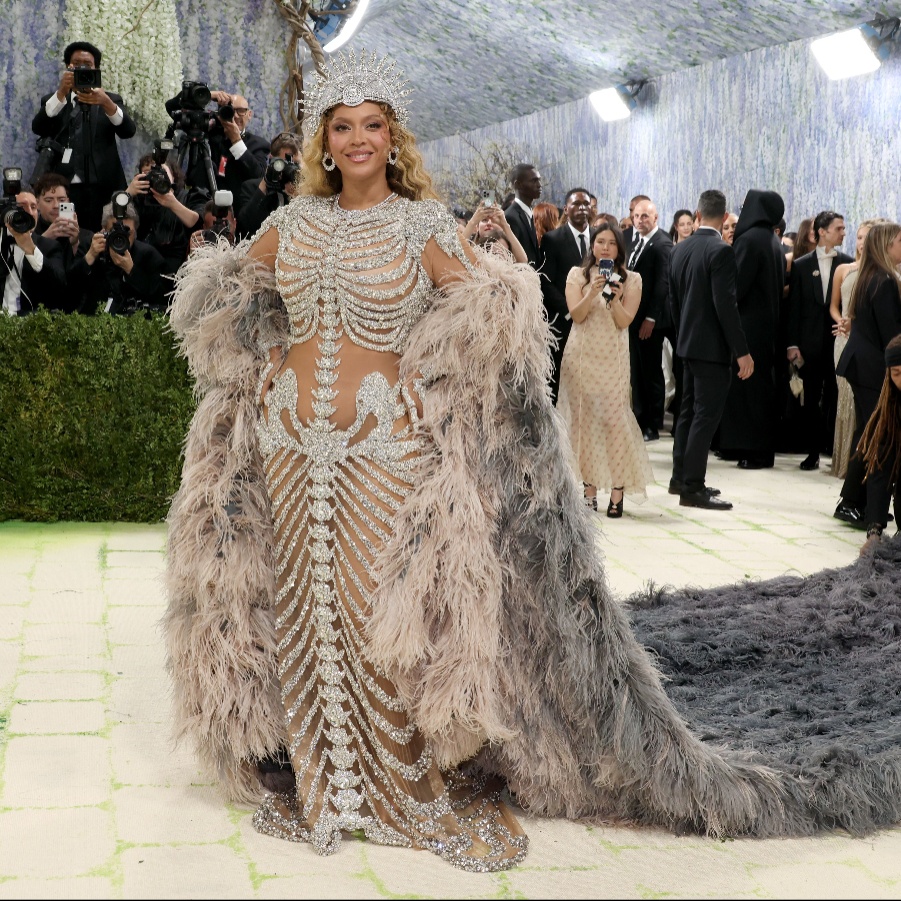
This year’s Met Gala theme, ‘Costume Art’, offered plenty of room to highlight the relationship between clothing and the body—what we cover and what we expose, what we transform versus what we celebrate. All eyes were on the red carpet, where the three Kardashian sisters seemed to have received the same memo: bare your boobs. Kylie Jenner appeared to be in a state of undress. Her Schiaparelli couture gown, which was embellished with 10,000 Baroque pearls, came undone to reveal a nude corset and faux but apparent nipples. Kendall, meanwhile, in GapStudio, riffed off the wet T-shirt in a liquid jersey gown with a flesh bra, one nipple peeping out from the top. And finally there was Kim Kardashian with a more sculptural take. Her tangerine fiberglass breastplate with its extra-pointy breasts was created by designer Whitaker Malem and British artist Allen Jones. Add to the mix Alex Cosani in a sheer Gucci corset and Cardi B’s comical padded boob clusters and the secondary theme to the gala was quite palpable. As multidisciplinary artist Tarini Sethi notes, “The Met’s ‘Costume Art’ theme makes the body a blank canvas—and women are painting on their own terms. Every shape, every size, centre stage. The women are the art.”

So how does all this tie back to art? Western paintings have always placed the female breast at the centre of visual storytelling, but the connotations are usually erotic, tantalising, be it Botticelli’s ‘Birth of Venus’ or Eugène Delacroix’s ‘Liberty Leading the People’, both iconic works of art where the breast signified submission to the male gaze. It’s only in the last century that female artists have reclaimed their anatomy as their own.

The Met Gala restaged that narrative on real bodies. The breast was not viewed solely for its conditioned sensuality. Instead, like art, it provokes conversation. Contemporary artist Shilo Shiv Suleman, whose work sits at the crossroads of magical realism and social change, has long been drawn to the female form. “In my ancestral village in Kannur,” she says, “breasts were carved into temple stone for worship, painted onto chests as breastplates for Bhagwati. Women walked with brown skin wrapped in translucent white silk. Before Victorian modesty stitched morality into blouses, our ancestors saw the body as life itself—as god. Cut to 2026 and silicon moulds adorn Kardashian bodies. Nipples erect. While this moment showcases a somewhat comfort with the female form, it gives Barbie doll bosom.”

Suleman argues for a more radical remembering, for the need to decolonise our experience of the body, to see it again as sacred rather than synthetic, a temple rather than toy.

Whether that message survives beyond the red carpet is another question. Gen Z may campaign to ditch their bras, yet in television and on the big screen they’re still filtered and flagged for the male gaze. Just look at the latest season of Euphoria, where most of the characters seem fixated on ways to monetise their bodies. It’s a gendered approach to capitalism deftly hidden behind the guise of female autonomy. Ryan Murphy’s The Beauty showcased a slew of polished, perfected bodies, nipples and all.

For a more nuanced view of our breasts, though, there is Apple TV’s latest offering Margo’s Got Money Troubles. The series about a student who becomes pregnant by her English teacher and turns to OnlyFans to support her baby is messy and funny. Margo’s breasts appear in all their moods—bare, bejewelled, or dressed in cosplay, yet there’s a certain pride that the titular Margo takes in choosing this new line of work. Her approach is not shrouded in shame or abject secrecy, and, unlike in Euphoria, no one is making a fool of her.

Does that mean I’m ready to wear the Skims faux nipple top out on the streets of Mumbai? Probably not. But I can appreciate the fact that even if I chose to, at least it won’t be censored on Instagram anymore.

The Nod Newsletter

We're making your inbox interesting. Enter your email to get our best reads and exclusive insights from our editors delivered directly to you.