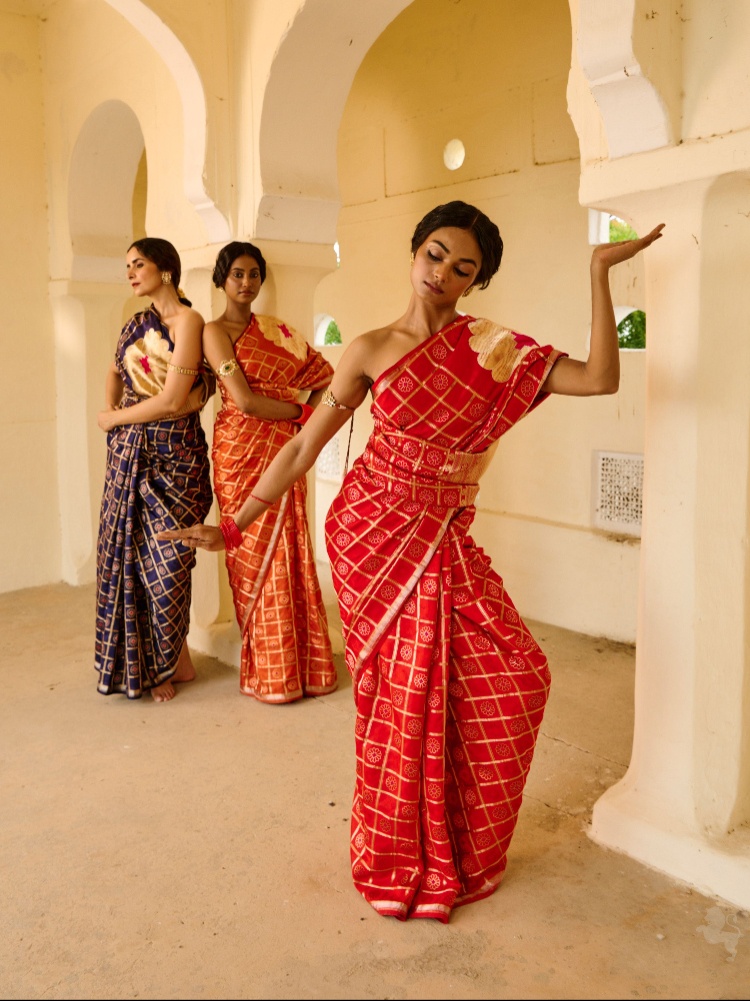
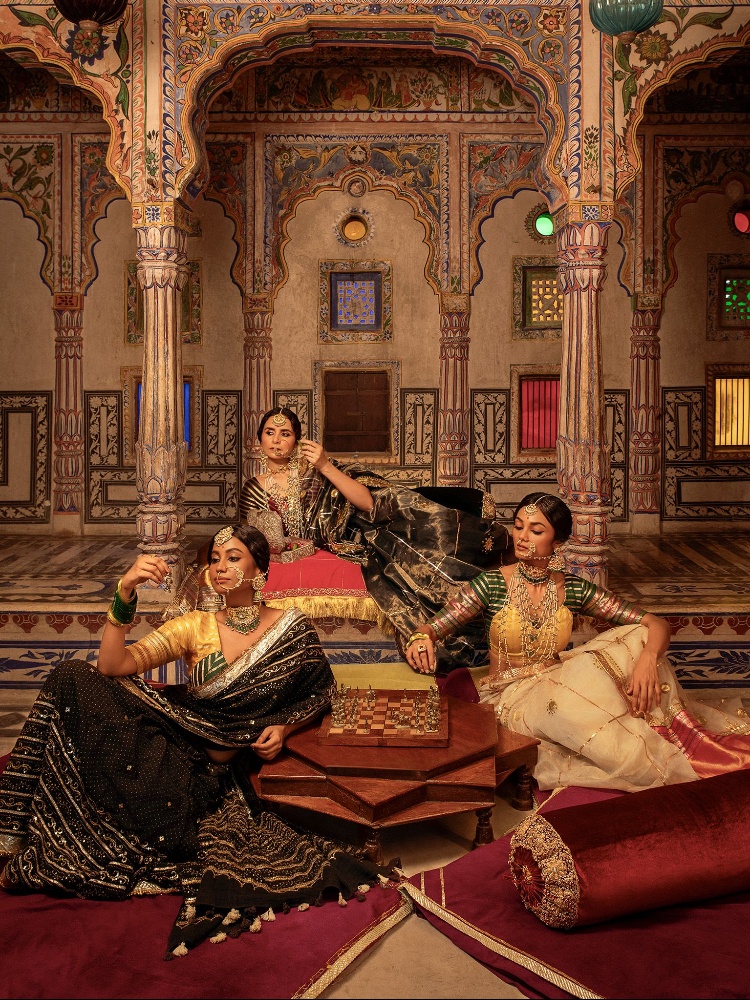
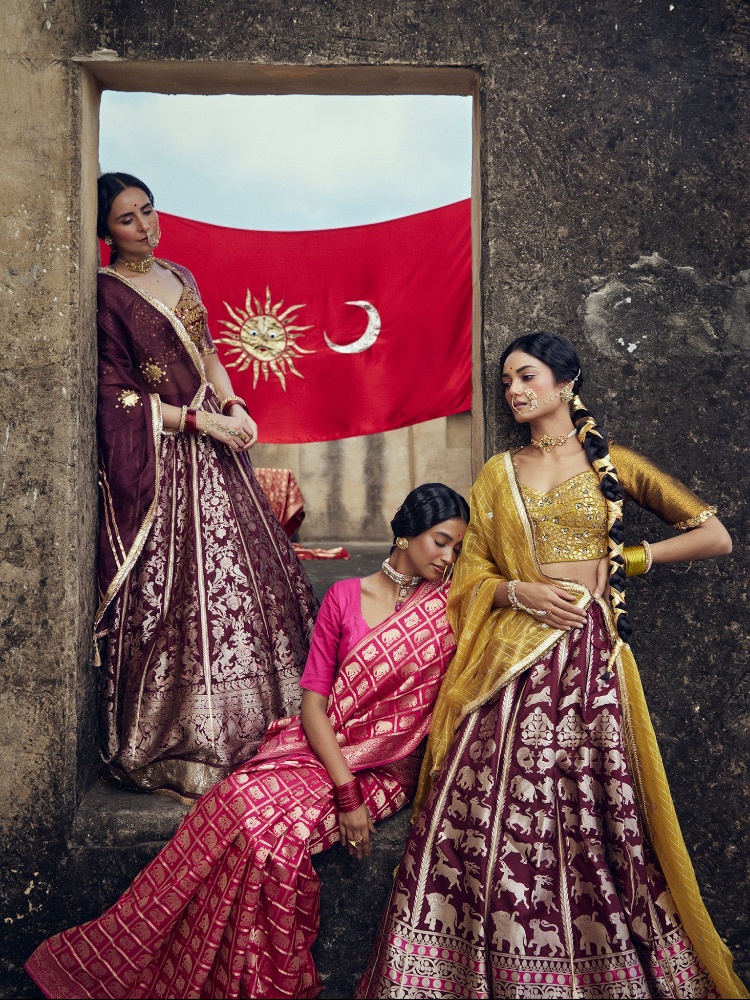
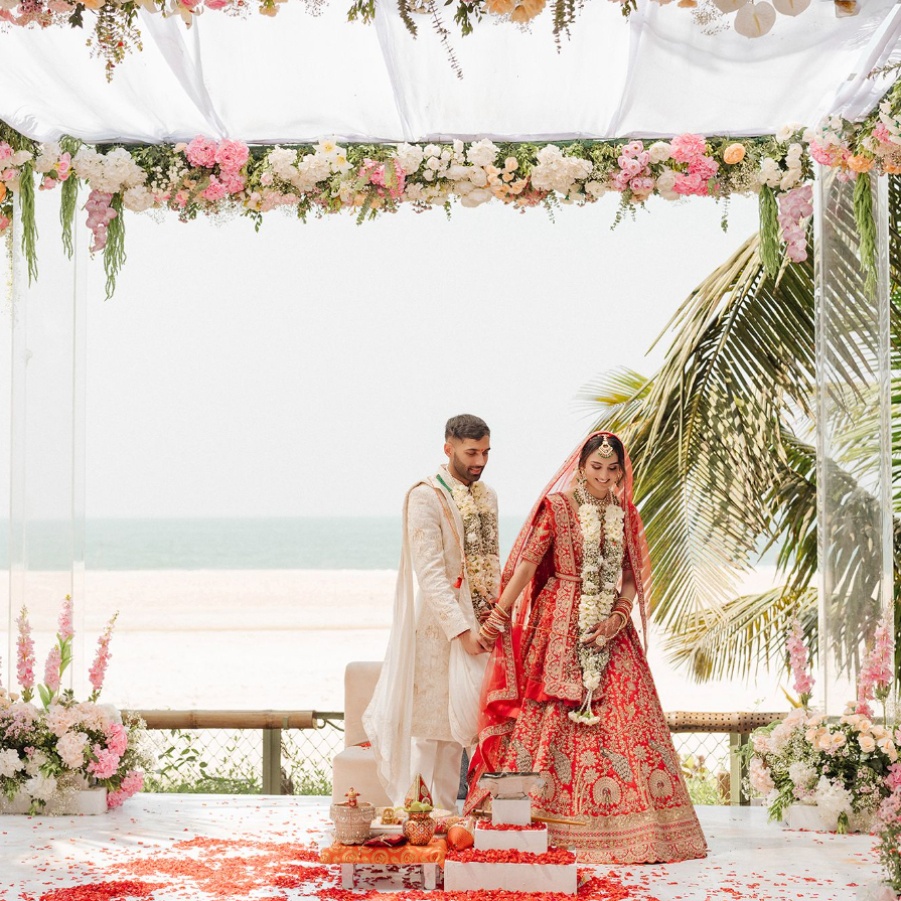
In Maheshwar, he saw a gap; women were buying the famous saris for their mothers and grandmothers but not for themselves. He responded by introducing colours like fuchsia, shades of neon (including a chutney-green version that went viral), marigold yellow, and even peacock blue and bottle green borrowed from the same palette as Kanjivaram saris.
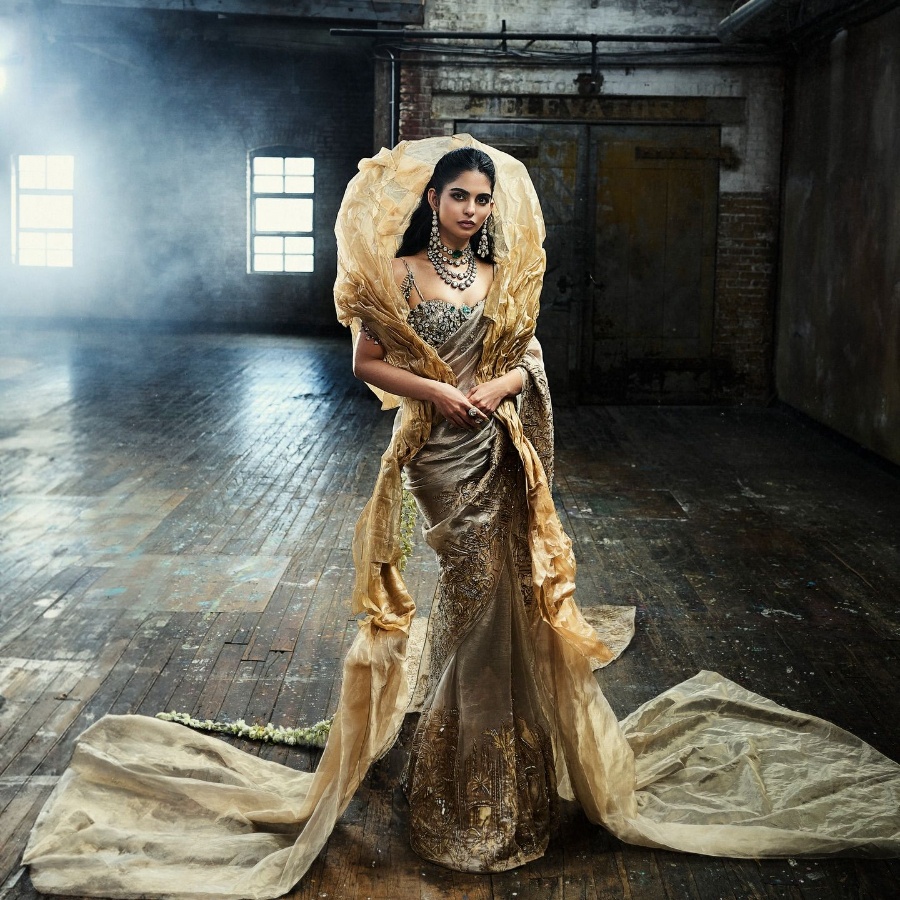
In Chanderi, he revived museum textiles and translated Paithani motifs onto the fabric (as seen on Rashmika Mandanna in the movie Chhaava), whereas with Benarasi he moved away from linearity, bringing back older geometric chaarkhana designs.
From Mau saris with real gold zari to saafa drapes (drawing from the traditional Rajasthani turbans), his practice constantly reinterprets history. In fact, his opulent zari tissue saris have an unmatched tactility to them (“the secret to softening them is to dip the fabric in castor oil," he grins), while the unique shade of red he uses (inspired by the nayikas of Satyajit Ray; he is Bengali, after all) has become his signature colour.
The details are subtle: minimal borders, traditional motifs like the konia, and an obsessive focus on fall and feel. For Das, revival is a necessity, because he is a firm believer that without acknowledging one’s roots, one cannot move forward.
Making tradition move
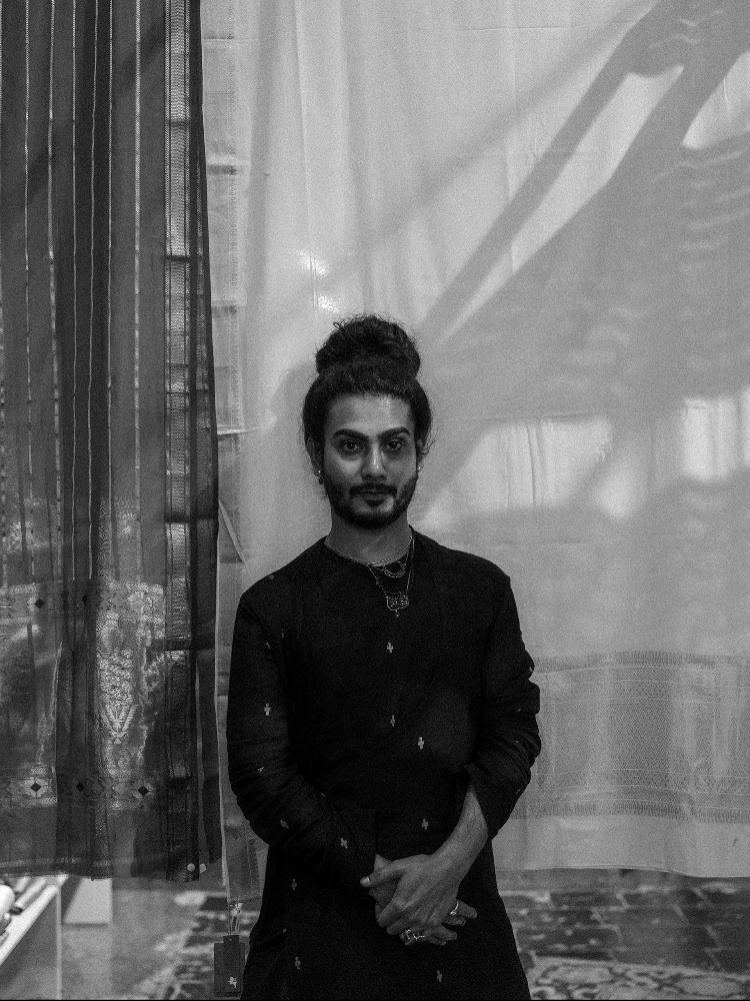
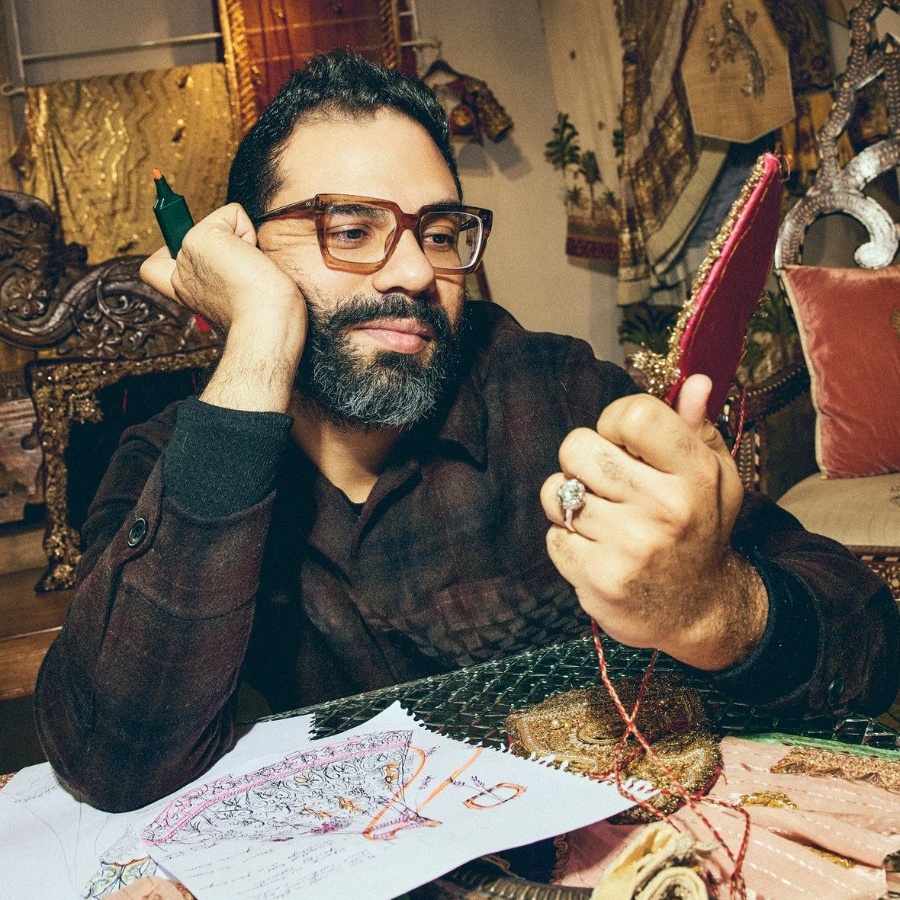
The scale and scope of his work are about more than design. He’s a polymath shaped by the arts—trained in Hindustani music and dhrupad (under the Dagarwani tradition), a student of Odissi (at Nrityagram), a painter (the walls of his studio are decked with his miniatures), and a sculptor—each discipline informing the other.
“Dance and painting have shaped how I understand the body,” he says. “They’ve taught me about scale, movement, and sensuality. When I design, I’m always thinking, how can this sari move better, feel more intuitive?”
Das’s inspirations are equally layered: the canvases of Indian artists, poetry, museums, vintage books—anything that captures India’s maximalist spirit. His atelier, which he opened in Hyderabad in 2024 and furnished himself, feels less like a store and more like a museum: Santipur clay dolls instead of mannequins (“they’re kinder to Indian body types”), Ashta Bhairava masks, Kerala teak interiors, and brocades glinting from every corner.
The focus on movement is perhaps why his saris are strikingly light, designed to shift and breathe with the wearer. For Das, the sari is not just a garment but a living form. “It’s a second layer to an Indian woman,” he says when we meet at his studio. “It understands your body, your movement, even your history.”
It also explains his impatience with his pet peeve: pre-stitched saris (not AI, in which he is not interested). Quoting cultural historian Malvika Singh with a smile, he says, “A stitched sari is a frock,” before adding, more pointedly, “I would go further and say it becomes a costume. Don’t tell me that the young can adapt to ever-evolving technology but cannot drape a garment that generations of their ancestors did!”
Just five years since he launched his label, Das has already dressed Bollywood stars—including Vidya Balan and Aditi Rao Hydari—as well as cultural czarinas like Bijayini Satpathy, Shobana, and Leela Samson. Yet he remains surprisingly grounded, preferring to zip around the city in rickshaws, and he continues to innovate. Right now he is excited about two major projects: creating dance saris (36-inch ikat drapes with elongated pallus designed for movement) and reintroducing old Venkatgiri patterns, from Madras checks to burfi borders, to Chanderi. Through it all, his vision remains anchored in the past. “Indian women,” he says, “should look like they’ve stepped out of a Raja Ravi Varma canvas.”