



Arts09 Dec 20259 MIN

All eyes on Nikhil Chopra

Over the next 110 days, the Goa-based artist and curator of the upcoming Kochi-Muziris Biennale is relying on collaboration and a little help from his friends to present big ideas across 22 venues

Image

Shivani Gupta

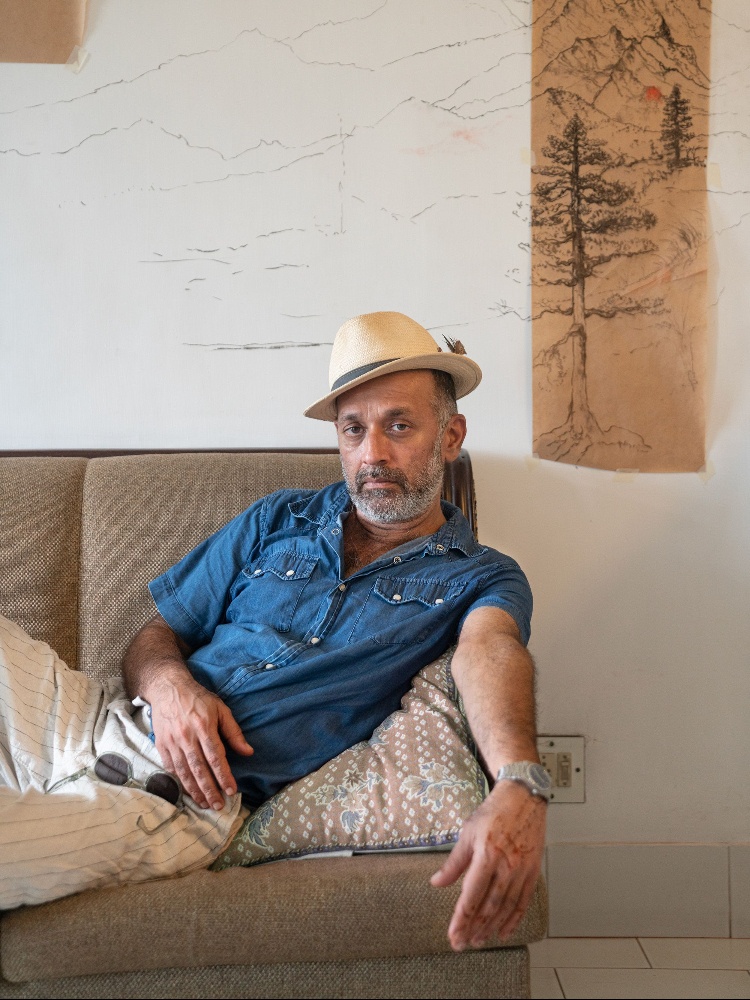
More nakedly joyous than cautiously optimistic, Nikhil Chopra’s forecast for the upcoming Kochi-Muziris Biennale suggests a fever dream. The Goa-based artist promises a dynamic edition that embraces a state of flux. “Vibrant, shapeshifting, moving, shaking, pulsating, vibrating, breathing and sweating” are some of the adjectives he threw about in the manner of prophecy at a recent talk in London. His teaser, though impromptu, eerily sums up the rapturous tenor of each of his performances across the arc of his artistic career, from Sir Raja II (2003) to Fire X Fire (2024). Perhaps this very alignment between his artistic temperament and curatorial tendencies made him the best choice as artistic director of the Kochi-Muziris Biennale 2025-26.

The upcoming edition, which begins on December 12 and goes on till March 31 next year, follows on the heels of a controversy-ridden fifth instalment (2022-23), whose opening was unceremoniously ‘postponed’ 48 hours before the official inauguration, after most of the art world cognoscenti had already landed in Kochi. Financial mismanagement, post-pandemic shipping delays, and structural oversight were among the reasons for the embarrassing deferral. Incidentally, the only thing to open on time during the fated last edition was the live art programme Where Do We Stand Now? put together by Chopra and HH Arts Spaces, the Goa-based organisation he co-founded in 2014, at Dutch Warehouse. Shubigi Rao, who was then the artistic director, along with participating artists, issued a joint letter to the Biennale appealing for a structural overhaul. Venu Vasudevan, known for using his bureaucratic prowess to rescue state-run institutions from inertia, was subsequently roped in as the chair of the Biennale’s board of trustees, while Thomas Varghese was appointed to oversee the Biennale’s management and administration. Co-founder and trustee Bose Krishnamachari assumed the role of president. He, along with his co-panelists—curator Shanay Jhaveri, photographer Dayanita Singh, collector Rajeeb Samdani, and artist and artistic director of KMB 2014-15, Jitish Kallat—voted in favour of Chopra as the sixth edition’s curator, along with HH Art Spaces.

Chopra is aware of the enormous responsibility he shoulders. “The stakes are really high,” he said over a video call from Kochi. “This one just has to be a success!” But, as his teaser suggests, he is optimistic, perhaps on account of the longevity of his collaborative relationships, particularly with his artist-partner Madhavi Gore and with French artist Romain Lousteau, with whom he conceived HH Arts Spaces. The trio are no strangers to working with frugal budgets and limited resources. Chopra interprets his current role as “a two-year immersive performance in the persona of an art curator”, an exhilarating proposition for those of us who have witnessed his longue-durée performances and are familiar with his aptitude for conjuring narrative suspense primarily through non-verbal bodily cues.
3.jpg
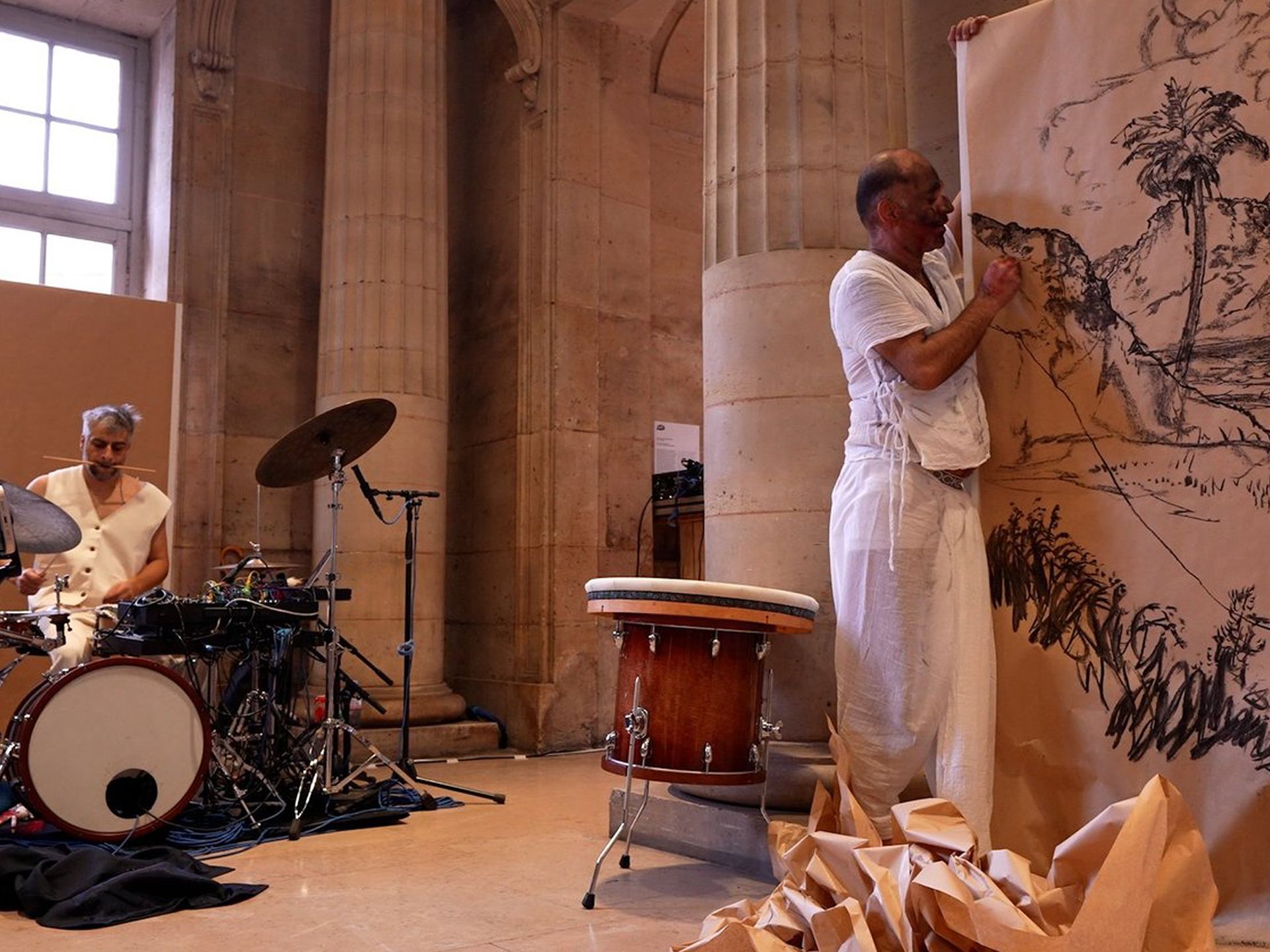
Fire X Fire (2024) was a collaborative performance piece by Chopra and French musician Uriel Barthélémi

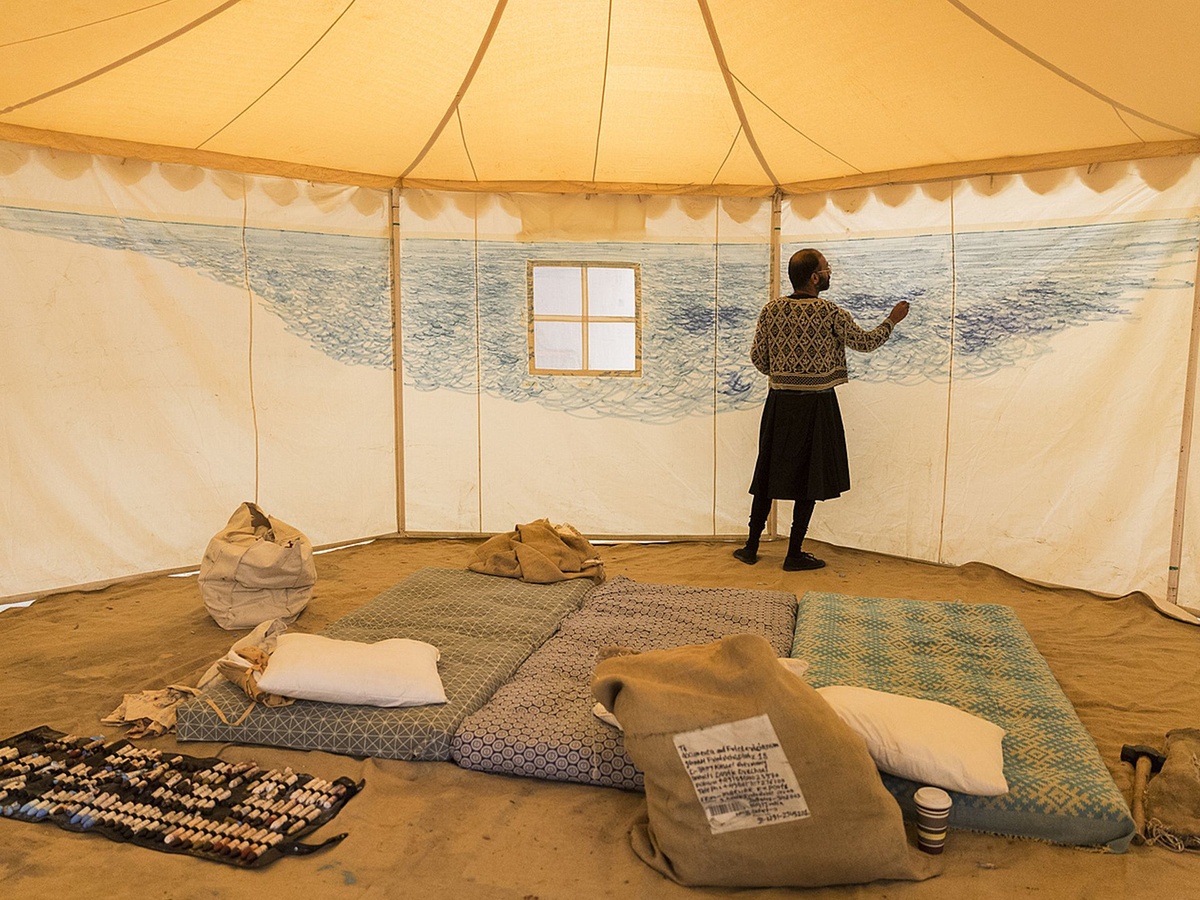
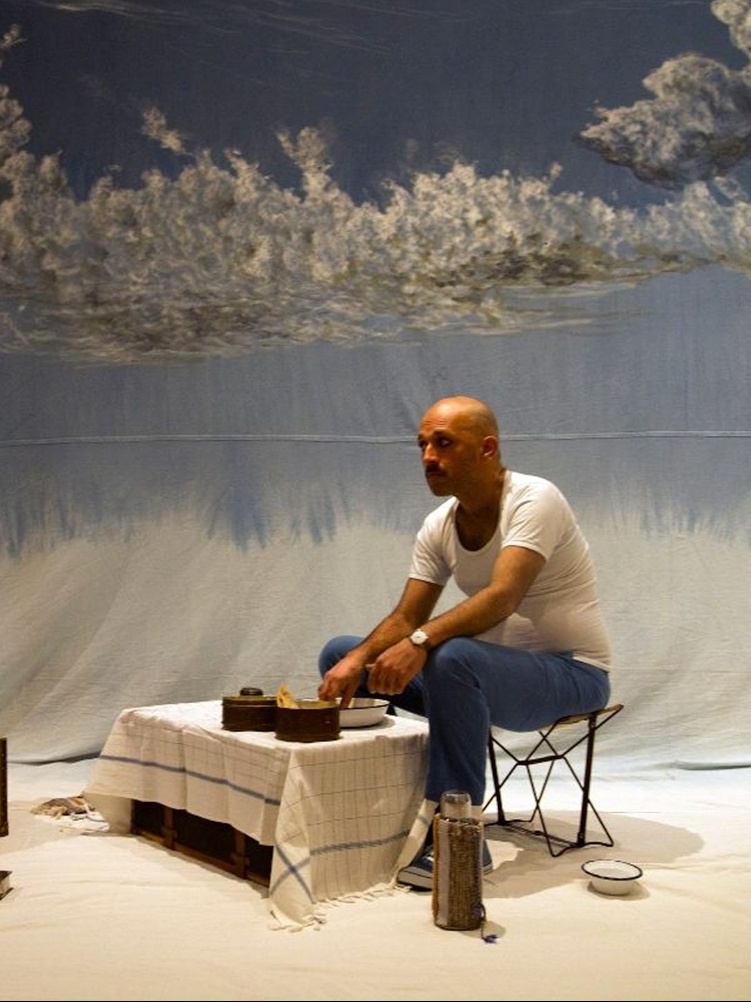
The 51-year-old artist is always actively silent, while his plotlines lie on the spectrum between intuitively choreographed and wholly unscripted. Prior knowledge of his practice or background information pertaining to the performance, though welcome, is rarely a pre-requisite for immersion. Every pregnant second bears an immediacy, whether entangled in rituals of inaction, rest or art making. Chopra’s body is usually the protagonist, fluidly engendering a range of personae as he ‘makes art’ in front of his audience, often through the medium of drawing, using materials whose properties or histories echo the contextual specificities of the site in which his work is unfolding. Each performance feels like a “dynamic process”, embracing a vibrant “state of flux, shapeshifting, moving, shaking, pulsating, vibrating, breathing and sweating”.

Chopra achieves this quasi-mystical effect by surrendering to the durational nature of the process. He uses time the way a watercolourist uses water. And in doing so, he creates a “neutral” emotional site—a judgement-free space. This begins by not judging himself. “I don’t already think that I’m creating a beautiful performance or an ugly performance, or I’m enjoying it or not enjoying it. These feelings that one has are left outside of that realm of thinking about what it is that I’m doing in the moment.” Emotional neutrality doesn’t mean passivity. “It’s important for me to make the audience feel active in their presence, that, if anything, this is a cycle of looking but also of being looked at, which means I am not a passive object placed in a vitrine or on a wall that gets looked at, but an active object that has the ability to return the gaze.”

“The stakes are really high... This one just has to be a success!”

The cycle of sending and receiving and vice versa is an aspect Chopra is also looking to nurture within the Biennale this time, which is titled for the time being. When I ask him if the main exhibition would be eschewing spectacle for the processual, he reminds me that there is spectacle in vulnerability. “The way in which I place the audience allows them to become vulnerable with me, become aware of their presence with me, and, therefore, implicate themselves in making sure that we see ourselves through this experience, as opposed to seeing ‘me’ through this experience,” he explains. “Because in every spectacle, you want to come to the end of that story… We risk together, and we are victorious in this moment together.

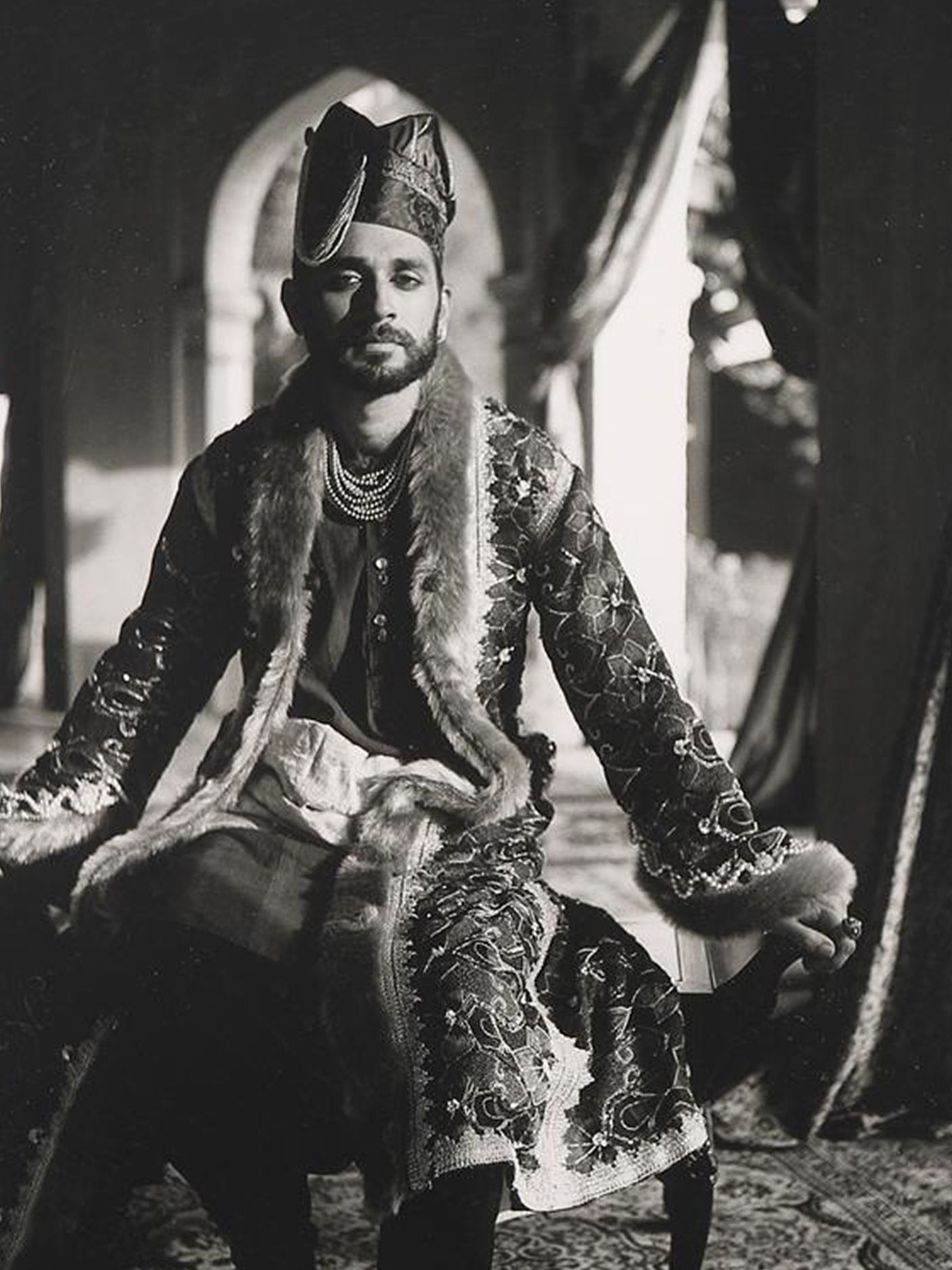
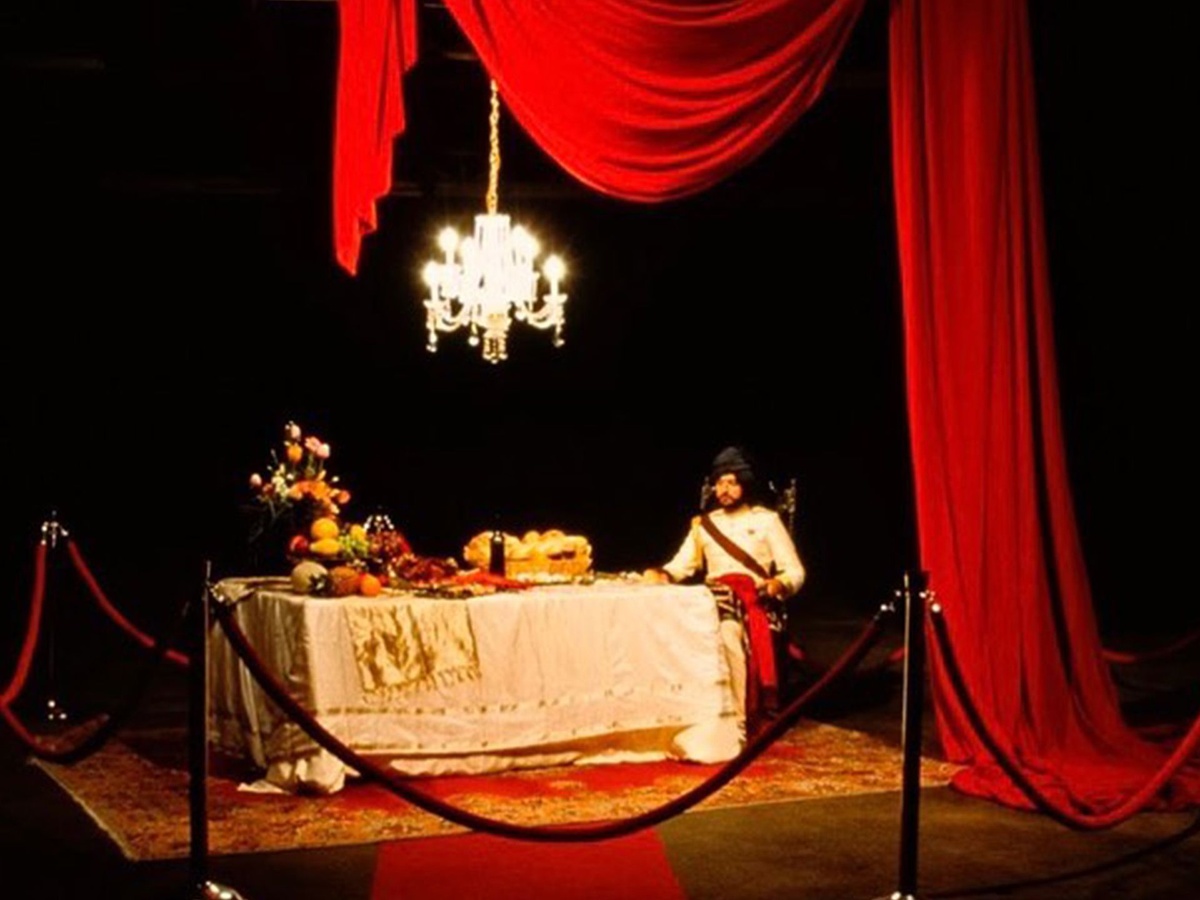
Across performances, Chopra actively collapses the boundaries between process and practice by placing the labouring body at the centre of art making, so that the process becomes the artwork. This early-career decision offered him the objectivity he felt was crucial to “divert attention away from the artist as the author of the work”. It runs through the corpus of his artistic output, beginning with Sir Raja II, his first public performance in 2002 at the Department of Art’s graduating exhibition at Ohio State University. Attired like an affluent, Westernised, British Raj-era Indian prince, Chopra was seated beside a lavishly laid table positioned at the end of a 350-feet-long red carpet, bearing the demeanour of a subject sitting for a portrait. The table setting evoked the still-life genre of Western painting. “I sat motionless for three hours, the food was warm and aromatic to start with and then started to smell by the end of the show. I felt like I had arrived home,” he narrated in an Instagram post in June 2021.
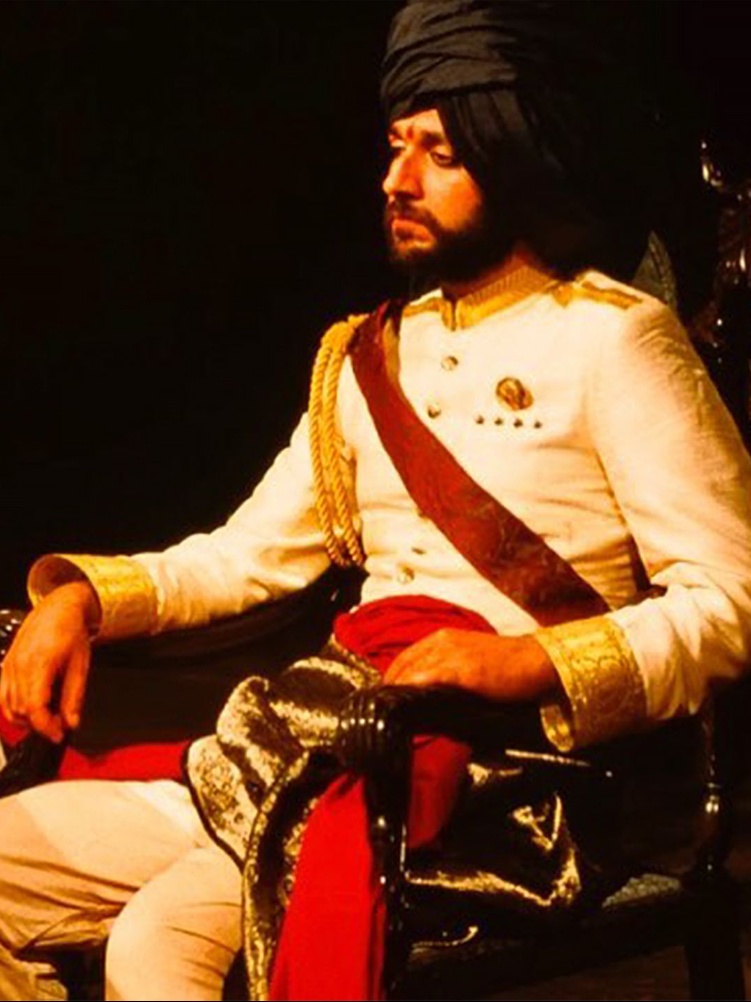
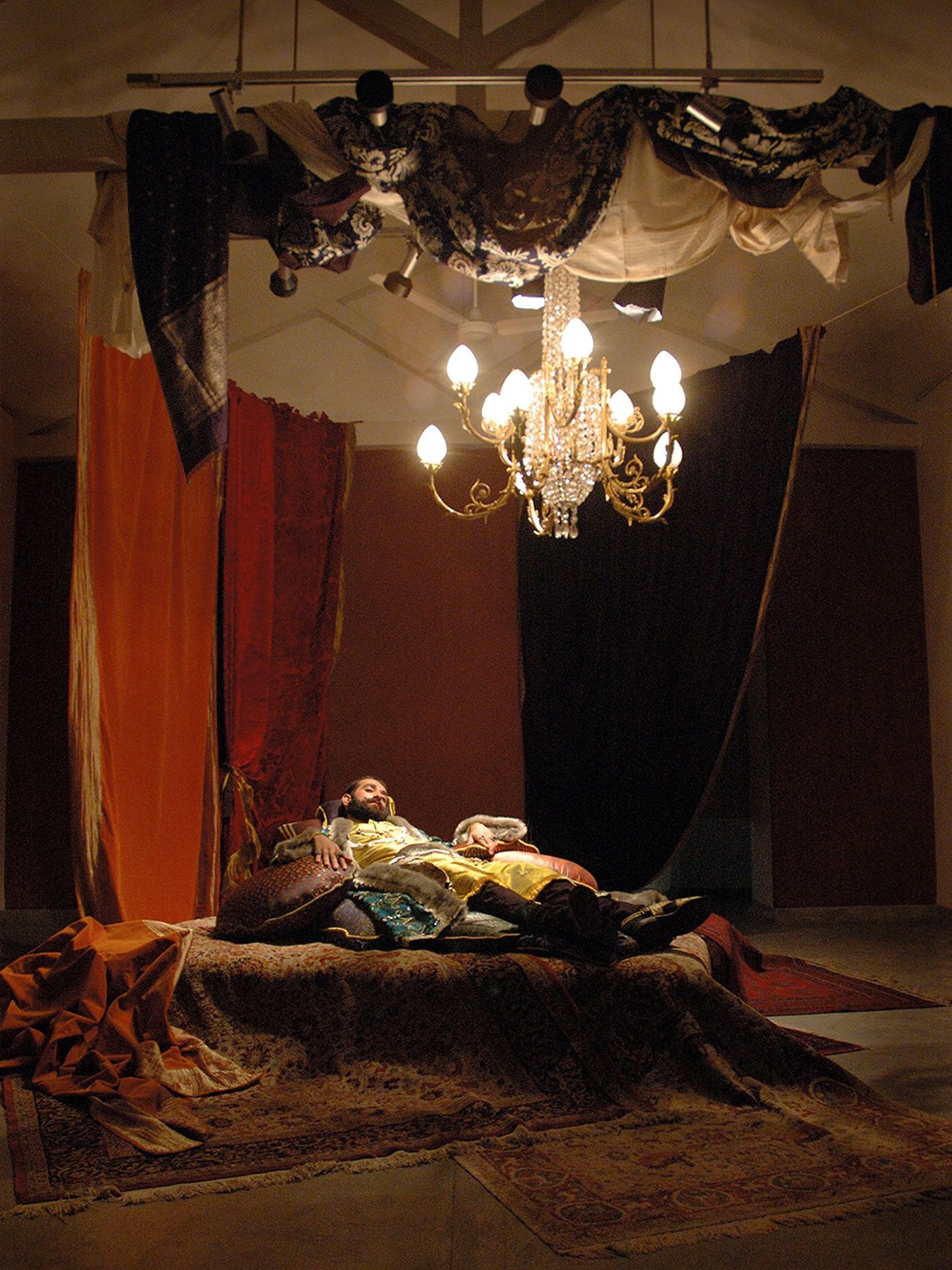
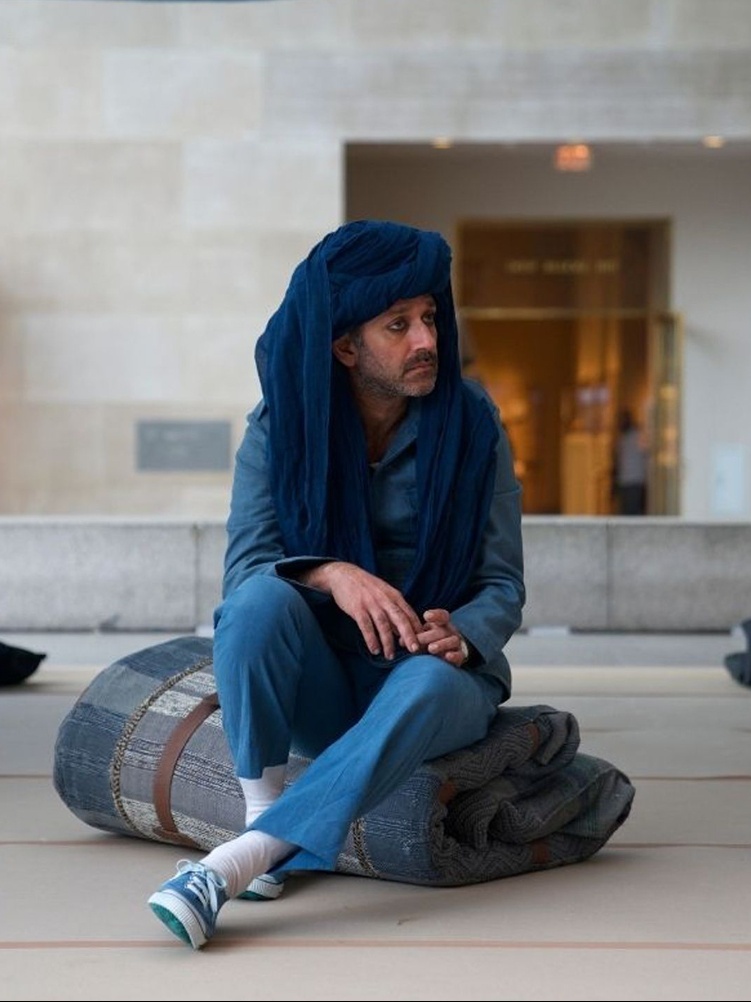
After earning his Master of Fine Arts degree at Ohio State University, Chopra returned to India and reprised the persona of the titular aristocrat in The Death of Sir Raja III (2005). Dressed in regalia, he occupied a set of tableaux featuring jewels, velvet drapes, and ‘oriental’ rugs, posing for his friend Munir Kabani’s lens over a 72-hour span at Mumbai’s Kitab Mahal. From then on, Chopra’s performance work got increasingly more expansive, intricate, ambitious, and complex, from his La Perle Noire II, at KMB 2014, a 50-plus-hour durational performance during which he inhabited and drew the horizon from the cell-like room of the sea-facing Aspinwall House, Kochi, before escaping in a traditional boat, to Drawing a Line Through Landscape (2017), a nomadic multi-city performance along the 3,000-kilometre route from Athens to Kassel for documenta 14, to his nine-day inhabitation of New York’s Metropolitan Museum of Art titled Lands, Waters and Skies (2019).

During a conversation in Mumbai with Jitish Kallat, Chopra recounted how, 15 years ago, he rented a shop at Grunthaler 9 in Berlin’s Wedding district—between a bar and a cafe—to investigate how one could do performance within a studio with “sitting duck audiences”. Over months, Chopra managed to cultivate a thriving community. “Bitten by that mosquito,” when Lousteau, whom he met casually on a Goan beach, floated to him the idea of renting a space to invite other artists to co-create, Chopra went all in. “Out of pocket” they rented an oversized property in Siolim called Heritage Hotel. On the evening of the first open studio, Chopra and Lousteau’s jaws dropped upon discovering a massive traffic jam on the approach road. “At that moment we realised we had birthed something incredible,” he told Kallat. “I invited Madhavi, my lifelong collaborator, to join the mix. She comes from a critical thinking background and could give words to our ideas.” Over time, the network of collaborations grew exponentially, resulting in micro ecosystems. “And then, eventually, those micro ecosystems grew into micro communities, and then those things led up into macro things, like the Biennale—the largest project that we’ve ever done, or that I’ve ever undertaken,” he said.

Unsurprisingly, for the time being is refreshingly grounded in collectivistic tendencies, friendship ecologies, and sweaty concepts, boasting a modest 70 artist projects within its central exhibition. Chopra and his team aren’t gunning for spectacle. “What we are aiming for is to let the process lead into the spectacle,” he explains. From Marina Abramović to Ibrahim Mahama, many of the invited artists nurture practices that bridge the gap between studio and exhibition. “A lot of art is going to be unfolding over the 110-day period. A lot of the durational live work you’re going to see being played in the spaces. And a lot of processes are going to become very obvious to people; the bones and the veins of the way in which things are built and made will become very much visible.”

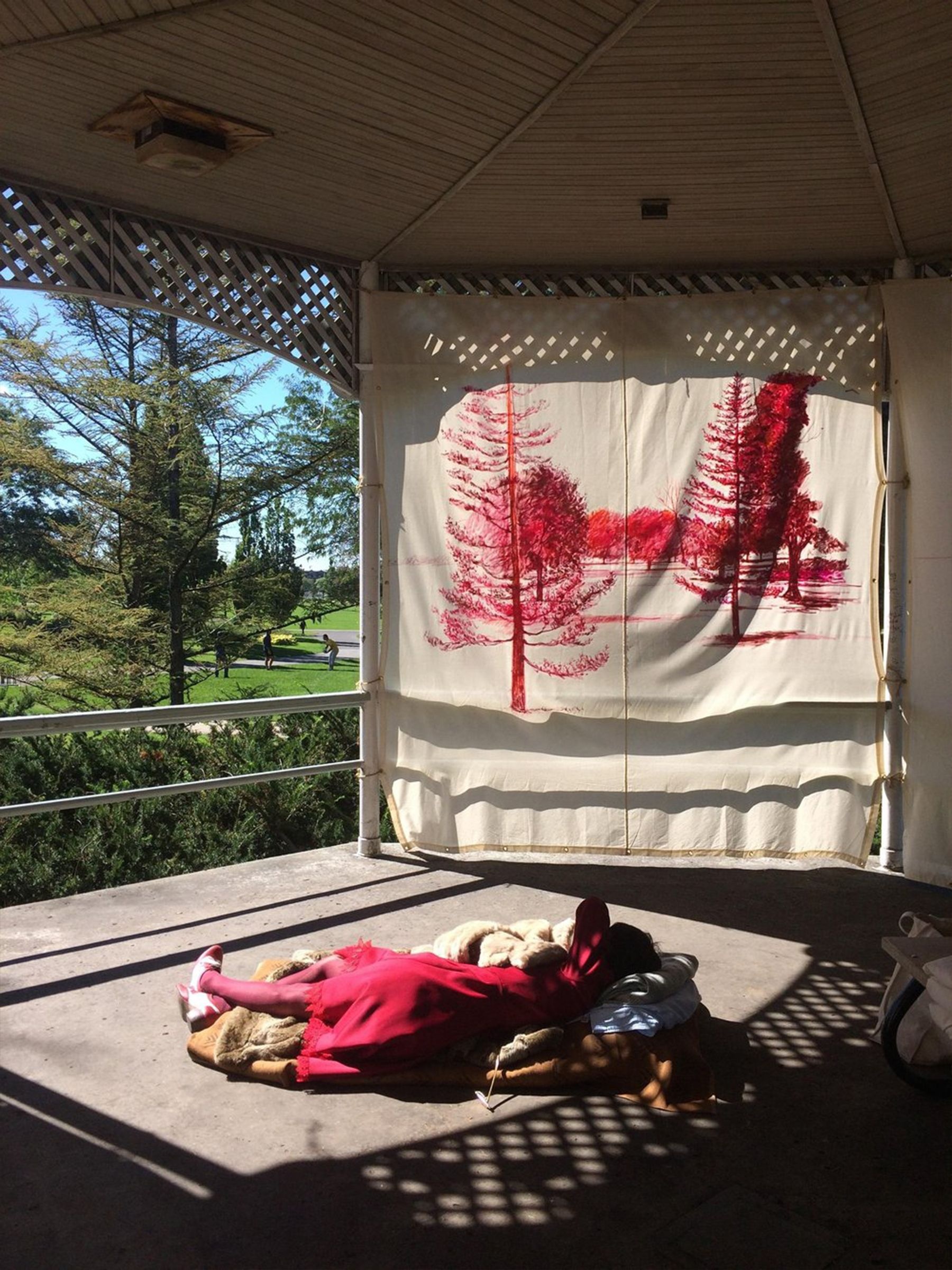
Dhaka-based artist Yasmin Jahan Nupur, for instance, has conceived a work tracing the layered histories of the spice trade incorporating maritime materials within handwoven textiles such as jamdani, cotton and silk. Her performance will draw from “gestures of labour, spoken word and coastal landscapes”, she shares in an email. “I am still in the process of refining the work, which will further evolve in Kochi as I engage with the site and context.” Incidentally, Nupur first met Chopra back in 2014 at the Dhaka Art Summit, when Mahbubur Rahman invited him as well as Nupur to conceive long-durational performances. “He [Chopra] worked in front of a large wall canvas, drawing with boot polish. My own performance took place in a room where I was tied to a chair against a pillar, suspended about 20 feet above the ground. During the summit, Nikhil came to see my performance; he saw me floating on the chair. After we both completed our work, he came up to me and said, “We must work together. Let’s keep in touch.” Chopra later invited Nupur to do a residency at HH Art Spaces in 2016, which coincided with his curation of the Performance section of the Serendipity Arts Festival.

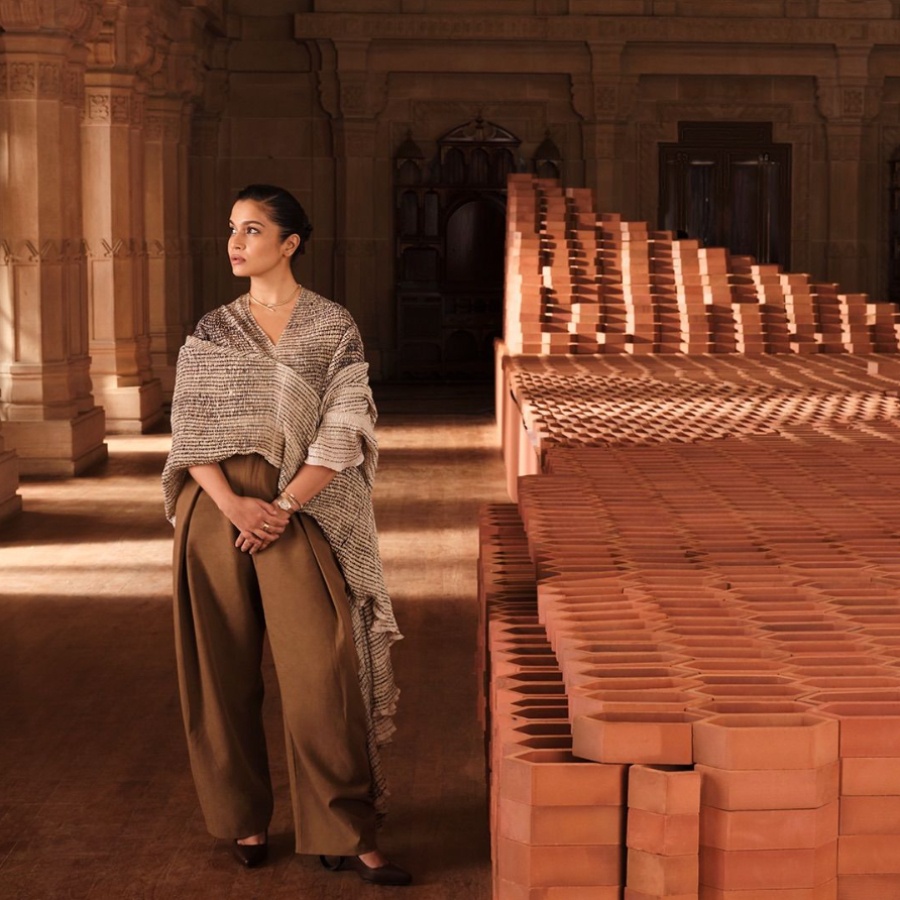
Part of Chopra’s approach involves decentralising the Biennale, taking the emphasis away from Aspenwall House and activating spaces that haven’t been used before—this year boast 22 venues, the most in the Biennale’s history. Site-specificity is a notable feature, as is the decision to encourage on-site production using local talents and material. Beyond the spectacle or lack thereof, Chopra and his team have been mindful about offering audiences places not just for consuming art but also for rest and repose. “A lot of the sites have places for people to receive the art from a place of relaxation and nourishment. There’ll be a tea ceremony in one of the installations, there’ll be floor mats and cushions in others… The canteen is very much part of an artist’s project. Even in the different warehouses, we made sure that we placed artworks in a way where, by the time you reach this place, you should be able to sit down and take a nap, especially because we’re working in hot, tropical conditions, you know.” This attention to nurture is a form of resistance.

“We’re in a really tough time on this planet, a time of animosity, where war is becoming part of everyday conversation on every dining table. It’s important to fall back on love as currency,” he told Kallat while explaining his investment in friendship economies. Beyond these gestures of consideration, though, there’s the hope that the Biennale might just offer audiences the opportunity to taste the kind of transcendence Chopra confessed to achieving occasionally during his performances—“micro moments”, when suddenly matter and material cease to matter, when the need to make something disappears. “I disappear, you disappear,” he says. Such loaded ephemerality is hard to hold on to, and isn’t a given, but for Chopra the desire to go to that liminal space remains the driving force.

The sixth edition of the Kochi-Muziris Biennale, curated by Nikhil Chopra, is scheduled from December 12, 2025, to March 31, 2026.

The Nod Newsletter

We're making your inbox interesting. Enter your email to get our best reads and exclusive insights from our editors delivered directly to you.