





Dusk descends and soft lamps light up a spacious Bandra living room. I’m at the home of actor Rasika Dugal, part of my close circle of friends ever since she graduated from the Film and Television Institute of India (FTII). Those were her theatre days that featured heartfelt performances in plays like Romeo and Juliet and The Vagina Monologues. The coffee table on which a glass of nimbu pani has just been placed is a minimalist, handcrafted table by Tianu, one of her new prized possessions. This meeting is a far cry from the rickety tables at Toto’s Garage Pub, a group favourite, where we’ve spent countless evenings croaking along to rock anthems. But even there, my standout memory of Rasika is of white wine being poured from an ice bucket—an unusual order for a beer-glugging grunge bar.
Rasika has put her home together with characteristic care and precision over the past year. Her husband, actor Mukul Chadda, takes no credit for the prettiness on display. From the sinkable white couch to the artfully faded carpet, the modernist knick-knacks on the book rack, and the quirky art on the walls, it’s all been handpicked. Last New Year’s Eve, Rasika used her gleaming coffee machine to make espresso martinis even as some of her friends fooled around, clasping her freshly won Filmfare OTT critics’ award for Shekhar Home (2024-). The long dining table with a pleasingly grooved edge is where we’ve shared countless avocado salad and crab fried rice meals ordered from Mag St. A copy of Chimamanda Ngozie Adichie’s Dream Count, in which I’ve scribbled notes in pencil, lies on a side table; Rasika has permanently borrowed my copy, having developed an attachment to it. Even though she often complains about not reading enough, Rasika is completely immersed in whatever she does read. Enough to need a support group to share her visceral reactions to characters, like the monstrous artist Ilan de Toorjen Foss in Kiran Desai’s The Loneliness of Sonia and Sunny.
For most of us, Rasika is a serious actor known to portray embattled characters with a rare combination of rawness and restraint. But as a friend you see the unfiltered, goofy side of her; her distinctive laughter rings out in short, metronomic bursts and goes on for a while. The triggers are many, ranging from a corny meme to an ironic insight. She’s self-critical to a fault, some might say.
“You know too much!” she exclaims as we begin our conversation, so let me lay it all out for everyone. I know Rasika comes from a Sikh family settled in Jamshedpur, who, because of their Burmese roots, can make a magical khow suey. Jamshedpur, where she grew up and often returns to for themed birthday parties (‘Polkas & Pearls’ was the last one) and eggnog-flavoured Christmas evenings, still seems like her happy place. (“When someone tells me they’re from there, I feel like I have a sense of what their life would have been like.”) Few know Rasika studied for a year in Brazil. And that both she and her partner Mukul are Math majors. She took Urdu lessons for Manto (2018), learned piano for Little Thomas, which will be in theatres next month, and has religiously practised volleyball for an unreleased project. These days, she trains for pickleball but does not play competitively because “I’ll be very sad if I lose”. I know she’s aching to adopt dogs but doesn’t have “two straight months to spend with the puppies at the moment”.
Despite all that one knows about her, to ask Rasika a question is to be guaranteed a nuanced—and often surprising—reply. Right now, I’m curious about her pedigreed academic career, unusual for an actor. “The idea of being in LSR [Lady Shri Ram], this famous feminist college in Delhi, was more important than the idea of doing maths or anything else. Just like the idea of being in FTII was more important than wanting to act. I applied for two courses that year. One was the month-long film appreciation course, and the other was the acting course. And I didn’t get into the film appreciation course,” she says with a half-embarrassed giggle. I’m alarmed by the irony.

Last year, while watching The Secret Agent (2025), an excellent Brazilian political drama, I was struck by how the city it’s set in—Recife—is where Rasika studied for a year as an exchange student. How was a teenager from Jamshedpur brave enough to step into this alternate universe? “I’ve always had the ability to not think things through. It has held me in good stead.” A near humble brag from the queen of self-deprecation.
She recalls the day she found herself in the middle of a carnival in Recife. “There were these electric trucks with bands playing music on top, and you danced along. I was accompanied by a beautiful girl called Rinata, and there was this drug that people were smelling off handkerchiefs, which I was so afraid of. I hadn’t even been to a bar in my life! And suddenly, there were gunshots in the air, in celebration…”
Memories of Mirzapur’s opening scene come to mind; the series, not the movie. “Exactly!” says Rasika. But this month has been all about Mirzapur: The Movie, which recently released to much love and acclaim. Rasika plays Beena Tripathi, the transgressive wife, stepmother, and power wielder in the crime drama that’s made a pioneering jump from OTT to the big screen.
Working on the movie has been uncanny: “I rewatched the first season before starting the film, but the plot goes back two and a half seasons in relation to the series. It was a very strange experience. How do you erase things that you know about yourself? It was like science fiction. I regretted having rewatched it for a bit, as I told Guru [director Gurmmeet Singh], because it was hard to pretend to be ignorant of the knowledge I had about the character. Sheeba [Chaddha], in fact, [rightly] said she didn’t want to rewatch the show before the film’s shoot.”
But it’s now time to revel in the film’s success, even for the ever-watchful Ms Dugal. At the time of publishing, the film is approaching the ₹190 crore mark in India alone, a big feat for a film born of a Prime Video show with a terrific ensemble cast but no superstars.
Besides Beena Tripathi, Rasika is also known for playing Neeti Singh, a soft-seeming cop who navigates personal and professional complexities as she’s promoted from trainee to ACP in Delhi Crime, the Emmy-winning police procedural show. Rasika is often asked about her own response to the patriarchy considering the prickly contours of the world her characters inhabit, shaped by masculine forces. “I realise that even though I grew up in a house that didn’t put any kind of pressure on me, I did do a lot of things that women in patriarchal societies tend to do. For example, developing a body language that is slightly apologetic in general. Or being nervous about expressing one’s sexuality,” says the actor who has portrayed roles like Safia in Manto and Savita in A Suitable Boy (2020) exceptionally.
Questioning social mores is a theme that runs through the actor’s life, whether it’s doing a post-graduate diploma at Sophia College’s prestigious SCM [Social Communications Media] programme, working as a field researcher for two years before her FTII admission, or essaying roles that explore the interior lives of women in a world that slaps lazy labels on them. Try as she may, she cannot let go of her affinity for indie cinema. “Every year I tell myself: this year, no indie film. Too much work, too little payoff, no guarantee of release. The time to rough it out is gone. But I just can’t seem to help myself. A good script comes along and I find it very, very interesting. It’s a heart-based decision entirely,” says the star of the heart-warming Tu Hai Mera Sunday (2016) and the experimental Fairy Folk (2022).
She started her career with one such gem, Kshay (2011), where she played a woman spiralling into an obsession with a sculpture. In Chutney (2016), she played a small-town flirt with relish. During the Covid-19 lockdown, she was literally the girl next door in the social-distancing-themed short Banana Bread (2020) with Mukul; the real-life couple worked on the story, screenplay, and dialogue together to fight the pandemic blues. And her last one, Lord Curzon ki Haveli (2023), was a dark comedy with a post-colonial subtext. As we speak, she says she’s excited about a new indie after reading the script; she’s taken the bait again.
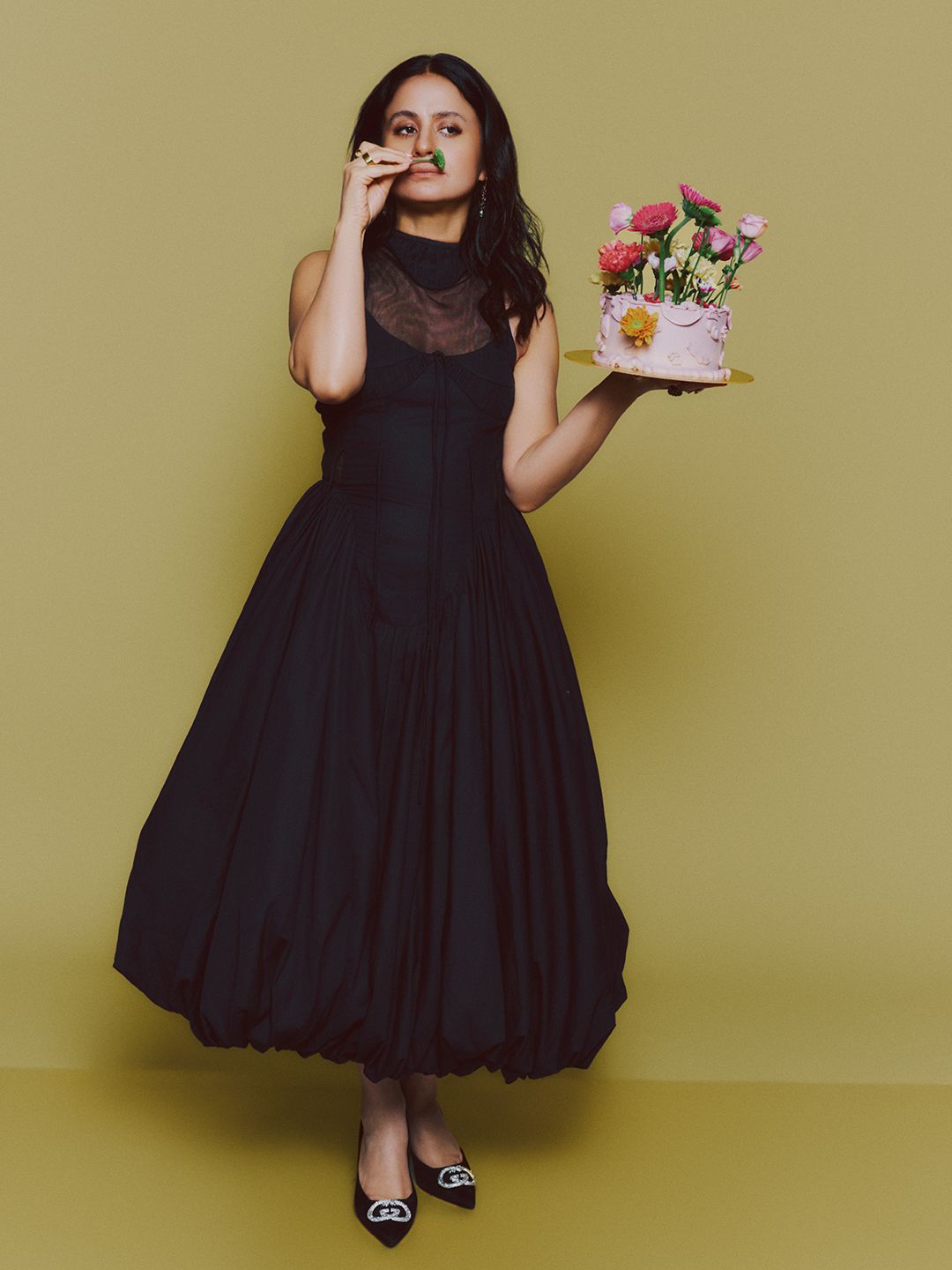
The distressed, harrowed women of her mainstream oeuvre are very different from the actor we encounter on her IG Reels. Her 1 million followers know this: Rasika’s Instagram is an entertaining glimpse into what’s missing from her on-screen persona. “I’m very happy when people give me that feedback,” she says. Rasika often speaks about her discomfort with oversharing on social media; instead, she uses her natural comedic skills to great effect to connect with her audience. “Years ago, before content creation had become a full-fledged industry, I had done this short video where I play different characters from the film world. Lootcase was being cast at the time. My name came up, but the question was whether I would be able to handle comedy. That video is how I got the film.”
“Are there any professional skills you’ve had to especially work on?” I ask. “I don’t know if I’m any better at it, but I’ve learned to accept certain things. Our work is so time-bound because of budget constraints. Very often you have to say: ‘This is not the best [result], but technically it was good, so let’s live with it.’ That’s very hard to do because you’ve imagined the scene beforehand and you want it to go a certain way. And you know that this is it. The stakes are always very high, I think to myself, and everybody’s taking it damn casually!” she laughs.
Actors who are thorough in their preparations—and Rasika is unequivocally from that school (Urdu, piano, volleyball...)—seem to face an additional challenge. “Somehow, being ‘easy to work with’ becomes crucial in the industry. Nothing should come in the way of that. You feel the pressure to hide your prep so as not to make others feel nervous or intimidated. The expectations from actors can be very low. And at some point, that starts showing in your performance. Boredom is very dangerous for an actor.”
No wonder, then, that the greatest pleasure in her life is “a scene truly well-delivered”. Like in the climax of Hamid (2018), in which she plays the wife of a missing Kashmiri man. “Throughout the film, Ishrat is very quiet, almost angry. In the last scene, she opens a trunk filled with her husband’s belongings and she finally breaks down, which is kind of an acceptance about him not returning. So, I felt that that was the pivotal moment of the film upon which everything rests. Now there’s me and Talha [Arshad Reshi] in the shot, who was a very good actor to work with, but you never know what might happen with child actors. The child was so stumped by my crying that he just kept quiet, which was great for the scene. I didn’t know what exactly was going to happen, but all the work I’d put in for a whole month—reading, watching documentaries, learning a dialect—came together, and it worked magically.”
And sometimes, despite the actors’ best efforts, all that work is lost on film. That’s what happened to her and Irrfan during Qissa: The Tale of a Lonely Ghost (2013). The two redid a scene eight different ways, each of which felt incredible. “It looked like nothing on screen. Mukul had come over to Chandigarh to meet me on what were supposed to be my two days off, but I was busy redoing this scene. That’s where having an actor for a partner really helps: he understands. Anyway... Shooting it had felt really special, and I often wondered what Irrfan thought about it. When we met at another film’s screening, about two and a half years after Qissa’s release, he said to me: ‘Humaare beech kucch hua tha uss scene mein. Woh film mein dikha nahi.’ [There was some magic between us in that scene, but it didn’t show up on screen.] So, we shared that same elusive feeling!”
Dusk has turned to night, bringing with it compelling thoughts about dinner. We order in idlis from Bastian Ammakai, a new favourite, and are joined by a mutual friend and Mukul, who adds bisi bele bhat and prawns rawa fry to the order. Dinner-table conversation can take any form: from cinema (she loved the Norwegian Oscar-winning family drama Sentimental Value (2025) but also laughed copiously when I called it “Bergman by IKEA”) and democracy to pickleball and fridge magnets. The per-capita intelligence and creativity in the Dugal-Chadda home is unusually high; I personally don’t know any other socially responsible, Math major, actor couples in the city.
As I prepare to leave, it is with a familiar mix of lightness and ease. Rasika cares about her guests being well looked after and is a mindful guest herself. Whether it’s her dabba of grilled veggies or a bottle of Prosecco, she often carries what she needs. At some point in a home hangout—at hers or a friend’s—she will be found gently reclining, nodding along to stories and songs. This is a snapshot of Rasika I hold dear: a Stanley water bottle at hand, her sleepy head resting on an available shoulder, and frequent eruptions of fitful laughter.
Editorial direction: Megha Mahindru. Photography: Pulkit Mishra. Videography: Prasanna Khawale. Styling: Naheed Driver. Bookings: Nikita Moses. Art direction: Mehak Jindal, Ria Rawat. Set design: Risha Shetty. Makeup: Gargi Karmakar. Hair: Bhakti Lakhani. Styling assistance: Vedica Vora, Anushka. Artist reputation management: Hardly Anonymous Communications