



Weddings12 Sep 20263 MIN

The homegrown label giving white wedding gowns an avant-garde rethink

With Nanai and Akimugha Yeptho draws on textile traditions from Mizoram and Nagaland to make bridalwear that feels romantic, sculptural, and a little subversive

With Nanai and AKimugha Yeptho Bride from the N-East

Courtesy With Nanai and Akimugha Yeptho

What comes to mind when you picture a white wedding dress? Perhaps a little lace, tulle, or a sweeping train. But how about a halter-neck corset with an exaggerated bustle inspired by a woven bamboo basket? Or a completely sheer top with a ruffled collar and sculptural sleeves paired with a column skirt covered in embroidery of hibiscus flowers and Himalayan cherry blossoms?

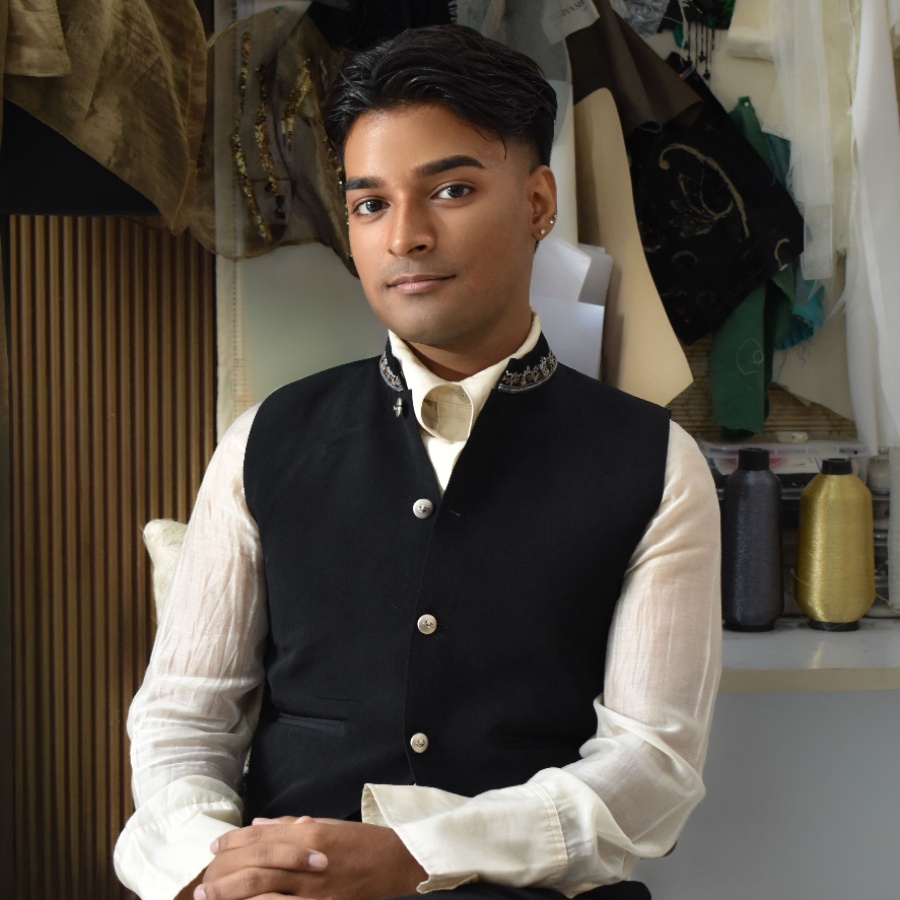
At With Nanai and Akimugha Yeptho, the familiar codes of a white wedding gown are pushed into more experimental territory. Founded by NIFT-Bengaluru graduates Angela Lalramtiami and Akimugha Yeptho, the Delhi-based bespoke bridalwear label combines dramatic silhouettes with textile traditions and visual references from Mizoram and Nagaland, where the designers hail from respectively.

The word “Nanai” is used as a term of endearment within Lalramtiami’s close-knit family. For her, using it in the brand name is a way of welcoming the world into her inner circle. ‘With’ introduces Yeptho as her partner, representing the couple’s shared creative vision.

A.A Portrait of the founders.jpg
Angela Lalramtiami and Akimugha Yeptho, founders, With Nanai & Akimugha Yeptho

The label started from a problem the two saw repeatedly among friends and family: while India is a powerhouse for bridalwear, one that NRI brides routinely fly back for, the options shrink dramatically when what you’re after is a white gown. “Most of the brides that we know would travel abroad for their dresses, since the ones available in India are mostly imported and very limited. Our main vision behind starting a white bridal brand was for brides in India to stop going to the West [for wedding dresses],” says Yeptho.

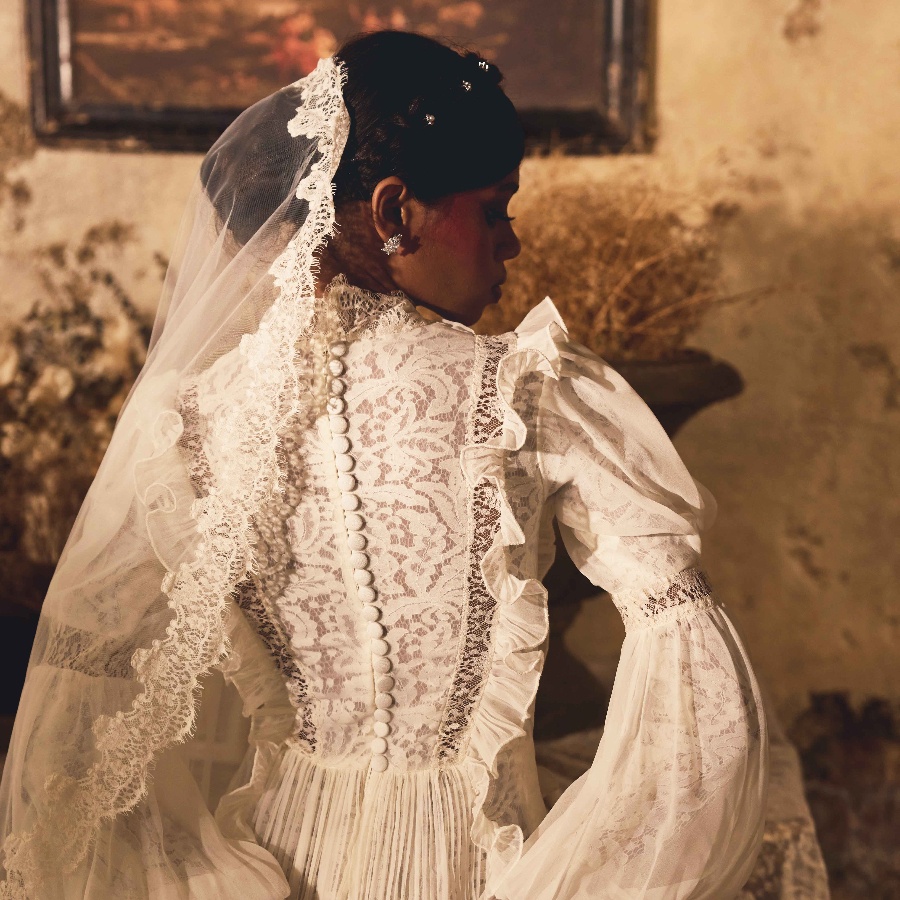
Their solution, however, wasn’t simply to make the same conventional white gowns closer to home. Their debut collection, ‘Bride from the N-East’, asks what the white wedding gown might look like filtered through their own lens, bringing handwoven fabrics native to their home states in conversation with French lace, three-dimensional beading, and couture embroidery techniques. Familiar bridal elements such as corsets, veils, and mermaid skirts are combined with sharp tailoring, unexpected proportions, and silhouettes inspired by objects and landscapes closer to home.

For the fabrics, Lalramtiami returned home to work with women weavers she had first met while working on her university projects. She spent several months living and working alongside them, and the same artisans have now become suppliers for the label, weaving Mizo textiles like ⁠⁠puan var (white cloth) and meng par, as well as Naga textiles including Pulosu mini and ⁠⁠Lazami mini, traditionally worn as wraparound skirts, using backstrap or loin looms. The weavers aren’t so much a collective as independent artisans and hobbyists scattered across different villages, found through neighbours, family friends, and distant relatives.

Translating those fabrics for the white dresses the designers were imagining, however, required some editing. “When I first started my college graduation project, I had started with the weaves used for our traditional attire, which are all hand-woven,” Lalramtiami says. “Since our traditional attire [has a lot of prints and motifs], plain fabrics aren’t quite popular back home. So, when we introduced it to bridalwear, we wanted simpler designs.” Yeptho says they were drawn towards a plain white puan as a starting point: “Plain white is not used much, but since we are designing bridal, we wanted to use fewer motifs and more solids.”

The instinct to combine seemingly opposite ideas also mirrors their relationship as designers. ‘Bride from the N-East’ isn’t the first time the college sweethearts have worked on something together. Though they studied in different departments at NIFT, creative critique on each other’s assignments became a natural part of their relationship and, eventually, the foundation of their creative partnership. Their tastes, by their own admission, sit at two contrasting ends of the spectrum. “She’s more like Miss Sohee and I’m more like Alexander McQueen,” says Yeptho.

While Yeptho leans towards the fierce and theatrical, Lalramtiami brings a softer, more delicate sensibility. “She brings in the element of femininity—soft, elegant, simple, more dainty design. So, when we combine both, there’s that bridge in between,” he explains.

According to him, that bridge is best represented in their Elin set, which pairs a corseted top with a petal-shaped hem, kimono sleeves, and a ruffled collar with a mermaid skirt. Across the collection, the push and pull is evident in garments that sway between romance and severity—cinched waists against exaggerated shapes, delicate beadwork on architectural construction, and ethereal sheer fabrics offset with sharply cropped solid white jackets.

To evoke a sense of nostalgia for the northeast, the designers chose to incorporate motifs from the landscapes they grew up around. Hibiscus and Himalayan cherry blossoms appear in embroidery, bamboo trees inspire tasselled details, while woven baskets from the region, known as khang or thul, inform the shape of a bustle with a train.

Hibiscus & Pahhiya Embroidery.jpg
Hibiscus and Pahiyya (Himalayan Cherry tree) embroidery

While ‘Bride from the N-East’ begins with the Lalramtiami and Yeptho’s own histories, the designers want their bespoke practice to make room for those of their clients’ too. Future pieces could draw on a bride’s culture, ancestral textiles, or landscapes she associates with home, to create something more personal. “I think we see our brides [as people who] are confident in their skin as well as deeply rooted in their own cultures. They like to have their personal stories told through their garments,” says Yeptho.

The Nod Newsletter

We're making your inbox interesting. Enter your email to get our best reads and exclusive insights from our editors delivered directly to you.