




A few weeks ago, a fellow beauty writer told me about Morphiya, a new in-clinic treatment built around exosomes—the tiny vesicles that carry proteins, lipids, growth factors, RNA, and signals that support repair and regeneration. If retinol was the skincare wizard of the last decade, exosomes are angling to be the next, grounded in the idea that your skin can be coached to behave better at a cellular level. Over the last couple of years, exosomes have quietly moved from research labs and regenerative medicine into dermatology, surging in popularity. They’re touted as a way to improve skin texture, reduce inflammation, and support wound healing, particularly when paired with treatments like microneedling, which allow them to penetrate deeper into the skin.
But what sets Morphiya apart from other exosome treatments in the market? According to Dr Geetika Mittal, founder of Isaac Luxe, the treatment uses a patented Hybrosome technology that combines young exosomes with liposomes loaded with essential nutrients and natural actives. “Unlike standard exosomes, Hybrosomes deliver both rejuvenating signals and supportive ingredients, creating a more optimal environment for cellular renewal,” she explains. Morphiya’s exosomes are also not human-derived; they are sourced from an isolated bovine herd and collected from calves’ cord blood—a process that, according to Dr Steven Cohen, who is part of the scientific board behind the treatment, does not harm animals and is comparable to cord-blood donation after childbirth.
At the time, my chronically dry skin was looking especially dull thanks to rickshaw rides through Mumbai’s suburbs, and I had a wedding coming up the following weekend. So, I decided to give it a shot to see if it lives up to its claims.
I landed at Isaac Luxe in Santacruz, where an in-house dermatologist assessed my face and walked me through the treatment. The procedure, she explained, was the application of Morphiya’s Dermal Hybrid Exo Kit—two vials containing the magic potion and a diluent—which would be mixed together and delivered into the skin using microneedling. Once the assessment was complete, and after fair warnings about the redness and irritation the microneedling could cause, I was escorted to one of the treatment rooms.
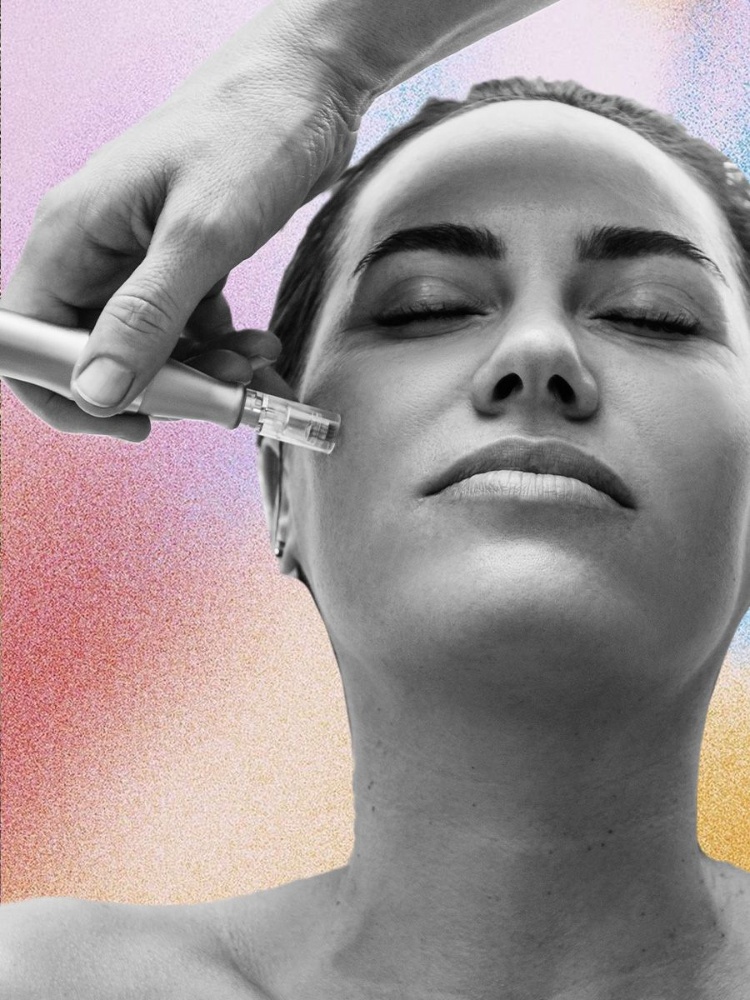
The appointment moved quickly. After cleansing, an aesthetician lightly massaged my face with a layer of cool, gloopy aloe vera gel infused with vitamin E to hydrate my parched skin. Once my face felt sufficiently hydrated, the numbing cream followed. After about 10 minutes, when sensation had more or less disappeared, the dermatologist returned. She went over my face with a good ol’ dermaroller, releasing the exosome mixture from the Dermal Hybrid Exo Kit with a dropper as she worked. It is far less intimidating than it sounds.
For the finale, the aesthetician applied Morphiya’s Genesis Formula SOS—a calming serum to soothe the inflammation from the microneedling. From start to finish, the entire treatment took under 30 minutes—a detail worth noting at a time where gel manicures tend to eat into entire afternoons.
Post-treatment instructions were fairly simple: no washing my face for the next four hours (if I could help myself, ideally until the next morning) and no actives—only a gentle cleanser, moisturiser, and sunscreen. Did my face change dramatically in the hours that followed? No. But it also wasn’t red or overly sensitive like the doctor had warned me either. “When the Dermal Hybrid Exo Kit is applied topically later with microneedling, mesotherapy, or PRP, it enhances the effectiveness of the treatment while also minimising post-procedure discomfort,” Dr Mittal explains.
Over the next few days, I stuck to a pared-back routine—sans actives, milky toner, face oils—and was surprised to find my skin didn’t feel as parched as it usually does without them. The glow came the following week. My skin looked radiant, a tiny acne scar I had on my left cheek faded, and the pores on my nose looked smaller. Even my smile lines looked lighter, less etched than before.
Dr Mittal explains this staggered result is typical. Clinically, Morphiya tends to deliver benefits in two phases: an initial improvement in hydration, calmness, and luminosity, followed by more long-term collagen and elastin stimulation that shows up as firmer, more elastic skin over time. In other words, early glow first, structural change later. She also notes that Morphiya is designed as a protocol rather than a one-time treatment, typically recommended at intervals of two to four weeks, supported by a simplified at-home routine to help maintain results.
Any conversation about skin repair inevitably circles back to retinol—still widely considered the gold standard for treating pigmentation, fine lines, and wrinkles. I’ll have to admit I’m a reluctant retinol user at best: despite multiple attempts to get on the wagon with the gentlest formulas, I’ve never managed to apply it with the consistency demanded to see proper results. Dr Mittal is careful not to dismiss retinol’s efficacy but positions Morphiya differently. “Retinol works primarily by peeling the skin,” she explains. “Morphiya, on the other hand, works by repairing the cell’s youth mechanisms, which is why its effects are likely to be more long-lasting.”
Will I be doing it again? I’m not overly concerned about wrinkles just yet, and if I ever manage to stay faithful to retinol, perhaps I won’t need to. But if my skin ever feels like it needs an intervention—something that doesn’t require nightly discipline—this treatment is one I’d consider returning to.
Morphiya Face at Isaac Luxe is priced at ₹50,000+taxes per session
Address: 1st floor, Keshav Kunj, Linking Road, Santacruz West, Mumbai - 400054
Ph: +91 9311883898