



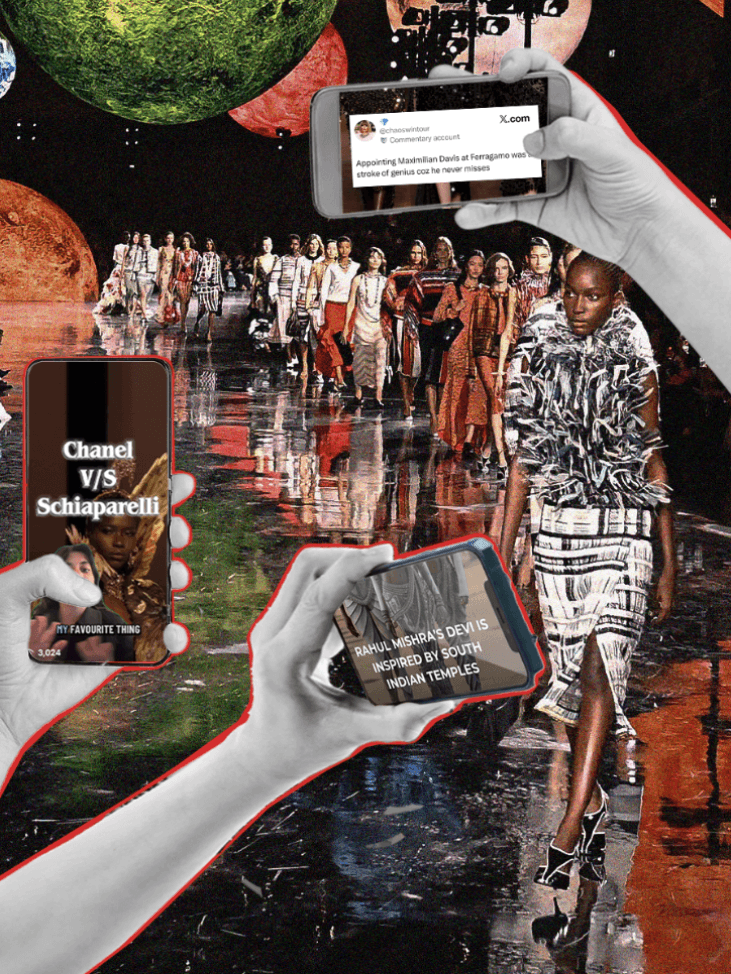

There was a time when fashion month had a standard morning ritual: logging on to Style.com to read Tim Blanks’s nuanced dissection of a collection, waiting for Cathy Horyn’s realistic, more practical take on things, and checking Tommy Ton’s post-show streetstyle snaps.
Today, one doesn’t need to wait for a review at all. Verdicts arrive swiftly—within minutes of a collection hitting the runway—from all corners of the internet. They come in the form of memes, savage one-liners, green-screen Reels, and hot takes engineered to go viral. It’s an era in which the bags “slap”, the girls on the front row are “living”, and a model is probably “giving diva”.
Humour and irreverence, it seems, are fast becoming the new-age fashion commentator’s language of choice. Sprinkle it with some pop culture references, a trending song, and a generous helping of cheek, and there’s your recipe for virality.
When Hanan Besovic of widely followed fashion commentary account I Deserve Couture and self-proclaimed “PhD in meme” attended Gaurav Gupta’s couture show in Mumbai this July, his Reel asking the famous attendees to teach him one difficult Hindi wordword—cue ‘rasoighar’ and a lot of ‘vatavaran’—garnered over 12 million views, twelve times more than his other content from the show—even the one featuring Bollywood showstopper Ananya Panday.
Closer to home, the anonymous account Diet Sabya references everything from memorable quips on Koffee with Karan and Ekta Kapoor’s television dramas to Jaya Bachchan’s paparazzi clips in its discourse on fashion. Cheeky repertoire is the MO for newer Indian accounts on the block too, like Brown Fashion Gal, Chaos Wintour, and The Assistant Wears Prada.
“I have a young audience online. Gen-Z responds well to humour and overall unserious references,” says Shreya Shrivastava, who runs Brown Fashion Gal.
Besovic calls humour refreshing and a lifesaver. “It lets you criticise without coming off as mean. At the end of the day, we’re talking about whether the socks match the shoes, not curing cancer. It’s not always that serious. I mean, Loewe has a broken egg on its heel—do we really need to intellectualise that?” he wonders.
It also makes fashion—historically, an infamously closed-off, gatekept world—more accessible, says journalist Sujata Assomull. “Humour allows people to engage with an idea without feeling that they need to understand all the rules or have a fashion education to have an opinion,” adds Assomull, who also actively uses Instagram to share her commentary on the industry.
Fashion, but make it funny
The internet, after all, is where the court of public opinion convenes, shaping the reception and narrative of a brand in real time. Shrivastava—who does admit to finding the contest to be the “fastest fingers first” unrealistic—has also found the posts she makes on her phone in under five minutes perform the best.
For a designer like Gaurav Gupta, the immediacy and range of opinions that social media offers is exciting. “It’s a good thing that fashion is no longer happening in isolation. You can put something out and immediately see how people are responding to it. That can be very useful for a designer,” he says. “Couture doesn’t have to be discussed only through traditional fashion media or in a very serious way. There is room for humour, personality, internet culture, and different points of view.”
More so at a time when traditional media’s critical coverage is often bound by commercial ties to the very brands they are meant to review. “I am not paid by any brands, so I try to be an honest and fair page,” says Hiral Arora, who runs Chaos Wintour. “For me, it’s about how beautiful the post looks and also how it can spark discussion,” says Arora.
It’s not that deep. Or is it?
Where humour becomes less interesting, however, is when everything is reduced to a joke, says Gupta. “Fashion can be funny, but it can also be serious, emotional, political, technical. And that’s the difference between a reaction and a critique,” he says. “To really understand a collection, you need to look at the work, the technique, the idea behind it, and how it sits within the designer’s larger body of work. That takes a little more time.”
Arora agrees that a meme, particularly one with negative undertones, can flatten a moment because “the depth is low”. She prefers to follow up her social media posts with long-form pieces on Substack.
But on a platform that thrives on rage bait, a controversial hot take is often the easiest route to sky-rocketing numbers. And its downside is that a takedown—no matter how hilarious or well-timed—is dismissive of months of work. “Not every account is in it for the love of fashion. Some just want to get famous,” admits Besovic. “There is a certain lack of respect [in social media commentary] today, which I find obnoxious. You cannot hate on a collection or call it trash because you didn’t like the colour of the coat. Even when I’m critical, I’m never a prick about it. Critique needs to come from a place of knowledge and understanding—because that’s somebody's vision, time, effort, and money,” he feels.
That’s where discernment needs to kick in, a muscle not every netizen is prone to exercising just yet. “So many people listen to their favourite commentator and then just adopt their views without thinking for themselves. One should always question the authenticity of their source,” points out Arora.
Being a critic, Assomull suggests, eventually requires more than a strong opinion. It demands the ability to dissect the work, place it within a broader cultural and historical context, and articulate why something succeeds or fails. As she points out, “Anyone can have an opinion, but not every opinion carries the same weight—and audiences need to recognise the difference.”
Perhaps fashion needs a bit of both today—the person who can turn a purse into a punchline, and another who can explain what the same purse says about the moment and industry at large. But the real trick will remain in knowing when to laugh at it and when to take fashion seriously.