



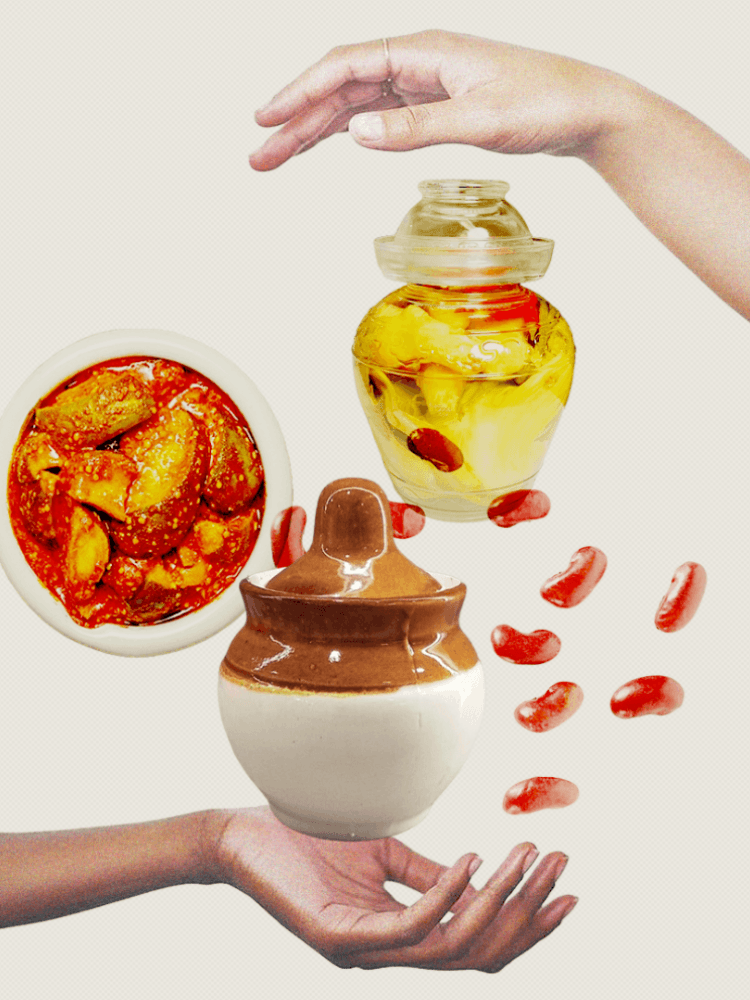

Do you have food in your kitchen that is older than you? I know it’s an odd question, but think about it. Well, turns out I do. (And no, there’s no yellow-green fungus growing on it.) A month ago, the classic rice-and-dal combination felt too bland, so I went snooping for a condiment that could scratch the itch for discovery. Hidden behind greasy bottles of chilli, mango, and mixed vegetable pickles, I found a jar with something as dark as charcoal.
I’d never seen anything like it; it could be mistaken for black bean miso, but it smelled far too zingy and was cut up into little pieces. When I took my specimen out to the dining table for inspection, Amma, my grandmother, said, “This is lemon pickle; I made it when we lived in Jayanagar before you were even born.” To Amma, this blackened jar represents a family home that I’ve never seen. Every winter, she and my dad pull it out to slap on parathas and mix with khichdi.
Placing the tiniest piece on my tongue and registering the umami tingle of aged lemon, I instantly felt nostalgic for a time I’ve never experienced. I wondered what Amma looked like back then. Did her bangles still hang loose on her wrist, clinking together while she spiced the dried lemons? Did she wear thick round-rimmed glasses even then? After abundant romanticisation, I posted a picture of the fated pickle on Instagram, calling it my family’s edible heirloom.
Quickly, I learned that my experience isn’t unique. “Around the time of Partition, my nani made a batch of pani wala nimbu ka achaar,” shares food writer Roshni Bajaj Sanghvi. “I was born 31 years after Partition, and I remember eating that same black pickle as a child.” When it finally ran out, Sanghvi’s mother made a fresh stock, which still lives with her decades later.
But don’t be fooled by our stories; edible heirlooms go far beyond generational lemons. You may not know it, but there’s probably a lot of unassuming food around you that can last longer than a lifetime. Archaeologists discovered 3000-year-old honey in Egyptian tombs and it was still ready to be put on a pancake. Online, you will also find people feeding sourdough starters that are over a century old.
Similarly in Kolkata, Jenny Chen has a bottle of Sichuan pao cai, a traditional Chinese fermented vegetable pickle, that her mother made in the ’80s. “My mum passed away in 2008, and she was my last connection to my Sichuan culture,” the Indian-Chinese school teacher shares. “Living in Kolkata, it’s easy to forget that side of my identity. This jar feels like an important part of holding on to it.” Every few years, Chen replaces the radish, cabbage, and peppercorn mix in the pickle with fresh veggies. But the base remains constant: the sour salt-water brine that her mother made years ago.
For long, we have understood heirlooms as rings with emblems, old wedding saris, even recipe books and passed-down glassware that connect us to family. But these jars go beyond steps to cook. They preserve taste, not mere techniques. For Chen, the edible heirloom doubles as a conscious effort to preserve her Chinese identity. It’s not just a nostalgic call-back to the past but a way to lean closer to herself as the world around changes.
After all, food has always been integral to how people make sense of themselves and their culture. This is more noticeable in a country like India, where even the oil that you cook with changes dramatically as you cross state lines. The same link between taste and identity influences traditional yak herders in Sikkim. For generations, they have cooked their food using chilu, or calorie-rich yak fat, which brings warmth in freezing temperatures.
“Historically, this fat was separated from yak meat and stored inside sheep stomachs to increase its longevity,” explains Dr Hissay Doma Lepcha, a Sikkim-based food researcher and home cook, adding that the fat can last for years. Today, many herders’ homes have refrigerators that allow for air-tight storage, yet they continue this practice of keeping the fat in sheepskin, making it a common sight in many kitchens. “The edible food isn’t the only heirloom that lasts years. The way they store it is also part of their culture and they want to carry that forward over time,” she adds.
Meanwhile, Shubhra Chatterji, founder of fermentation festival Desi Cultures, defines edible heirlooms in relation to nature, not just family or identity. Living between Mumbai and Tons Valley in Uttarakhand, the food researcher and filmmaker has long cherished indigenous varieties of colourful corn and speckled rajma that grow only in the mountains. Yet these unique crops are facing risk. “Up in the hills, you see climate change stare you in the face. We didn’t get a good crop of rajma for a couple of years,” she says.
In response, in 2023 Chatterji set up an unofficial seed bank, which she calls her heirlooms. Unlike other pass-me-downs that are preserved static, the researcher gives her seeds back to nature. “It is by harvesting them that you feed the seed bank, saving it for the years to come.” Every time she gives the village farmers indigenous rajma seeds in an attempt to plant more, there comes the uncertainty of survival, but it’s a risk she’s willing to take.
In one way or another, this insecurity colours all edible heirlooms. They gain their value from interaction, not isolation. The aged lemon pickle is not only special because of how many years it has been preserved but also because its unique umami taste is hard to recreate without the hand of time.
Yet every time I dip into that final jar, I worry about how many spoons it can serve us before disappearing forever. My knee-jerk reaction was to build out a time capsule. I bought a basket full of jars and asked Amma to make fresh batches using the OG pickle as a starter. The plan is to seal the jar and save it for future generations.
While in theory this quick fix ticks boxes, it also feels like cheating. The present jar is special because it has served as a tangy companion on many dal-rice nights over 30 years. It wasn’t stowed away with the intent to one day become an heirloom. It stayed precious because people continued to reach out for the pickle across generations. It is enjoyed when eaten, not just bottled up and forgotten.
Instead of mourning what’s dwindling, Sanghvi has developed her own way of coping. “Back in the [Covid-19] pandemic when there was so much anxiety around us, I made pani wala nimbu ka achaar. To me it represents a slice of time that brings comfort,” she says. “My son was four when I made it, and now he’s 10 and still loves it. We have promised to make the next batch together once this is over. This way I’m passing down the technique so the flavour stays alive.”